The Beasts Intertwine This Way - Reviews

The Beasts Intertwine This Way
+Add to Custom List
Sort
Add review
... Read More
This section is dripping with symbolism and I can't stop thinking about it. The chameleon comparison for Kiriyama isn't random. Chameleons wrap prey in their tongues—slowly, completely, from the outside in. Kiriyama represents the law that consumes without digesting, the system that pretends to protect while actually suffocating. And then there's the water imagery everywhere: the rain on asphalt, Zero's damp hair, the swamp in Kiriyama's eyes versus the infinite night in Zero's. Water as both danger and intimacy. But the biggest symbol for me is the wall. Kagura literally built a defensive wall around his heart after failing to save Haruka, and now he's choosing to tear it down for Zero anyway. 'The end doesn't matter.' That line keeps echoing in my head. It's not just about romance—it's about agency. He's choosing his own risk, his own possible destruction, rather than staying safe and hollow. And the neck marks—Kiriyama looking at them like they're evidence of something criminal, while Zero sees them as something beautiful worth tending to. Two men, two readings of the same body, two ways of loving someone.
... Read More
This part with the rain—'smoke-like rain'—it's not just atmosphere, it's Kagura's entire emotional state made visible. He's drenched in something he can barely see, searching for Zero in the darkened asphalt like a damn fool. And I love it. The author doesn't give us some dramatic confession or even a text message; they give us this quiet, almost pathetic moment where our detective is standing alone under streetlights chasing shadows. That line 'Recently, when he let his guard down, this had been happening frequently'—chills. Actual chills. Kagura pretends he doesn't need to fully understand Zero, that shared purpose is enough, but the text keeps pulling us back to those questions: Where was he born? Who were his parents? How did he build Enwu? He's trying so hard to be rational, to keep distance, but his heart's already wandering into dangerous territory. And Zero? Zero sent these three kids to save him. Three undocumented teenagers who could've vanished after the warehouse incident. What does that say about Zero's feelings? About the way he shows care without saying a word? The romance here isn't in grand gestures—it's in smoke-like rain and knives stuck in shoulders and vans idling at corners. It's suffocating and beautiful.
... Read More
Okay, let's just... let's just talk about this chapter. The assault. I can't—I don't even know where to start. The translator's note literally says 'brace yourself' and I should have known better, I always should have known better. But now that I've read it, I can't un-read it. What's worse is how the chapter frames it. Zero saying 'I'll be the one to protect you' while violating him. Kagura waking up alone, stiff and aching, and his first thought isn't about himself—it's about Xuan. His concern for someone else while he's physically devastated. That's such a Kagura thing to do, honestly. Even broken, he cares more about other people. But then he also says 'she had no choice' about Xuan. He's absolving her too, right? Like he blames himself for everything—the ambush, her betrayal, his own suffering. Zero was technically right though. If Kagura had gone to that meeting spot without being intercepted, he'd be dead. The man saved his life in the most unhinged, complicated way possible. The guilt, the confusion, the fact that Kagura can't even bring himself to resent Xuan—it's all so layered and painful. This book does not do easy emotions. Every feeling here is tangled with something else, like a knot you can't untie. I respect it. I also need to lie down for a while.
... Read More
Okay first of all — this book does NOT have a ton of dialogue, which honestly surprised me. I went in expecting banter and got something way more interesting: loaded silence and razor-sharp lines that cut. The semi-gang guy saying 'Look at the high-and-mighty detective now!' and then 'We can play with him all we want later——get him in the car, now!' — these lines paint a picture of thugs who are arrogant but not stupid. They know they're outmatched right now (tear gas doesn't discriminate) and they're smart enough to retreat. Their dialogue feels natural, not caricatured. And Kagura's rescuer? He says exactly one thing in the first two chapters: 'Damn it.' Just that. After carrying a full-grown man through a maze of alleys while being pursued, he says 'Damn it' and drops him. That's it. That ONE line tells us everything about this character — he's frustrated, maybe injured himself, and completely uninterested in making conversation. Powerful stuff. The translator's note was a fun exception — 'This light novel consists of 2 main stories, 1 side story (255 pages).' But that's meta-commentary, not part of the narrative voice. What I appreciate most is that the author trusts the reader. There are no exposition dumps through dialogue. Kagura figures things out internally ('It wasn't the yakuza' — he's already analyzing the situation while getting tased). The narrative voice stays close to his perspective, which means we experience everything through his hazy, electric-numbness brain. It's intimate and disorienting in the best way. Makes me want to read the next chapter IMMEDIATELY.
... Read More
The stakes in this batch just went FROM TEN TO ELEVEN and I am not okay. Let's map this out because the escalation is BRUTAL. Chapter 10-11: Kagura is investigating Machida Shogo's murder, learning that the Eastern Alliance is involved. Fine, standard procedural stuff. Chapter 12: Sanae gets KIDNAPPED in a parking garage. Five men in balaclavas, coordinated, premeditated, plates swapped en route. This isn't a random crime—this is targeted. And Kagura tries to chase them and gets STUNNED. Tased. Gagged. Stuffed in a sack. Now he's captive too, and the Eastern Alliance has BOTH of them. The suited man makes it clear: cooperate or Sanae gets hurt. This is the ultimate leverage play. What makes this so tense is that Kagura KNOWS the calculus. He's been in dangerous situations before—he factored in being punched and kicked. But this? This is different. The knife at his lips, the threat of disfigurement, the veiled sexual violence... the author isn't pulling punches. The warehouse setting by the sea adds to the dread—reclaimed land, sound of waves beyond a wall, a place designed for roughing someone up and making them disappear. And that ending. Just... ends. With the suited man leaning in, something cool and hard pressing against Kagura's lips, and the chapter cuts off. I've read three times and I still can't process it. The suspense here is ABSOLUTE. We don't know if Sanae is hurt. We don't know if Zero is involved. We don't know what happens next. And the Eastern Alliance? They're not just background antagonists anymore—they're personal, they're organized, and they're winning.
... Read More
Okay, I need to talk about this scene where Kagura finds the girl from that night working in a Vietnamese goods shop. And then she tells him her name is Xuan. And Xuan means SPRING. And his cousin's name is HARUKA which ALSO means spring. The way the author slams these two connections together is absolutely devastating. Kagura literally clenches his fist until his nails dig into his palm. He's a trained detective, he's been maintaining composure the entire chapter, and one name drops him completely. But what really gets me is the guilt layering on top of everything. This girl was dragged by the arm, almost unconscious, through the back entrance of that club. And Kagura watched. He chose evidence over her safety. He told himself it was unavoidable, that it was part of the investigation, but you can feel how much it's eating at him. And now here she is, working in a shop, smiling at him, saying she likes Japan. The gap between what she's experiencing and what she's telling him is just... God. Then the Haruka flashback hits like a freight train. She was his anchor after her parents died, the girl who held his hand in the hospital hallway while her spirit left her body. And now she's missing. And the classmate she was close to was arrested for drugs. The parallel between these two girls—both vulnerable, both trapped in ways they can't escape—isn't even subtle. The author is just watching us break alongside Kagura. And then Kagura gives his first name 'Jin' instead of his full name 'Jinya.' One syllable away from exposure and also one syllable away from connecting with someone he cares about on a real level. The tension between his double life and his emotional isolation is everything.
... Read More
Okay so the structure of these chapters is genuinely masterful and I need to unpack why. Chapter 7 ends with this soft, almost comedic beat — Sanae passed out snoring, Kagura climbing upstairs to his own apartment, the whole thing radiating warmth. Then Chapter 8 opens with institutional briefing rooms, foreign mafias, human trafficking, and a dead body. The whiplash is intentional. It's like the author is saying: "enjoy this domestic moment, it won't last." And it doesn't. The pivot from Sanae's drunken mumble about respecting Kagura to "the body of a man was found in Tokyo Bay" is one of those structural choices that made me physically pause my reading. What's wild is that the author doesn't spend time explaining the transition — they just cut. That's confidence. And then the confirmation scene at the morgue? It's short. Aizawa lifts the cloth. It's not Zero. Kagura exhales. End of scene. Three paragraphs to deliver a moment that could have been a full chapter in lesser hands. But here's where I have a question though — why does the section about Zero's potential usefulness trail off mid-thought? "The thought of taming that beast-like man, who blended into the darkness, se..." The sentence just stops. Is this a cliffhanger or a formatting error? Either way it left me hungry.
... Read More
I need to talk about how this chapter handles conflict on multiple fronts because honestly, the author is playing 4D chess with plot dynamics and I am here for it. Let me start by saying this segment is absolutely stacked with reveals that recontextualize everything we thought we knew. Zero dropping that Kiriyama is also a 'Non-Citizen'—that hit me like a freight train. We've been set up to see Kiriyama as the ultimate 'Citizen' antagonist, the legal genius operating within the system, but no. He's outside even that framework. That means everything changes. The power dynamic between these characters isn't what we thought at all. And then Zero's backstory about his grandfather, his mother's suicide-adjacent shame, the delusional 'prince'—this isn't just emotional padding. This is the key that unlocks why he pushes Kagura away, why he uses manipulation as both weapon and shield. His family history explains his entire worldview in one devastating monologue. The way he describes his mother saying 'these eyes are the prince's' with such bitter contempt? That's not just trauma dumping, that's character foundation. But here's what really got me—the scene where Kagura ties Zero up with a zip tie. On the surface, it's a power play reversal. Kagura flips the script, takes control physically. But narratively, it's so much more than that. It's the moment where the tension between them finally breaks open into something explicit, and yet both of them still refuse to fully submit. Zero asking 'Do you think this means you've tamed me?' with that mocking tone—there's no winner here. That's the point. Neither of them can tame the other, and neither wants to admit that maybe they don't want to. The chapter ends on Zero's mother's confession about trying to abort him, calling him a 'gift' from her imaginary prince. That line alone reframes the entire title of the work. 'The Beasts Intertwine This Way'—these two are both products of abandoned, unwanted, or delusionally loved existence, and that's what bonds them. So my question is: does the author know exactly where this is heading, or are they improvising this level of thematic density as they go? Because if this is planned from the start, I am deeply impressed.
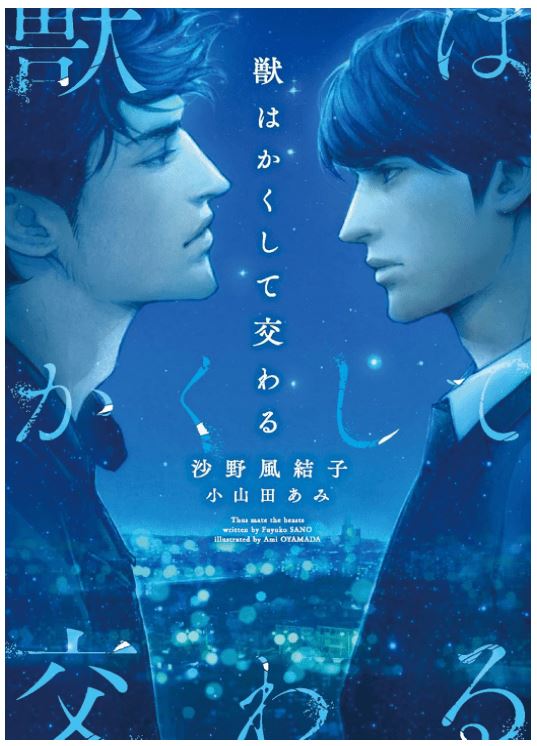
... Read More
Okay so this opening is basically a masterclass in 'here's a situation and we're not telling you everything yet.' Kagura Jinya is a 30-year-old organized crime detective who literally sets himself up as bait against these semi-gang types. Like... bro. The fact that he already told the rookie to trigger the transmitter signal if they hadn't heard from him by 11 PM and then just goes into that alley alone at 9:31 PM — who gives a damn if he's 'young for a detective,' this man has a death wish or something. And then instead of dying, he gets dragged away by some absolute mystery man who carries a 178cm grown man over his shoulder like it's nothing. Like a grocery bag. The translator even noted it — 'like a wild beast with perfect night vision.' That's not a normal civilian, that's a whole different species. I love that the story immediately establishes: this man has a purpose 'stronger than most of his colleagues.' We don't know what it is yet, but the narrator is basically whispering 'trust me, it'll be worth it.' The half-gang subplot with the Eastern Alliance connected to foreign mafias is classic setup — it gives the story a foundation to build on, and the fact that these criminals used childish threats via smartphone but then showed up with modified stun guns and tear gas canisters? That contrast tells us something about the world. They're sloppy but dangerous. Then the rescue happens and Kagura's left hanging: 'Not knowing if this man was friend or foe.' My hands were literally sweating. Who IS this guy? And why did he save Kagura specifically? This is the kind of plot hook that makes you immediately open the next chapter.
... Read More
"But the place they run off to might be an even worse hell." That line from Kagura keeps looping in my head. Because it's true, isn't it? These trainees are trapped between two bad options — stay and be exploited by management organizations, or flee and potentially fall into the hands of even more dangerous groups. There's no safe choice. That's the kind of setup that makes you genuinely anxious for characters. And the stakes keep escalating. First it's about corrupt management organizations taking kickbacks. Then we learn about Enwu and the Eastern Alliance pulling trainees away. Now there's a Vietnamese mafia called Rong Lan operating out of a restaurant. Each revelation adds another layer of danger. What makes the tension work so well is that Kagura is putting himself directly into these dangerous situations. He's not sitting behind a desk — he's riding a motorcycle at night, wearing a disguise, watching from across the street. He could get hurt. He could be recognized. The author doesn't shy away from making us feel that risk. Sanae's comment about "the weak keeping getting exploited, here and there" captures the systemic nature of this conflict. It's not just one bad apple — it's an entire system designed to prey on vulnerable people. And Kagura is standing against it, alone but determined.
... Read More
Let me just say this upfront: I stayed up way too late reading this. Not because it dragged at all — absolutely not. But because every scene is either building tension or releasing it in the most satisfying way. The structure of the first two chapters is honestly brilliant. Chapter 1 (the prelude) drops us in medias res — Kagura is already being carried, already dazed, already uncertain whether he's been rescued or captured. No exposition dump, no 'Kagura was a detective who...' Just: 'Who is this man, really?' And we're along for the ride. Chapter 2 then rewinds and gives us the full context — the threatening messages, the plan, the ambush. We see Kagura checking his watch: 9:31 p.m. 'All he needed to do was keep them occupied for about two hours.' TWO HOURS. He signed up for two hours of potentially gruesome torture and here we are watching it happen in real time. The tension is unbearable. And then — CRACKLE. The stun gun hits him. We feel every second of it. His body 'seized up, arching backward.' The semi-gang member laughing 'Look at the high-and-mighty detective now!' — I literally gritted my teeth. And just when it's about to get worse (and it could have), the tear gas canister flies in and our mysterious savior appears. The transition from chaos to movement to the breathless run through alleys — it never lets up. The chapter ends with Kagura's body being dropped to the ground and 'Damn it' muttered by someone we haven't fully seen yet. Cliffhanger? Yes. But it's earned. Every beat counts.
... Read More
I need to talk about the atmosphere in this book because it's IMMACULATE. There's something so visceral about how the author describes the setting — 'The frigid November air suddenly filled with heated tension' is such a simple sentence but it does SO MUCH WORK. You can feel the cold. You can feel the dread. Then there's the stun gun scene — 'Sparks crackled in the darkness like a small lightning bolt.' This is the kind of imagery that makes you flinch. And the tear gas canister flying into Kagura's field of vision? 'He instinctively closed his eyes and held his breath.' These are survival instincts, and the author makes them feel real, not cinematic. But the best moment — and I mean the BEST — is when Kagura finally gets a look at his rescuer's face in the dark alley. 'His deep-set eyes, with a double-lidded gaze, had a stern look, and the whites held a faint bluish glow.' A FAINT BLUISH GLOW in the whites of his eyes. That's not just description, that's CHARACTER DESIGN speaking through narration. This man is not from this world, or at least not entirely of it. The maze-like alleys, the thin crescent moon, the bitter scent filling Kagura's nostrils — these are all sensory details that ground the reader in a specific time and place. Tokyo's backstreets at night, the kind of place where good people don't walk alone (and bad people definitely do). It feels lived-in. The world isn't just a backdrop; it's actively working against the protagonist. I love that.

Leave a comment

You must be logged in to leave comments. or
