Spring is the Plan of Life - Reviews

Spring is the Plan of Life
+Add to Custom List
Sort
Add review
... Read More
"I had a feeling you'd like it." And Yao Jinxi just sat there eating watermelon in silence because what even is the appropriate response to that. This entire chapter is just one long slow burn and I am SUFFERING. The moment that got me tho was when Yao Jinxi is alone after Wu Yang leaves, staring at the doorway, thinking about how being alone is liberating but also undeniably lonely. Then he flashes back to Xia Ruonan and how even after everything they've been through, she still has HER OWN HOME that has nothing to do with him. That detail about her separate life just DESTROYED me. It's such a quiet, devastating observation about what it means to be single and queer in a world that doesn't really build infrastructure for people like him. And then Wu Yang comes back with WATERMELON like he can sense the mood shift. The contrast between Yao Jinxi's internal existential crisis and the normalcy of cutting fruit is so perfectly capturing of how these moments actually feel in real life. You're having a full emotional episode and someone just hands you a plate of food and expects you to be okay.
... Read More
This might be the single most important character moment across all these chapters and honestly I need to sit with it. Wu Yang's internal monologue about people being 'tools' used to be... what, a coping mechanism? A way to keep distance? Fine. But then he looks at Yao Jinxi and thinks: 'In his own way, despite his lack of emotional understanding and his mind plagued by mental illness, Yao Jinxi was like a campfire compared to the sun.' A campfire. Not the sun. Not something grand or distant. Something warm enough to huddle around. Something close enough to burn if you get too near but good enough to risk it. And then the line that wrecked me: 'So, defining Yao Jinxi in any particular role felt too shallow for him.' That's Wu Yang — who has reduced everyone else to functional categories — admitting that this person doesn't fit any box he's got. That's growth. Real growth. Not the dramatic 'I've changed' kind, but the quiet 'I don't know what this is and that scares me more than anything' kind. The kitchen scene where they're cramped together and the narrator just says 'It felt like... they're family' — that's not just Yao Jinxi projecting comfort, that's Wu Yang experiencing something he hasn't had in a long time. Domestic intimacy without agenda.
... Read More
Let me just say this about Wu Yang and Yao Jinxi—something shifted between them and I felt it. It wasn't one dramatic moment, it was a whole series of tiny things that you'd miss if you weren't paying attention. When Wu Yang says "I really enjoy being at your place," and Yao Jinxi gets that "inexplicable skipped beat"—that's not nothing. That's the whole book right there in five sentences. But then you look at Wang Peng and it's like, okay, this guy is a walking red flag wrapped in a decent salary. He invites people out, orders fifty-six thousand worth of food, tries to pressure people into drinking, and gets mad when Wu Yang doesn't play along. Classic performative masculinity. The fact that Xia Ruonan keeps trying to mediate between him and everyone else? Oof. She's aware something's off—she even notes that her boyfriend "didn't exactly click" with Yao Jinxi and Wu Yang—but she's still the one defusing situations. What hits me most is Yao Jinxi's protective instinct. He literally invents a story about going to a barbecue together to cover for Wu Yang when Wang Peng pressures him. That's not casual friendship. That's someone who has your back without making it a thing about being your back. And Wu Yang? He just... accepts it. Doesn't make it dramatic. Just keeps eating his perfectly cooked tripe. The dynamic between these two is so quiet it's almost infuriating. No grand declarations, no dramatic confrontations. Just two people who understand each other in a room full of people who don't.
... Read More
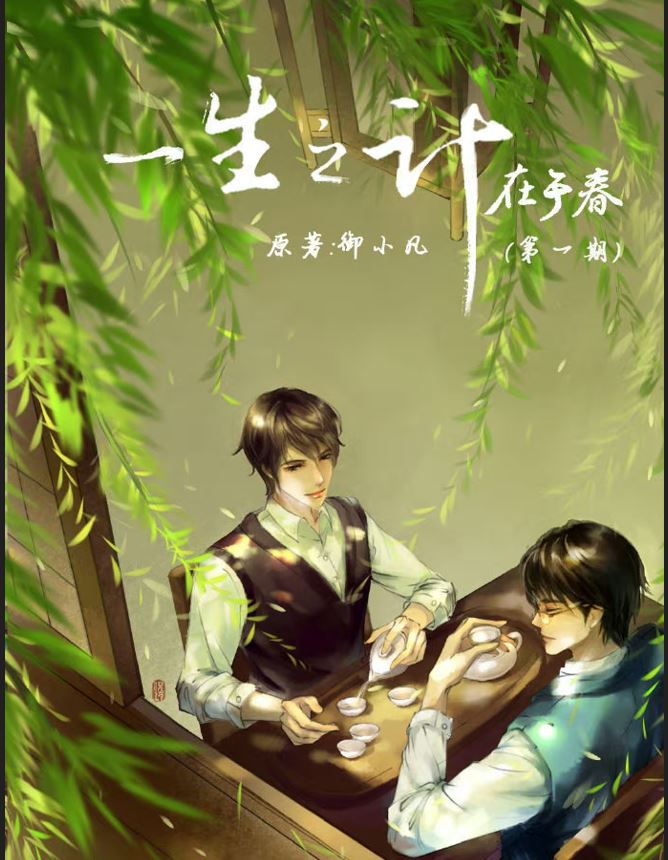
I need to talk about this one moment and I can't even pinpoint exactly why it wrecked me in the best way. Wu Yang walks into Yao Jinxi's tea shop, and the text says he "deeply inhaled the aroma filling the small tea shop — a mix of sour wooden notes and the fragrances of various teas. He felt his usually tense mind finally relax in this atmosphere." That's it. That's the whole scene. No dramatic confession, no lightning strike of romance, just a guy breathing in the scent of something warm and realizing, for the first time in a while, that his shoulders have dropped. But here's what makes it land so hard — you have to remember where Wu Yang's head was before he walked in. He was in the middle of explaining away a late-night phone call to Xia Ruonan, fumbling through apologies, basically admitting he's been causing trouble for someone he cares about. He's carrying guilt and confusion and probably a lot of unprocessed feelings, and then he walks into this tiny shop with carved wood tables and tree-stump stools and the smell of old wood and loose-leaf tea and suddenly he's not thinking about any of that. And Yao Jinxi doesn't try to fix anything. He just... makes tea. He performs these practiced, graceful motions — "his slender, fair fingers" moving over the leaves, the water, the cups — and Wu Yang watches him like it's the most captivating thing in the world. Not romantic in a blatant way, but there's something tender about watching someone do something they're genuinely good at, something that brings them peace. The narration calls it "a distinct air of sophistication," but what it really feels like is intimacy without demand. Then Wu Yang blurts out, "Watching you brew tea is really pleasing to the eyes" and immediately regrets it, internally scolding himself for letting his guard down. And Yao Jinxi just deflects with a joke: "You always unconsciously say such pleasant things." This back-and-forth — the overshare, the panic, the gentle save — it's the most realistic emotional exchange I've read in a while. It's not curated. It's messy and warm and true. I kept re-reading that part because it captured exactly what it feels like to start trusting someone, that moment when your mouth says something before your brain catches up.
... Read More
I never thought I'd say this about a setting description but the Lijiang passages in these chapters are genuinely cinematic. The author doesn't just say 'it was pretty'—there's this one line about shadows and red lights intertwining into a sea of lights that I had to stop and reread because I could literally see it. And the bit about the city's murmurs accompanying every passerby as they passed lanterns, passed small bridges, passed others, passed themselves? That recursive structure mirrors exactly what Yao Jinxi is feeling in that moment. He's walking through this place that's seen generations of people do the exact same thing and he's part of that continuum. The inn description was also surprisingly effective—the Naxi girl showing them up to a duplex that overlooks everything, bamboo tables and chairs arranged neatly. You get the sense of height, of being above the crowds but still connected to them. What struck me most though was how the author deliberately withholds the photo moment. Most novels would have the characters stop and take a selfie here, but instead they're just… present. Standing at a crossroads looking up at layers of eaves extending to the boundary between earth and sky. The instruction not to take photos forces the reader to actually visualize the scene instead of imagining their own phone screen. That's craft.
... Read More
let's talk about yao jinxi's relationship with xia ruonan because this chapter is basically a masterclass in platonic love. he shows up. he knows her parents are divorced and coming separately to send her off—which means he paid attention, he remembered the family dynamics, he cared enough to ask around. when he enters the bridal room, his first instinct isn't to flirt or make a joke, it's "she's probably very nervous." he prioritizes her comfort before anything else. and then the mom doesn't recognize him. "who are you again?" and yao jinxi just says "when i was little, i lived next door to you" and moves on. no explanation, no ego wound. this man has been part of this family's history for decades and nobody remembered him. i respect the chill energy. but the real moment is when she jokes about having an extra kid and letting yao jinxi and wu yang raise him. everybody else is shocked. yao jinxi? he laughs, pats her shoulder (carefully, because hairstyle), and says fu hongyu can afford a whole soccer team. this is not a man who takes himself seriously when his friends are being silly. he's the anchor. later, holding wu yang's hand in the church, when wu yang asks "what if we do something like this too?"—yao jinxi's response is gentle teasing but also genuine. he doesn't shut it down harshly. he just says what is what is, and wu yang already knows the answer. they're two people who've been through everything together, and their dynamic is so comfortable it aches.
... Read More
This chapter opened with a client call about tea art, but what I kept coming back to was the lunch they shared afterward. Sweet and sour spare ribs, boiled fish slices, chicken-stuffed tofu, steamed scallops with glass noodles, oyster sauce lettuce — the author named every dish like they were building an altar to ordinary intimacy. Two men, a kitchen, a table full of food neither of them could finish. And Wu Yang cleaning up while Yao Jinxi poured him tea. That's the emotional core of this whole relationship: it's not in the big moments, it's in who washes the dishes. Yao Jinxi felt his gratitude 'didn't quite match the trouble Wu Yang was going through.' That imbalance — that's the heartbeat of everything between them. Wu Yang is supposed to be on vacation. Instead he's driving around the city, cooking, washing clothes, offering apartments, picking up broken friends. And Yao Jinxi knows it. He knows and he can't repay it, and that knowledge sits between them like a third person at the table. The most devastating line in this entire batch isn't dramatic at all. It's Wu Yang's offer: 'I can drive you there. And then when I pick up Xia Ruonan, I'll come back to get you.' He's planning his entire day around keeping everyone else comfortable while he has 'nothing else to do.' The author drops this casual line and it absolutely shattered me because we all know what that really means. And then Xia Ruonan deciding to break up with Wang Peng — her 'can't take it anymore' — that's a different kind of emotional collapse. But the text cuts away from her story right when Wu Yang's jealousy surfaces, and that's when I realized: this novel isn't just telling one love story. It's showing us what love looks like when it has nowhere to go.
... Read More
I need to talk about Wu Yang because this chapter GAVE him a moment that perfectly encapsulates everything I love about his character. While Yao Jinxi is on that heavy phone call with his brother, Wu Yang doesn't hover. He doesn't push. He just... stays. And when Yao Jinxi comes back from the balcony, visibly affected, Wu Yang is the one who comes up behind him and rests his chin on his shoulder. No grand speech. Just physical presence saying what words couldn't: I'm here. "A prodigal son turning over a new leaf is worth celebrating. Cheer up." That line is so WU YANG. He's warm but not preachy, practical but not cold. He acknowledges the weight of the moment without making it about himself. And then the dynamic shifts instantly when he starts getting flirty—pushing Yao Jinxi toward the railing, nibbling his neck—and Yao Jinxi has to physically pull him back because OH RIGHT THERE ARE OTHER PEOPLE. This is the beauty of their relationship: they can go from deeply emotional to playfully intimate in the span of three sentences, and it feels completely natural. They're comfortable enough to just BE themselves together. The dynamic with Yao Jinchen is also fascinating. Wu Yang's reaction to learning his brother is coming back is hilariously self-deprecating: "Should I compete with him? I don't have the energy to clash with him." He's genuinely not threatened. He just wants the guy to be polite. That's either incredible maturity or incredible exhaustion, and honestly both read as love. Then there's the Xia Ruonan thread—she's drawing a story ABOUT THEM. A stray cat meeting a rabbit. I'm dying. The fact that Yao Jinxi immediately assumes he's the rabbit and gets defensive about it? So in-character. And Wu Yang just watches him spiral with amusement. Classic.
... Read More
This is the moment where the plot actually starts moving, you know? Up until now it's been setup — Xia Ruonan's complicated relationship with Wang Peng, her friendship with Yao Jinxi, the mystery of Wu Yang as this person she keeps mentioning. And then chapter 2 drops us right into the meet-cute (well, meet-tense-cute) and everything shifts. The structure here is really clever. We get the conversation between Yao Jinxi and Xia Ruonan first, which establishes their dynamic and gives us context about Wu Yang through her words. Then Wu Yang arrives and the power balance changes completely. The narrator goes from feeling like the confidant to feeling like... well, a third wheel who is suddenly very aware he might not want to be one. The Wang Peng subplot hangs over everything like a ghost. Xia Ruonan won't say bad things about him, but everyone at the table knows he's the reason this meeting feels so charged in the first place. Yao Jinxi bringing him up casually and Wu Yang responding with that practiced smile — it's a whole mini-arc compressed into a few lines of dialogue. And then the chapter ends with Wu Yang asking if Mr. Yao is also in sales, which is such a mundane question on the surface but in context feels like the start of something. A rivalry? A friendship? Neither man knows yet. The reader absolutely does.
... Read More
I need to talk about this one scene because it wrecked me. Wu Yang wakes up three days later, groggy and disoriented, and the very first thing he sees is Yao Jinxi passed out in a chair, chin on elbow, eyebrows furrowed like a child who's worried himself to exhaustion. The text says Wu Yang emerges 'from a dim nightmare' and his gaze shifts 'from blurry to clear'—and this tiny detail, the transition from fog to focus, is where the entire emotional weight of their relationship lands. Three days. No proper sleep. Dark circles. And Yao Jinxi didn't call for help or bring in family to share the burden—he carried it alone. 'This was his own affair since Wu Yang was his partner.' That line hit like a truck. Not because it's dramatic, but because it's so matter-of-fact. This is just how he loves. And then there's the Wu Yang response—just watching, just taking it in, no grand declaration. But when Yan Zhaowen hints that Yao Jinxi 'cares about you a lot,' Wu Yang's reply is razor-sharp: 'I will take good care of him.' Two sentences. That's it. Not 'he cares about me' or 'I appreciate what he's done'—but a promise directed at Yao Jinxi's wellbeing, not his own. This is love as mutual guardianship, not romance-as-grand-gesture. The whole book operates on this frequency, and it's so much more affecting than anything shouty or melodramatic could ever be.
... Read More
The title of this novel—一生之计在于春 (Spring is the Plan of Life)—takes on such a different meaning after reading these chapters. Spring represents new beginnings, planning, growth. And here we are watching two people whose plans are being forcibly rearranged by something as arbitrary and indifferent as cancer. Wu Yang's life plan never included stomach cancer. None of ours do. The author frames this diagnosis not as fate or destiny but as random disruption—which feels true to how illness actually enters lives. It doesn't come with narrative justification or poetic meaning. It just arrives. The imagery of packing and moving is loaded with symbolic weight. Wu Yang has always been someone who doesn't accumulate—no strong concept of 'home,' minimal belongings, transient relationships. Yao Jinxi offering his own space as a temporary home, then planning for longer-term housing nearby, represents someone building roots for another person. The house near the shop—that's not just practical, it's Yao Jinxi symbolically weaving Wu Yang into his daily world. The black tea is a small but significant detail. Yao Jinxi brewing it 'good for the stomach'—it's this tiny act of care that's almost too small to matter but somehow carries the entire weight of the chapter. When you can't fix the big thing, you fix the small things. You make tea. You pack bags. You arrange hospital visits. You hold someone at night. And the five-year survival rate—that concept itself is almost cruel. Five years is both hope and sentence. It's a timeframe that stretches far enough to be meaningful but ends with a question mark. The author leaves us suspended in that uncertainty.
... Read More
The chapter title is 'The Past that Can't be Spoken of' and honestly, that phrase is doing SO much heavy lifting throughout this entire scene. What can't be spoken of? The abuse Yao Jinxi clearly endured in the past—the text mentions 'the scene from years ago kept replaying in his mind' but we never learn what happened. That deliberate withholding is the author's way of showing us that trauma lives in the unsaid, in the gaps between words. Then there's the physical setting itself—the cramped space between the table and the cabinet where Yao Jinxi gets trapped. It's literally a suffocating, narrow gap with no room to escape. Symbolically, this is his entire relationship with his brother and family: confined, pressured, unable to move. And the rolling shutter door—that's another layer. It's a barrier between the private horror inside and the busy street outside. Wu Yang crashes through it, which feels almost mythological, like he's breaking through the walls of Yao Jinxi's isolation. The tea is interesting too. Tea in this novel seems to represent care, routine, normalcy—something Yao Jinxi has probably lacked. Wu Yang making terrible tea is actually a beautiful metaphor: he's offering care in the only way he knows how right now, imperfect but sincere. And the blood on the white shirt—white symbolizing purity or innocence being literally stained by family violence. The author isn't shy about using visual symbolism. Every image in this chapter carries weight beyond the literal action.

Leave a comment

You must be logged in to leave comments. or
