Spring is the Plan of Life - Reviews

Spring is the Plan of Life
+Add to Custom List
Sort
Add review
... Read More
So Xia Ruonan HATES Yao Jinchen, and I am OBSESSED with the way this is being peeled back layer by layer. The author doesn't just dump exposition — we get it through Xia Ruonan's actual reaction, which is way more interesting. She can't even say the word 'younger brother' without grinding her teeth. That's not sibling rivalry, that's trauma. What's really clever is Wu Yang's position here. He's essentially the audience surrogate, noticing all these weird tells and refusing to just accept the surface story. When Xia Ruonan says 'Jinxi was the one who got bullied the most,' that line hit me like a truck. The power dynamic between these two brothers is completely different from what Yao Jinxi has been projecting to the outside world. And Wu Yang's suspicion at the end of the previous chapter — that 'vague suspicion that was too absurd to be certain' — I feel like we're heading toward something big. The plot is quietly building this conspiracy of silence around the Yao family, and everyone except Wu Yang seems to know exactly what he's not supposed to ask about.
... Read More
The stakes here are domestic and emotional rather than life-or-death, but don't let that fool you—the tension is real. Xia Ruonan is in a situation she doesn't know how to handle: a coworker who grieves and leans on her emotionally, calling at impossible hours, and she's worried about how it looks alongside her relationship with Wang Peng. The external conflict is straightforward—boundaries vs. empathy, friendship vs. loyalty. But the internal conflict is where it gets interesting. Yao Jinxi clearly has personal experience with this kind of messy emotional entanglement (again with 'that time'), and his discomfort is palpable even when he's being casual. Every question he asks carries weight. 'Does Wang Peng know about this?' isn't just curiosity—it's the author ticking off a bomb fuse. And then there's Wu Yang himself, whose grief is the invisible third character in every scene. He hasn't appeared physically yet, but his presence扭曲s every interaction between Yao Jinxi and Xia Ruonan. The suspense works because we're waiting for the moment this falls apart—or resolves. Will Yao Jinxi intervene? Will Wang Peng find out? What happened 'back then' that makes Yao Jinxi so wary? The author is threading multiple sources of anxiety simultaneously, and the pacing keeps them all humming.
... Read More
Let me start with something small that means everything: that box of donkey-hide gelatin with the label saying it's 'for women.' Yao Jinxi doesn't use it himself. He places it at the bedside like a ritual offering, then immediately pivots to practical concerns. This object—this small, almost absurdly specific gift—contains the entire geography of their relationship. Who brought it? Probably someone who knows Wu Yang's preferences, someone outside their immediate circle. That Yao Jinxi accepts it without comment but also doesn't use it suggests he's guarding something: the intimacy of caregiving is his alone, and he won't let even well-meaning gestures dilute that. Then there's the YAO family name itself—three characters with the same surname (Yao Jinxi, Yao Jinchen, Yao Hong) orbiting around a center that keeps pulling them in different directions. Blood ties that should anchor them instead become vectors of conflict. And Wu Yang himself—referred to throughout as this fragile body being fought over—carries the theme of who gets to care for whom, who has the right to be present, who earns the title of 'partner' versus 'brother.' The radiation therapy, the TCM pulse diagnosis, the nurse hire—these aren't just plot mechanics, they're competing philosophies about how to face suffering. Western medicine says 'wait and monitor.' Traditional medicine says 'feel the pulse, trust the body.' The narrator seems to side with neither exclusively, letting both approaches coexist, which feels like the book's deeper argument: care isn't about choosing the right system, it's about showing up.
... Read More
Let me just say this about Wu Yang's dialogue in this chapter—he is an absolute MASTERCLASS in character voice through restraint. The man says very little but EVERY word counts. When he finds Yao Jinxi on the floor, his first line is just 'Are you okay?' Not 'What the hell happened?' Not 'Who did this to you?' Just 'Are you okay?' And then later: 'Do you want to talk about it?' That's it. That's the entire conversation about trauma. Compare that to Yao Jinchen, whose dialogue is this incoherent, desperate rambling—'Brother... Why won't you agree to be with me? Haven't you always obeyed my every wants?' It's unhinged and manipulative and completely self-serving. The contrast between these two male leads' voices is SO sharp it's almost painful. And then there's the tea scene, which is peak Wu Yang: 'You made this tea so poorly.' 'I'm sorry. This is my first time. Maybe it'll be better if I make it a few more times in the future.' This exchange is apparently the funniest part of the chapter to me because it's so domestic and normal after absolute chaos. Wu Yang's voice is consistently warm without being sappy, professional without being cold. The narrator's voice also deserves mention—it's intimate and close to Yao Jinxi's perspective, sometimes slipping into poetic territory ('a hole was torn in his heart') but mostly staying grounded and sensory. The physical descriptions—'scorching breath,' 'wet and cool sensation,' 'bright yellow-orange colour'—these are the kind of details that make you FEEL the scene rather than just read it.
... Read More
There's a moment where Wu Yang puts contact lenses in instead of wearing glasses and nobody mentions it directly, but it tells you everything about how he's changed — how he's become more visible, more present, less shielded. And then there's the Buddhist prayer beads Yao Jinxi puts on to cover his wrist scar. Two objects. Two acts of hiding or revealing. I've been thinking about this scene for days. Wu Yang washing the dishes after a meal Yao Jinxi cooked for him — that's not just domestic fluff. That's Wu Yang saying 'you fed me, now let me take care of you' without having to say it out loud. Their dynamic is built on these tiny exchanges that mean more than grand declarations ever could. Yao Jinxi teasing him about special treatment ('Should I still wash the dishes?') and Wu Yang laughing it off — this is two people who already understand each other's love language. But then Wu Yang picks up Xia Ruonan and the entire relationship landscape shifts again. She sees a paper bag in the front seat and moves to the back. She's walking on eggshells around him, and Yao Jinxi would never let that happen. The text says Xia Ruonan 'had no reservations' with Yao Jinxi — they do things for each other without hesitation. Wu Yang notices this. Of course he notices. 'As a result, he couldn't help but develop some aversion toward Xia Ruonan.' That's not hatred. That's hurt wearing a mask of annoyance. And Yao Jinxi, driving off to meet clients while Wu Yang stays behind to hold everyone else's pieces together — the author keeps showing us that Yao Jinxi doesn't always recognize what Wu Yang is doing for him, and that gap between perception and reality is where the real story lives.
... Read More
Okay so right off the bat, chapter 1 drops us into this weird little situation with Xia Ruonan panicking about her new coworker Wu Yang, and honestly the way it unfolds is interesting because it's layered. We're not just getting 'friend needs help'—we're getting hints, breadcrumbs. Yao Jinxi clearly knows something about Wu Yang from his own past, because when Xia Ruonan says she feels like he reminds her of Yao Jinxi 'at that time,' the text just... stops and doesn't explain what 'that time' means. That's a deliberate cliffhanger move by the author, and it got me immediately curious. The narrative structure here is basically: mundane delivery job → mysterious message → meetup → slow reveal of romantic complication → a question left hanging. It's efficient pacing. No filler. Every line either advances the situation or deepens a mystery. I also noticed the Wang Peng subplot is already simmering in the background—Xia Ruonan even hesitates to badmouth her boyfriend. That's a classic setup for future conflict, and I love when authors plant seeds this early. Will Wang Peng find out about the 2 AM calls? Is Yao Jinxi going to interfere again like he did 'back then'? The story is already winding tension in multiple directions simultaneously.
... Read More
Okay so let's talk about Wu Yang because this man is operating on a completely different frequency from everyone else in this scene. The man LIED about having chickenpox to get two weeks off work JUST to hang out with Yao Jinxi. That is not a side character energy. That is main character who has completely lost his mind over someone energy. And the way he just slides into Yao Jinxi's space like he owns the place—going upstairs, cleaning the room, asking about travel books—no boundaries whatsoever. Meanwhile Yao Jinxi is sitting there being all passive-aggressive polite while internally screaming. "Did you end up working for too long by accident?" he says with genuine concern, and Wu Yang hits him with "But I wanted to see you." BRO. I love that Wu Yang just has no filter when it's about Yao Jinxi. The dynamic where Wu Yang is Bold and Forward and Yao Jinxi is Flustered and Overthinking their entire friendship-to-something-more trajectory is everything. And honestly, the fact that Wu Yang remembered to pick up salt AND vinegar shows he's not just being charming—he's actually caring about this person's daily life in ways that go beyond surface-level flirting.
... Read More
The stakes in these chapters went from 'maybe I should get checked' to 'I have cancer' and the emotional whiplash is unreal. What struck me most was Wu Yang's internal monologue. The author gave us access to his thoughts for a brief but devastating moment: "What if I die?" Three words. That's it. And they carry so much weight because up until this point, Wu Yang has been the calm one, the collected one, the guy who doesn't flinch. But in that single question, all of his composure cracks and we see someone who was never really prepared for this possibility. Meanwhile Yao Jinxi is doing everything he can to stay functional—packs Wu Yang's things, arranges housing, tries to maintain normalcy—but you can feel him barely holding it together. That moment when he grabs Wu Yang's arm and says "Hey? What are you thinking about?" is heartbreaking because it's not really about the answer. It's about needing to make sure his partner is still THERE, still present, not already somewhere else in his head. The conflict here operates on multiple levels. External: cancer, treatment, the practical nightmare of organizing everything. Internal: Wu Yang's detached calm masking genuine fear, Yao Jinxi's desperate need to control the uncontrollable. And relational: the power dynamic shift where Yao Jinxi suddenly becomes the caretaker and Wu Yang becomes the patient, and how they both navigate that without making it weird. The translator's note about this being an HE definitely changes how I read the tension. Every moment of worry now has dramatic irony layered on top—I know it works out, but watching them not know in the moment makes every tender gesture feel fragile and temporary.
... Read More
The dialogue in this chapter is genuinely excellent and I want to talk about why. Each character has such a distinct voice that you could identify them blind. Wang Peng sounds like exactly what he is—performative, slightly insecure, constantly measuring himself against others. "Can we make around fifty thousand from this?" "Fifty-six thousand." He can't even brag without making it a competition. And his approach to drinking culture is so realistically toxic: "You're not giving your brother a face." Classic guilt-trip disguised as camaraderie. Xia Ruonan's dialogue is full of hedging and deflection. "Jinxi~ Jinxi~" with the tilde—that's someone who performs warmth. "Ruonan just said we're all going out to eat together" when clearly Wang Peng organized this. She's always translating, always smoothing edges. Yao Jinxi is dry, observant, occasionally savage. "What a man. So petty, acting like a little girl" muttered under his breath while calmly eating tripe. He doesn't engage with people's nonsense, he just comments on it and moves on. His advice to Wu Yang about reading between the lines with Xia Ruonan is hilariously accurate and delivered with zero ceremony. And Wu Yang—his dialogue is deceptively simple. Short sentences, almost monotone delivery, but underneath everything he says is loaded. "I'm also allergic to alcohol." "I really enjoy being at your place." "I've developed a liking for it now." He says the least and means the most. The gap between his surface calm and his actual intentions is where all the charm lives. The author's narrative voice matches this perfectly—detached but warm, observant without being judgmental. It's the kind of narration that lets you draw your own conclusions.
... Read More
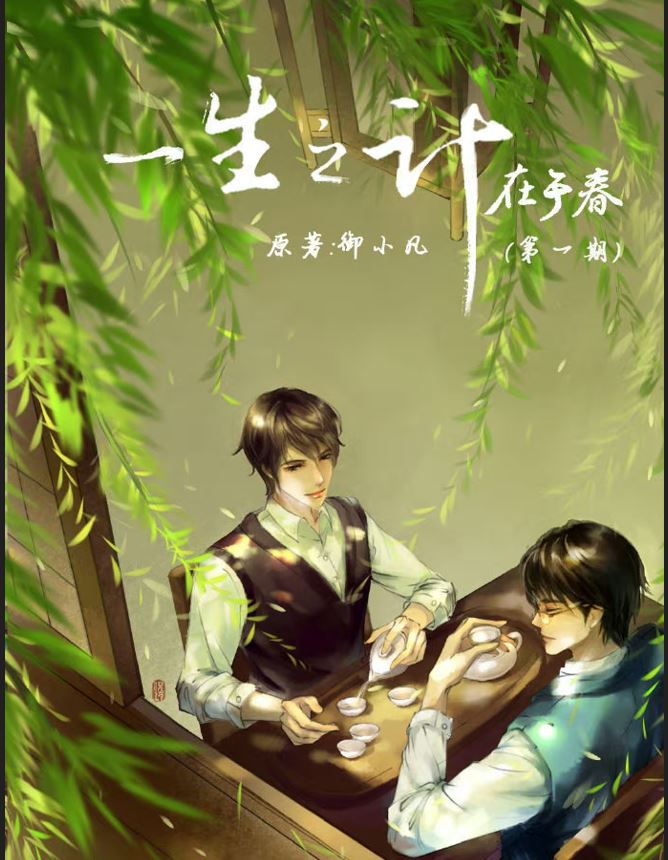
'I'm back.' Two words and suddenly the whole scene transforms. One moment Wu Yang is just some guy sitting alone in a tea shop, next moment the space around him shifts because Yao Jinxi walked in. The author doesn't describe the shop much at all—no details about wooden counters or paper lanterns or anything you'd expect from a traditional Chinese tea house. Just the light switching on, the usual spot, the brewing of tea. And somehow that's MORE effective than any elaborate description would've been. What strikes me is how the setting mirrors their relationship. The tea shop is Wu Yang's domain—he knows where to sit, he brews the Pu'er without asking, he handles the business side smoothly. Yao Jinxi is the one who comes and goes, who brings hotpot aftermath and casual money jokes. But the 'I'm back' creates this sense that the shop is also somehow Yao Jinxi's place now. It's not just Wu Yang's territory anymore. The contrast between the warm domestic scene—the tea, the hotpot, the easy conversation about business deals—and the cold reveal of the private detective is devastating. One moment you're sipping tea with these two guys and the next you're sitting in a completely different emotional temperature. The author never warns you about the tonal shift. You just go from 'ah cozy' to 'wait what' in three lines of dialogue. And that glossary section about 'giving face' at the beginning—it's oddly relevant to everything that happens here. Wu Yang giving face, losing face, the social performance of relationships. The whole chapter is wrapped in this web of social etiquette and what people choose to reveal or conceal. I loved how the hotpot detail grounded everything. Real food, real full stomachs, real Tuesday-night-level domesticity. That's what made the private detective revelation hit so hard—because it came from such an ordinary, warm space.
... Read More
This chapter has the most cozy, slice-of-life energy wrapped into what could've been a serious business discussion. Let me paint the picture for you: two tall, handsome men sitting side by side on small stools at the edge of a pool, catching shrimp together. Girls are surrounding them, but they're completely oblivious, just chatting while fishing. The visual alone is cinematic. It's like a scene from a drama where the background characters are all living their lives and these two are just... existing beautifully. And then the meal! The chef's skills 'aren't exceptionally good' but the ingredients are fresh, and they caught the shrimp themselves. That homemade element matters. It's not a fancy restaurant meal, it's a communal experience where they put in the work and then enjoy the results. The shrimp congee without shells, the spicy dry pot shrimp, the egg drop soup, the oyster sauce lettuce - this is comfort food at its finest. The details of the meal feel so grounded and real. Yao Jinxi serving Wu Yang first, making sure the portions are 'just right,' asking about cilantro - these are the kind of domestic details that make worldbuilding feel alive. This isn't a fantasy epic with sprawling kingdoms; it's a story about people living in a world where you can go catch your own dinner and have a nice meal with someone. The setting serves the characters, not the other way around, and that's honestly refreshing. The whole atmosphere is warm and unhurried, which makes the underlying tension about business and past relationships hit harder because we're grounded in this gentle reality first.
... Read More
This chapter is a masterclass in slow-burn emotional pacing. Let me break down why it works so well. It opens with Yao Hong entering the café and immediately the stakes are clear. She has a stern expression. Yao Jinxi's prepared lines vanish. The reader feels that shift in the air the moment she walks in. But instead of rushing into the confrontation, the author lets the silence stretch. Wu Yang pours tea. The fragrance fills the space. Nobody speaks for what feels like an eternity. Then Yao Jinxi says "Mom." Two syllables that carry the weight of however many years they've been apart. And the author immediately cuts to the physical reactions — red eyes, tightened jaw, clenched teeth. No melodrama. Just bodies telling the truth when words fail. The structure of the conversation itself is genius. Yao Hong doesn't ask about his feelings or their past. She asks about his injury. Then she asks whether he went to university — which is really a roundabout way of asking whether he suffered because of her. Each question is a probe, testing whether the wound is still open. And Yao Jinxi's responses are equally careful, each one showing how much he's grown and how much he still protects her. The pacing peaks when Yao Hong loses control and covers her face with her hand. Up until that moment, she's been holding herself together with visible effort, and the reader has been holding their breath alongside her. When she finally breaks, it's not loud or dramatic — it's a quiet gesture that says "I need a moment" and that's somehow more devastating than any breakdown could be. Then Wu Yang's internal monologue about time solving problems gives the chapter its philosophical anchor before returning to the surface-level conversation about the tea shop. The chapter ends on that note of tentative rebuilding, which is exactly the right place to stop. Not resolution, but possibility.

Leave a comment

You must be logged in to leave comments. or
