When Two Alphas Meet, One’s an Omega - Reviews

When Two Alphas Meet, One’s an Omega
+Add to Custom List
Sort
Add review
... Read More
OK so this whole passage is such a weird pivot. You have this incredibly charged scene where they're wrestling in bed, pillow talk, tickling each other like idiots—and then BAM, Bai Huai just... resets. He goes back to being the composed, glasses-wearing, book-reading roommate like nothing happened. And that's the plot twist here, honestly. It's not a dramatic reveal or anything, it's the emotional whiplash. Jian Songyi is down there having an internal crisis about hormones and feelings, spiraling into this whole O/Alpha thing, while Bai Huai is just over there flipping through physics problems like a maniac. The author is basically saying: you thought that was intimacy? Yeah, probably not. It's a quiet gut-punch disguised as domestic fluff. I love how the chapter title 'Those Years of Being Imaginary Lovers' lands so much harder after reading this. They were never even close to being real lovers—Jian Songyi was doing all that emotional labor solo.
... Read More
The dialogue in this chapter is absolutely phenomenal and I need to talk about how each character has such a distinct voice. Lu Qi Feng is cold and analytical — he literally squeezes an empty can asking to change the subject, and when he speaks about Bai Huai watching Wang Shan jump, his words are precise and heavy. He says I will definitely be depressed on the spot. That's not casual observation, that's someone processing trauma through logic. Yang Yue is protective and sharp, warning Yu Ziguo not to keep linking Song Yi and Bai Huai like some ordinary couple. I won't be able to protect you, brother. That line tells you everything about his loyalty. Yu Ziguo is the playful one, waving his hand like he doesn't mind the tension, calling himself attractive people — he's using humor as armor. But Zhuo Luo is where it gets interesting. She speaks gently, revealing secrets, and when she reads Song Yi's note aloud, her voice changes. I almost wanted to buy a wreath for this martyr named Bai Huai after I read the full text. That's pure Zhuo Luo — dramatic, affectionate, devastatingly honest. The WeChat exchange between Song Yi and Lu Qi Feng is my favorite part. Lu Qi Feng probes with Don't you like him? Aren't you going to drive him out of Nanwai? and Song Yi fires back with My lover? Why are you talking like Yu Ziguo now? I fancy soft and cute Omega. Not a tall, hard, and venomous Alpha. Bai Huai and I are brothers at best. The voice distinction is so clear — Song Yi is defensive, precise, trying to control how he's perceived. And then the follow-up message is where his real voice cracks through. Of course we get into arguments, but I still have to be loyal to a brother. The repetition proves he means it. Bai Huai's dialogue is sparse but devastating. When he says I suddenly remember Brother Song who is a man of his word, every syllable is measured. The hug request at the end — I haven't received my hug yet either — that's not whining, that's a person finally naming a need.
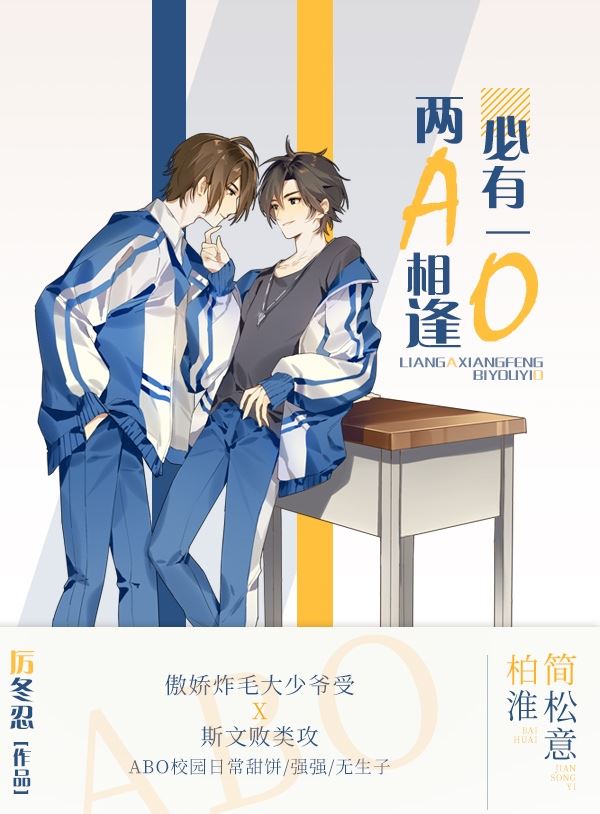
... Read More
I am OBSESSED with the Jian Songyi and Bai Huai dynamic and I need to talk about it. Let's start with Bai Huai because honestly he's the most interesting character in this whole thing. On the surface he's the perfect rival — top scores, won the handsome boy contest, calm demeanor. But the text reveals something way more complicated underneath. When he's lying in bed thinking about what Ice Cream Xiaoyuanzi said, he actually QUESTIONs whether Jian Songyi would be happy if he (Bai Huai) fell in love with the cub. Not whether HE wants to — whether Jian Songyi would be HAPPY. He's been tracking Jian Songyi's emotional state this whole time without even realizing he's doing it. And then he sends his school uniform to Jian Songyi's house. Why? Because he REMEMBERS Jian Songyi mentioned it earlier. He notices things. He cares in this quiet, practical way that doesn't announce itself. Jian Songyi is a whole different case. The text says it plainly: "He's just not used to losing. If he really loses, then he won't hold grudges against the other side. The only reason why he feels irritable is that it was Bai Huai." That's the entire relationship in one sentence. It's not about winning. It's about WHO he's losing to. There's something personal there that goes back to childhood — "It's been like this since he was a kid." These two have a HISTORY that the story hasn't fully unpacked yet, and I am dying for context. What kills me is that Jian Songyi KNOWS he went too far. "He also felt that his harsh words today had gone too far and hurt his feelings a little." He acknowledges it internally but refuses to take it back because of pride. That's not just stubbornness — that's fear. If he apologizes, he has to admit that Bai Huai matters to him beyond just being a rival. And Bai Huai? He reads between the lines. He understands why Jian Songyi is hurting and instead of gloating or pushing further, he shows up. Literally. At midnight. During the worst moment of Jian Songyi's life. The scene where Jian Songyi pushes Bai Huai away saying "How can an Alpha be hugged? It's so unseemly" — that's not rejection. That's panic. He's vulnerable, vulnerable is dangerous, and the only defense mechanism he has is pride. But he squeezed out his LAST strength to say that. He had nothing left to give and he STILL tried to push him away. That's not strength. That's the opposite. Also can we talk about how the supporting characters completely misunderstand everything? Yang Yue and Xu Jiaxing are over there theorizing about poisoning and last cares before death, and the reality is WAY more tender than either of their wildest theories. The comedy of errors around these two is unmatched.
... Read More
The dialogue in these chapters is doing something wicked and wonderful. Bai Huai's voice is so distinct from Jian Songyi's that you could tell them apart blindfolded. Jian Songyi is sharp, defensive, all teeth and sarcasm—"You are shameless" followed by dead silence. But Bai Huai? He's soft-voiced, measured, deliberately provocative. "Little Songyi, don't look at me with such hateful eyes." That nickname alone should be illegal. And the banter! "If I remember correctly, what you said yesterday was that if you don't get me to leave Nanwai convincingly, then you won't be an Alpha." Bai Huai remembering every stupid thing Jian Songyi has ever said to him, reciting it back with that infuriating calm. This is a man who has been counting every word, storing them away like treasures. But the real masterstroke is how the author lets silence do the work. So many of the most emotional moments have almost no dialogue at all—just Jian Songyi thinking, Bai Huai watching, a leaf falling. The author trusts the reader to feel what isn't being said. And it works devastatingly well. The single line "I'm no better than these things, but you can always come to me, okay?" carries more emotional weight than entire chapters of screaming matches in lesser novels. Bai Huai's voice—warm, wounded, relentlessly gentle—is the kind of narrative gift you don't find often.
... Read More
"It was like a steaming kettle inside where all the students rushed around to crowd the piece of paper." This one sentence does so much work. You can FEEL the heat, the chaos, the suffocating pressure of a room full of kids whose entire social hierarchy just got rearranged on a single sheet of paper. The author doesn't need five paragraphs of description—just a kettle metaphor and you're instantly in that classroom. Then you cut to Jian Songyi, unmoving, watching the stampede like it's some species of wildlife he's studying from behind glass. The contrast between the frantic crowd and his complete stillness tells you everything about who this person is without a single explanatory paragraph. And the teacher scene! Shi Qing walking in with test papers, immediately roasting Jian Songyi's handwriting while knowing full well it's a perfect score, comparing it to his three-year-old nephew's scribbles—that's such a specific, lived-in detail. You can picture this teacher. He's young, he's comfortable with his students, he makes jokes that are sharp but not mean. It grounds the whole ABO/academic rivalry setup in a world that feels real and lived-in rather than some sterile concept playground. The school setting isn't just a backdrop, it's a character itself.
... Read More
This chapter made me feel so many things at once. Let me start with the most quietly devastating line in the whole passage: Zhuo Luo saying Jian Songyi is as good as the sun. Think about that metaphor for a second. A sun doesn't belong to anyone. It shines on everyone equally, and yet everyone wants it for themselves. That is exactly Jian Songyi in this story, isn't it? He is warm, he is kind, he brings food to tired Alphas after training, he remembers which of his friends has blood that attracts bugs, he rubs Zhuo Luo's head and says be good like it is nothing. But inside, he is also exhausted, sleeping badly since childhood, using someone else's leg as a pillow because his inflatable one leaked, hiding his face behind a hat because he feels guilty for taking advantage. The moment where he wakes up on Bai Huai's thigh is everything. It is so casually intimate, so normal, so deeply charged. Bai Huai does not move. He does not wake him. He says your legs must be numb but I slept too, as if it is nothing. But Jian Songyi is burning up inside, convinced he took advantage, convinced he is hot again like the night before. That heat is not just physical, is it? It is shame. It is the omega conditioning he has fought so hard to suppress. It is the terror that his body betrays him even when he is unconscious. And then Zhuo Luo's entire monologue about forgiving Brother Song even though he got scammed out of all his mosquito repellent because Bai Huai can compete with me? That broke me. He literally says I really forgive you. I am not angry at all. With a smiley face emoji in the narrative. This man has built his entire emotional world around a person who will never be his, and he is joyful about it because joy is all he can afford.
... Read More
Okay so let me just say this chapter is a masterclass in how to take a supposedly sweet moment and immediately twist it into a mess. Jian Songyi shows up with noodles—actual longevity noodles, because apparently his mom cooked them and his dad helped and they both suffered through making waste noodles—and the first thing that hits me is how much worldbuilding is packed into what could've been a simple gift scene. The nod to Alphas and Omegas drops casually like it's nothing, but it changes everything we know about their relationship dynamics. And that deleted post subplot? Chef's kiss. Bai Huai literally went out of his way to protect Jian Songyi from seeing something, tried to filter the world for him, and still Jian Songyi found out anyway. Of course he did. The irony is almost painful. What I love about the structure here is that the chapter starts warm—you can practically smell the noodles—and then Jian Songyi's anger basically detonates in the first five minutes. But instead of letting the conflict spiral into actual drama, the author pivots hard into humor and physical closeness. Bai Huai just smiles through it. Just SMILES. And then the dinner scene happens and suddenly you're back to domestic softness. The arc within a single chapter is wild. From offense to deflection to a shared meal under warm lighting. If this book keeps doing this, I'm never leaving.
... Read More
Let me just say - this chapter hit me like a truck. On the surface it's a relatively quiet chapter, right? Nothing explodes, no dramatic confrontations. But the plot density here is insane if you actually pay attention. We have THREE major threads converging simultaneously. First thread: the backstory dump about Bai Huai. The author doesn't just tell us he's been good to Jian Songyi - they list it like evidence in a court case. Medicine in his bag since junior high. Accompanying him through his first heat.故意 giving himself a fever so Jian Songyi could practice resisting Alpha pheromones without being exposed. This isn't romance novel fluff - this is strategic, calculated devotion. And the worst part? Jian Songyi KNOWS all of this and it makes him feel suffocated. 'When you find out who is the reason for your pain, you should beat them to death.' That line alone tells us everything about how trapped he feels. Second thread: the birthday. His whole family is scattered doing charity work. Only Aunt Liu is there. Eighteen years old and he's eating alone. I cannot stress how much the author uses this moment of loneliness to contrast with all the things he does for Jian Songyi. He has everything - wealth, intelligence, power - and yet he's completely alone while being the most devoted person in the story. Third thread: the cyberbullying conspiracy. Huang Fuyi. Nanwai. The IP addresses. The post-bar administrator who's apparently a shipper. Xu Jiaxing being blocked mid-conversation. Everything is connected and the author is building toward something massive. And here's what kills me - ALL of this is happening while Bai Huai is just quietly picking at his food. The narrative never screams at you. It whispers. And that's why it haunts you.
... Read More
Let's talk about stakes, because this chapter makes you FEEL what's on the line in a way most sports scenes don't bother with. Jian Songyi is an Omega. He took an INHIBITOR. He's running in heat. The text is brutally clear: "This kind of three-kilometer race can simply kill an ordinary Omega." An ordinary Omega. Not him. He's NOT ordinary. But the threat is real, and the author never lets us forget it. Then the abdominal pain starts. Side stitches. Oxygen deprivation. Numbness. Powerlessness. "His body seemed to be no longer his own." That's the most terrifying kind of conflict — not man versus man, but man versus his own flesh. He could stop. No one would blame him. He's already accomplished something insane by being in this race at all. But here's what raises the stakes beyond physical danger: social stakes. If he fails publicly, it confirms every prejudice. It gives Li Ting and people like him proof that Omegas don't belong in Alpha spaces. Jian Songyi knows this. That's why his podium speech matters — it's not just post-race boasting, it's a deliberate act of defiance. "There is a saying that I am afraid that some people did not hear clearly, so I will repeat it here." He's not just finishing a race. He's reclaiming territory. Every step is an argument. And when he collapses at the end and Bai Huai catches him — that's the moment all the tension releases. He made it. He survived. He proved it. But the cost was real, and the book doesn't pretend otherwise. Li Ting walks away pale. The reader should too.
... Read More
Bai Huai left the classroom and went to the back of the school. The ivy at the back door of the school has withered, several old trees have begun to fall into disrepair, and only the lights of the old street outside the back door come in, vaguely showing a figure hidden in the branches and leaves. I keep coming back to this description. The withered ivy. The decaying trees. The faint streetlights filtering through branches. This isn't just a setting—it's the mood of the entire scene compressed into one paragraph. It's liminal space. It's where secrets go to breathe. The front of the school is all light and notes and casual conversation, but the back door? That's where Bai Huai sheds his student persona and becomes something else. The contrast between the two spaces is deliberate and effective. Inside the classroom: warm lighting, shared materials, Yu Ziguo happily photocopying notes, Jian Songyi complaining about covers. Outside: darkness, shadows, the metallic taste of pheromone power dynamics, and a conversation that feels like it could end in violence. And the person hidden in the branches and leaves—Huang Fuyi, waiting like prey. The visual of him emerging from foliage into the vague glow of streetlight is almost cinematic. You can feel the temperature dropping just from reading it. The world of this novel feels lived-in, and those atmospheric details are doing so much heavy lifting without ever stopping the plot.
... Read More
I need to sit with this scene for a moment because the way Jian Songyi and Bai Huai's relationship operates here is absolutely devastating in its subtlety. Think about the bracelet. Bai Huai carved something into that grape stone — "painstakingly carved for his own good" — and it was socially prepared for Jian Songyi. This wasn't a casual gift. This was someone pouring their private devotion into an object and handing it over with nothing said aloud. And Jian Songyi understood that completely. He knew exactly what it meant. But then Bai Huai takes it off. Just quietly, removes it, and the entire architecture of their relationship cracks. What broke my heart wasn't the removal itself — it was Jian Songyi's reaction. He wanted to pull the string, to force the bracelet back onto that wrist, but then he remembered the posts. He remembered the word "disgusting" floating around about Bai Huai. And he froze. Not because he was scared of the舆论, but because he suddenly understood: this bracelet, this token of care that Bai Huai gave him freely, is now tied to something public and painful. Taking it off isn't rejection. It's self-protection. And Jian Songyi — who has spent his entire life knowing exactly how to get whatever he wants, who's been capricious and picky and expensive since childhood — is completely powerless here. He can delete posts. He can track IP addresses. He can use every connection at his disposal. But he can't make Bai Huai feel safe again. "Originally, the word 'disgusting' was like an invisible hurtful ice pick on his chest." This line — it comes from Bai Huai's POV, and it's the most honest thing in the entire passage. The word wasn't even directed at him directly, but it lands like a physical wound because it's attached to something he chose to give. Meanwhile, Jian Songyi is left wondering what Bai Huai wants, what he's afraid of, and —最关键的部分 — whether anything he does will make things worse. He remembers all those childhood moments where Bai Huai arranged everything for him, and now the tables have turned: Bai Huai is the one pulling away, and Jian Songyi has no idea how to reach him.
... Read More
I need to talk about this scene where Bai Huai coaxes Jian Songyi into drinking his medicine and I am SHOOK at how layered this character is. On the surface, Jian Songyi thinks he's the one in control here. He's like, "I made you a promise, let me extract real value from it" — very much the generous rich kid granting a favor. But Bai Huai? He's sitting there calmly turning pages, already three steps ahead, thinking about how to collect these favors strategically. The author literally tells us: "he estimated that he would be able to coax many more opportunities to make demands, but this time it would not be a pity." PITY? This man is planning a lifetime of polite favors. But here's what actually got me — the milk candy. Bai Huai slides him a piece of milk candy under the table, hidden by the cup, so "no one had seen it" and Jian Songyi's school image stays intact. This is a person who notices EVERYTHING about Jian Songyi — that he's self-conscious about his reputation, that he can't handle bitter medicine, that he needs a sweet follow-up. And he does it silently without making a production out of it. Then Bai Huai thinks to himself that his greatest wish for Jian Songyi is just to live healthy and happy to age 120, while simultaneously plotting how to use these little favors to "spice up his love life in the future." This man is both genuinely tender and strategically romantic and I cannot handle it. Jian Songyi, meanwhile, has no idea any of this is happening. He just thinks "Bai Huai seems like a good person, I've misjudged him" and decides he's going to share his luck and friends with him. The dramatic irony here is absolutely delicious. He thinks he's doing Bai Huai a favor by being nice, when really Bai Huai has already been taking care of him in the quietest way possible. Also the author note confirms Bai Huai's feelings aren't some vague admiration — "in his unlucky days, Jian Songyi became his greatest luck." That recontextualizes EVERYTHING.

Leave a comment

You must be logged in to leave comments. or
