My Husband Has Forgotten Me - Reviews

My Husband Has Forgotten Me
+Add to Custom List
Sort
Add review
... Read More
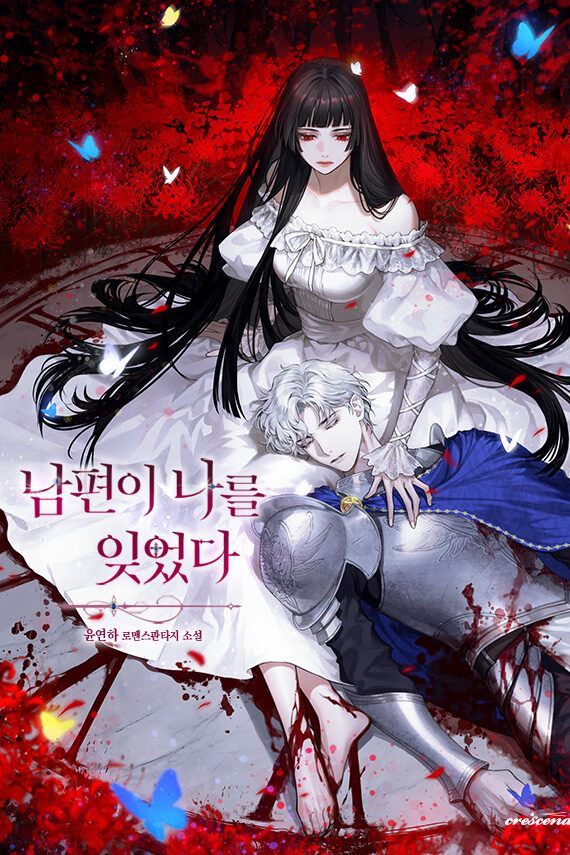
The imagery in these chapters is OBSESSED. I'm not even joking. From the very first line—"From the warmth of a cosy spring, it was suddenly plunged into the bitter chill of winter"—the author establishes this devastating temperature shift that mirrors Chronosa's internal state perfectly. She's burning up inside while the world around her freezes over. The contrast is relentless and intentional and I love it. The blue butterfly though. THE BLUE BUTTERFLY. It appears at the very beginning, fluttering against the railing she could never cross, and then at the end it's leading Anankeus to her through the snow. It's this tiny fragile thing that keeps showing up in scenes of death and desire, and honestly? It's become my favorite atmospheric motif in the entire book. The author uses it like a visual heartbeat—when things get cold and desolate, the butterfly appears. When life and death blur together, there it is. And the color palette of this whole sequence! White snow, black hair, blue wings, red eyes, blood from her nails digging into her arms, the white cloak with the embroidered insignia of the War God Eires. It's like a painting. Every frame could be a watercolor and it would hang in a museum. The scene inside after the terrace door closes is equally vivid—moonlight on tangled bare skin, her pale body against white sheets, the only color being her red eyes "reminiscent of the sun." Warmth and cold living in the same breath. Honestly the worldbuilding detail I appreciated most was how this feels like a place with history. Belphegor, the tower rooms, the mention of Gulgalta where "the world burned"—all of this sits behind the scene like a foundation. The snow isn't just weather, it's the accumulation of every conflict they've ever had, settling quietly over everything.
... Read More
I need to talk about the atmosphere in these chapters because the author absolutely NAILS it. The opening battlefield description is ruthless — I mean genuinely gruesome. The way corpses are described as torn apart, the crimson fountain spraying into the air, Anankeus's snow-white hair getting soaked in red. This is not a sanitized fantasy war. This is visceral and ugly and the author does not flinch from showing us that. But then — and this is what makes it unforgettable — right after all that violence, we get the funeral scene. Anankeus walking among the dead, closing each eye, saying their names. The line 'I commanded you not to die' broke me. A man who has killed so many people, who has accepted death as normal, is broken by the deaths of his own people. The contradiction of a god of war mourning his fallen is so beautifully cruel. The bath scene though — that is where the atmosphere shifts completely. One moment you are in blood and mud and death, and the next you are in warm water, remembering the scent of someone, the warmth of skin. The contrast is staggering. The author uses that sensory shift to show us how Anankeus's entire internal world has been upended. The battlefield smells 'oddly unfamiliar' now because his mind is somewhere else entirely. And the Satyrus woman — her entrance is handled so perfectly. She is described through her trembling, her lowered gaze, the rough rags she wears. Then later when she stands up and looks at him with boldness, it is such a powerful visual moment. The faded red wedding knot she pulls from her robes is such a small, intimate detail in the middle of a war tent. It grounds the entire scene in human emotion instead of military strategy. The final image of Anankeus calling the intruder 'a rat' while smiling that crooked smile — it is chilling and wonderful and I need to know what happens next.
... Read More
Let's talk about what's actually at stake here, because on the surface this looks like a captor-captive scene but underneath it's a philosophical brawl wrapped in silk and blood. Chronosa's opening position is clear: she's been ordered by her father to die. Execution. She's accepted it. Her ankle was severed, her vocal cords torn—she's a broken weapon, and she's fine with that. Death is obedience. Death is loyalty. So when Anankeus tells her she will LIVE, that's not mercy—that's an act of war against her father's wishes AND against her own decision. "Unfortunately, you only have one choice. Because I will make sure you live." This line changed EVERYTHING. He's not just keeping her alive for information. He's taking away her right to choose her own end, and in doing so, he's making himself her enemy in a way that goes beyond politics. But the REAL conflict is internal, and it's where this passage absolutely shines. Chronosa is torn between three things simultaneously: her body's instinctual response (the rut, the heat, the desperate need), her pride as a Protogenoi princess who has NEVER submitted to anyone, and her duty to her people. When she finally eats the porridge, it's not surrender—it's strategy. "Betraying her father's command was better than betraying her people." She's playing the long game. She's using his brutality as a smokescreen while she gathers information. That is a character who is never, ever passive, even when her body is literally pinned beneath another person's. Anankeus's conflict is just as layered. He should kill her. His father would have killed her. She's a demon, an enemy, someone who should be nothing more than a liability. But he can't. The text makes this abundantly clear: "A demon woman, of all things, someone he should've just killed without hesitation had him tied up like this." He's aware of his own weakness. He knows he's compromised. And instead of admitting it, he doubles down on cruelty—the feeding, the dominance, the verbal sparring. But the butterfly incident reveals the truth: he SMASHES it because he can't handle seeing something fragile and beautiful in the same space as this situation. It's displacement. It's anger at himself. The stakes keep escalating too. Chronosa's father— the Great Lord of Belphegor—cut off his own daughter's ankle and vocal cords. That's not discipline, that's something darker. Anankeus pieces it together: "To do something fit for a traitor... to his own daughter. And yet he dressed you in silk, adorned you with rare jewels." This father loved her and punished her in the same breath. What did she do? What secret is she keeping? The political stakes behind this personal violence are terrifying and the author isn't rushing to explain them. By the end of the passage, Chronosa has survived another day, gained something (information, leverage, his attention), and lost something (her illusion that she could control her own body's responses). Anankeus has failed to break her, failed to stay detached, and is now questioning whether his own instincts are betraying him. Neither has won. Both have been marked. The conflict isn't resolving—it's deepening, which is exactly what good conflict should do. Also can we talk about the physical stakes? She can't walk. She can't speak. She's been deliberately maimed. And yet she dominates this scene verbally and psychologically. The body is broken but the spirit is iron. That contrast is what makes every confrontation between them feel so electrically charged. She has NOTHING physically but she refuses to give anything away. That's not just dramatic—it's deeply moving.
... Read More
I need to talk about the Walpurgis Night re-enactment scene because WOW. Demons in shackles, huddled around a tiny fire in bitter winter cold, singing songs about their homeland. Butterflies fluttering through — of course butterflies, they never make sense but they keep appearing and somehow it works. The woman from Sardis telling her story to Chronosa is one of those moments where the entire world just opens up in front of you. She's held onto this dream for THIRTY YEARS. Thirty years of forced labor, watching her friends die, waiting for a rescue that may never come. The image of her chipped cup with 'Arcadia' carved into it, filled with murky water instead of wine, trembling in her old hands — I literally had to stop reading for a second. And then her head falling to the ground with those silent tears hitting frozen earth. The prose here is so controlled, so precise. You can feel the cold. You can see the firelight on her wrinkled face. The way the narrative zooms out to explain the political landscape of Arboas versus Arcadia right in the middle of this intimate scene is masterful — it grounds the personal tragedy in something enormous. War, nations, ideology, all collapsed into one old woman's dream of going home. And then Chronosa reaching out to touch her shoulder. Just that one gesture of empathy between two prisoners who understand each other without speaking. The scene doesn't resolve, it just... exists. Like real life. Like suffering. I'm still not over it.
... Read More
On the surface, Chronosa's self-poisoning is a plot device — a way to force Anankeus to keep her alive. But the symbolism runs so much deeper and it's been haunting me since I finished. Nasongpepl tea and almonds. Two seemingly harmless things that become lethal only under specific conditions — specifically, during rut. This is a poison that exploits biology, that weaponizes desire itself. Chronosa didn't just poison her body; she poisoned the very thing Anankeus can least control. She turned his rut into a hostage situation. And then there's the physical toll on her body. She's already been broken — her voice taken, her legs disabled by her own father. The poisoning is another layer of self-harm, another way her body becomes a site of violence. But she treats it with such casual indifference: "Unfortunately, I guess it wasn't a lethal dose." She gambles with her life the way other people gamble with cards. Her body is already a prison; why not add poison to the list? The blue-winged butterfly is another symbol I can't shake. Butterflies represent transformation, fragility, beauty that doesn't last. It flutters near her constantly — is it drawn to her scent, her fever, or is it something more? A spirit companion? A manifestation of the self she's been trying to escape? And the gloves. Anankeus wears them always. He considers demons unclean. But when he finally touches her — grabs her cheeks, steals her lips — there's no glove between them. The physical barrier between priest and demon, human and monster, falls away in that one reckless moment.
... Read More
I need a moment. A full moment. Because what the author did in this chapter with Anankeus and Chronosa... I can't even. The forced feeding scene. Let's just sit with it for a second. Anankeus literally chews bread in his own mouth and transfers it to her. He says it's because she won't eat, and he's right—she'd rather starve than accept charity from him. But the physicality of it! Their lips touching. Her tongue being seized. "Their saliva mixed. An unfamiliar taste spread through her mouth." UNFAMILIAR TASTE. Are you kidding me? This is supposed to be degrading, this is supposed to be him breaking her, but it reads like the most intimate thing either of them has ever experienced. And she KNOWS it. Her body betrays her immediately: "Her heart had dropped to the floor with a loud thud. Dizzying butterflies of every color swirled about." Then she retches afterward—not just physically but psychologically, because part of her wanted it and that self-disgust is DEVASTATING. And then the REAL gut punch: she eats the porridge later NOT because she forgives him but because she's making a strategic calculation. "Betraying her father's command was better than betraying her people." She uses HIS cruelty as COVER to get what she wants. That is such a brilliant character move. But here's what destroyed me—the ENDING. She tells him flat out: "That time, I gagged because your scent was revolting." After everything—the feeding, the touch, the heat between them—she looks him dead in the eyes and says his Scent disgusted her. That's not defiance, that's a declaration of war wrapped in honesty. And Anankeus? He can't even process it. He just leaves. I literally put the book down and stared at the ceiling. The way these two are built—neither willing to yield, both drowning in something neither understands, using power plays as foreplay—it's not just chemistry, it's COLLISION. Every interaction is a knife fight where both people are bleeding and neither can stop. And the blue butterfly! First it flutters near Chronosa during that scene, then it clings to the doorframe after Anankeus leaves, and he SMASHES IT. "Its wings crumbled within his grasp." THAT scene said more than any dialogue could. He killed something beautiful in a rage he couldn't even name. What does that make him? What does that make THIS? I'm not ready for whatever comes next. These two are going to destroy each other and I am HERE FOR IT.
... Read More
Okay so let me just say this upfront: the pacing in these chapters is absolutely ruthless and I have never been more grateful for it. The chapter opens with exposition—Chronosa's options, her father's choices, Anankeus's task. Fast. Efficient. Three sentences and we're in the room with them. No wasted breath. Then immediately: "Why do you insist on following your father's command?" The question hangs there like a blade. And instead of answering, Chronosa does something brilliant—she communicates through silence and implication, reading his emotions one by one like she's undressing him. Greed. Lust. Carnal craving. Yearning. Thirst. Desire. Each word lands like a physical blow. The author spaces these out perfectly, giving each one room to breathe, and by the time she says Desire, the entire room has shifted. What I love most about the structure here is how the author controls tempo through sentence length. During the tense moments—when Anankeus grabs her, when the butterfly appears, when he leans over her—the sentences get shorter, sharper, almost staccato. "He seized both her slender wrists with one hand and yanked them above her head." Short. Direct. No decoration. But then when Chronosa's internal state takes over—when her body responds despite her will—the prose stretches out, becomes more fluid, almost dreamlike. The rhythm of the writing mirrors the rhythm of their bodies. And the scene breaks! The author does these gorgeous micro-transitions. One moment they're in the black room with the spider lilies, the next—"Around noon, the scent of winter poured through the crack of an open window." Just like that. A time jump that feels like waking up from a nightmare. Chronosa is alone again, small in a sliver of light, and the reader gets a moment to catch their breath before the second wave hits: he comes back with food, and the whole dynamic replays at a different intensity. The structure also brilliantly mirrors the emotional arc. The first half is escalation—tension building, bodies growing closer, words getting more dangerous. The middle peaks at the forced feeding and the retching. Then it DESCENDS—Anankeus leaves, destroys the butterfly, checks his own temperature, realizes HE might be affected too. The descent is almost slower, more deliberate, like the aftermath of a storm. And then the final return to Chronosa, the second feeding scene, and the devastating one-liner ending. The structure is essentially: confrontation → peak → aftermath → confrontation again, but deeper this time. Like waves. Each wave pulls the reader further under. There's no filler. Not a single paragraph that doesn't advance either the plot or the psychological tension. I read this in one sitting at 2 AM and I don't regret it. I regret that it ended.
... Read More
The visual storytelling in this passage is absolutely cinematic. Let me just start with the opening image: a winter butterfly — forgetting the season — fluttering toward flames. That single image says everything about this world. Seasons are broken. Nature is wrong. And the little creature can't even tell anymore what's natural and what isn't. It lands on Chronosa's shoulder like a piece of dark poetry. Then there's the firelight rendering everything in impossible colors. "Her jet-black hair, glinting with a crimson glow from the flames." "Pure white hair and silver-plated armor gleamed fiercely red in the firelight." Gold. Red. Silver. Black. The palette is so deliberate it feels like the author is painting with light itself. And that scent — the pheromones of the season of revelry, a fragrance potent enough to pierce through the stench of blood and burning — this world has its own biological logic, its own rules for how desire and danger intersect. Belphegor as a fortress city feels lived-in and real. The Grand Duke standing atop the walls with his sword embedded in the ground, the red sun chariot dyeing the sky — these images stick with you. And Gulgaltha, this small village that was just celebrating life before being obliterated... it exists only in memory and ash, which makes its destruction even more visceral. The worldbuilding isn't told to us in exposition dumps; it's woven into every glance, every sensory detail, every scar on Chronosa's body.
... Read More
How does a mute character have the most razor-sharp dialogue in the entire book? This is the question I keep coming back to. Chronosa communicates through lip-reading and text, and the author uses this limitation as a superpower. Her dialogue is stripped of vocal ornamentation — no tone, no inflection, no ability to soften a blow with a gentle voice. What's left is pure, unfiltered content. Every word carries maximum weight because there's nowhere to hide. "Yes. It's nothing." — on the subject of death. Two sentences. No elaboration. She could be talking about the weather. "Do whatever you want to me. But don't drag in an innocent woman." — this is the line that breaks Anankeus open. Not because it's threatening, but because it's selfless. She's facing torture and her first instinct is to protect someone else. And then there's Anankeus, whose dialogue is all aggression and deflection. "You are my duty. You are the front." He's a man who can only speak in metaphors of war because he doesn't have the vocabulary for anything else. When Chronosa forces him to confront his own curiosity, he can only respond with questions — "What secret, exactly, was he trying to hide?" He's trying to solve her like a puzzle instead of feeling her like a person. The most devastating exchange is almost entirely hers: "So, do you pity me? Because I'm not… normal?" "Or do you despise me?" "Pick one, High Priest." Three questions that reduce a powerful High Priest to "Hmph" and contemplation. She holds all the power in that moment despite being physically restrained, disabled, and captured. That's exceptional writing.
... Read More
What I love most about this writing is how much is communicated without words. Chronosa can't speak — she has a scar on her neck that rendered her mute — so her entire emotional world is expressed through silence, through eye contact, through the movement of her lips that Baal reads like a language only he knows. And the author leans into that beautifully. Look at how each character's voice is distinct even in short exchanges. Talata's dialogue is sharp, cruel, almost gleeful — "Ahahaha, haha! Look at this! I've caught a big one!" She talks like someone who's never had to consider consequences. Anankeus is colder, more methodical, his dialogue clipped and precise: "A demon noble of Belphegor." The Grand Duke? Three lines, maximum, but each one lands like a hammer strike. "There will be no surrender." "I cannot trade you alone..." "Die with honor, Protogenoi Chronosa." Every word weighed, every syllable deliberate. And Beroe — the nanny — her desperate "My lady, are you alright?" before she even checks her own wound. That instinct, that reflexive prioritization of Chronosa over herself, tells us everything about their relationship in one sentence. The dialogue here never wastes a single breath. Even the silence — Chronosa's wordless laughter at the end — has more voice than most novels generate in entire chapters.
... Read More
Okay so let's talk about this absolute mess of a relationship dynamic because I am HERE for it. Anankeus literally says "Even if she died, just as she said, it wouldn't matter in the least" — and then proceeds to basically refuse to act on that logic in every single way possible. The man is a walking contradiction and I love it. He calls her an enemy. He's a butcher in the demon realm apparently. And yet here he is, threatening to torture her nanny instead of actually extracting information the normal way. Which is both terrifying and weirdly protective?? Like bro you figured out she's a spy in like two seconds, you know exactly what she is, and you're still going through these elaborate emotional contortions instead of just... handling it. And Chronosa! Oh my god. She's testing him at every turn. She reveals the Beelzebuth information knowing full well it's borderline classified but not quite crossing the line. She deliberately provokes him about his god. She literally says "Pick one, High Priest" like she's forcing him to confront the fact that he has feelings about her. And she's completely aware that he's affected by her pheromones — she calls it out directly — and yet she uses that knowledge as leverage anyway. The moment that absolutely wrecked me though was when she asks him if he pities her or despises her. Two options. Neither one is acceptable to her. And his answer — that it's closer to curiosity — is such a cop-out but also SO honest. He doesn't even understand why he can't just let her die. He KNOWS she's dangerous. He KNOWS what she is. And he still can't do it. That's the thing that's going to be the death of him, isn't it?
... Read More
I need to talk about the STAKES because this is where the author earns every single page of tension. Chronosa is literally standing on a terrace railing that she could fall from. She's in a condition—the rut—that makes her vulnerable to manipulation. She knows Anankeus is an enemy. Solon is watching. And yet she asks him to help her. The power imbalance here is SO severe that I was genuinely anxious reading it. What makes this scene work as high-stakes conflict isn't the physical danger—it's the psychological trap Chronosa has set for herself. She says it clearly: "If another man came to me, I'd still crave him. I'd still beg to be held." She's admitting that her body will betray her regardless of WHO it is. The only question is whether she can control which version of herself survives this. If she gives in to Anankeus, does she become a traitor? Or does resisting become its own kind of self-betrayal? And Anankeus—oh, Anankeus has his own stakes. He's a demon serving the War God Eires, he's under orders from the Holy Sovereign, and yet he's torn between duty and this pull he can't explain. His line "Even if you don't want me—I want you" is terrifying because it's honest. He's not hiding behind justification anymore. He's choosing her over his programming. The chapter ends with this almost domestic image—moonlight, tangled bodies, the description of it as a "sweet and quiet honeymoon"—but we KNOW this isn't the end. The war exists. The factions exist. Tomorrow they go back to being enemies. That's what makes the stakes unbearable. They're stealing this moment knowing it will cost them everything later. And honestly? That's what makes it beautiful.

Leave a comment

You must be logged in to leave comments. or
