Legal Violation - Reviews

Legal Violation
+Add to Custom List
Sort
Add review
... Read More
Let me just sit with this for a moment. A sixty-ton overloaded truck. A driver who sees the checkpoint and chews the gas anyway. Three motorcycles and a crew of officers standing on a rain-slicked road, and one of them — Feng Lulin — decides to become the obstacle. The stakes here are impossible. Bai Yangyue and the others think it's suicide. "If the overloaded truck crashed into them, even a T-72 tank would be flipped. What could they use to stop it?" This isn't heroic overconfidence. This is a man who literally understood the mathematics of his own endangerment and chose to step forward anyway. What makes this scene work isn't the scale of the danger — it's the intimacy. We know Feng Lulin from his ID photo, from his teammate's casual remarks, from the way he frowns at distant engine roars. He's not a superhero. He's a patrol captain who worked overtime for three consecutive days during New Year. The fact that he's tired matters. The fact that his palms are sweaty matters. These details make the courage real. "Human beings are made of flesh and blood, and in emergencies, their hearts can't stay calm." This line is the thesis of the entire conflict scene. The author refuses to let us forget that fear exists alongside bravery. Feng Lulin isn't brave BECAUSE he doesn't feel fear. He's brave DESPITE it. And Feng Tang? His conflict is quieter but no less important. He's just found someone who can't be bought, impressed, or ignored. For a man who's never encountered resistance, this is a threat to his entire identity. Who will break first — the cop or the rich kid?
... Read More
Okay, first of all, I need to address the elephant in the room — the translator's note dropping mid-chapter. That came out of nowhere and honestly threw me off. But setting that aside, the structural choices within the actual story content are fascinating. Chapter 147 (or whatever the numbering ends up being) opens with what reads almost like a comedic beat — a traffic accident, bumbling police work, two guys named Feng who keep crossing paths. It's light, fast-paced, almost slapstick. And then we get Chapter 116 which is a completely different tone, a completely different world. The transition is jarring in the best way. It's like flipping from a modern slice-of-life comedy into something heavier, more intimate, more dangerous. The pacing within Chapter 116 itself is deliberate and slow — almost achingly so. We follow Qingyan through a full evening routine: the massage, the walks, the pillow, the decision. Then the journey to the Yu house. Each beat is given space. The author doesn't rush us from the carriage arrival to the confrontation; we walk through the alley, see the door, hear the footsteps, watch Yu Qingxi's face. And the ending — it cuts off right as Zhou Yanliang's emotions are peaking. You want more. You NEED to know what happens next. Classic cliffhanger done right.
... Read More
Okay I need to just sit with what Feng Lu Lin wrote. "Report me? Do you want to elope with me?" In the middle of a police investigation thread, on WeChat, at midnight. This man is absolutely unhinged and I am HERE FOR IT. The whole dynamic between these two is built on this razor-thin line between hostility and flirtation, and it is so good. Feng Tang responds with "In your dreams" while glaring at his phone like he's trying to burn a hole through the screen. But then — get this — he reads the message again. And again. He doesn't let it go. He's sitting there in bed, under his blanket, cheeks burning, replaying those words. And then the most tender beat: "Half-asleep, Feng Tang thought it would be nice if someone could hold him right now." That's the whole romance novel in one sentence. That's not even about Feng Lu Lin specifically — that's just human loneliness at 2am, except we all know exactly WHO he's thinking about. The WeChat name thing is also peak rom-com energy. Blocking him, unblocking him thirty minutes later, and when Feng Lu Lin changes his name to "Bubble Hall" as a prank response? Feng Tang's reaction — "God knows, Feng Tang almost choked" — followed by "unable to suppress a silly grin" — you cannot fool me, this person is already gone. He's completely smitten and pretending it's just annoyance. The scene where Feng Lu Lin grabs his shoulder at the end? That touch — cold voice, but the physical contact, the fact that he BLOCKS Feng Tang from leaving — that's the thesis statement of their entire relationship. "Why did you switch to a white car?" is not really about the car. It never is.
... Read More
The stakes in this chapter are terrifyingly low—and that's what makes them devastating. No one's life is on the line. Meng Sen isn't coming for vengeance. Feng Lulin isn't dying. But the potential for harm hums underneath every exchange. Feng Tang could've called the police. He almost does. Then he doesn't. The traffic accident last night involved a cop—anyone's brother, anyone's father—getting hit. The city was under curfew. Someone was injured. And yet Feng Tang's immediate reaction isn't shock; it's spotting Feng Lulin on the road, riding home half-asleep. The conflict here isn't external. It's the tension between what should matter and what actually gets addressed. Feng Tang doesn't report Meng Sen. He doesn't lecture his brother. He drives. He offers a ride. He lets it go. The stakes aren't raised by danger—they're revealed in avoidance. And that's infinitely more uncomfortable than any climax could be.
... Read More
This chapter is interesting because it doesn't really have a traditional plot arc—it's basically one continuous escalation from a flirtatious comment to an almost sexual encounter in a bar hallway, then a quick dash to a car. What I found compelling was the pacing: the author starts with verbal sparring, lets the tension build through increasingly physical exchanges, and then when it peaks, it cuts away almost abruptly to the car scene. There's no big cliffhanger, no revelation that changes everything—but I found myself emotionally invested anyway because the escalation feels so natural. Every beat follows logically from the last: Feng Lulin gets frustrated with Feng Tang's resistance, pushes harder, Feng Tang matches him, then exceeds him, and suddenly they're both past the point of no return. The transition from hallway to car to inside the vehicle is handled with this matter-of-fact efficiency that makes it feel like it could happen to anyone. One thing I'm curious about though: who is He Qing, and what's his role here? He's sitting at a booth, clearly part of their social circle, and hands over car keys without really questioning it. There's a moment where he asks "Not Nan He, right?" which suggests there's at least one other romantic interest or potential complication on the horizon. I'd love to see how the plot resolves around that question—whether Feng Tang and Feng Lulin end up navigating something bigger than just their own push-and-pull.
... Read More
I keep coming back to the central image of this chapter—the tunnel—and what it represents. Light versus darkness. Being seen versus being hidden. The jacket as both shield and confessional booth. The tunnel is the obvious symbol: a passage between two states of being. They enter as colleagues/accomplices/whatever label they've been avoiding, and something shifts inside it. But the deeper layer is aboutvisibility. Feng Lulin covers Feng Tang's eyes from the blinding light—not to protect him from beauty, but to protect a moment of intimacy from being exposed. The sunlight at the tunnel exit represents the outside world, judgment, the consequences of being seen together. Every time they get close, reality intrudes: the checkpoint, the phone call, Bai Yangyue's nervous glances in the rearview mirror. The jacket is perhaps the richest symbol in the passage. It creates a temporary private world—two heads beneath fabric, breath synchronized, the outside world blocked out. It's both a barrier and an invitation. When Feng Tang pulls it off afterward, he's returning to a world where they can't exist like this openly. "Ignoring Bai Yangyue in the front seat, whether the car's recorder was on or not"—this line is devastating. Every gesture between them is calculated against surveillance, against exposure. And that high school memory at the end, fragmentary as it is, ties into the theme of performance. Back then, Feng Tang was performing bravery for an audience of hormonal teenagers and passing teachers. Now he's performing normalcy for a wider, more dangerous public. The flagpole they couldn't climb becomes a metaphor for everything they want to reach but can't quite achieve—not from lack of effort, but from the weight of consequences. "I just want to see you live like a normal person." The tragedy isn't that they can't be together—it's that they can't be ordinary together.
... Read More
There's something oddly specific and wonderful about the way this novel builds its world without ever stopping to explain itself. The lotus-shaped streetlights—patented by the state, costing billions, denser than trees along main roads. This is a detail the narrator just drops like it's completely normal but it paints such a vivid picture of a city that's investing in its aesthetic identity. You can almost see them lining the streets as Feng Tang drives home, all those glowing lotus flowers casting light on his face. And then the golf course on a rooftop! Of COURSE this is a world where playing golf requires going to the top of a building because city resources are so scarce. It's a small detail but it tells you so much about the setting—wealthy characters living in an overcrowded, vertically-oriented metropolis where even leisure has to be stacked on top of everything else. Feng Tang's slight fear of heights making him reject golf in favor of horseback riding is the kind of character-revealing worldbuilding I live for. The Lanzhou old horses, the car dealership, the Feng family doorstep from two years ago—each location carries emotional weight. The parking lane where Feng Tang and Feng Lulin have their goodbye scene, with the silhouette against the window and the streetlights coming on as he finally drives onto the main road. That transition from the intimate space to the open city feels like a visual metaphor for their whole situation: connected but always heading in different directions, with light ahead of them.
... Read More
The nighttime police station sequences are genuinely atmospheric. You've got citizen journalists swarming around supercars, the impounding process, navy blue decals on police vehicles—that's worldbuilding through texture, not exposition. What I love most is the scene where Feng Lu Lin pulls Feng Tang into an embrace to shield him from a police flashlight beam. The image is so cinematic: two men locked together under the harsh white light, Feng Tang muffled against Feng Lu Lin's chest, unable to push away because... well, partly because he physically can't, but also because part of him doesn't want to. And then this mundane detail cuts through the tension—Feng Lu Lin asking if he wants his water warm or hot. The contrast between the high-stakes world they're operating in and this tiny domestic gesture is chef's kiss. The Bentley being carefully unloaded, Feng Tang shivering at the thought of He Qing's reaction, the streetlights casting Feng Lu Lin's shadow like a dark force pressing down on him—these are all visual anchors that make the world feel lived-in rather than constructed.
... Read More
I need to talk about Feng Lulin because this character is everything to me and nobody is discussing them at the right volume. The scene where Feng Tang sees the alternate account with the military uniform selfie and bandage on the Adam's apple—I physically gasped. Who is this person?? Feng Tang asking did you hurt your neck was so domestically intimate I almost cried. And then the profile picture going completely black? The author really said let's make them panic over a social media aesthetic. But here's what got me: Feng Tang noticing his own preferences shifting. Watching that video and realizing the top wasn't his type anymore. Not the pale soft masculine type he thought he wanted. Something else. Something he's still figuring out. And Feng Lulin—where were they in all of this?? The morning marks on Feng Tang's waist that he could still see when he turned his body. Sensuous and vivid. The fingers that left them. I'm over here connecting dots that may or may not exist but I NEED to know what happened between them before this chapter started. Their relationship is like a house of cards and I'm watching from outside waiting for the wind to hit. He Qing being along for the ride too, half asleep punching the air shouting let's go—this trio dynamic is exhausting and magnetic and I don't know if I can handle another chapter of them making terrible decisions together.
... Read More
The pacing in these chapters is so deliberately measured that you feel every second dragging by—on purpose. We get three distinct days laid out like beats in a song. Day one: heat, embarrassment, escape. Day two: distraction, near-trip, failed composure. Day three: desperation, confrontation, breakthrough. Each day is shorter than the last, mirroring how Feng Tang's resistance is crumbling. Then right after the confrontation peaks, instead of resolving everything with a grand romantic gesture, the author does something much smarter—they pull back. Feng Tang runs away 'faster than a rabbit,' and we get a whole section of him just sitting in his car watching from a distance, cursing but unable to stop. That's counterintuitive pacing—after the high-tension confrontation, you'd expect resolution, but instead we get lingering. And THEN the payoff comes: Feng Lulin approaches him after his shift, the hood-pulling moment, the apology, the earlobe touch. The structure here is basically: build anticipation → brief release → deeper anticipation → emotional payoff. It's torturous in the best way. The paragraph breaks are also doing heavy lifting—short, sharp lines during the dialogue sections create urgency, while longer flowing prose kicks in during Feng Lulin's internal monologue about them being 'the same kind.' That shift in rhythm signals we've moved from external action to internal revelation.
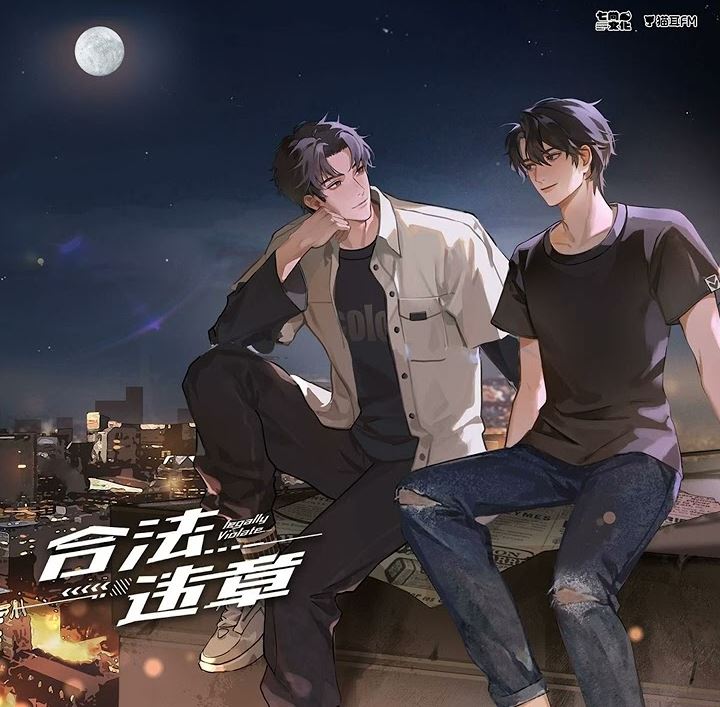
... Read More
Okay the whole motorcycle scene is dripping with meaning and I can't unsee it. Feng Lu Lin refusing to wear a helmet while making Feng Tang wear one? That's not carelessness, that's a philosophy. This is someone who accepts risk as part of living. The reflection vest, the baton, the uniform—all of it signals duty and visible responsibility. But underneath that is a man who survived being beaten up in military school and chose to fight back rather than lie in a hospital bed. The entire passage reads like an extended metaphor about control. Who controls the bike? Who holds on? Who decides when to slow down and who decides to speed up? And then there's the imagery of the city moat with brighter lights—usually moats represent boundaries, barriers, things keeping you trapped. But here the moat becomes the path they're riding along, the lights are brighter than ever. The contrast between Feng Tang's world of inherited privilege and Feng Lu Lin's world of earned survival keeps echoing. Feng Tang admits he envied nouveau riche people who could buy cars with full payment and live freely. Meanwhile Feng Lu Lin has nothing but his own hands and a conscience. The story isn't really about a motorcycle ride. It's about two different kinds of freedom colliding at 3am.
... Read More
The dialogue in these chapters is absolutely addictive. Feng Tang and Feng Lulin's text exchanges read like a combat sport and I am here for it. Feng Lulin: "To grab you." Feng Tang: "Do your head!" Two lines. That's an entire conversation and it contains so much. Feng Tang's quick, witty deflection — he can't handle directness so he turns it into a joke. And Feng Lulin just keeps pushing, calm and persistent, until Feng Tang is the one backing away. Then there's the voice message where Feng Tang says he'd invest millions in an adult film just to watch himself. That's such a Feng Tang thing to say — narcissistic, flamboyant, but also almost sad underneath it. He's so proud of his body that he wants to monetize it, but he also admits he'd never actually show it to anyone else. Only Feng Lulin gets the private version. The narrative voice is equally distinctive. It has this sardonic edge when it's focused on Feng Tang — observations about his mother Liu Lizhu's "encouraging" educational method, the humor in how she praised his stick figure drawings as masterpieces — and then it softens considerably when it shifts into Feng Lulin's perspective. The narrator knows Feng Tang's internal world fluently but gives us only glimpses of Feng Lulin's thoughts, which makes those glimpses feel earned. Lanzhou's character also has a wonderful voice through the group chat interactions. His dry "it's an advertisement" private message to Feng Tang, the way he quietly reports illegal fundraising — this is a man who exists primarily to be exasperated by his friends and it's glorious.

Leave a comment

You must be logged in to leave comments. or
