A Cruel Game - Reviews

A Cruel Game
+Add to Custom List
Sort
Add review
... Read More
Okay so let me just... breathe for a second. The plot moves in TWO completely different directions here and I am NOT okay. On one hand, you have this insane confrontation between Gayu and Hye-ryeong where Hye-ryeong drops these revelations like bombs. Jeha paid an enormous fortune for Gayu's life. He threw away everything he didn't want—the merchant guild inheritance, his whole plan—to save ONE woman. And Hye-ryeong knew this the whole time. She says it so calmly too: "No man would participate in a plan that could bring ruin upon an entire family merely because he was curious about a woman." That line hit me so hard. It reframes everything we thought we knew about Jeha's motivations. And then Gayu's response—oh god. When Hye-ryeong offers to free her, to restore her status, Gayu basically laughs in her face. "His money, his heart, and even his body." She doesn't want freedom. She wants THIS. The moment where one man looks at her like she's the only person in the world. Even if it ends tomorrow. But then—the CUT. Right when we're done with that emotional wreck of a scene, we follow Jeha to DAEJU. A buried corpse. A woman named Jin Gahee. Not THE Jin Gahee. Another one. And this middle-aged woman at the end who looks FAMILIAR. My brain is STILL trying to process what this means. Is this a twin? A sister? A fake? Who is she and WHY was she buried a month ago? The author plays with dramatic irony like a god here. We know Gayu is alive. Jeha does not. He's staring at a dead woman who shares her name and we can't scream at the page fast enough.
... Read More
I need to talk about this scene where Gayu is staring at her reflection in the bronze mirror. The author really understood assignment here. You have all these layers of literal and figurative masking—the white powder on her face, the crimson blusher described as resembling fresh blood, the veil that's about to be placed over her eyes. She looks like a doll. A beautiful, bloodless doll. And the prose makes you feel every cold brush of powder, every tight tug on her hair, every meaningless gesture performed on her body while she watches herself become a stranger. The pleasure house itself is rendered so vividly. The opening scene with all those competing courtesans gossiping through the doorway, their envy and admiration drifting in like incense smoke. The rich scent of perfume that Yeon-hwa brings with her. The lingering musk in the chamber where Gayu is left alone on that crimson bed. Even the sound design is there—the click of the door closing, the rustle of fabric, the steady breathing of the man standing in darkness just feet away. What really sold me though was the visual of that thin veil seeping soft lamplight through it, how it reminded her of moonlight. The author keeps tying light imagery to Gayu's emotional state—pale powder, crimson lips, the blurred glow behind fabric. It's like the whole world has been drained of color except for these sharp, painful highlights, and Gayu is moving through it blind. The sensory details don't just decorate the scenes, they carry the emotional weight. I could literally smell that room.
... Read More
"I want to see her." Those three words from Jeha destroyed me. Not because they're dramatic — but because they're so quiet, so honest, and come from a man who had just learned that every single thing he thought he knew about the woman he was with was a lie. Let's talk about THAT scene where he grabs her throat. Yes, it's violent. Yes, it's frightening. But read closely — the text says what filled his distorted eyes was NOT anger. It was SORROW. Pain. Despair. The eyes of a man who had discovered a truth he should never have known. And Gayu's response? She doesn't resist. She just... looks at him. She struggles to smile because she WANTED to look beautiful for him. She cries because she's been holding this secret alone and now the man she loves is looking at her like a stranger. "Who are you?!" he screams. And the answer, I'm sure, is something like: I'm the one who embroidered a black dragon for you because I wanted to do something ordinary for the man I love. I'm the one who stayed up nights unable to sleep because you were gone. I'm Gayu, not Gahee, and I've been living a lie since the day I was born. But what about the flashback? That's where my heart actually broke. The real Gahee — frail, confined, reading books she'd finished — looking at Gayu through the window and seeing her scrubbing in the sunlight. "Beautiful enough to inspire jealousy. Beautiful enough to draw a sigh of envy." And yet Gahee never envied her sister. She KNEW how precious a healthy body was. Gayu offering to go to the bookstore in disguise. That playful smile. "Just like when we were children." They were sisters who cared for each other before the world turned them into pawns. Before Gayu had to sacrifice herself to save the man she loved. Before the real Gahee collapsed from grief and never woke up. The mother's confession practically gutted me too. "She only begged him to spare that man's life." Gayu agreeing to become queen — to live a "hellish life" — not for power, not for duty, but because her father threatened to kill the person she loved. That is devastating. That is the kind of love that makes you question whether anything in this world is fair.
... Read More
The silk tassel. The branded skin. The cat. Three symbols that I think carry the entire thematic weight of these chapters. The tassel is the most obviously romantic symbol—something beautiful, intricately knotted, cut from Jeha's own person (literally from his waist), offered without a word of explanation. But it's also fragile. It's decorative. It's something you CARRY but not something you WEAR. Juju says "whenever you start wondering whether everything was a dream, just look at this." So it functions as proof of reality—tangible evidence that he was there. But proof for whom? Gayu needs to believe it was real. Jeha needs to leave something behind without having to SAY anything. The tassel is the only language they share. The brand mark operates on a completely different symbolic level. "Government Slave"—two characters burned into flesh. It's permanent, painful, and public (even if only Jeha sees it). But what's haunting is that it represents SYSTEMIC violence rather than personal violence. Jeha didn't brand her. The STATE did. And yet he feels responsible. Why? Maybe because as the richest, most powerful man in the capital, his silence IS complicity. Maybe because he benefits from a system that reduces human beings to marked property. The brand is the story's way of saying: you cannot separate the political from the personal when love enters a room like this. And the cat—"don't encourage stray cats." I'm not sure this is accidental symbolism. A stray cat seeks warmth but belongs to no one. It comes and goes. Feeding it creates dependence without guarantee of return. Gayu watches it leave and then looks at the sky, thinking about HOW LONG it's been since he last came. The cat is her own position reflected—peripheral, unwanted by the world but seeking something to anchor to, and warned not to hope too much.
... Read More
Can we just take a moment to appreciate how well-written the antagonists are in this opening? Yeon-hwa's dialogue is genuinely unsettling because it's so polite. She's smiling the entire time, her tone is almost playful, and yet every single thing she says is designed to cut. "Surely you're not planning to ask the Master of Garyong to take your hairpin tonight?" That's not even an accusation—that's worse. That's mockery wrapped in concern, the kind of thing someone says when they've already decided you're worthless and want everyone else to agree. And the head mistress! "You live as a dog does, obeying whatever its master commands." There's this incredible cruelty in how calm she is while saying it. She's not even angry. She's just stating facts, like she's giving Gayu useful advice. The line "If we were ordered to cover not your eyes but your very airways, we would do that as well" is something I need to process because it's so coldly logical. But the most interesting dialogue work is in the unspoken stuff. When Gayu says "I won't die" and Yeon-hwa responds with actual incomprehension—"Why do you want to live that badly?" It reveals everything about how disconnected these women are from each other. Yeon-hwa genuinely cannot understand survival instinct when you've already lost everything. That's a whole philosophical gap between them in one line. The male lead's dialogue is sparse but devastating. "Take it off." "You'd better hurry. I don't have much patience." He's playing a role, and the tragedy is that Gayu's role-playing with him internally—remembering the cruel words she intended to use—while he's literally speaking them to her now. The dialogue does double duty here: it's characterization AND foreshadowing at the same time.
... Read More
There is SO much going on underneath this scene that most readers will miss if they're not paying attention. Let me break it down. The BITING. This happens THREE times in the scene and each time means something different. First, HE bites HER neck — marking her, claiming her like a predator. This is about power and ownership. Second, she bites HER OWN lip till it bleeds — this is about restraint, about trying to hold onto dignity when everything is being stripped away. Third, HE bites her LIPS during the kiss — this is... complicated. Is it aggression? Passion? A desperate need to taste her, to confirm she's real? I think it's all three. The SCARS. When Gayu traces his jaw and feels "a rough texture" — this is THE most important detail in the entire scene. Why does Wi Jeha have scars? What happened to him? The author deliberately places this moment RIGHT BEFORE he asks "Are you curious about me?" It's like his body is telling a story that his mouth won't. Those scars are physical proof that he has suffered too — that he is not just a cold predator but someone who has been BROKEN. The EYE CLOTH. This is such a brilliant symbolic device. She can't SEE him during the intimate part, which means she's experiencing him purely through touch and sound and instinct. When he finally unties it and she sees his face — "the smile she knew all too well" — that's the moment the abstract becomes REAL. The voice she longed for, the face she remembers. Symbolically, this is about TRUTH vs ILLUSION. She fell in love with a voice and an idea. Now she has to deal with the real man, scars and all. And the HEARTBEAT. Thump. Thump. Thump. It appears again and again like a drumbeat. His controlled exterior vs his racing heart — that's the central metaphor of the entire scene. He says he's cold and merciless but his BODY tells a different story. The heartbeat is the truth his mouth won't speak.
... Read More
Okay so let me just say — the power dynamic in this scene is INSANE and I cannot stop thinking about it. Gayu is literally tied down, stripped of everything, and Wi Jeha is treating her like prey. But here is the thing that got me: his HEARTBEAT. The author keeps coming back to it — thump, thump, thump — this massive controlled predator whose body is betraying him. He says all these cruel things, calls her lowly, mocks her situation, but his fingers are trembling, his breath is ragged, and he literally cannot look away from her. I keep going back to this line: "Are you curious about me?" — and then she asks WHY and he says "Because you think I'm Wi Jeha?" and KISSES her. That is not the move of a man who hates her. That is the move of a man who has been starving for years and finally found food. And Gayu! She starts off terrified, biting her lip till it bleeds, trying to resist. But then — watch this — she starts TOUCHING him. Her fingers trace his jaw, his chest, and when she finds that rough texture (scars?!), she doesn't pull away. She LEANS in. And when he asks if she's curious, she wants to say yes so badly she can barely breathe. The relationship here is NOT simple revenge or simple obsession. It's two people who have both been hurting for years, and this brutal encounter is somehow the only honest thing either of them has felt in a long time. When he finally says "I'm going to hold you like this. Every single day. Whenever I want." — that's not a threat. That's a vow. And she doesn't run. She just... arches like a bow and lets him hold her. God, I need the next chapter NOW.
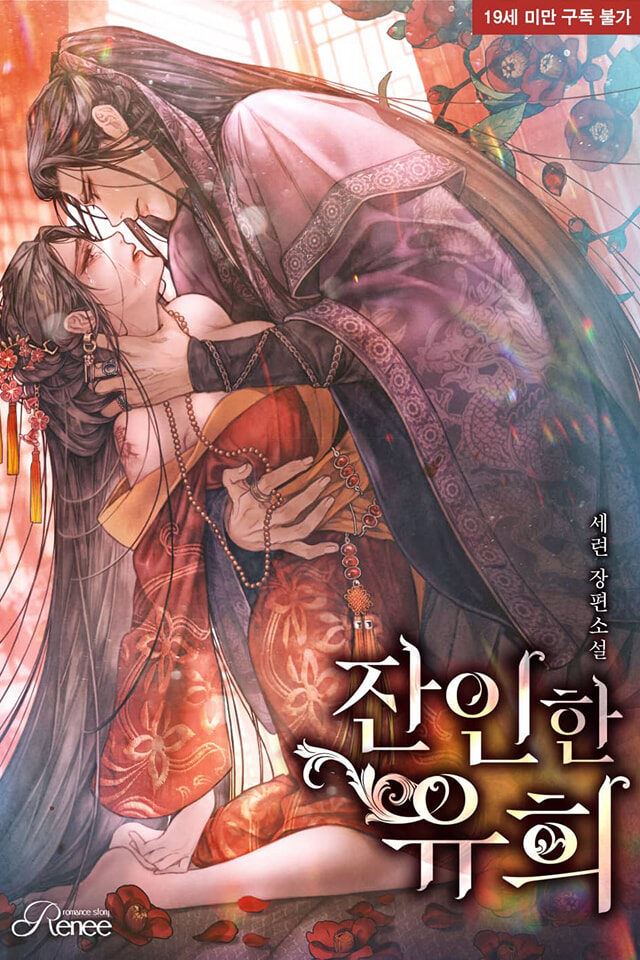
... Read More
I need to talk about the name thing because it's been rattling around in my brain since I finished reading. The girl who followed Gayu around—the loyal one, the kind one, the one who deserved better—she was named Gahee. And now Gayu has to BECOME Jin Gahee. Her father called her that name the first time he properly addressed her, and it was the name of his dying daughter, not hers. So her entire identity has been stolen before she even steps into this room. The veil is another symbol that got me. Covering her eyes so she can't see the man who bought her—it's about power, yes, but it's also about what happens when you're forced to exist without being able to witness your own humiliation. She has to feel everything without the relief of visual confirmation. Is he really who I think he is? Can I trust my memory or has everything been stripped from me already? And the blood-red lips against white powder—the whole aesthetic of this pleasure house seems built on the erasure of natural identity. They're painting her into something she's not, dressing her as a courtesan when she was born to be queen. The crimson bed, the musk, the dragonfly-wing-thin fabric—all of it is about constructing a false version of her while the real her watches from behind these blindfolded eyes. What fascinates me most is the recurring question of who pays. The head mistress says it explicitly: "Why? Because we've been paid." Money as the ultimate arbiter of human worth. Gayu was supposed to belong to a king, and now she belongs to the highest bidder. But then the highest bidder turns out to be someone from her past, and suddenly the whole economy of power shifts in ways neither of them expected. The theme of transactional relationships versus genuine human connection is going to be HUGE in this story.
... Read More
There's something absolutely haunting about how this bookshop is described. Let me just start with the entrance — Gayu walks through what she thinks is the front door but it's actually the back employee entrance, all narrow and dim, and only later does she discover the REAL entrance, grand and open with a proper sign. That detail alone tells you everything about this place. It's not supposed to be found easily. It hides from people who aren't meant to find it. "The further she walked into the shadows, the more she could smell the rich scent of paper and ink. It was as if the scent itself was answering her question — this was indeed a bookshop." This line. This single line. The author turns a smell into an answer, into a form of communication. The bookshop isn't just a setting — it's ALIVE. It responds to her presence. And the lighting! Everything inside is dim, shadowy, until the lamp appears beside her desk as if placed there intentionally while she was too absorbed to notice. Was it really placed there? Or did she just stop paying attention? The boundary between the ordinary and the slightly-off is maintained so delicately throughout these chapters. Even the final image — her walking home under moonlight while a large shadow follows unseen behind her — feels like a painting. Every scene in this sequence could be a frame from an art house film. I kept rereading passages just to sit inside them a little longer.
... Read More
The stakes in these chapters keep escalating even though nothing outwardly "big" happens. No battles. No dramatic confrontations with third parties. Just two people in a room, and the air between them thick enough to cut. Let's talk about what's actually at stake here. For Gayu: she has survived by making herself small, by accepting her position as government slave and pleasure house worker with whatever dignity she can salvage. Jeha's visits are dangerous because they give her something to WANT. Desire is vulnerability. Vulnerability is death in her world—if he decides he's done with her, if his attention shifts elsewhere, she loses the one thing that made captivity bearable. That's why she tries to TEAR the longing out of her heart. Self-preservation. For Jeha, the stakes are equally terrifying but inverted. He has power—wealth, status, absolute authority over the merchant guild. But with Gayu, that power means NOTHING. She doesn't owe him anything. She can look away. She can fear him. She can be grateful and then still not want him. His entire identity as a dominant force collapses in her presence, and that collapse is what the wine, the cruelty, the forceful kissing are ALL ABOUT. He's trying to reassert control because the alternative—admitting that he came back because he couldn't stay away, that her trembling body undid him, that he has NO power over his own feelings—is unbearable. The moment that highest tension occurs is when he grabs her chin and says "I told you not to look away from me again." Look away? From WHAT? From the fact that he's hurting? From the fact that he cares? Or from himself? Because I swear that line operates on at least three levels simultaneously. And Gayu's response—closing her eyes instead of meeting his gaze—might be the most rebellious thing she does in the entire scene. She won't give him the satisfaction of watching her watch him. She protects the last interior space he can't reach.
... Read More
The STAKES in this scene are absolutely terrifying and I need to talk about why. On the surface, Gayu is in immediate physical danger. A powerful man has overpowered her, she's restrained, half-naked, and he is explicit about his intent. But the REAL stakes go so much deeper. Let's start with what she STANDS TO LOSE. She was SUPPOSED to become queen today. The old king's wedding. Her family's honor. Her position. Her future. And instead, she's being sold — "handed over to the man you consider beneath you." The humiliation is absolute. If she resists too hard, he's made it clear he won't stop. If she submits, she loses everything she worked for. There is literally no winning move. But here's what makes the conflict SO much more interesting: WI JEHa's internal conflict. He's fighting himself the ENTIRE time. He says cruel things — "you think I'm beneath you?" "your very existence has become lowly?" — but his body betrays him. He trembles. He curses under his breath. He fights the desire that's consuming him. The conflict isn't just Gayu vs Jeha — it's JEHa vs HIMSELF. And the suspense! The author keeps asking questions we NEED answers to. WHY was she supposed to marry the old king? WHAT happened to give him those scars? WHY does he hate her so much but can't stay away? HOW did she end up in the merchant guild's possession? Every line raises new questions while answering old ones. The moment that absolutely destroyed me: "On the very day you were supposed to become queen, that precious body is being sold for money." THAT is the stake. She had everything — power, status, a kingdom — and now she has NOTHING. And he KNOWS it. He's using that knowledge like a weapon. But is he really enjoying it? Or is he punishing her because she once rejected HIM? I am emotionally BRUISED and I need resolution immediately.
... Read More
The atmosphere in this whole sequence is just *chef's kiss*. Let me paint it for you: Gayu is on a bed, probably in some kind of merchant guild residence or fancy room, and the lighting goes from dim to BRIGHT when he unties the cloth over her eyes. That moment — "Light flooded her vision with almost painful intensity" — I felt that in my actual eyes. It was like the scene itself was forcing her (and me) to really SEE him for the first time. The clothing details are doing SO much work here. He's wearing "pristine silk robes" — untouched, immaculate, controlled. She's barely covered, her garments being slowly removed. The contrast between his expensive, controlled appearance and her vulnerability is visceral. And then HE starts taking his clothes off too, one by one, and her face flushes deeper each time. The author makes you feel every layer that comes off. But the WORLDBUILDING is what really got me. Did you catch this? "On the very day you were supposed to become queen." SHE WAS SUPPOSED TO MARRY THE OLD KING. Today was her coronation day. She was going to be QUEEN. Instead, she's being sold to the merchant guild master. The world here has arranged marriages, merchant guilds that can buy people, a royal wedding happening on the same day — this is a society where women's bodies are currency and power decides everything. And the room itself — the bed, the silk, the way light hits his crimson-lit eyes... it's sensual but claustrophobic. You can't escape. The door is closed. There is nowhere to go. The entire scene takes place in this one room and it feels like a pressure cooker. Every surface, every texture, every drop of sweat and tear is described with this almost painful intensity. I felt trapped in that room with them.

Leave a comment

You must be logged in to leave comments. or
