Your Fangs Are Perfect for Biting My Glands - Reviews

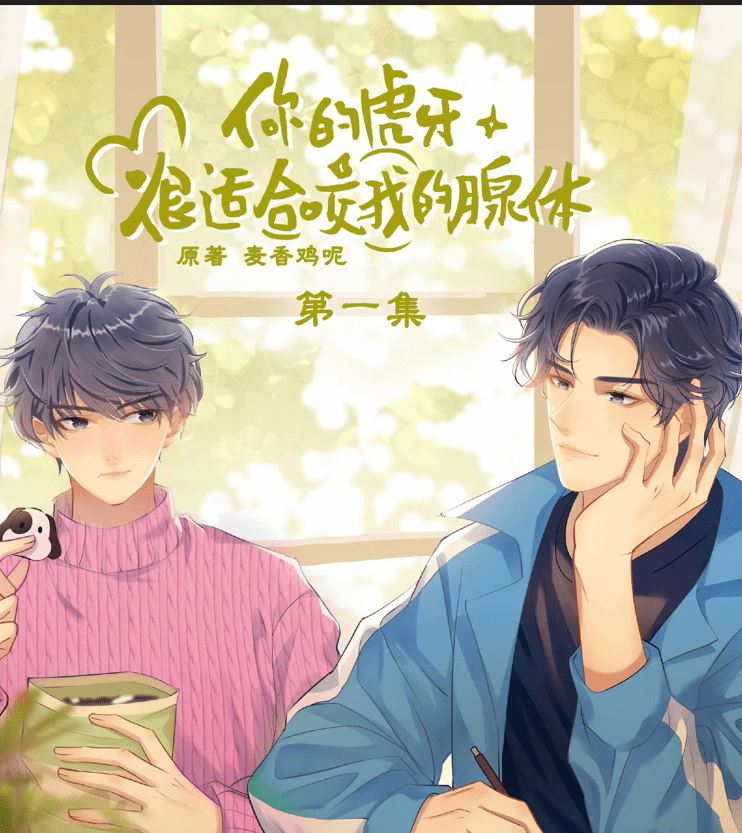
Your Fangs Are Perfect for Biting My Glands
+Add to Custom List
Sort
Add review
... Read More
This book has somehow managed to make drying someone's hair the most intensely romantic moment and I am not okay. So here's what happens: Zhou Zhou comes out of the shower, fresh and clean, with wet hair and that "suspicious sense of excitement" the narrator mentions. He's been holding onto this fantasy—mentioned earlier in the text—of sitting on Cheng Che's lap. And Cheng Che... Cheng Che just KNOWS. He turns around, sees Zhou Zhou hovering there, and without missing a beat, pulls him between his legs. Then offers to dry his hair. Then pats his own lap and says "Come and sit here." The text describes it as "such a telepathic moment" and I SCREAMED. Because this is the thing about these two—they've been building toward this intimacy slowly, carefully, and now it's just... happening in an ordinary apartment with a hairdryer on the coffee table. No grand confession. No dramatic music. Just Cheng Che pressing Zhou Zhou down onto his lap with a "firm touch" and Zhou Zhou clinging to his shoulders, feeling bewildered and caught off guard. What gets me is the power dynamic shift too. Zhou Zhou starts off wanting to initiate, but then Cheng Che takes over completely. And instead of resisting, Zhou Zhou gets shy. He tries to back out with "I can do it myself" but Cheng Che doesn't let him. The vulnerability in that moment—Zhou Zhou letting himself be held, Cheng Che showing he wants to take care of him in the most mundane way possible—it's devastatingly sweet. I swear I felt my chest tighten. Also can we talk about how Cheng Che deliberately took the day off just to walk Zhou Zhou home and then come back to his place? He knew exactly what he was doing when he said "I want to take a shower too" even though he only got a tiny bit of soup on him. Manipulative in the best way possible.
... Read More
Okay so I need to talk about how the author paced this entire chapter because WOW. The scene starts with Zhou Zhou being all closed off and resistant, right? He's pushing Cheng Che away, saying go home, don't ask me anything. And the pacing here is slow, deliberate, almost suffocating. You can feel the tension building with every line. Then BAM—Cheng Che pins him against the wall and kisses him. The transition is so sudden it just hits you like a truck. It's not drawn out or dragged; the author knows exactly when to strike. What I love most is how the chapter ends though. Cheng Che pretends to leave, says "Alright, I'll go then," and Zhou Zhou is sitting there crying like—wait, WHAT? But then he comes back with water. And this playful teasing where he moves the glass away from him? This is such a deliberate pacing choice. The chapter doesn't end on a heavy dramatic note, it ends on this almost flirty, charged moment. The author is keeping us hooked without feeling like we just got dangled off a cliff. It's more like... a really good cliffhanger that also makes you smile, you know?
... Read More
Okay so I just had to talk about this because honestly the plot engine of this entire novel IS Cheng Che knowing Zhou Zhou is an omega. Like, from page one of these chapters, everything is reframed by this single piece of information. It's not just a twist—it's the lens through which we see every interaction between them. Every time Zhou Zhou insists he's an alpha, every time he deflects the couple card at the dessert shop saying 'we're just friends,' it's heartbreaking BECAUSE we know what Cheng Che knows. The plot does something really smart here—it takes what could've been a simple 'omega incognito in alpha school' premise and makes it about power, secrecy, and the agonizing gap between what one person knows and what the other is forced to pretend. Cheng Che deliberately doesn't push Zhou Zhou to confess, even though he has every reason to. He waits. He endures his own hunger, puts on that isolation bracelet, literally walks away. Why? Because he wants Zhou Zhou to choose to tell him, on his own terms. "However, his father believes he'll definitely be an alpha in the future. So he arranged for him to go to your school," his uncle said. This line hits different when you understand the full context. Zhou Zhou's dad sent him to this school expecting an alpha son, and now Zhou Zhou is living a daily lie. The plot keeps circling back to this question: when does the mask come off? And the tension is killing me because we BOTH know it's coming—we just don't know when Zhou Zhou will be ready to say it out loud.
... Read More
"Only you that I've comforted like this," Cheng Che says. And I just... I keep coming back to this line. Because underneath all the heat and pheromones and awkward first kisses, there's something really tender about what's happening here. Zhou Zhou doesn't even know WHY he's crying so much. He's overwhelmed, his body is reacting to everything, and Cheng Che is the one person who understands how to reach him. The kiss isn't just sexual—it's a language. It's the only way Cheng Che knows how to say "I'm here, I see you, it's okay." But then the water scene changes everything symbolically. Water = comfort. Water = care. Cheng Che brings him water not with a kiss this time but with something practical and gentle. Yet he TEASES him with it instead of just handing it over. That's Cheng Che's love language right there—mixing tenderness with playfulness. He can't be soft without being a little cheeky. And Zhou Zhou's resistance? "It's meaningless..." he says about the kiss. But we know it's not meaningless. Neither of them knows what they're doing here. They're both navigating something they've never navigated before. The theme of this chapter isn't really romance or desire—it's about two people figuring out how to communicate when words fail them.
... Read More
I need to talk about the dialogue in these chapters because it's doing SO MUCH work and I'm not sure the author realizes how good they are at this. First, Zhou Zhou's internal monologue versus his external speech. When he's alone: 'What should I do, what should I do, what should I do...' - that triple repetition is pure Zhou Zhou. But the second he talks to Cheng Che it's all controlled and polite: 'What are you going to have?' The gap between those two voices IS the character. You don't need narration to tell you Zhou Zhou is nervous, his dialogue pattern tells you. Then Cheng Che's lines are almost always short, declarative, and somehow more romantic precisely BECAUSE they're short. 'You're all sweaty. Don't rub his head.' Four words of protection disguised as practical advice. 'I don't have sweat on my hands.' Deflecting affection with logic. Every Cheng Che line is a little lockpick opening a door Zhou Zhou didn't know was there. And Jin Wuqi's dialogue is in a completely different register - everything is performative and layered with double meanings. 'Only couples go on dates. So what does that make us?' That's not a question, that's a challenge wrapped in silk. 'How is it nonsense?' when Yu Yang calls his confession nonsense - Jin Wuqi refusing to accept anyone's framework but his own. The voice distinction between these three male leads is so sharp you could identify them blind. The store clerk's 'Would you two like to get a membership card? We have a couples' card promotion' line is also peak supporting character writing. One line, three emotional shocks delivered to Zhou Zhou simultaneously.
... Read More
I need to talk about the symbolism in this chapter because it's denser than you'd expect from a surface-level campus romance. The first symbol is the tie. I keep coming back to this but it deserves its own section. A tie is something you wear around your neck. It constrains. It binds. And this particular tie has their initials embroidered on the BACK—meaning Cheng Che wears it against his skin, closest to his body, but no one else can see it. It's a secret bond. A private marking. In a world where omegas can be physically marked, the tie becomes a metaphorical equivalent—something chosen, something given freely, something that signals ownership to those who know how to look. Wen Ran even says it almost explicitly: "But the discerning eye can tell at a glance that you're an omega who has already been 'marked'." The word is in quotation marks, which means the author is asking us to consider: what counts as a mark? Is it the biological one? Or is it the embroidered initials on a tie? Then there's the imagery of heat and cold running through the entire chapter. Scorching sun. Umbrella for shade. Minty sake pheromones providing cooling relief. Zhou Zhou literally moving toward Cheng Che for temperature regulation. Heat and cold as metaphor for emotional states—the burn of separation, the relief of proximity. It's not subtle but it's effective. And the deepest symbol, I think, is height. Cheng Che on stage, elevated. Zhou Zhou at the back of the line, looking up. "The most beautiful flower on the high peak." But then Cheng Che admits he was straining to SEE him, that his eyes never left him. The person on top is actually looking down. The person below is actually being watched. Roles invert. Power shifts. Nothing is where it appears to be.
... Read More
Let me just be clear about what's on the line here because the author is making it very obvious. This isn't just "will they or won't they" anymore. This is survival stakes wrapped in emotional devastation. Zhou Zhou's heat is his first real one since differentiation—he's literally learning how to survive his own body—and he's doing it alone while the person who promised to be there is somewhere else being intimate with someone else. The external conflict is brutal enough: a beta antagonist (Su Han) who has history of harming Zhou Zhou, who now holds the phone, who says "Cheng Che is busy right now and can't attend to you" with this sickening amusement. But the internal conflict is worse. Zhou Zhou already didn't tell Cheng Che about the heat. He tried to handle it himself. That pattern—self-isolation, protecting others at his own expense, assuming he'll be abandoned anyway—is the real wound. And Cheng Che? He's playing the perfect grandson at a family banquet while texting his partner sweet nothings, completely blind to what's happening at home. The dramatic irony is suffocating. We know. We've always known. And we're screaming at the page.
... Read More
The dialogue in these chapters is so distinctly voiced it's almost funny. Zhou Zhou has this specific rhythm—short bursts, muttering to himself, switching from angry to soft in three seconds flat. Listen to how he talks on the walk home: "Damn it," Zhou Zhou, holding his school uniform jacket with a white shirt inside stained with vegetable soup, mutters in frustration. "What's wrong with him? He spills soup on me right away. If it weren't for my good manners, I'd definitely splash the soup back. I didn't even get a chance to take a sip of the cola!" That's not just dialogue. That's a personality. You can HEAR this guy. He's complaining about the soup incident but really he's venting about something deeper, and the fact that he chooses to focus on the trivial detail (not even getting to drink his cola!) is so relatable and human. It's the kind of thing people actually say when they're upset but don't want to seem dramatic. And Cheng Che's lines are deliberately sparse. "There's no 'if' for that." "I'll help you dry your hair." "Come and sit here." Three words, sometimes one. The contrast between Zhou Zhou's chatter and Cheng Che's silence creates this rhythm in every scene—they fill each other out. Zhou Zhou talks to cover his nerves, Cheng Che acts to cover his feelings. Neither of them says what they actually mean directly, but the reader knows. The narration itself also has a great voice—those little aside comments like "this boy is so软 for Cheng Che it hurts to watch" or the narrator noting Zhou Zhou's "suspicious sense of excitement." It feels like having a friend narrate your story who can't resist poking fun at you. Very conversational, very warm.
... Read More
Let me just say this — the pacing in these chapters is unhinged in the best way. You open with Zhou Zhou waking up, phone empty, and you're IMMEDIATELY in his head. No warm-up, no context dump, just: no messages, feelings are bad, let's call the friend. And then the chapter spirals. It goes from 'did he like me' to 'am I being stupid' to 'he didn't even text' to 'what if I can't do this anymore' in the span of maybe eight paragraphs. And the suppressant scene — that was the gut punch. I was on the emotional rollercoaster and then BAM, injection needle, thirty-day cycle, he's doing this to himself just to stay in school and pursue a guy. That's three layers of stakes stacked on top of each other in one paragraph. Then it cuts to Yu Yang, same headache, same paralysis, and you're like oh my god these are the SAME problem. And then Monday morning, both of them looking like death, and Cheng Che ISN'T EVEN THERE. The author drops that like a brick at the end. I literally had to put the book down for five seconds. The structure here is: personal crisis → friend mirror → external consequence. It's a perfect compression triangle. Every scene pushes the emotional temperature up and the next scene doesn't let it cool down. The only breather is that awkward conversation between Zhou Zhou and Yu Yang, which barely counts because they're both too tangled to actually resolve anything.
... Read More
The worldbuilding in these chapters is what I call 'iceberg immersion' — the author isn't giving us a textbook dump of ABO mechanics, they're letting us absorb it through lived experience. When Yu Yang pops his head through the classroom window like a literal groundhog, you immediately understand this is a school setting with walls, windows, hiding spots. Then the suppressant explanation drops naturally inside dialogue — not as exposition, but as negotiation between siblings trying to solve a practical problem. That's how you do it. The Alpha Training Center versus Omega Training Center divide tells us everything about the social hierarchy without a single infodump. 'They didn't even let you stay in the Beta class' — one line and we understand the rigid caste system. Zhou Zhou's description of themselves as having 'the stance like that of a young tiger' when they swung a chair at someone who mocked them… that image. That's not just characterization, that's worldbuilding through physical presence. The school environment feels lived-in because the rules of this world are baked into every interaction. When Zhou Zhou thinks about what would happen if the school found out, you feel the institutional weight pressing down. Every setting detail reinforces the central tension: in this world, your biology determines your fate, and Zhou Zhou is holding onto an identity that might not match either.
... Read More
I need to talk about how this chapter makes the stakes feel real without any actual dramatic conflict happening. Here's the thing: nothing 'bad' happens in these chapters. No one discovers them. No one threatens them. Cheng Che feeds Zhou Zhou grapes and Zhou Zhou does homework and they share a bed. But the entire time, there's this underlying tension because the reader KNOWS what's at stake. The school rules are explicit: no concealing second gender, no romantic relationships. Violate them and what happens? The text never spells it out directly, but the threat hangs over every scene like a guillotine. When Cheng Che flicks water droplets on Zhou Zhou's neck while he's studying, it's playful—but that neck has a healing wound, an exposed gland, a place where a single bite could change everything. If a teacher walked in right now, if anyone found out, Zhou Zhou's marked status would be undeniable. His 'little strawberries' would be evidence. The pheromone blend would give them away instantly. And Cheng Che seems almost careless about it. 'Last night, my hands were wet like this too,' he whispers against Zhou Zhou's ear while peeling grapes. He's flaunting it. Not recklessly—he's not leaving proof everywhere—but with a confidence that suggests he's willing to risk discovery. That's the real stakes here: not just 'will they get caught' but 'how much is Cheng Che willing to lose for this?' Zhou Zhou's internal monologue reveals his fear: 'Why bother? Every time he confronts Cheng Che, he ends up defeated. Why is it that he never seems to learn his lesson?' But is it really defeat? Or is it the exhaustion of someone who knows the rules but keeps choosing the person anyway? The conflict isn't external—it's the ongoing negotiation between self-preservation and desire. And every chapter, desire wins. That's what makes me keep reading. I'm not waiting for a dramatic climax. I'm watching two people slowly, deliberately, choose each other in a world that tells them not to.
... Read More
Let's talk about pacing for a second because this ending is a MASTERCLASS in how to slow down. The chapter opens with breakfast banter. Lazy voices. Eye-closing relaxation. Then they notice it's near sunset, consider the balcony, complain about the heat, and eventually step outside. Every beat is deliberate. Every sentence feels like the characters are moving at the speed of their own comfort level. "Oh my god, it's too hot outside. Let's just stay in the air-conditioned room." — this line made me laugh out loud because it's SO specifically Zhou Zhou. He's not ready to be poetic yet. He's being practical and petty and real. And then Cheng Che corralled him onto the balcony anyway. The transition from dialogue-heavy opening to the longer, more descriptive sunset passage is seamless. The author doesn't announce "now it's getting serious"—the prose just naturally expands as the emotional temperature rises. By the time we get to the ocean imagery and the kiss, the reader is already riding that wave. And the ending? Just a kiss. No epilogue teaser. No dangling threads. The translator's note literally says "That's the end." Sometimes a story knows when to stop. This one did.

Leave a comment

You must be logged in to leave comments. or
