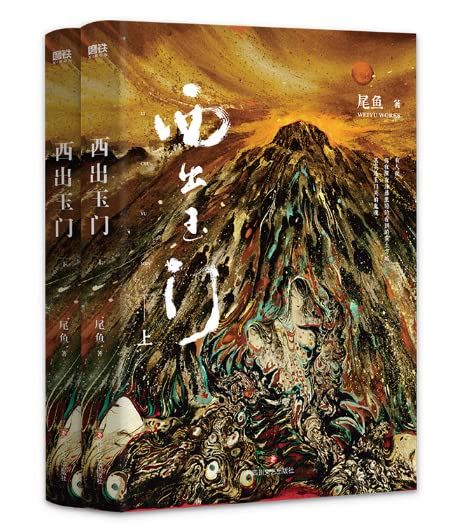
I've been thinking about this section for hours and the symbolism keeps revealing new layers. Let me try to untangle some of it.
The Shadow Puppet Coffin is the central symbol here, obviously. But what does it represent? On the surface, it's a container for the dead — nine shadow puppets in ancient clothing, silent and still. But the fact that they're shadows, not bodies, is crucial. These are images of people, not people themselves. They're representations that have been preserved, trapped in a medium between existence and memory. The painted scenes on the coffins — chained prisoners being led into the pass — suggest punishment, transition, and the threshold between worlds.
Yumen Pass itself is a historically loaded symbol. It was the actual gateway between the Chinese civilization and the wild western unknown. Soldiers marched through it. Poets wrote about it. It was the last outpost of the empire before the desert swallowed you whole. In this novel, it's become something more — a liminal space, a threshold between the living world and whatever exists on the other side. The chant 'one step out and your blood flows dry' captures this perfectly. Crossing the threshold changes you. It might even kill you.
The sand eye is perhaps the most unsettling symbol. It repairs the coffin mounds — the very structures that house the dead. The sand that shoots from it hardens, becoming part of the landscape. This suggests a cyclical process: death, preservation, erosion, repair, repeat. The eye is both guardian and maintainer, watching over something it doesn't explain. It's an image of a world that operates by its own logic, indifferent to human presence.
And then there's the concept of superimposition — the idea that Bailongdui and Yumen Pass occupy the same space at different layers, like transparent sheets. This is deeply symbolic of how memory and history overlap with the present. The past isn't gone; it's still there, waiting to be seen if you know how to look. The tire tracks that disappear and reappear beneath the mounds are proof that reality is thinner than we think.
The Peach Blossom Spring allusion ties all of this together. Tao Yuanming's story is about a hidden world that exists alongside the ordinary one, accessible only to those who stumble upon it by chance. Chang Dong is essentially saying: Yumen Pass is our Peach Blossom Spring. It's always been here. We just couldn't see it until now.
This is a story about hidden layers — in landscape, in history, in reality itself. And the act of reading it, of paying attention, becomes its own kind of passage through the pass.