Tokyo Rebirth: From Aristocratic Heiress to Global Tycoon - Reviews

Tokyo Rebirth: From Aristocratic Heiress to Global Tycoon
+Add to Custom List
Sort
Add review
... Read More
There's this one moment — just a split second — where Satsuki and Shuichi lock eyes across the table during the family council, and everything shifts. Up until that point, Shuichi has been treating his daughter like a precious but fragile thing, someone to be protected from the ruthless world of the Kazoku. But in that glance, both of them understand: the game has changed. She's not his little girl anymore. She's his partner. And the beautiful, terrifying part is that Shuichi doesn't recoil from it. The text says it explicitly: "Instead, a wave of ecstasy surged within him." He's relieved. His daughter is a lion cub, not a white rabbit. After his wife's death, he was drowning in foxes at the House of Peers and jackals at home, and now he has an ally who actually understands the game. But let's talk about Kenjiro for a second, because this is what makes the whole thing so devastating. The man is greed personified. He sees Satsuki's words as a gift from the heavens — independent operations, full control, a path to sidestepping his brother entirely. He can't see the trap because his own hunger is blocking his vision. And the moment he accepts? He ruffles Satsuki's hair and promises to buy her dresses. Irony so thick you could cut it with a knife. Meanwhile, Satsuki herself — oh man. The inner monologue at the end, "Do your best to die, dear Uncle," while she's smiling up at him like an angel? That's not just clever writing. That's a character who has completely internalized the logic of this world. She's performing innocence the way a spy performs identity. And the teddy bear? It's either a prop or a weapon. Probably both.
... Read More
The stakes in this passage are elevated so smoothly you barely notice them climbing. We start with a family in decline—once illustrious, now riddled with termites, barely maintaining appearances. The five-billion-yen loan from Sumitomo Bank is introduced almost casually, as if this is normal business. But then the father's inner monologue reveals what's actually on the line: the House of Saionji, a hundred-year dynasty, potentially bankrupt within a year if the exchange rate shifts. "If the yen appreciated from 250 to 200, or even 150… The Saionji factories had a profit margin of less than 10%." The math is brutal and specific. This isn't vague drama—the author has done the actual economics homework, which makes the threat feel real. A 10% currency swing equals bankruptcy. A 30% swing means they lose money on every single transaction. That's not a risk, that's a death sentence. And the conflict isn't just external. Shuichi is wrestling with his own guilt—his daughter's terrified eyes at the funeral, her innocent remark about the dam, stuck in his mind like a thorn. The external financial crisis mirrors an internal crisis of fatherhood and responsibility. He's failing his family either way: expand and risk ruin, or don't expand and watch the family slowly wither. Then Satsuki enters with the dam theory and reframes the entire conflict. The real enemy isn't bad economics—it's the Americans. The dollar is a weapon, Volcker is the antagonist, and the Saionji family are villagers downstream from a dam they didn't build but must now navigate. The stakes just exploded from "should we take this loan?" to "how do we survive a financial war we didn't choose?" The Kenjiro confrontation in the annex promises to escalate further—half a dozen men in formal dress, smoke-filled air, the word 'madness' shouted across a rosewood table. The stakes are compounding, and I am here for it.
... Read More
"The amber glow of the desk lamp struck Shuichi's face, carving the wrinkles at the corners of his eyes into patterns resembling a dried riverbed." I keep coming back to this image of a father under amber light, exhausted, carrying the weight of a century-old house on his shoulders. And then his daughter walks in with her unevenly sliced cake and warm milk, and something in me just… crumbles. Because we know what we know about Satsuki. We know she didn't bake that cake. We know she crafted the whole performance—flour scattered on purpose, slices butchered to look authentic. Every gesture, every word calculated. And yet. And yet when Shuichi eats it and says it's the most delicious thing he's ever tasted, I believe him. Not because the cake is good—it's "slightly dry and far too sweet"—but because he's eating his daughter's love. The calculation behind it doesn't invalidate the emotion on his side. That's the tragedy of this scene, isn't it? He's being manipulated, yes, but his love for her is real, and his gratitude is real, and his tears are real. The authenticity belongs entirely to him. The milk spill—when he knocks over the glass and the white liquid floods across that crimson carpet like some kind of blood replacement—that's the moment the abstract becomes visceral. Shuichi's entire world shifts in that instant, and Satsuki reacts like a frightened animal. "Did I… misread it?" Her voice drops to this tiny, vulnerable register. For one heartbeat, the mask slips. Not because she's caught—she'd never be caught—but because she genuinely doesn't want to frighten him. There's something almost tender in that fear, even if she can't articulate why she feels it. And then the forehead wipe. The hand on his shoulder. "As long as Satsuki is with Otou-sama, Satsuki isn't afraid of anything." Is this performance, or has something real grown underneath the calculation? The text refuses to give us a clean answer, and I think that's deliberate. The most painful relationships in fiction are the ones where love and manipulation occupy the same space. That's what's happening here. I can't look away.
... Read More
The symbolic contrast between Okura Masami's Maxim's macarons and Satsuki's simple Darjeeling tea is doing SO much heavy lifting here. Masami is literally consuming imported luxury as a weapon—'These were flown in specifically from Maxim's de Paris!' she announces like a peacock. It's about conspicuous consumption, about proving that money trumps pedigree. Meanwhile Satsuki sits alone with standard school tea and a foreign-language book, projecting an image of refined self-sufficiency that's supposed to intimidate. But then Satsuki produces THAT fruit pâté for Emi—a similarly expensive item, yet used differently. Masami's macarons are about exclusion and display; Satsuki's pâté is about connection and investment. And the Radio Technology magazine, the solder smell, the red-and-white shells—these are symbols of the invisible infrastructure that actually powers the economy, hidden beneath the glittering surface of aristocratic social games. The author keeps returning to this theme: real power lives in the supply chains, not the salons. Satsuki knows this, which is why she's already thinking about stock options while everyone else is fighting over who gets to sit where at tea time.
... Read More
Can we just talk about how manipulative AND weirdly tender this whole interaction is? Satsuki handing over that expensive French fruit pâté while extracting factory secrets—she's basically buying a twelve-year-old's loyalty with candy and politeness, and honestly it works because Emi has been so starved for kindness in this cold school environment. The moment when Emi says 'Saionji-san, you're such a good person' absolutely wrecked me in the best way, because we as readers KNOW she's not being genuine. But then Satsuki tells her 'those glowing vacuum tubes are much more interesting than diamonds' and suddenly I was questioning whether there's a real kernel of respect beneath all the calculation. I kept thinking about Emi clutching that Radio Technology magazine behind her back like it's something shameful, and how Satsuki reframes it as something special. Is this friendship or exploitation? Both, apparently. That's what makes it hurt so good.
... Read More
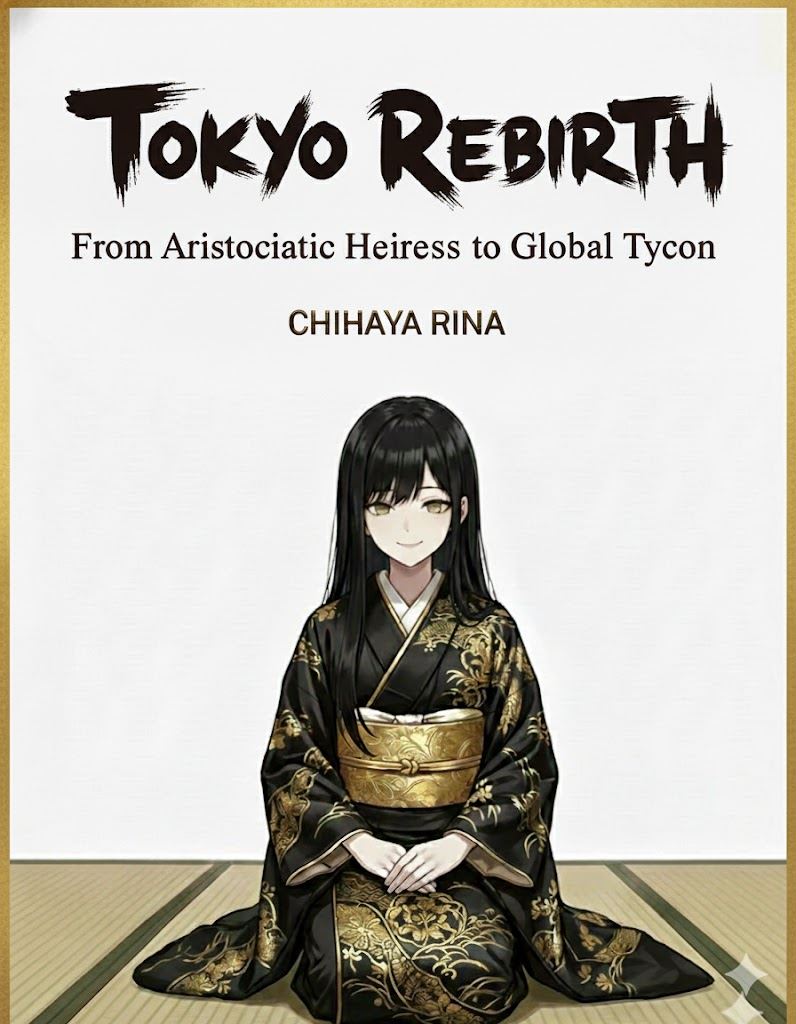
There's something happening beneath the surface of this chapter that I can't stop thinking about, and it's all wrapped up in images the writer keeps returning to like a heartbeat. The black lily. That's the key image. Satsuki is described as "a black lily blooming upon a grave—beautiful, yet lethal." Lilies are funeral flowers. Black lilies don't exist in nature—they're dyed, or painted, or imagined. They're beautiful precisely because they're wrong, because they violate the natural order the way Satsuki violates every expectation placed on a twelve-year-old grieving daughter. She is an artificial flower in a room full of real ones, and that artifice is her weapon. Then there's the mirror. Satsuki stands before a full-length mirror and evaluates herself as an asset. Not as a person—as a biological vessel. The mirror is the threshold between who she was (the Goldman Sachs executive who jumped from a Manhattan skyscraper) and who she's become (the Saionji duke's daughter born at the finish line). Every time she looks in glass in this chapter, she's seeing a version of herself that isn't quite real. The reflection shows a pale, tear-rimmed child, but the eyes behind them are ancient. "Frozen pool" is another image that haunts me. When Kenjiro catches her looking at him from Shuichi's blind spot, her fear has vanished, replaced by "a gaze that was as deep and impenetrable as a bottomless, frozen pool." Water that has lost its ability to move. A pool so cold it has stopped reflecting anything. This is what trauma does—not just to children, but to people who have died and been reborn into bodies too young to carry what they've seen. The Plaza Accord hangs over everything like a storm front. It's the invisible third character in this chapter. Kenjiro talks about American orders and hard currency like they're guarantees. Satsuki knows they're poison. The text mentions that five months from now, yen appreciation will destroy export-dependent industries. The Saionji family's textile and machinery parts factories—these are exactly the kinds of businesses that will get crushed. And the five billion yen loan that Kenjiro wants to take out? It requires mortgaging nearly half their ancestral Osaka land. The family is about to sell its future for a dream that will evaporate the moment the dollar strengthens. But here's what the symbolism is really saying: Satsuki isn't just preventing a bad investment. She's positioning herself to profit from the collapse. When she traces "Short" on the window, she's not thinking like a noble daughter protecting her family's heritage. She's thinking like the woman who once watched candlesticks on a Goldman Sachs monitor and knew exactly when to pull the trigger. The graveyard where she's planted her black lily isn't her mother's funeral—it's the Japanese economy itself, and she's already holding the scythe. The cold snap in April is the final image, and it's everything. Spring should be arriving. Cherry blossoms should be drifting. But the cold is stubborn, refuses to let go, and something beautiful is delayed. That's 1985 Japan on the eve of the bubble. That's Satsuki in a twelve-year-old body full of memories from a life that ended in a fall. That's an era pretending it will last forever when the cliff is already visible ahead.
... Read More
Okay, the Yoshino Ayako section gave me actual chills. Satsuki essentially walks up to a complete stranger and whispers about the Ministry of Finance investigating illegal financing and bad real estate debts—and she does it while casually pretending to stumble. The stakes she creates are MULTIPLE layers deep. For Ayako, it's her father's career and possibly his life (they literally mention figurative seppuku). For Masami, it's her family's loan access from Mitsui Bank's Shinjuku branch. And for Satsuki, she's positioning herself as the gatekeeper of information that could determine who survives the coming financial storm. The scene where Ayako grabs Satsuki's sleeve and asks 'The news you heard…is it true?' with her voice trembling—that's conflict crystallized into a single desperate gesture. The author has built a pressure cooker here: Okura Construction's land reclamation project depends on the very bank Ayako's father manages, and Satsuki just handed her the detonator. I'm not even worried about whether Satsuki will win anymore—I'm terrified of what she'll do when she does.
... Read More
Let me just be straight about the stakes here because this is where the chapter earns every ounce of its tension. Shuichi has already mortgaged rental buildings in Shinjuku, shops in Ginza, reserve land in Chiba. The ancestral home in Marunouchi is the last thing standing between him and total ruin. His brother Kenjiro tells him plainly: close the position, save half the fortune, keep the house, let your daughter live comfortably. That's not a trivial offer — that's a responsible, sane, ADULT recommendation. And the fact that Shuichi is considering it makes him human, not reckless. But then Satsuki reframes the entire question. What's left if he wins? He wanted to restore the House of Saionji. What's left if he loses? Fukagawa slums, six tatami mats, hauling crates. She's essentially telling him: you've already lost everything you can lose. The only thing keeping you from the bet is the illusion that there's something worth protecting. And that's the real conflict — not Shuichi vs. the market, not Shuichi vs. Kenjiro, but Shuichi vs. his own need for dignity. The moment he accepts that failure means nothing more than starting over with his daughter, he becomes dangerous. "Once you're at the table, there's no sense in pulling back your chips." That line isn't financial advice. It's a philosophy of total commitment. The market scene at the end raises the stakes even higher — other traders are going LONG on the dollar, confident, comfortable, yawningly sure. And Shuichi is about to smash all of that. The collision is inevitable. The question is just how loud it's going to sound.
... Read More
Okay, so let me just say — the way this whole scene is engineered is absolutely masterful. On the surface, it looks like a family squabble over expanding a factory. Kenjiro wants to go all-in, Shuichi is hesitating, the elders are pecking at both of them. Classic deadlock setup. But the whole time, you're waiting for the pivot, and it comes from the most unexpected source: a twelve-year-old girl clutching a teddy bear. Satsuki's proposal — let Kenjiro run the factory independently with Dad just as guarantor — sounds like a child's innocent compromise. Everyone in the room sees it that way. Even the reader might do, at first glance. But then the narrative quietly pulls back the curtain, and you realize: this was a surgical strike disguised as childhood naivety. The factory is a ticking bomb (inventory backlog, rising costs, risky export contracts), and Satsuki literally fed her uncle the idea that he'd won while she was burying him in debt. And then — plot twist within a twist — once they're alone, Shuichi isn't angry or horrified. He's ECSTATIC. His daughter didn't just survive this viper's nest; she outmaneuvered every snake in it. The scene then transitions from domestic intrigue to geopolitical thriller as Satsuki reveals her real plan: short the dollar. What started as a family power struggle becomes a financial war declaration. The narrative arc in these chapters is tightening like a boa constrictor. Every reveal builds on the last, and I was literally leaning forward reading it.
... Read More
Can we talk about how Satsuki's dialogue is basically a masterclass in controlled performance? "Satsuki doesn't really understand, but as long as Satsuki can help Otou-sama, Satsuki is happy." The third-person self-reference—what the notes call burikko—is deployed with surgical precision. She switches to this cutesy, infantilized speech pattern at exactly the moments when she needs Shuichi's guard down. When she's delivering the dam metaphor, she frames it as a confused child stumbling through words. When she's offering strategic advice, she phrases it as innocent imagination: "Where do you think the money should go? Don't think too hard; say whatever comes to mind." She's directing her father's conclusions while making him think they're his own. The dialogue writes manipulation as if it were affection. And Shuichi? His voice is raw, fragmented, barely holding together. "Five billion…" The ellipsis does so much work. "I see… I see!" The repetition of his own voice catching back to him, realizing in real time what he's been missing. "This child…" The chuckle at the end, shaking his head, completely unaware that his daughter just weaponized his love against his better judgment. Kenjiro's entrance—"This is utter madness!"—slams into the scene with such violence that you can hear the teacup shatter. His dialogue is all caps energy even in print, and it contrasts perfectly with Satsuki's honeyed manipulation. One man roaring about expansion, one child whispering about dams, and the father caught between them like driftwood. The narrator's voice deserves mention too—it's observational without being clinical, emotional without being sentimental. Phrases like "A chill ran down Shuichi's spine; cold sweat instantly soaked his shirt" don't tell us how he feels, they show us the physical evidence of feeling. The prose trusts the reader to connect the dots.
... Read More
The opening scene in Akihabara is gorgeous. I'm talking full sensory immersion here. August heat, the smell of solder and chicken skewers, condensation sliding down Satsuki's fingers onto scorching asphalt that evaporates instantly. You can FEEL that humidity. And then the author pivots to September and — boom — we're right in the middle of Typhoon Mary, and suddenly the whole tone shifts. The Saionji estate study is described as having curtains drawn tight with just a narrow sliver of light, expensive hardwood furniture all clammy and cold from the moisture. It's suffocating. The contrast between these two worlds is intentional and brilliant. Akihabara is alive, hot, buzzing with potential — even the dark alleyway where Emi shows Satsuki that yellow NES shell feels electric with possibility. But the Saionji estate? It's prison-like in its luxury. Shuichi sitting in his "executioner's chair" surrounded by overflowing ashtrays and that fax machine that won't stop spitting out losses. The imagery of the fax machine is almost a character itself — Whir—clack—whir—disgorging thermal paper like it's vomiting bad news. There's one line that stuck with me: "Tokyo in September was held in the suffocating grip of Typhoon Mary, which was gathering strength over the Pacific." Not just weather description — that's the mood of the entire second half of this batch. The dollar rising like a stubborn bull, Shuichi wondering if he's insane, the family elders circling like vultures. Everything feels like it's about to break open. The worldbuilding here isn't about elaborate fantasy realms — it's about making a real historical moment feel visceral and immediate. 1985 Japan, pre-bubble peak, and you can taste the tension in every sentence.
... Read More
Okay so I need to talk about this moment because my jaw was literally on the floor. Satsuki just completely dismantled her entire family in a funeral home and the way she does it is both terrifying and absolutely brilliant. Think about it—Kenjiro is this scheming uncle who's trying to push a terrible investment through at his sister's funeral, right? Classic exploitative relative energy. And Satsuki, this twelve-year-old girl who everyone presumably sees as this fragile, grieving child… she uses HIM against himself. She walks over in her black mourning dress, pretends to be scared, and then drops this line about the American uncle talking about trade deficits like it's the most innocent thing in the world. "If America truly restricted imports or forced the yen to appreciate… then expanding the family's operations now was indeed suicidal." But she never says this. She makes her FATHER say it essentially, by making him connect the dots himself. That's the move. She doesn't confront Kenjiro directly—she lets the adults around her feel the chill themselves. The text says everyone present was shrewd, and they ALL understood the US-Japan trade friction was real. But hearing it from a grieving child who apparently overheard it at the American Embassy? That's a different kind of weapon. And then the look she gives Kenjiro when he can't find his voice. From an angle invisible to Shuichi, the fear vanishes and becomes "a gaze that was as deep and impenetrable as a bottomless, frozen pool." Frozen. Pool. These are not the words you use for a twelve-year-old girl. This is someone who has made peace with being a monster and calls it strategy. But here's what gets me—the relationship between Satsuki and her father Shuichi. She touches his arm, she trembles in his embrace, she calls him Otou-sama with this trembling voice. Is any of it fake? Fujita calls her "Asset Evaluation: Excellent" and she agrees, defining herself as a biological vessel. But then she also says she can't leave Otou-sama alone. Is that performance too, or is there something real underneath all that calculation? I keep coming back to that final moment where she traces the word "Short" on the foggy window. Her uncle wanted to build a factory. She's going to borrow that five billion yen and bet against it. She's not just defending the family—she's planning something much bigger, something that involves financial warfare on a scale that would make Goldman Sachs blush. And she's twelve. The dynamic between these two cousins-in-law—Shuichi the noble but weak head of house, and Kenjiro the ambitious branch-family upstart—is basically the entire Japanese corporate drama in miniature. Satsuki just walked in and rewired the boardroom with a tea cup and some well-placed English words.

Leave a comment

You must be logged in to leave comments. or
