Rose of the Abyss - Reviews

Rose of the Abyss
+Add to Custom List
Sort
Add review
... Read More
The stakes in this passage operate on three levels simultaneously and they're all crushing. First: Chai Yuening is literally walking into death zones, asking to borrow military vehicles she can't afford, with money she doesn't have. The external stakes are survival-level. Second: Chu Ci is an inhuman in a world that wants to dissect her, and she's actively considering whether Chai Yuening will eventually choose the 'greater good' over her. That's internal betrayal anxiety wrapped in genuine trauma. Third: Chai Yuening's own moral conflict — she's an ordinary person who can rationalize executions when they're 'for the safety of more people,' but the moment the gun is aimed at someone she cares about, her entire framework collapses. 'Even if someone tells me that the person I'm risking my life to protect might only have a one-in-ten-thousand chance of retaining their self-awareness, I don't want to give up.' This is the thesis statement of the entire novel, isn't it? The tension between utilitarian survival and stubborn, irrational love. And Chu Ci hearing this for the FIRST TIME from someone who actually means it — that's the moment everything shifts.
... Read More
Can we just pause and appreciate that Chu Ci cradles the glass of sugar water with both hands and responds like a kitten? That image has been stuck in my head since I finished reading. This girl came into their lives completely broken — no memory, no past, no identity — and the very first thing she does is try to keep up with drinking like she's desperately trying to belong. Two small cups and she's done. But she keeps going because everyone else is drinking. She's performing normalcy. She's trying so hard to be part of something. And Chai Yuening sees it. Of course she sees it. She's the kind of person who notices everything. The sugar water moment is so small and domestic and absolutely devastating because it represents the first time Chu Ci has been taken care of without having to earn it. No mission. No proof of value. Just… you're sick, here's water. The intimacy of that gesture between two people who've known each other for approximately three days is staggering. But what gut-punched me most was the ending — Chai Yuening lying on her floor pallet, half-asleep, smelling that ethereal fragrance again. She's protecting this girl who can't remember anything, and she herself is hearing phantom smells that might mean danger is closer than either of them realizes. The tenderness and the threat are braided together so tightly I can't breathe. I need to know what's happening to both of them.
... Read More
Can we talk about how Chu Ci barely speaks and somehow says the most? "Are you leaving?" — five words and an entire emotional universe cracks open. And Chai Yuening's response "I don't live here" is so brutally simple, so clinically true, and yet it lands like a punch. Chu Ci's "Mm" when she closes the door — Ren Dong literally notes that she heard loss and disappointment in that single syllable. Meanwhile the team dialogue is completely different energy. Ren Dong: "Next time you go out, you have to take everyone with you. Don't go alone again. Staying alive is more important than anything." Direct. Fierce. No decoration. Chai Yuening's reply: "There won't be a next time, I promise you." Which is either a comfort or a threat depending on how you read it — and I love that ambiguity. The author gives each character a distinct voice without making it loud or overwrought. Even the bedtime broadcast voice has personality: "Sleeping early and waking early is beneficial to your health. May you embrace sweet dreams tonight." It's institutional warmth, the state trying to sound like a mother. And Chu Ci's note — practical, caring, specific about the ham and the heating instructions — that's character revelation through writing style alone. Nobody needs to tell us this girl is thoughtful; the note proves it.
... Read More
The tension in this passage does not come from action. It comes from silence. From the space between what is said and what is meant. Chu Ci has offended someone called You Lan. We do not know who You Lan is or what happened, but we know it matters. A Floating City amnesiac, alone after crossing You Lan — life would not be easy for her. This single sentence carries enormous weight. It tells us Chu Ci is vulnerable, displaced, and possibly in danger. Chai Yuening knows this. The text says: The thought softened Chai Yuening's resolve. She could have walked away. She could have pretended not to notice the girl following her. Her conscience shouldn't ache too much. But it does ache. And that is the conflict — not whether she will take Chu Ci in (we know she will), but whether she can convince herself it is the right choice. The five minutes at the boarding area are agonizing in their slowness. Chai Yuening watches the digital clock. She tells herself everyone has their own home and life. She is not wealthy. The world overflows with people in need. And yet. When she finally asks, "Do you want to go back?" and Chu Ci answers, "Do I get to choose?" — that question destroys me. It reveals everything about Chu Ci's experience of the world. Choice is not something she expects to have. Chai Yuening's answer — "Of course" — followed by the warning that some choices aren't necessarily good ones — is surprisingly wise for someone who has not yet figured out her own path. The stakes here are not life and death (not yet). They are something quieter and perhaps more important: belonging, responsibility, the decision to let someone else into your life when you have already decided you cannot carry anyone.
... Read More
This chapter is ABOUT so many things, and the central metaphor—the isolation wall—haunts me far more than any horror scene could. On the surface, it's a physical barrier. A wall that rises from the ground to separate the Seventh District from the Ninth, to contain whatever mutation is spreading. But the author keeps reminding us that this wall was NEVER supposed to be used. "The west gate led to the Ninth District and was originally the Seventh District's safest exit, one that didn't require an isolation wall." Safest. Required. The language of infrastructure, of planning, of a world that assumed it could PREVENT this. And now the预防 has failed, and the wall is the only thing left. But the deeper theme here is what the text explicitly states: "Suddenly, human life and death seemed to have become a matter of probability, a pile of numbers." A PILE OF NUMBERS. That's the horror. Not the mutation, not the chaos, not even the wall. It's the realization that in this new world, human beings have been reduced to statistics. How many can we save? How many must we sacrifice? The wall isn't just concrete—it's the physical manifestation of utilitarian ethics, and it rises without anyone debateing whether it's right or wrong. The author doesn't moralize. There's no narrator telling us this is unjust. The wall just rises, and the people just scream, and the armored vehicles just drive away. The indifference is the point. And then there's the detail about the military producing ONLY armored vehicles, explicitly forbidding ordinary residents from purchasing them. This is a world where mobility is weaponized, where the ability to flee is restricted to those with connections. The evacuation itself becomes another layer of hierarchy—some people get in vehicles, some climb onto the exteriors, some are sealed inside with their district. "No one knew what tomorrow would bring, or where they should flee to next." That's the thematic core. The story isn't about surviving the apocalypse. It's about surviving the realization that survival is arbitrary. That the wall could have been anyone. That tomorrow might not exist for anyone.
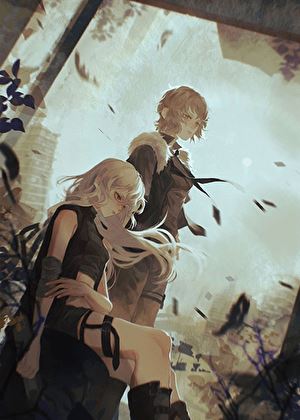
... Read More
The bathtub scene is one of the most visually arresting passages I've read in this novel. Let me paint it for you because the author really does the work here. Semi-transparent tub, water jets creating ripples, colored lights shifting from deep purple at the bottom through light purple to rose-red at the top — all of it blurred and dreamlike. And then there's this green halo floating horizontally within the blue-purple, carried by the water's motion. The narrator explicitly compares it to an aurora that most people have only seen in books. An aurora. Something so distant and unreachable that it exists only in texts for the people living in this world. And Chu Ci says the most important line of the entire passage: "Like the outside." Not the surface. Not the real sky. Just... the outside. This word carries so much weight for people who live underground or behind fog. The author then does something brilliant by having Chai Yuening reach out and touch the same glass at the same moment as Chu Ci. Two people, separate worlds of experience, touching the same barrier at the same time. Then the alarm shatters it all. I need to talk about the evacuation scene though because the contrast is violent. You go from this quiet, almost meditative color-light moment to absolute chaos — people in disheveled clothes, bumping into each other, a woman's communicator going unanswered, KTVs and bars instantly deserted leaving only neon lights and filth. The luxury of the black market street "coming to a complete end tonight" is such a specific image. You can feel the ground shaking under everyone's feet. And You Lan, the most glamorous woman in the outer districts, standing alone outside her own bar entrance, clutching a communicator that won't connect, looking like she's been "abandoned by the entire world." The worldbuilding here isn't exposition dumps, it's layered into every visual detail.
... Read More
What makes this chapter so tense isn't the external threat—it's the internal one. On the surface, the stakes are straightforward: Chai Yuening needs an armored vehicle to escape whatever danger is pursuing them. You Lan delivers. Problem solved. Right? But the real conflict here is so much quieter and far more dangerous. Chu Ci is hiding something. Not just 'I have fragmented memories'—that's the tip of the iceberg. The way she falls silent when asked about remembering, the way she calls those fragments 'not important' while clearly finding them deeply significant, the way her expression changes when she notices Chai Yuening blushing from across the room—all of it screams that there's an entire history she won't share. And the stakes? If Chai Yuening pushes too hard, she loses the trust she just earned. If she doesn't push at all, she might be traveling with someone whose true nature she doesn't understand. Meanwhile, Chai Yuening is dealing with her own conflict: she's falling for Chu Ci, and she's terrified of ruining what they have by asking the wrong questions. The armored vehicle represents freedom, yes—but it also represents commitment. Once they leave the Seventh District, there's no going back. They're choosing to face whatever comes next together, with all its unresolved tension. You Lan's role as catalyst is crucial here. Her suggestiveness about the bathtub creates external conflict that mirrors the internal one. By implying something romantic between Chai Yuening and Chu Ci, she forces Chai Yuening to confront feelings she wasn't ready to examine. The result? A complete emotional breakdown behind a pink bolster pillow. And Chu Ci's vulnerability in those final moments—lying on the bed, barefoot, stealing the pillow, looking up at Chai Yuening but not finishing her thought—that's the highest stakes moment in the entire chapter. She's exposed herself physically and emotionally, and the narrative literally cuts off before we know what she wanted to say. The reader is left hanging, desperate for resolution, while both characters are frozen in this charged silence. That's how you build tension. Not with explosions or car chases—but with a girl who can't finish her sentence because she's afraid of what happens if she does.
... Read More
I have to say something about how well-written the dialogue is here because most books don't nail this. Every character has a distinct voice, and I could tell who was speaking without looking at the names. Lu Qi sounds like a bratty younger brother type—'Tch… old piece of junk. Should've been replaced long ago' and then immediately jumping to complain about not being included in the dangerous mission. His dialogue is impatient, reactive, slightly immature. You can picture him kicking his legs in the back seat. Lao Xiang is the gruff protector—'You're a grown woman. If anything had happened to you before I died, I wouldn't have the face to see your parents when I go down there.' That's not just dialogue; that's a whole personality packed into one sentence. He's ancient, experienced, deeply loyal, and he's not afraid to use emotional manipulation ('see your parents when I go down there') to make his point. He's basically the team dad who expresses care through scolding. Chai Yuening's voice is the most interesting because it shifts. With the girl, she's gentle, patient, almost parental. With her team, she's quick-witted and deflection-prone—'Yes, yes, I know I was wrong. I'll never do it again. Besides, I wasn't exactly alone. I was hitching a ride in their luxury car.' She uses humor as armor. Even when she's terrified or traumatized, she wraps it in a joke. And the girl? She says almost nothing. Two words, maybe three at a time. 'I… can't remember anything.' That silence is so loud. Her dialogue—or lack of it—tells us everything about her trauma, her mystery, her danger. It's masterful characterization through restraint.
... Read More
Let me just say — the pacing in this stretch is masterful and I'm not even mad about it. We start with Chai Yuening walking Chu Ci through the Base, helping her settle, giving her money, saying her goodbyes. It's slow, deliberate, almost intimate. Then — cut to Chai Yuening alone on the street at night, hungry, rushing home before power cuts. The mood shifts from warm to lonely in one paragraph. Then the thermos appears. Then morning comes. Then the team base, Ren Dong calculating expenses, the casual mention of Luo Kun's death, the decision to stop taking commissions. Each beat lands exactly when it should. There's no rush, no dragging. The author trusts the reader to sit with these quiet moments. The transition from the emotional weight of Chu Ci's departure to the practical warmth of the soup to the grounded reality of mercenary life feels completely organic. And ending on Chai Yuening stretching into sunlight, taking down the commission sign, saying "let's rest for a bit" — it's a perfect narrative exhale. The chapter doesn't end on a cliffhanger; it ends on a promise that the calm won't last. That's how you control reader engagement. You don't yank them forward with false tension — you let them breathe, and then you take the breath away.
... Read More
The most emotionally devastating moment in this entire batch is tiny. Like, physically tiny—less than five millimeters wide, caked with dried blood. Chu Ci opens her hand and there it is: the tracking and positioning system she carved out of her own body. She could have kept it hidden. She could have stayed off the map, safe and unfindable. Instead she offers it up like a peace treaty written in her own bone. And she does it while looking at Xue Zhou with what the text calls an 'almost naive tone, yet with utmost seriousness.' That contrast is everything. She's not performing vulnerability; she's just stating a fact: this is what I have to give, take it or leave it. I also need to talk about Chai Yuening's reaction—she just stands there, completely shut down, watching the person she's been traveling with reveal that she's an experimental subject from the Floating City. The emotional whiplash of this chapter is unreal. And then the lounge scene at the end, warm yellow light, fractured-pattern floor tiles, two people sitting close under multi-angle surveillance like caged animals waiting for a verdict. I'm not okay.
... Read More
This passage is steeped in symbolism, and the central metaphor is deceptively simple: clothes. Chu Ci wears the same outfit for over ten days because she has nothing else. When they get torn from the fight, she washes them and wears them damp rather than go without. Clothes here represent dignity, safety, and basic human needs—everything she's been stripped of by amnesia and exploitation. But there's a second layer too. Chai Yuening's empty refrigerator, her two sets of bowls, her habit of keeping extras—all of these speak to a different kind of poverty. Not material lack, but emotional isolation. She's lived alone so long that having another person in the apartment feels both crowded and precious. The potatoes and wilted greens become a shared meal between two people who understand scarcity in different ways. And the radio Chu Ci stares at but doesn't dare touch—it's a symbol of connection, of the outside world she's been cut off from, of stories she hasn't heard yet. Even the book Ren Dong brought for her to 'cultivate her sensibilities,' dusty and unread, mirrors Chu Ci herself: someone being told what to value but never shown how to access it.
... Read More
Okay so I have to talk about Chu Ci. This woman survived an entire detention center and came out still that eerily calm, honest-to-god deadpan energy and I am OBSESSED. The scene where she casually tells You Lan that Chai Yuening dries her hair after showers?? Like that is the most wholesome thing I have ever read and also the most devastating because you can TELL there is so much history between them that isn't being said out loud. And then there is Chai Yuening who is clearly the responsible one driving the group through this nightmare but whose entire being screams 'I care way too much but I will never admit it verbally.' She spots You Lan heading towardChu Ci and immediately pokes her arm like 'stop, you are going in the wrong direction.' That is not captain behavior. That is something else entirely. You Lan is basically theGreek chorus here, the one forcing these two to actually speak about their feelings even though they would rather die. The bathtub colored lights?? What is this show, a romcom or an apocalypse survival story?? But honestly that contrast is what makes it work. In a world falling apart, these people are still finding ways to be soft with each other. That is genuinely powerful writing.

Leave a comment

You must be logged in to leave comments. or
