Rose of the Abyss - Reviews

Rose of the Abyss
+Add to Custom List
Sort
Add review
... Read More
I want to talk about structure here, because this passage is doing something clever. It begins with a question that the reader cannot immediately answer: Will Chai Yuening take Chu Ci with her? The narrative withholds the answer through hesitation, through Chai Yuening's internal debate, through those five interminable minutes at the platform. By the time Chu Ci leaps off the train and runs after her, we already know — but the emotional payoff comes from watching Chai Yuening's resistance dissolve. The apartment scene that follows serves a different purpose. It is not about whether Chu Ci will come — that is settled — but about what coming means. The awkwardness of two people who do not know how to share a small space. The unspoken negotiation of who sleeps where. The radio still playing when Chai Yuening forgot to turn it off. Notice how the plot moves from external to internal. The train station is public, crowded with strangers passing through. The apartment is private, intimate, cramped. This spatial movement mirrors the emotional movement: Chu Ci goes from being a stranger following behind to someone standing timidly by the door, half hidden. The chapter ends on a note of suspension — Chu Ci has finally spoken her first full sentence ("Thank you"), and Chai Yuening has found relief. But the real story is just beginning. What happens when two people who barely know each other must share a small apartment? What is Chu Ci running from? Who is You Lan? The author has set up a domestic situation that feels inherently dramatic. Not because of explosions or battles, but because intimacy reveals everything.
... Read More
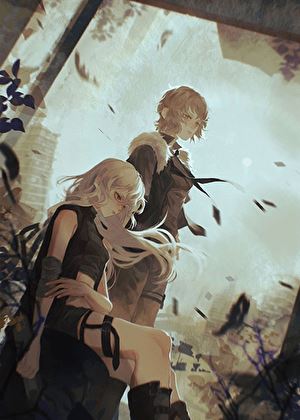
Okay. Can we just stop for a second and talk about the very last line of this section? “The moment those words were heard, those clouded eyes seemed to light up in an instant.” That's it. That's the entire scene. One sentence and I was completely destroyed. Let's break down what we actually know about Chai Yuening right now. She just survived a life-and-death situation. She's on leave. She bought a secondhand wooden rocking chair like she's already started planning her retirement to a farm somewhere. She closes her eyes and listens to base broadcasts about ecological zones and crop harvests and infection detectors like she's actually imagining a normal life. And then her communicator buzzes. And she sighs. Not angry. Not even really annoyed. Just … the sigh of someone who loves her people too much to say no. She goes to bail out Lu Qi, who is basically a younger brother figure throwing a tantrum because people called his captain a murderer. And instead of scolding him properly, she pats his shoulder and tells him not to let trash talk win. That's not a captain talking. That's someone who actually cares whether the people under her protect their reputation or just throw hands. She could have left him there. She didn't. Then comes Chu Ci. And I need to process what just happened. This girl is sitting in a corner of a detention cell, curled up small, silver-white hair cascading over her shoulders, and the second Chai Yuening says “Someone signed a letter of guarantee for you,” those clouded eyes LIGHT UP. Not a smile. Not a word. Just light. Like someone who has been sitting in darkness finally sees a doorway open. And Chai Yuening—who clearly doesn't understand why she keeps doing this, who rolls her eyes at Ban Xiangming's jokes, who is probably exhausted beyond measure—she signs the paper anyway. This is a relationship waiting to happen and I am HERE for it. I can feel it in my bones. The author didn't even try to hide it. Just dropped that single image of those eyes lighting up and called it a day. Ruthless.
... Read More
Okay so this whole evacuation sequence is actually a massive plot pivot and I need to talk about it. The author has been slowly building toward this moment where the Base basically admits defeat on the outer districts, and when Major General Xue Zhou delivers that line about 'prepare for the worst,' my stomach dropped. This isn't just a setback—it's the point of no return. The military can't retake the signal towers, the black vines grow back faster than they can clear them, and now they're sealing the self-destruct systems like some kind of scorched-earth plan. What hits me hardest is how this revelation comes through Chai Yuening. She's the one receiving the order, and the reader experiences the horror alongside her because we don't get any exposition dump—we just get her silence and that trembling voice asking 'what about the Ninth and Second Districts?' The narrative choice to keep the military's full desperation behind communicated walls rather than showing it directly is genius. It makes the base's crumbling control feel even more terrifying. And then Chu Ci, as always, cuts through all the emotional weight with one line: 'When are we going to the main city?' Like she already accepted this before anyone else did. The team's forced evacuation with You Lan adds this weird comedic beat—the robbing-from-herself moment with the bedsheets and quilts—but it immediately undercuts the gravity. You Lan isn't even given time to process before she's being dragged into a vehicle like a piece of luggage. I kept waiting for some bigger dramatic reveal about Du Xia but the author just... doesn't give it to us. Chai Yuening notices Du Xia isn't in the vehicle and pretends not to notice. That restraint is so deliberate and so painful.
... Read More
The dialogue in this passage is remarkably sparse, and that sparseness is its greatest strength. Consider this exchange: "Did you spend all the money I gave you last time?" "Almost." "You went to the Seventh District black market looking for work?" "Mm." "Didn't go well?" "...Mm." That trailing ellipsis before the second "Mm" says everything. It says: I tried. I failed. I am too ashamed to explain further. And Chai Yuening's response — a soft sigh, then "You could've come to me if you needed help" — carries the weight of someone who has been watching this girl suffer and feeling powerless. The narrative voice itself is worth examining. It moves between close third-person perspective on Chai Yuening and occasional wider shots that place her observations in a broader context. When the text says "This wasn't an easy world to survive in" followed by "Her conscience shouldn't ache too much" — that is the narrator commenting, judging gently, almost scolding Chai Yuening for caring too much. Lu Qi's brief appearance early on provides tonal contrast. His joke about his "just-got-into-a-fight face" and his earnest self-defense as an "upstanding citizen" bring humor into a scene that otherwise leans heavily into melancholy. Ren Dong's snort of laughter is equally effective — two beats of comedy that prevent the passage from becoming overwhelming. Chai Yuening's feigned anger — "One more 'but,' and I'm sending you back to the Ninth District" — is not really anger. It is affection dressed in intimidation. And Chu Ci's silence in response is the perfect counterpoint.
... Read More
"If we really ran into one, all the firepower in this vehicle combined wouldn't be enough to take it down!" Ren Dong just casually drops that line and the entire mood of the chapter shifts. One moment everyone's bickering like a loud, dysfunctional family, and the next you're reminded that these people are driving through an apocalyptic wasteland where a single beast could wipe them all out. The stakes keep escalating throughout this chapter. First it's the fog—"almost like the depths of the old Fog Zone." Then the black vines, climbing towers and blooming with flowers that glow red at night, symbols of calamity according to the narration. Then the rain starts falling and the wind howls, making the environment itself feel alive and hostile. What's clever is how the author builds tension not through action scenes but through atmosphere. The night watch sequence is probably the most tense part, and literally nothing happens except Chai Yuening sitting in the driver's seat watching a danger monitor while rain hits the window. Yet I was on edge the entire time. The ticking pocket watch, the endless rain, the long night stretching ahead—it all creates this suffocating sense of dread. And then there's the bigger question hanging over everything: what happened to Luo Kun? Ren Dong mentions that "there wasn't even a complete corpse." The text says Du Xia warned them about using the same vehicle model. These people know they're vulnerable. They know good people have died. And they're still driving into the fog anyway.
... Read More
I need a moment. The opening of this passage had me absolutely wrecked. Jing Mu crying in that suppressed, quiet way, and Chai Yuening just saying 'At least, you're still alive.' Not 'are you okay' or 'what happened' but just acknowledging the brutal math of their existence where being alive is somehow still a victory. That line from You Lan later though hit different: 'Maybe we'll never get a good night's sleep again.' And Chai Yuening trying to make a joke about it not being funny and the atmosphere getting HEAVIER. The way the author handles collective trauma here is staggering. Nobody is comforted. Nobody is fixed. They are just... driving through a tunnel together. But then the scene shifts and these three women end up on that wooden plank bed, and You Lan starts gossiping about hair-drying practices and suddenly the whole room feels warmer somehow. That is the magic of this book. It lets you GRIEVE and then it lets you find tiny moments of joy anyway. The romance between Chu Ci and Chai Yuening is not dramatic declarations, it is someone drying someone else's hair and calling it routine. That is real love. That is the kind of love that survives the end of the world.
... Read More
I need to sit with this scene for a while. Chu Ci asking Chai Yuening to choose for her—that's the most devastating emotional beat in the entire chapter and I'm still not over it. Think about what's happening underneath: this person who has never had agency in her entire life is finally being offered the one thing she never knew she wanted. 'You're different from the people in my memories,' she says. That line hit me like a truck. She's comparing Chai Yuening to everyone else she's ever known—people who told her what was right, what she should do, what she could do for humanity. And Chai Yuening is the first person who actually lets her breathe. But here's the thing that made my chest tighten: when Chai Yuening can't answer the hypothetical about handing her over, Chu Ci smiles and says 'thank you for your hesitation.' She already knows the answer. She already knows that if it came down to it, Chai Yuening would choose the many over her. And instead of being angry about it, she absolves her. 'It's not your turn to choose. This is my own choice.' The love between them isn't in grand declarations—it's in that quiet moment where one person sees the other's pain and removes the burden from their shoulders. Then she asks 'did I choose correctly?' Like she's twelve years old and wants approval. God.
... Read More
Let me sit with the symbolism here because this chapter is Dense with it and I need to process. The micro-locator embedded in a human body is the central symbol and it operates on at least three levels. First, it's literally a tracking device—Chu Ci can't be lost, can't be free, is constantly monitored. Second, it represents the Floating City's relationship with its subjects: care expressed as control, protection expressed as imprisonment. Third, and this is what gets me, it mirrors the underground Base itself. Both are enclosed worlds that claim to protect their inhabitants while simultaneously stripping away their autonomy. Chu Ci is the Base in human form. The elevator is another massive symbol. The text describes it as a 'man-made abyss with no visible top or bottom'—the team is literally ascending through darkness toward an unclear destination. They're leaving one cage (the underground Base) to patrol another cage (the surface, now overrun with vines and beasts). The 'abyss' framing suggests there's no true escape, only different flavors of containment. The black vines are clearly more than environmental hazard—they're the physical manifestation of corruption spreading upward, of a world that was supposed to be dead underneath slowly claiming everything above. Lao Xiang's observation that 'there'll be no sunset to watch' because the fog is so thick is quietly apocalyptic. The sun—the ultimate symbol of hope and natural order—is blocked. And then there's 'Unity is Strength,' the song Lao Xiang whistles. It's from the Old World. An anthem about collective survival from a civilization that already fell. The irony is almost too on the nose, but that's the point—the team is performing unity while fracturing internally, singing an old song while marching toward probable death. The text doesn't mock this. It honors it. There's tragedy in trying, and the story knows that.
... Read More
Okay so this whole section is like... the calm before the storm and then STORM hits. You think everything is fine after the first execution, right? Everyone's been tested, nothing shows up. Then BOOM, a bloodcurdling scream from the restroom and a mutated beast tears through the crowd. And the worst part? It was a security officer who got injured and HID IT. That is just gut-wrenching because it means the person responsible for keeping everyone safe was also the one who endangered everyone. The author did something really clever here — the beast used the panicked crowd as cover, which made the security officers hesitate to shoot, and that hesitation caused MORE injuries. It's this vicious cycle where fear paralyzes action, and inaction causes more deaths. Classic post-apocalyptic logic but executed perfectly. Then the aftermath is where it gets really dark. The infected who fail their tests — they don't even get a trial. They're just shot. One by one. The author doesn't shy away from showing the cold efficiency of it. 'Gunshots rang out once more... one after another.' No drama, no mercy. Just the sound of people being executed because the world demands it. And that cliffhanger at the end? Chai Yuening whispering to Chu Ci that she can help her escape if she wants? What does that imply about Chu Ci's past? What is she hiding? I need to know what happens next desperately.
... Read More
I am not okay with how tender this chapter is. Chai Yuening literally has never taken care of anyone in her life. She's a mercenary. She's hard. She's survived. And yet here she is at 2am patting Chu Ci's back while the girl vomits tears into a sink, mixing sugar water, dragging a nearly unconscious Chu Ci to bed, putting a plastic basin beside her — all while muttering complaints the whole time. "It's one thing for the two heavy drinkers at the table, one old and one young, to drink so much, but why did you have to keep up…" That complaint-is-care mask. That is such a real human thing. She's annoyed but she won't stop. She says don't drink next time but she already brought the water. She's clearly touched by something and doesn't know how to express it except through practical action. And Chu Ci — drunk, vulnerable, barely conscious — just keeps saying mmm like a kitten. She trusts Chai Yuening enough to not resist when she's carried to bed. The silver-haired girl wraps herself from head to toe in the quilt like she's trying to disappear, and Chai Yuening just… accepts that. Doesn't push. Just sets the basin and lies down on her floor pallet. The Thirteenth Mercenary Team unanimously approved Chu Ci in one chapter and now we see Chai Yuening individually adopting her in another. The team dynamic is forming quietly — not through battle or dramatic declaration but through shared meals, cheap liquor, and 2am sugar water. I love them so much it hurts.
... Read More
Let me just sit with the imagery for a second because this book is DRENCHED in it and I need to unpack it. Chai Yuening clutches a 'rusted, stopped watch' while staring out at skyscrapers flashing past. A watch that doesn't work anymore. In a world where time seems to have broken—where Growth Season resets everything, where the fog swallows history, where the old world's ruins are all that remain—this stopped watch is basically the thesis statement. Time stopped. Civilization stopped. And yet they're still moving forward anyway. The black vines themselves are another masterpiece of symbolic design. They don't attack. They don't poison. They just... grow. Cover everything. Exhale fog. Bloom with these strange, succulent-like flowers that glow faint red and purple. Nature isn't fighting humanity here—it's REPLACING it, quietly, beautifully, terrifyingly. The vines are the new rulers and they're not even hostile about it. That's somehow worse than any monster. And the girl. Silver hair. Silent. Found in a nuclear ruin where vines can't grow. She exists in the spaces between the old world's destruction and the new world's takeover. She's almost like a living artifact—beautiful, damaged, untouched by whatever's consuming everything else. What is this story actually about? I think it's about what survives when the world ends. Not buildings. Not technology. Not even people, necessarily. But moments of connection. One person choosing to save another for no reason at all. That's the thing the black vines can't grow over.
... Read More
"She didn't know what Chu Ci was so happy about. Just as she didn't know what she herself was so sad about." This line absolutely wrecked me. Like, come on, the author just quietly dropped that in the middle of a scene where everyone else is celebrating and Chai Yuening is being all cheerful and deflecting, and then BAM — this devastating one-two sentence about her inner state. And she doesn't even know what she's sad about herself. That's not some grand tragic moment, that's just... the quiet erosion of someone who has been holding everything together for too long. The relationship between Chai Yuening and Chu Ci is so fascinating to me because on the surface, they're total opposites. Chu Ci is all bright energy, rare smiles, darting up stairs with excitement. Chai Yuening is the grounded one, the responsible captain who makes the hard calls and covers for everyone else. But then you look closer and the roles start blurring. Who's really protecting whom? Chu Ci seems to see through Chai Yuening — that whole exchange at the end where she casually demolishes the captain's financial situation, pointing out she's drowning in debt, and Chai Yuening just... freezes for a second before trying to laugh it off. A character who never lets her guard down, whose defense mechanism is humor and deflection, getting genuinely caught off guard by someone she considers beneath her responsibility. And Ge Heguang's mini-conversation with Chu Ci earlier — "Until humanity truly finds its freedom, we are all in a cage" — that hung in the air like a warning label on the whole chapter. He sees something in Chu Ci that others don't, or maybe he just recognizes the weight she's carrying despite her lightness. The author keeps positioning Chu Ci as this enigma everyone orbits around but nobody fully understands, while Chai Yuening is this wall everyone leans on but nobody checks on. I need to know what happened to Du Xia. I need to know what Chai Yuening is actually sad about. And I need to know what Chu Ci knows that the captain doesn't.

Leave a comment

You must be logged in to leave comments. or