Like Fire Meets Gunpowder - Reviews

Like Fire Meets Gunpowder
+Add to Custom List
Sort
Add review
... Read More
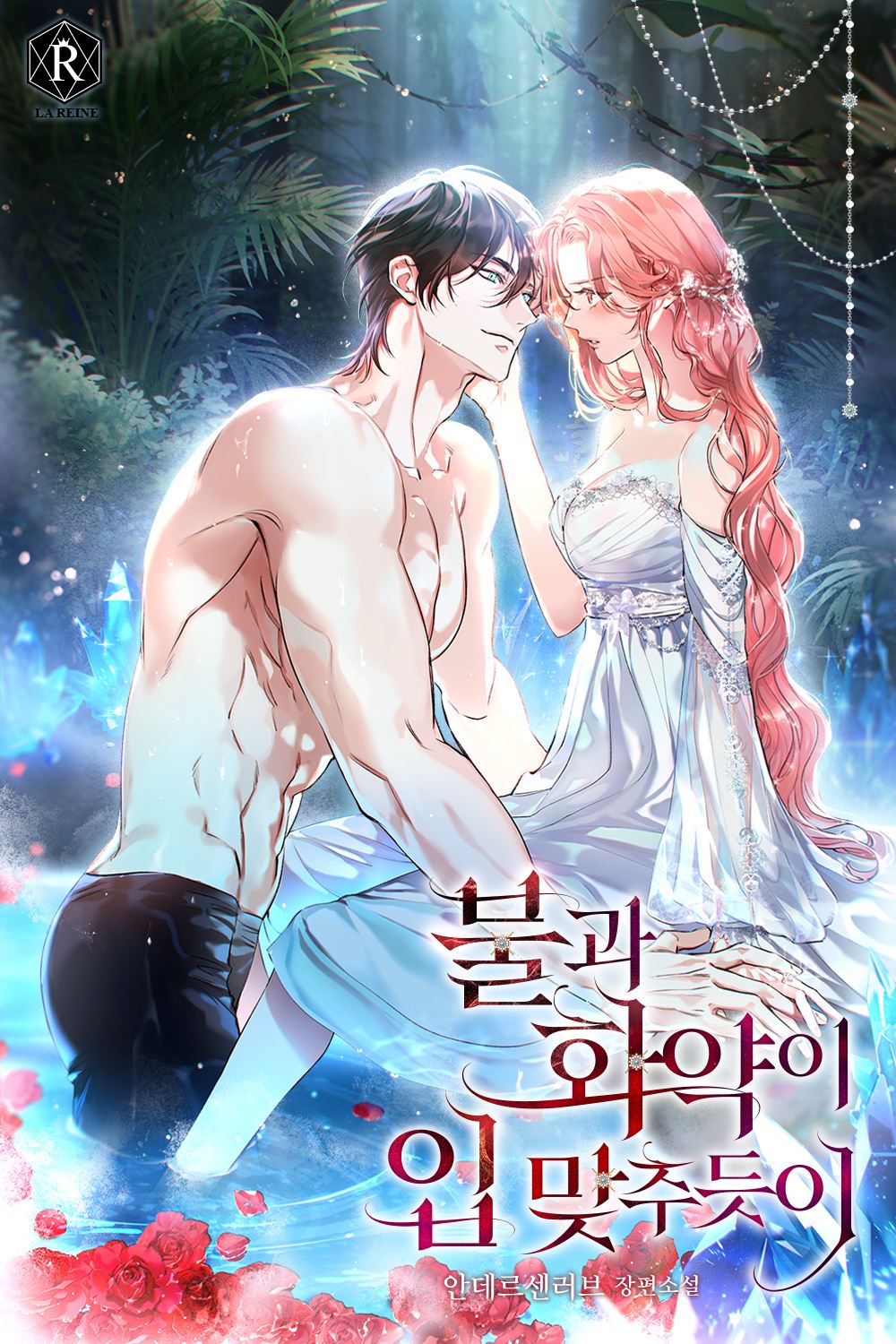
Okay can we just talk about this scene for a second because my heart absolutely broke open. Rose and Jade sitting in that hot spring, the water, the grass between his fingers, and he just casually drops a promise like it's nothing. "I swear I won't get married before you." Like he's offering her a band-aid when really it sounds like he's handing her his entire heart on a silver platter and pretending it's a business deal. And Rose—bless her clueless, brilliant heart—she just negotiates the terms like they're haggl ing over horse prices. "One year from now. Marriage is forbidden, Rosemaria Ordo." She treats it like a game. But the narration? The narration doesn't let us forget: "his eyes, somehow, weren't smiling." They looked like "the deep green of the fog forest"—dark, shadowed, unreadable. He's making a sacrifice here and he knows she'll never understand why. Meanwhile Rose is so wrapped up in her own romantic confusion—remember when she supposedly said she needed someone to love passionately? When did she say that? Why can't she remember?—that she completely misses the tragedy happening right in front of her. The CP energy between these two is off the charts. It's not dramatic confession or grand gestures; it's two people orbiting each other so closely they've forgotten what it feels like to be apart, and one of them is already signing away their happiness without saying a word.
... Read More
Here's what struck me most about this section: Rose explicitly identifies her greatest enemy, and it's not the Camelots. It's her own household. 'This household. Truly, this household is my greatest enemy of all.' That line came right after her father's drunken rambling and it hits with the force of something almost tragic. The stakes operate on multiple levels simultaneously. On the political level, there's the Camelot-Ordo rivalry, the incident at the imperial palace, the question of who will inherit and lead. On the personal level, there's Rose's relationship with her family - she loves them but is exhausted by them. She's the only responsible adult in a family of chaos agents, and she knows it. What makes the conflict so compelling is that none of it is simple. The brothers aren't villains - they're children in adult bodies, spoiled but loved. Anne isn't weak - she's managing impossible situations with whatever tools she has. Even Jade, the supposed enemy, exists in a gray area where his indifference might be protection rather than cruelty. The tension Rose faces is structural, not situational. She'll always be the designated adult. She'll always have to clean up messes. She'll always be the one apologizing to people her brothers provoked. And yet she does it anyway, with a serene smile and dry internal commentary. That's the real stakes here - not who wins a duel or who controls land, but whether Rose can maintain her sense of self while carrying everyone else's burdens. The ending with Jade at the hot springs raises the stakes to a new level. Her sanctuary is invaded, her escape route blocked, and the one person who might understand her situation is also the person she's supposed to oppose. Every resolution creates new complications.
... Read More
Let's break down what's actually happening plot-wise because this book is playing 4D chess with us. Layer one: Jade returns after five years. Everyone has opinions. The rumor mill goes wild. This is the inciting incident that reshapes the social landscape Rose operates in. Layer two: Rose is being pressured into marriage by her entire household. Not because she wants to, but because the Ordo family needs to maintain its standing. The Camelot marriage situation raises the urgency — if Jade marries first, the Ordo family "loses." Layer three: Rose has a secret history with Jade that nobody in her family knows about. The crystal, the hot spring encounter, the dreams — these are plot elements the reader is meant to track while everyone else in the story remains oblivious. Layer four: Shurelli arrives, and she's not just cute comic relief. She's the daughter of Anton and Eva Basil — two families connected by divorce, shuttled between households. She represents the next generation, the continuation of these bloodlines and their dramas. Her rose-colored eyes tie back to the founding of House Ordo, which means she's also a symbol of legacy and expectation. The plot moves between these layers seamlessly. One moment you're reading gossip columns, the next you're watching a six-year-old distribute handmade flower pouches, and somehow both scenes advance the same underlying tension about what Rose's future holds. My prediction: the proposal handkerchiefs won't go to any of the suitors currently on the table. Rose said she'd fight the world for the right man. I believe her. And I think Jade is coming back into the picture before this arc resolves.
... Read More
This chapter does something really impressive with its structure and I want to unpack why it works so well. It opens at full throttle—monsters attacking, mist closing in, danger everywhere. We're introduced to the wolf pack, the chase, the confrontation. High energy, high stakes. Then Jade does the most unexpected thing possible: he picks up the unconscious wolf and runs AWAY from the danger, not toward it. Comedic timing at its finest. The transition into the hot spring scene is where the real magic happens. We go from "twelve wolves closing in" to two people in a sacred spring having a domestic conversation about candy and marriage proposals. The contrast is jarring in the best way. It's like the author is saying: "Yes, the world is dangerous, but right now these two people are solving each other's problems instead of fighting monsters." And the pacing within the hot spring scene itself is meticulous. It starts with humor—the wolf being petted, the candy trade attempt, Jade offering his body as currency (which Terra absolutely destroys). Then it drifts into something quieter, more contemplative, with the ring discussion and Jade's backstory about where he found it. The tempo slows. We breathe. And THEN—BAM—marriage enters the room and everything shifts. The author doesn't rush this. They let the conversation develop naturally, letting small moments accumulate weight before dropping the Alberty Berna bomb. By the time Jade asks about marriage, we've already invested so much in these characters that the question lands like a physical blow. The ending—"Stop finding fault with my future wife"—lands perfectly because everything before it earned that moment. The comedy, the tenderness, the unspoken history between them—it all builds to this single line that reframes every interaction we've watched. No filler. No drag. Every beat serves the relationship. This is how you write a chapter that entertains AND advances the story simultaneously.
... Read More
Okay so let's talk about the crystal on Rose's finger. The rose diamond. She looks at it in the moonlight and it "seemingly remind[s] her that everything that had happened until now had been real." This is huge. A physical object anchoring her memory against the feeling that it's all a dream. It's literally a trophy — not in the sports sense, but in the ancient sense. A token of something lived. And then there's the rosemary. She's embroidering it on twelve different proposal handkerchiefs. Rosemary = remembrance, obviously. But also — it's *her name* almost. Rosemaria. The author is weaving her identity into every single stitch. She's preparing for a future she doesn't want but feels obligated to accept, and she's doing it with her own name embroidered repeatedly. That's not subtle. That's devastating in a very quiet way. Shurelli's rose-colored eyes are another layer — the same eyes as the founding head of House Ordo. The bloodline symbol, the legacy, the expectation. Everyone in that family is carrying something visible and invisible at once. Even the rumors about Jade — twelve wives, thirty children, becoming a "perfect male deity" — these are projections. People filling in the blanks because they don't want to see the real person. The novel keeps asking: what is real versus what is performed? The marriage market is performance. The family drama is performance. Only the hot spring moments feel unguarded. The author really loves making objects do emotional work. Everything carries weight.
... Read More
Okay, so this section is a masterclass in emotional whiplash and I'm not okay with it. We start with the absolute softest possible scene—Rose listening to Shurelli's bedtime story about the Bunny Prince, and Rose herself is melting, recalling Jade's chest from the hot spring like some lovesick teenager. You're thinking, okay, this is going to be a warm, fluffy interlude, right? Wrong. One paragraph later, the mood drops so hard I nearly choked. Anton and Piar come back in tatters—swollen faces, casts on arms and legs—and instead of any genuine concern, Rose's internal monologue pivots from sweet domesticity to analyzing why her family is fundamentally broken. The pacing here is brutal and intentional. It's like the author wanted to make sure we never got comfortable. The Shurelli sequence ending with "Thank you, but I don't need the fluffy tail" followed immediately by "Sadly, the peace Shurelli's visit had brought lasted less than a week"—that transition sentence is a sledgehammer. And then the fog forest scene! It's almost too much. We go from family political intrigue to a genuine life-or-death monster encounter, and Rose is supposed to be processing everything in real time. But here's what struck me—the wolf howls, the mist thickening unnaturally, Terra getting tackle-dragged through the grass. It all happens so fast. There's no breathing room between "Let's get out" and "A burst of killing intent vanished." The structure of this whole arc basically says: comfort is an illusion, and danger doesn't care when you're emotionally vulnerable. The chapter cliffhanger—something moving too fast to see, Terra on the ground, Rose with her sword drawn but unable to see her enemy—is exactly the kind of beat that makes you open another chapter immediately. No rest, ever.
... Read More
Okay, let me just say — the Resias assembly thread is NOT a side plot. It's the detonator. The whole scene starts with Shurelli innocently mentioning she went to a 'Resias meeting' with her mama, and BOOM. Every face at the table goes dark. Piar is ready to hunt someone down. Rose has to smoothly defuse a diplomatic incident that could have started a war between eastern and western noble houses. Here's what makes this plot move so tightly: the Resias assembly wasn't just some random historical detail. The text tells us Ordo, Biella, and Camelot were the three pillars. Then after the first Emperor died, 'Ordo and Camelot, the twin pillars of the assembly, had their relationship shatter entirely, and both families' standing collapsed alongside it.' Twin pillars falling together? That's not a coincidence. That's a shared trauma. That's foreshadowing for the Rose/Jade dynamic right there. And the eastern families holding a Resias-style gathering WITHOUT inviting House Ordo? That's a power move wrapped in a social event. Benyamin trying to explain it away as 'just a small gathering among heirs' is classic nervous deflection. He's clearly either lying or severely underestimating how much of a scandal this is. Meanwhile, the subplot about proposal handkerchiefs — Rose finishing number nineteen — is doing double duty. On the surface it's just romantic comedy flavor. But underneath, it's marking time. Each handkerchief is a failed attempt, a rejection, a moment where Rose is actively choosing NOT to commit. And she's doing it while simultaneously protecting her house from further disgrace. The plot threads are braided so tight you barely notice them until they snap together. The结尾 with the ring is the perfect structural pivot. We've gone from political tension → family dynamics → romantic subplot → and then BAM, the mysterious monster-prince who gave Rose a rose diamond appears. The narrative never lets you breathe, but it also never feels scattered. Every thread pulls in the same direction.
... Read More
The dialogue work in this section is genuinely exceptional because every character has a completely distinct voice, and I mean that literally. Rose speaks in sharp, controlled bursts - 'You have no sense of romance, Rose' she fires back, and you can hear the deliberate pointedness. She's always performing a role, even when she's just being honest. Her internal monologue is where the real voice lives though, and that's where the humor shines: 'Trying to have a conversation with thick-skulled people who couldn't be reasoned with was harder than solving advanced mathematics.' Jade's dialogue is performative laziness. Everything he says carries this double meaning, this layer of teasing underneath casual words. 'Did you miss me?' is the kind of line that works because it's both genuinely curious and entirely mocking, and Rose can't tell which. His voice is smooth, dangerous, and deliberately unreliable. The brothers are pure chaos in dialogue form. 'They insulted us behind our backs!' 'So breaking into someone's quarters with swords drawn was the right thing to do?' 'If someone hits you, you hit them back!' This isn't just bad reasoning - it's a completely different cognitive framework, and the author makes you hear it clearly through their speech patterns. Short, reactive, circular. Anne's voice is the most interesting to me because it's layered with exhaustion and affection. 'A mother really does need at least one sensible daughter. Sons just scurry around like rat droppings and cause trouble.' She's genuinely fond of her nephews but also genuinely tired of them. The way she switches between warmth and sharp reprimand feels like real family dynamics. And Robert's entrance - 'Rooooose! Your father is hoooome!' - the elongated vowels and drunk cadence immediately establish him as a force of nature. You don't need description to know this man has been drinking for two weeks.
... Read More
I cannot stop thinking about how good their dialogue sounds. These two have been trading insults and snacks since they were kids and it shows in every line. Jade opening with 'I just have a constitution that gets badly backed up if I stay cooped up at home, so I wander around. In the shamanic traditions of the East, they'd call it a wandering star curse.' What is that energy. He is so casually disrespectful it's hilarious. And then later at the hot springs: 'Do you have any candy?' out of nowhere, like a cat walking across a piano and hitting the perfect note. Rose's responses are equally sharp — 'A nose like a dog's. Maybe she should start calling him a baboon gorilla' is the kind of internal monologue that makes me laugh out loud. The narrator's voice is doing so much heavy lifting here too, especially with the running commentary about Camelot's fall from grace. The marriage proposal scenes are brutal comedy: 'Pardon me, but do you smell something?' followed by the horse dung explanation. It's mean but it's so funny. Their dynamic has this rhythm where neither one ever really loses, and that final exchange where both their smiles break at the same time? 'That moment is sweet...' — I am not okay.
... Read More
The dialogue in these chapters is a masterclass in dramatic irony, and I'm obsessed with how every character speaks differently depending on who's watching. Anne is the most layered voice here. On the surface she's just the enthusiastic matchmaking grandmother: 'Oh best isn't good enough, my darling' and 'A proposal handkerchief is completely useless if there's no one to give it to.' Sweet, right? Wrong. Every line is a pressure weapon. When she says 'You absolutely must get married this year, understood?' it's not advice — it's a demand disguised as love. And her internal monologue? 'The higher his standing rose, the greater the risk of him becoming an obstacle in Ordo's path.' This woman is running a geopolitical strategy inside a family dinner. Her voice is the sound of calculated warmth. Benyamin's dialogue is pure nervous deflection. 'Ah, it was nothing grand, just a small gathering among families from nearby domains.' He's clearly lying and everyone knows it. Then when Eva directly proposes him as a suitor, he goes from flustered to politely evasive in one breath: 'I still… think I need a great deal more time to consider the matter of marriage.' Smooth. Too smooth. This is a man who knows exactly what he's doing and is just trying not to mess it up. Eva's voice is the quietest but the sharpest. That single paragraph where she asks Rose to 'consider him as a candidate to share in your bright future' — delivered with clasped hands and a 'quiet seriousness' — is devastating. She's not just matchmaking; she's testing Rose. The conditional 'if you have a sweetheart hidden away' is a trap door. If Rose admits to loving someone, Eva will know exactly what she's working with. And Shurelli? Her dialogue is the only thing that isn't performative. 'Shu loves Ordo and Basil both so, so much. Being Mama and Dad's child makes me the happiest person in the whole world.' She means it. Every word. She's six and she has no idea that her innocent sentence is the thing keeping two houses from total war.
... Read More
I need to talk about this scene with Shurelli for a bit because my chest actually hurt reading it. Rose is surrounded by political maneuvering, her mother is mentally calculating marriage alliances like a chess grandmaster, and the whole house is one disagreement away from imploding again. And then this little girl takes Rose's hand and says 'Aunt Rose got a present from a prince too, didn't you?' And points to the ring. Rose's response is genius — she invents this whole fairy tale about a monster in the forest who just wanted candy. But the monster is obviously someone she has complicated feelings about. Someone dangerous. Someone from Camelot. And she's sitting there, playing pretend with a six-year-old, wrapping real emotional turmoil in children's story language because that's the only safe container she has. Then Shurelli says the line that wrecked me: 'But Aunt Rose isn't a princess.' And Rose internally laughs because bringing a Camelot prince into House Ordo is the funniest joke she can imagine. But Shurelli refuses to accept it: 'No. Aunt Rose is a princess. Aunt Rose is strong and brave and punishes people who do bad things.' This child — who has watched her parents divorce over soup-eating styles, who only gets to see both families during two seasons a year, who carries the blood of two houses that nearly destroyed each other — is the only one here who sees clearly. Rose IS a princess. Not by title. By choice. By the way she keeps showing up, keeps protecting Shurelli, keeps embroidering those handkerchiefs even though she doesn't believe in happy endings for her own house. And then Shurelli completes the fairy tale in her head: the monster was a prince under a spell, and he came to find Rose because she's his destiny. Rose plays along, but internally she's thinking 'the prince of the savage gorillas. Not kind or wonderful in the least, but a gorilla prince all the same.' The tragedy is that part of her might want to believe the fairy tale. Part of her is letting Shurelli believe it FOR her, because it's the only version of hope she can afford right now.
... Read More
Okay so the Hilude hot springs scene is one of those moments that just reads like a film director's dream. The description of the water itself is gorgeous — milky white swirled with faint blues and emerald greens and a sunset pink, rippling together like an aurora. I literally felt warm just reading it. And then you have the contrast between this incredibly serene, almost magical setting and... well, Jade being completely shameless about his lack of clothing. The humor lands because the atmosphere is so carefully built up first. You sink into Rose's perspective, feeling that relief of finally resting, and then Terra's shriek pulls you back into comedy gold. The steam, the water cascading off Jade's shoulders, the way the narration zooms in on the ring's gemstones catching the evening light — every beat is staged so deliberately. And that part where Rose is so entranced by the ring she momentarily forgets the anatomical spectacle in front of her? Chef's kiss. The worldbuilding is never an info dump; it lives in the sensory details. This place feels real, like somewhere that actually exists in this fantasy world.

Leave a comment

You must be logged in to leave comments. or
