Like Fire Meets Gunpowder - Reviews

Like Fire Meets Gunpowder
+Add to Custom List
Sort
Add review
... Read More
I need to talk about how seriously this book takes the marriage market while simultaneously treating it like complete nonsense. Both things at once. On one hand: Anne is literally throwing letters at her nephews, the brothers are swinging wooden swords at garden trees, servants are joining in, and there's this genuine panic that Rose will "lose" to Camelot. Lose?! It's a wedding. But the stakes feel enormous to everyone in that household because the family's honor is tied to it — Rose is an Ordo. She can't fall behind. On the other hand: the author is clearly satirizing this. Prince Cassius sends a letter about being "moved to my core" by her painting of a fog forest, and Anne is losing her mind like this is the best match ever. Meanwhile, Rose is internally thinking about how a certain large ape could probably throw someone over his shoulder, which is the most unhinged thought to have during a marriage discussion. But here's the thing that makes it work — Rose actually has real stakes. When she says she'd "crush every obstacle" and fight the whole world for the right man, that's not performative. That's genuine. The internal conflict is: she wants someone worthy, but the world keeps offering her mediocre options. And she refuses to pretend otherwise. The external pressure is constant and loud. The internal conviction is quiet and unyielding. That's where the real tension lives. Not in whether she'll marry, but in what she'll settle for — and whether anyone worth settling for will actually show up. Also the rumor mill surrounding Jade is its own kind of threat. If he marries someone else first, everything changes. The book knows this and keeps dangling it like a knife.
... Read More
The opening scene is absolutely cinematic. You have Cromatz Square, summer, a man standing before crowdsdeclaring his undying love, fire and gunpowmer imagery—'as fire and gunpowder meet in a kiss.' That single line gives me chills every time I reread it. The whole atmosphere of this world is built on this fascinating tension between an age that's supposedly at peace and an era that's completely obsessed with spectacle: duels as entertainment AND romantic love as public performance. The author basically says 'two entertainments have taken the nobility by storm' and you immediately understand the cultural mood. Then you shift into the Ordo household and the sensory details are different but just as vivid. Rose is in front of a mirror getting ready, ruby earrings heavy on her ears, and the prose makes you feel that weight. The garden at Primo Palace later is described with roses in every color, daffodils, lisianthus, violets—all blooming together 'heedless of season,' which I think is deeply intentional given Rose's name and house. It's almost like the world itself is conspiring to create a romantic atmosphere, and yet Rose is the one person in it who doesn't want any of it. What really sells the worldbuilding for me is how casually historical and political details get woven in. House Ordo was once one of the ten great vassal houses, granted their title by the first emperor. Now they're considered one of the top three causes of the Emperor's hair loss. That's a whole history lesson delivered in a single sarcastic line. The imperial family, the rival houses, the wandering heir—there's so much political machinery underneath this romance and I'm obsessed.
... Read More
The structure of these chapters is masterful. You start with Rose waking up in near-silence, the hot spring steam still on her skin, Jade already gone. It's slow. Meditative. Almost hypnotic. The prose slows down with her — short sentences, pauses, the word "Perhaps" repeated like a worry you can't shake. And then — BAM. "News that the Camelot heir had finally returned to the country spread across the Empire." One paragraph later you're in full chaotic mode. Rumors flying, brothers fighting with wooden swords, Anne hurling crumpled letters into gardens, servants joining the fray. The transition isn't jarring though. It's like the dream dissipates and reality crashes in. That's exactly the feeling Rose has, and the author makes us feel it too. What's clever is that even inside the chaos, there are quiet moments. Shurelli's arrival is like a calm center — a six-year-old distributing flower pouches, remembering everyone's name, making hardened household members behave like lambs. The chapter breathes. It doesn't just ramp up and stay there. The pacing at the end is also interesting. Rose's confession to Vivi about wanting to fight the whole world for the right man comes after all this noise, and it lands differently because of it. In the middle of absurdity, her conviction feels earned, not preachy. Some parts drag if you're looking for constant action, but I think that's the point. The lulls make the storms hit harder.
... Read More
How does a character leave so much impact without saying a single word in these chapters? Jade is GONE from the hot spring scene, but he's EVERYWHERE after. Rose looks at the empty space where he was sitting. She wonders if their entire encounter was a dream. She touches the crystal on her finger like she needs physical proof he existed. And earlier, the text tells us their history — Siset's grave, holding hands on a journey, years of separation — all compressed into one paragraph but carrying enormous weight. The way she thinks about him is revealing. She calls him "that large ape" internally but also remembers his pale backside swaying as he walked away. She's annoyed, flustered, fond, confused. It's the most realistic depiction of complicated feelings I've read. And then there's the contrast with everyone ELSE in her life. Her brothers treat her like a symbol of family honor. Her mother treats marriage like a military campaign. Terra is useful but distant. Prince Julius is mentioned as adequate but boring. Jade is the only one who makes her feel something unmediated. Vivi asks if Rose has a secret fiancé, and Rose deflects with logic about how she'd announce it directly if there were one. But we know she's lying to herself as much as to Vivi. She's been there. She knows what that feeling is. She's just not ready to name it. The relationship between Rose and Jade isn't written on the page these chapters. It's written in the silence. In what's missing. In the way a woman touches a ring in moonlight and refuses to let go of the memory.
... Read More
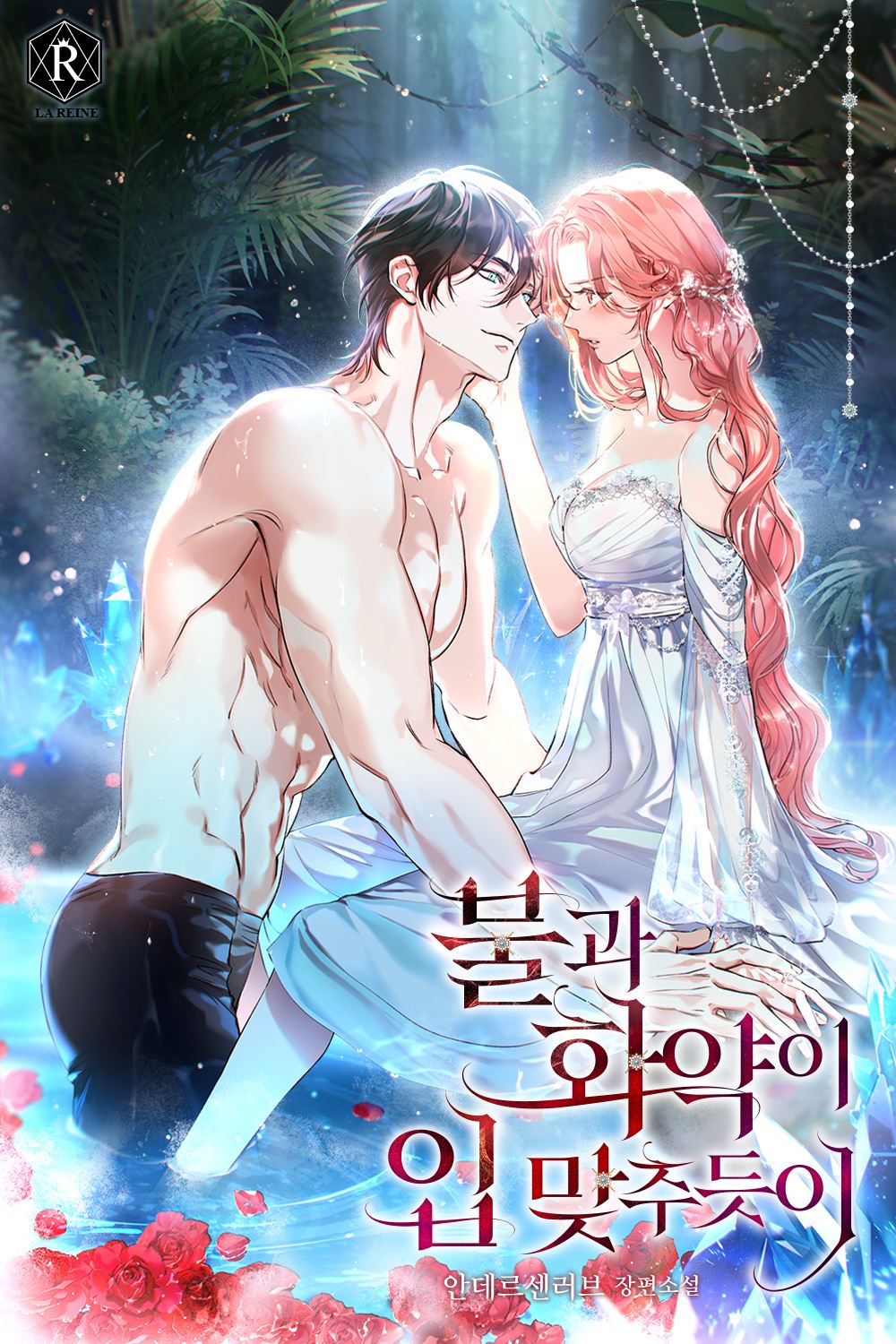
Okay so I need to talk about this hot spring scene because everything about it just cracked me up and also made my heart do something weird. Jade finds a wolf monster that stole his candy pouch, beats it up like a brawler, then carries it to a hot spring like it's a crying baby. "Poor thing, it must have been so frightened." Bro. You knocked it unconscious over CANDY. But honestly this is so Jade. Everything about him is contradictions wrapped in sharp edges. He's this supposedly terrifying Holy Knight who throws tantrums over stolen sweets but then shows up with genuine sympathy for a beast he literally just manhandled. And the way Rose tears into him about it? Chef's kiss. "What poor unfortunate woman is going to end up with someone like him!" She's roasting him so hard and he can't even fire back properly. Their dynamic is just... perfect friction. She provokes, he deflects, they bounce off each other like pinballs. But there's something underneath all the teasing that keeps getting more pointed with every chapter. When he starts staring at her lips while she eats candy? That's not nothing. That's barely hidden tension held together by sheer willpower and years of knowing each other. And then the whole marriage thing drops and his whole demeanor shifts. That sneer when Alberty Berna comes up? The way he looks at her afterward? Yeah, he's not just playing around anymore. Something in him just... locked in. "Stop finding fault with my future wife, would you? It's not as though I'll ever get married anyway." The self-deprecation here hits differently after everything we've seen. Is he saying he won't marry? Or is he saying he won't marry anyone BUT her without actually saying it? This scene is a masterclass in using comedy to mask genuine emotion. I laughed out loud and also felt my chest tighten simultaneously.
... Read More
I need to process what just happened with Shurelli because I am absolutely wrecked. This child walks downstairs, sees her father and uncle covered in blood-soaked bandages, and breaks down crying. Not a little upset—a full-on "Waaah! Don't die, Dad!" breakdown. And what do they do? They recover so fast that within minutes they're comparing scar sizes like middle school boys. Rose watches this and the realization hits her like a physical blow: these men could make their only child cry and forget it before the tears are dry. That's the personal stake. But the political stakes are escalating just as fast. Anton and Piar come back beaten and immediately push for a formal duel against Camelot. Not just any duel—a proper tournament combat where the strongest fighter from each house settles everything. Which means Rose vs. Jade. One fight. Winner takes the domain. Loser likely dies. Rose's response is chilling: "...Do you think you'd win?" She doesn't even finish the sentence. She can't say "Do you think you could bring down Jade Camelot?" because the answer is obviously no, and everyone in that room knows it except them. They're asking her to gamble everything on a fight she can't win, and then they're surprised when she doesn't roll over and agree. What makes the stakes unbearable is the timing. Right when Rose is having this tender moment with Shurelli—when the child is telling her about the Bunny Prince and Rose is letting herself imagine a softer future—the brothers shatter that peace by coming home in pieces and demanding war. Every good thing in Rose's life keeps getting interrupted by violence she didn't choose. And Siset keeps appearing like a ghost. Seven years dead, but every conflict reminds us of him. The old knight who died trying to stop young fools from fighting. And now the young fools are still young, still fighting, and nobody remembers why it matters. The cliffhanger—with something fast and lethal moving through the mist, Terra on the ground, Rose isolated and unable to see her enemy—feels like the novel is stacking every conflict on top of each other simultaneously. Family. Politics. Survival. Love. She can't escape any of them because they're all converging at once.
... Read More
I've been turning over the symbolism in these chapters and I think the fog forest scene is the thematic crown jewel of this entire section. The mist is an illusion—something that looks real but isn't. Rose figures this out because Chaconne, her horse, remains calm when a normal horse would panic. The horses can see through it. Only humans are fooled. And then Rose thinks: "Has your vision come back, Terra? Why couldn't the same be true between people?" BAM. That one sentence unpacks the entire emotional architecture of the book. The mist isn't just a monster attack mechanism—it's a metaphor for how Rose sees the world versus how everyone else does. Her family lives in fog. They can't see the real danger (Jade, Camelot, their own complicity) because they've constructed comfortable illusions. Anton and Piar think honor is something you take by killing people. Shurelli thinks her uncles are strong knights who get hurt during training. The household performs normalcy while Rot festers underneath. The breeding season detail is not accidental either. Monsters coming out of the mist because it's early for their mating cycle—that's the family's conflict with Camelot, boiling over before anyone's ready. The wolves howling from all directions, ten or twenty of them—that's not just a monster pack. That's the external pressure surrounding Rose from every angle: her family's expectations, Camelot's provocations, her own guilt about Siset, the weight of being the heir who set down her sword. And here's the thing that really got me: the wolf that moves too fast to see. It has "an intent as sharp as a killing blade." This is Jade. This is the inevitable confrontation Rose has been running from. It can move through the mist because it doesn't need illusions to find its prey. It can see clearly. And when it grabs Terra and vanishes, Rose is left with her sword drawn and nowhere to aim it—because the real enemy isn't visible, it never was. The recurring motif of vision throughout this section—Terra's restored eyesight, the horses seeing through the mist, Rose asking whether people can see each other clearly—is too deliberate to be coincidence. The novel is asking: who actually sees the truth, and what do you do when you're the only one who can?
... Read More
I need to talk about how each character's voice is instantly recognizable, because honestly some authors try and fall flat but this one nails it. Jade's dialogue is this perfect mix of casual arrogance and calculated restraint. He says things like "I dislike all animals with chest hair"—which is simultaneously the most juvenile and most deflection-heavy thing imaginable. And then moments later he's delivering sworn promises with eyes like a fog forest. His voice carries this weight behind every word, like he's always three moves ahead even when he sounds like he's goofing around. Rose's voice is sharper, more reactive. She fires back with things like "How am I supposed to believe that? One day you'll announce out of nowhere that you're getting married first, and my mother and father will both collapse on the spot." She's observant, quick-witted, and just a little bit desperate—not desperately for love, but desperately for stability in a life that keeps slipping. Then there's the supporting cast and their voices are equally distinct. Anton's ridiculous battle cries—"Dad is fighting the monster within! Hyah!"—complete with his daughter declaring that you have to warn the prince before punishing monsters. Piar silently upping his training regime because his brother got a cute moment with his kid. And Terra the maid, whose horrified speculation about Rose having "seen that man's ripe red pepper" had me absolutely howling. The dialogue doesn't just reveal character—it builds an entire household dynamic in a few lines.
... Read More
I keep coming back to that opening. Rose sleeping under a sky full of glittering stars, the insects chirring, the water… there's this whole scene where Jade is just sitting across from her and she wakes up and he's already gone. Not even a proper goodbye. And yet it feels like one of the most intimate things in the entire book. The hot spring setting — Hilude — is painted so quietly. No grand descriptions, just the summer night settling in, the steam, the mossy stones. It feels like a painting you could step into. And Rose wringing out her hair, shaking it loose past her shoulders, stretching her arms in that portable shelter… the author doesn't even need dialogue for a lot of this. The silence *is* the atmosphere. What gets me is the contrast with everything else in the book. One moment you're in this dreamy, moonlit hot spring with two people who've clearly been through something together, and the next you're reading gossip columns about Jade having twelve wives and thirty children. The tonal whiplash is real. But it works. It makes the quiet moments feel even more fragile, like if you blink you'll miss them. "Perhaps all of it had been a dream…" Rose thinks this. She's not sure. And I think that's intentional. The author wants us to wonder too — is any of this real? Is their connection? The crystal on her finger says yes. But the emptiness across from her says maybe not. This book has a visual language that I can't get over. Every scene feels like a film frame.
... Read More
There are so many layers of symbolism packed into this chapter that I want to make sure I don't miss any of them. The ring first. It's this small object that carries enormous weight—not just monetary value but emotional and historical. Rose assumed it was Camelot-made, something smuggled by a noble, which would make it a status symbol. But Jade says he picked it up in the Sibell Empire, in ruins where "whatever you pick up is yours by right." This detail matters because it tells us Jade operates by a different moral code than the nobility he moved among. He doesn't claim inherited legitimacy—he claims what he earns. And the curse warning? "Lose that ring and you'll be cursed, Rose." Beautiful gemstones always come with deadly stories. This is folklore logic—the idea that objects carry the weight of their history, that possession implies consequence. Rose's counter—the curse goes back to the owner if she loses it—shows her understanding of this symbolic economy. In this world, gifts aren't free. They create obligation, connection, debt. Then there's the candy pouch. A brown leather pouch that travels from Rose to Jade, then gets stolen by a wolf, then recovered through violence, then ruined by saliva. It's this object that passes between them like a baton, carrying with it the entire history of their exchanges. Jade fights a monster for it, then can't throw it away even though it's ruined. Sentiment over utility. Always has been. The wolf monsters themselves are mirrors. They create lifelike illusions. They surround and close in. But in the sacred space of the hot spring, they're stripped of aggression and reduced to rolling in the grass like ordinary dogs. The monsters lose their menace in warmth and safety. This feels intentional—these creatures become what they're capable of being when not threatened. "Even so, a monster is still a creature, Jade Camelot." Rose's line applies equally to the literal wolves and to Jade himself. They're both beasts in their own way, capable of violence but also capable of comfort, of loyalty, of showing up for someone in a misty forest. The theme keeps circling back to: what are we beneath our defenses? And the answer seems to be: not much different from everyone else.
... Read More
Okay so let me just start by saying this opening section is a masterclass in layered plotting. Five years apart, Jade shows up looking like a completely different man and suddenly every scene feels charged. The structure here is fascinating - we get the reunion beat, then immediately undercuts it with the brothers' chaos, then retreats to the hot springs for another encounter. It's like the author keeps pulling the rug out from under whatever emotional note they just landed on. The Camelot-Ordo rivalry operates as this constant undercurrent throughout everything. It's not just a backdrop; it shapes every interaction. When Rose sees Jade sitting there with mud-caked shoes propped up, the irritation she feels isn't just personal - it's generational. Her household versus his household, years of feud compressed into one glance. But what really caught me was how the plot uses Rose's brothers to expose her character. Anton and Piar are these chaotic forces that Rose has to manage, and through their incompetence, we see what makes her the true heir. She's the only one who thinks strategically. She's the only one who apologizes to the enemy when her brothers started it. The plot is basically saying: the strongest fighter isn't always the best leader. And that ending at the hot springs? Classic misdirection. Rose thinks she's found her sanctuary, then finds the one person she'd rather not see. The narrative keeps circling back to the same tension point and making it sharper each time. I'm invested.
... Read More
I need to talk about how the dialogue in this section does some extremely clever character work, specifically with the brothers. Anton and Piar come back half-dead, covered in bandages, and their conversation reads like this: "Look, brother. My scar is bigger, isn't it?" "Size means nothing. I had a bone in my leg shattered, I'll have you know." "That's our brother for you, what a man!" "Ha ha ha!" I literally cannot. This is genius-level characterization through dialogue. These two men just got into a brawl at someone else's festival over a bidding war, returned in pieces, and their only emotional range is sibling bragging rights. The author doesn't need a single narrator aside to tell us these people are shallow—their own words do the work. Then there's Shurelli, and her voice is completely different. "Waaah! Don't die, Dad!" That's a six-year-old. Pure, unfiltered, dramatic. And Vivi trying to soothe her with "Your father is a strong knight, Miss Shu, he'll be better in no time"—that's adult performance speech, the kind of thing adults say to children when they're also terrified. But Rose's dialogue is where it really gets interesting. Listen to this: "Fight to your hearts' content. Dying in an honorable duel is more dignified than dying in a brawl at someone else's domain festival, raging like animals in heat." That is SO Rose. The formality, the cutting precision, the way she weaponizes politeness. And then underneath all of that, the reader hears what she's NOT saying—she's already decided to face Jade herself, she's already mourning people who aren't dead yet, she's already leaving. And Shurelli's line—"They must have gotten hurt during sword training"—honestly made me sit up. A child who instinctively knows her family can't be discussed honestly. That's not cute. That's devastating. The narrative voice overall has this dry, wry quality. The narrator will drop something like "People with the memory of goldfish... Men who could make their only child, the family's only little one, cry and forget it within minutes" and it's so casually brutal it stings. The author's voice feels like a friend who will tell you exactly what they think while you're still processing it.

Leave a comment

You must be logged in to leave comments. or