Is this a Zombie? - Reviews

Is this a Zombie?
+Add to Custom List
Sort
Add review
... Read More
You know what hits different after everything? That ending moment. The anteater is dead, Sera has saved them all again, she's walking back to Ayumu and Haruna, and she just... slaps his palm. No words. No smile. Just a slap. And somehow that's more intimate than any romance novel handshake I've ever read. It's like she's saying everything without saying anything. Throughout the whole battle she never once looked back at him, never showed concern, never broke character—but that palm slap? That's trust. That's aftermath. I keep thinking about how Sera operates in this story. She's cold, efficient, practically robotic in combat, yet she's the one who told Ayumu to believe Eu when everyone else was doubting her. She's the one who intervened when Ayumu was interrogating Eu too harshly. Her protectiveness just expresses itself differently. Meanwhile there's this whole parallel thread with Haruna crying in Ayumu's arms that made my chest ache in the best way. Two completely different kinds of emotional connection, both happening in the same chapter, and neither one is romantic in the traditional sense but both feel deeply significant. The story isn't pushing a harem trope—it's building something messier and more real. Friends who've been through impossible things relying on each other in the smallest gestures.
... Read More
I keep coming back to one moment and I need to unpack it. During that dinner scene, Eu slaps Haruna when she says "just die," and then writes on her notepad: "Dying is painful." She's always been this emotionless, note-writing creature, and in that single line, the author managed to convey an entire philosophy about what it means to value life. This story keeps circling around death the way water circles a drain. Ayumu died. He came back. Eu died and was brought back, and she can raise the dead. Sera's village wants to resurrect their hundred-year-old chief to end a succession war. Death isn't the end here—it's a transaction, a tool, a problem to be solved. But the emotional weight of "dying is painful" cuts through all that supernatural mechanics and reminds us that these characters still feel something about it. The title itself—"My Favorite Thing is the Secret Art: Swallow Reversal"—repeated three times by Sera—is interesting on its own. A swallow is a bird, small and fleeting. Reversal implies turning something inside out, flipping perspective. In ninjutsu it's a feint-and-strike combo, but symbolically it feels like the story itself: presenting something as one thing (a cozy supernatural slice-of-life) while hiding the lethal strike beneath it. And then there's the constant imagery of blood. Vampire ninjas drink it for power and youth. Ayumu spills it continuously in the fight. Eu, who deals in death, quietly produces tears. Blood as life force, blood as violence, blood as something that connects the living and the dead. It's woven throughout these chapters without ever being the explicit subject, which is how good symbolism works.
... Read More
Let me trace the pacing of these chapters because honestly it's a rollercoaster that never lets you catch your breath. You open with a murder attempt—life-or-death tension, protagonist gets stabbed, dies, wakes up as a zombie. That's already a massive event. And then what happens? Instead of letting us process any of that, we cut to a breakfast scene with three girls eating and bickering like a sitcom. The whiplash is incredible. Then just when you think the story is going domestic, a third supernatural girl appears at dinner and it turns out she's a vampire ninja who wants to recruit the silent necromancer. Cue dramatic confrontation. Cut to the cemetery. Fight scene with ninjas using leaf swords and swallow reversal combos. And the chapter just... doesn't end cleanly. It stops mid-action with Sera unfurling leaf wings and raising her bladed swords. The author clearly understands that engagement comes from momentum. Each scene transitions into the next without a moment of breathing room, but here's the thing—it doesn't feel chaotic because the emotional through-line stays consistent. Ayumu is constantly surprised, constantly adapting, and his internal monologue anchors us through every pivot. When the tone shifts from horror to comedy to action, it's filtered through his voice, so we never feel lost. What works especially well is how the author controls information release. We learn about the vampire ninja faction war gradually—first just "people attack Eu," then Sera explains the soft vs. hardliner split, then we discover all previous attackers were also vampires. Each revelation adds a new layer without stopping the forward motion. The cliffhanger on the fight scene is perfectly placed; I needed to read the next chapter immediately.
... Read More
"The essence of my blade... lies not in secrecy. It dances like leaves in the wind." Those two lines from Sera during the anteater fight are honestly the thematic key to everything she represents in this story. Leaves are fragile, ephemeral, controlled by forces outside themselves—yet she weaponizes that exact quality. Her power isn't about brute strength or hidden techniques; it's about adapting, flowing, becoming everything at once. Three hundred leaf swords descending on an enemy is not a ninja move. It's something older. Something almost natural. And the anteater, for all its cunning and tactical intelligence, couldn't adapt to that. It tried to calculate, to predict, to counter—but you can't counter chaos dressed as beauty. There's also this recurring motif of transformation that ties everything together. Haruna needs to transform to feel powerful. Sera transforms nothingness into weapons. Even Ayumu himself—dead, resurrected, somehow still fighting—has undergone a transformation that no one fully understands yet. And then there's Eu, the necromancer who stays in her armor even to bowl, who does this tiny fist pump like a child, hiding behind layers of metal and silence. All of them wearing masks in different ways. The story keeps asking: what are you when the transformation stops? Who are you underneath the power?
... Read More
I need to vent about Aikawa because this guy is simultaneously the most loyal person in fiction and the most infuriatingly stubborn. Sera literally SLAPS him. Not metaphorically. She backhands him across the face and yells, "You know full well how much weight words carry for her, don't you?!" And I want to yell at him too. What is WRONG with this boy? Let me break down what's actually happening here, because I think people miss it. Aikawa keeps saying he needs proof to trust Eu. But that's not the real issue. The real issue is that he's terrified of what trusting her means. If he fully lets her in, then her danger becomes his danger. Her enemies become his enemies. Every time she shows even a sliver of emotion, his life gets more complicated. And he knows it. So he hides behind logic. "Where's the proof?" "Is that information reliable?" Easy questions. Safe questions. They keep him at arm's length from the thing he actually fears—which is caring about someone who could destroy him just by feeling something. Sera sees right through it. That's why she snaps. She's not mad he's skeptical—she's mad he's using skepticism as a wall. She knows Eu better than he does, and she knows that Eu's silence isn't deception, it's survival. But here's the thing that actually convinced me Aikawa is growing: the shopping scene. When he tells Sera to be greedy, when he ORDERS her to want things—that's the same impulse. He's forcing people he cares about to be vulnerable, to take up space, to risk disappointment. He's doing for Sera what he couldn't do for Eu. He's learning. And then on the rooftop, when Eu asks if he hates her, and he almost says the wrong thing, and then corrects himself—"Screw fate. I'll handle it." That's not just romance. That's a guy who has spent the entire series running from responsibility finally choosing to stand still. He's not perfect. He's not even close. But he's trying. And honestly, that's more than most protagonists can say.
... Read More
There's a theme running through these chapters that I didn't fully appreciate until the rooftop scene hit me like a truck. It's about the relationship between words and power, and how both are forms of violence when they belong to someone dangerous. Eu can't speak because her words literally reshape reality. If she says "it's cold," you freeze. If she says something about death, someone dies. Her voice is a weapon she can't holster. So she communicates through a notepad. Every sentence is written, edited, considered. Every word is chosen with surgical precision because an unfiltered word could kill. Sera is the mirror image of this. She can't refuse orders because her nature compels obedience. Her voice carries magical weight too—when she speaks, it happens. But unlike Eu, she doesn't fear her own power. She fears its consequences for others. Aikawa's journey is essentially about learning to listen to people whose words are dangerous. Not to dismiss them because they can't speak freely, but to find the meaning underneath the silence. When he pulls Eu to the rooftop and asks her to tell him why she suppresses her emotions, he's doing something radical: he's giving her permission to use words as connection instead of as weapons. The handwritten note that gets tear-stained—"You probably hate me now, don't you?"—that's the climax of the entire theme. A word written in desperation, not command. A word that doesn't force anything. A word that simply asks. And then there's the cat-ear headband. Think about what that represents. Sera, the lethal vampire ninja who can slice men in half, putting on a ridiculous accessory and going "meow." It's her way of speaking without words, of expressing something playful and light that her entire existence forbids. The headband is a language. A rebellion. A tiny act of defiance against a world that wants her to be only a weapon. Both girls are trapped by the power of their own nature. One can't stop speaking. The other can't stop obeying. And Aikawa, the ordinary guy with no magic at all, is the only one who can create a space where both of them are allowed to just... exist. The theme isn't about power. It's about what you do when power isolates you. And the answer, apparently, is: find someone who will sit on a dark rooftop with you and wait for you to cry.
... Read More
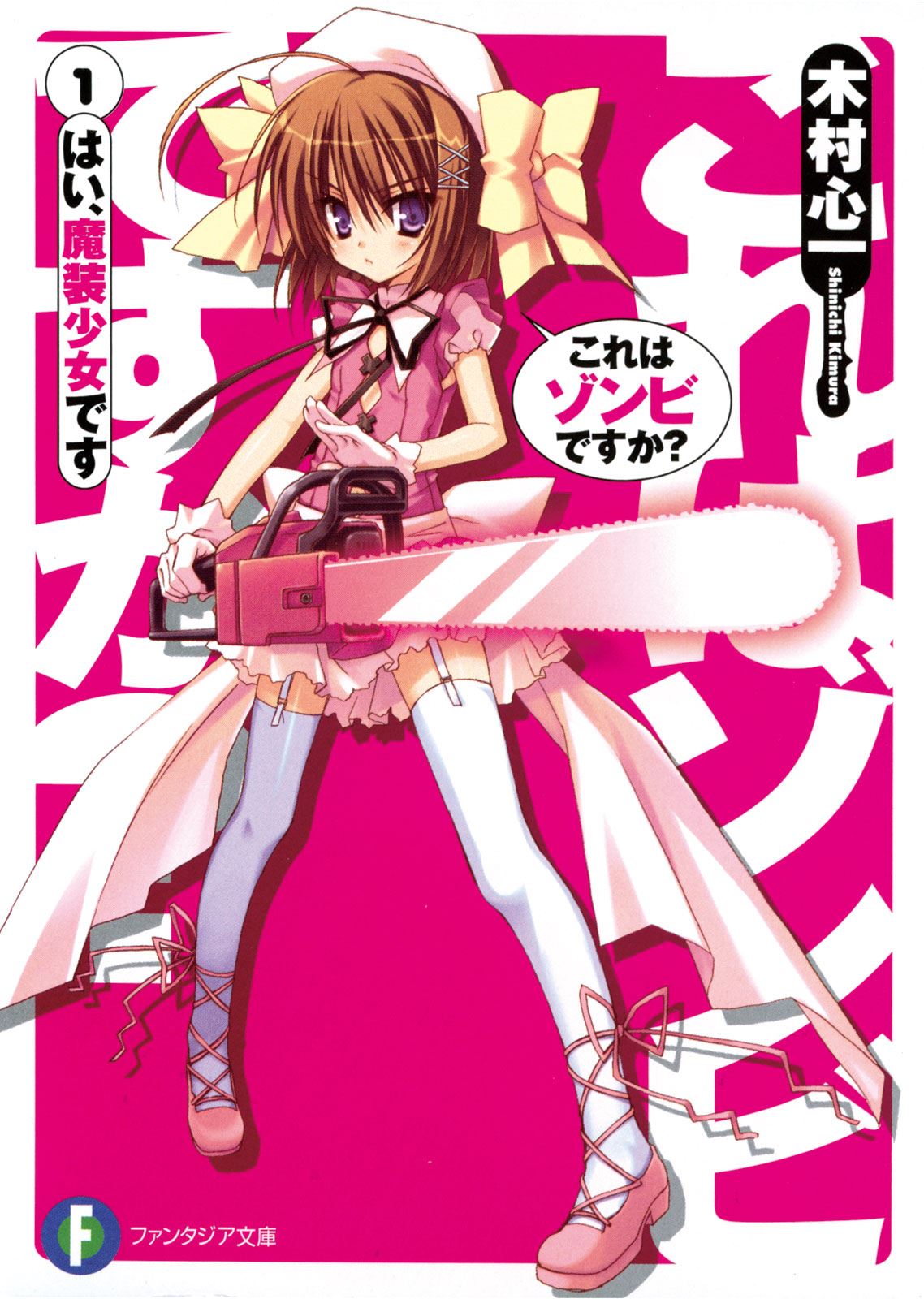
The sunlight imagery keeps coming back and it's not accidental. Ayumu explicitly states: 'If only the sun didn't exist, there'd be nothing to fear in this world.' He can't stand it. It blinds him, it hurts him, it's the reason he waits until night to leave school. The sun represents the normal world—the world of living people, of classes and routines and sunlight that burns. He no longer belongs to it. So where does he feel at peace? The cemetery. Moonlight. Cool breeze. Dark sky void of stars. The text literally describes it as shimmering only with moonlight, and he sits on a gravestone eating a rice ball like it's the Five-Star Resort. The cemetery is his natural habitat—a place of death that somehow feels more alive to him than anywhere else. That's rich symbolism: the living avoid graveyards, but for a zombie, it's home. And then there's the chainsaw named Mystletainn. Of course a magical girl's weapon is Arthur's legendary sword, flipped into a chainsaw. It rejects Haruna but accepts Ayumu. The artifact choosing the unexpected wielder—that's a classic motif, but it hits different here because Ayumu is literally dead. He's the outsider in every sense: not alive, not from her world, not even a girl despite being forced into the Magiclad role. The sword recognizing him says something about power not caring about labels. The whole setup feels like a meditation on belonging. Who gets to use magic? Who gets to rest? Who decides what's normal? Ayumu just wants peace. Instead he gets a tiny demon baroness, a cursed chainsaw, and a war between worlds. The irony is delicious.
... Read More
I need to talk about the Eucliwood scenes because they wrecked me in the best possible way. On one hand you have this absurd domestic situation where a silver-haired knight girl lives in your house and communicates exclusively through notepads while watching variety shows. It's hilarious. But on the other hand, there's this underlying loneliness that pulses through every interaction. The protagonist describing how he'd never been interested in girls before meeting Eu - how watching the loud giggling girls in class felt meaningless compared to this otherworldly being who communicated without speaking - that's genuinely touching. The cartwheel incident where he thought he'd ruined everything and then discovered she was laughing? Those small moments of connection feel so earned because the protagonist is someone who actively chose isolation. And yet, when he's cooking dinner for both Haruna and Eu, there's this domestic warmth that contrasts so sharply with the monster battles. 'Yaaay! I love you, big brother!' interpreted through his imagination of Eu's cute voice. He's building a found family without even trying, and the story treats it with genuine sweetness rather than mockery. But that ending - the blood splattered on the second-floor window, the word 'serial' starting to form - it reframes everything. All those warm moments with Eu suddenly feel fragile. What happened in that apartment? Who bled there? The contrast between the cozy dinner scene and whatever horror is hiding behind those silver hair and blue eyes makes the emotional whiplash absolutely devastating. I went from 'aww they're making kimchi pork together' to existential dread in two paragraphs and I'm not okay with that.

Leave a comment

You must be logged in to leave comments. or
