Summary

... Read More

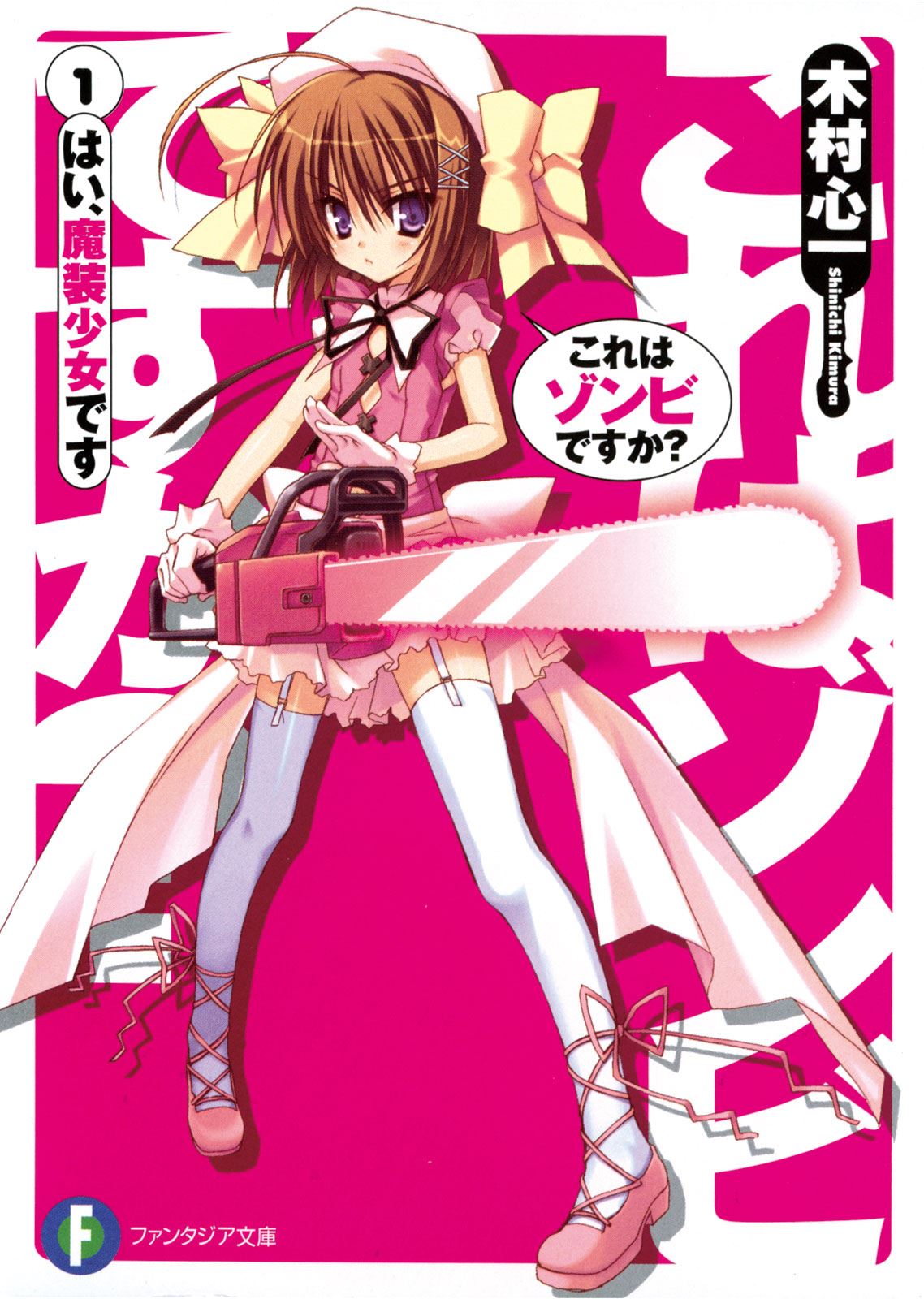
Ayumu Aikawa is a high school student who maintains a deliberately mundane existence, preferring the solitude of night and the quiet of his home. He harbors a single secret: he is a zombie. After being murdered by an unknown assailant wielding dual blades, he was resurrected by Eucliwood Hellscythe, a silent, silver-haired girl in full armor who calls him "big brother." Ayumu now resides in his family home, which has become a haven for supernatural beings. His peaceful routine is shattered when Haruna, a Magiclad Girl from the parallel dimension of Villiers, crashes into his life. Haruna is a small, foul-mouthed demon noble who wields a sentient chainsaw named Mystletainn. She accidentally lands in Ayumu’s cemetery hangout after being shot out of the sky, where she discovers that the chainsaw, which rejects her due to mana depletion, accepts Ayumu. It turns out Ayumu’s massive magical reserves have stolen her power, rendering him the only one capable of wielding it. Consequently, Haruna forces Ayumu to become her successor, dubbing him a "Magiclad Girl" despite his protests that he is male.

The core conflict arises from Ayumu’s dual nature as both an ordinary teenager and an undead warrior tasked with protecting Eu. He is reluctantly drafted into Haruna’s mission to defeat Megalo, creatures invading from Villiers that threaten both worlds. Ayumu’s zombie physiology grants him superhuman strength, pain immunity, and rapid regeneration, but he is forced to transform into a ridiculous magical girl costume to access the full potential of Mystletainn. The narrative establishes a strange household dynamic as more supernatural entities appear. Seraphim, a Vampire Ninja seeking to protect Eu for her necromantic power, arrives at their home. She engages Ayumu in combat at the cemetery, demonstrating her mastery of the Secret Art: Swallow Reversal. Although Ayumu is severely maimed during the fight, his immortality allows him to reattach his limbs and continue fighting. He ultimately spares Seraphim after realizing she is not the killer who murdered him, leading to her joining the household as another servant.

A key turning point occurs when Ayumu investigates the serial dismemberment murders that plagued the town prior to his death. Through his friend Orito, he meets Kyouko, a middle schooler who survived an attack by the same killer. Kyouko describes the attacker as having blue eyes and long hair, matching Eu’s description. This revelation casts suspicion on Eu, causing Ayumu immense distress as he struggles to reconcile the quiet, tearful girl who cares for him with the image of a cold-blooded serial killer. The mystery deepens when Eu inadvertently wounds Kyouko in a separate incident, further blurring the lines between truth and deception. Meanwhile, Ayumu faces escalating battles against increasingly powerful Megalo, including a Double-A class entity named Craw the Dastardly Villain. During this fight, Ayumu risks his life to save Orito from Craw’s lethal attacks, utilizing the chainsaw to alter local spacetime and wipe Orito’s memories to cover up the supernatural events.

The story direction shifts toward a larger threat as a Triple-A class Megalo, a massive whale-like creature named Ever-Losing Bluey, descends upon the city. Ayumu realizes that his current power levels are insufficient to defeat such a colossal enemy without significant preparation. He is forced to accelerate his training as a Magiclad Girl while balancing his domestic life with his undead responsibilities. The narrative explores the irony of his situation: he desired a quiet, boring life but is instead trapped in a chaotic world of magic, demons, and vampires. As he grows more accustomed to his new reality, Ayumu must uncover the true identity of his killer, protect Eu from those who wish to exploit her necromancy, and prevent the destruction of his world by the invasions from Villiers. The climax of this section sees Ayumu accepting his role, not as a hero, but as a reluctant guardian defending his new, noisy family against imminent annihilation.

Latest Release
DateGroupRelease
2026-10-01light novels translations c112
2026-10-01light novels translations c111
2026-10-01light novels translations c110
2026-10-01light novels translations c109
2026-10-01light novels translations c108
2026-10-01light novels translations c107
2026-10-01light novels translations c106
2026-10-01light novels translations c105
2026-10-01light novels translations c104
2026-10-01light novels translations c103
2026-10-01light novels translations c102
2026-10-01light novels translations c101

Community Reviews

Rating(0 / 5.0, 44votes)
5 stars
0(0%)
4 stars
0(0%)
3 stars
0(0%)
2 stars
0(0%)
1 stars
0(0%)

Popular reviews

... Read More
Let's talk about stakes for a second because this chapter escalated FAST. We went from a mild mystery about a missing artifact to Ayumu being bitten by an underworld watchdog to a house full of corpses in under thirty pages. And the scariest part? The actual killer is STILL OUT THERE. Cerberus One-Third tried to warn him. "They're—" And then he was dead. Three words. That's all the clue we got and it's agonizing. Whatever attack took out the dog, it was fast enough to bypass his perception entirely. A sword strike from chest to waist, clean and precise. Whoever did that isn't some random murderer. They're hunting. Specifically, they're connected to whatever killed Ayumu before—because Ayumu's immediate instinct wasn't self-preservation, it was recognition. He KNEW this feeling. The physical stakes are clear now: Ayumu can die again. And this time, unlike the Underworld where Eu brought him back, there's no guarantee anyone will救 him. Eu CAN heal him, yes—but the dog made that painfully clear. Every time she uses her power, she takes on the pain. So there's a limit. There has to be. And the moment that limit is reached, Ayumu is on his own. Meanwhile Sera's vampire ninja composure cracked for exactly half a second when a talking dog appeared. Haruna's entire arc about being a genius who failed because nobody could reach her is building toward something I can feel but not yet name. And Eu—stone-faced Eu who heals without hesitation—just became the most dangerous person in every room she enters. The chapter ends with a phone call about tofu. Tofu. After absolute carnage. And I need the next chapter immediately because I cannot process any of this.
... Read More
"In my arms, a warrior cried." That line honestly wrecked me. Like, we've spent so long seeing Haruna as this hyperactive, tsundere comedy relief character who yells about deviants and strikes poses, but right there in that moment she drops the act completely. The fact that without her Magiclad Girl form she can barely handle a little mana attack? That's not just a power gap—that's existential terror for someone whose entire identity is built around being a warrior. And she says it straight to Ayumu, of all people, the guy who's basically the only one who treats her like a normal person instead of a weapon or a joke. There's this one detail I keep coming back to: when she wraps her arms around his waist and says "This way, you can't see my face or my body. I... win." That's not childlike deflection. That's someone who feels exposed and vulnerable and doesn't know how else to ask for comfort without losing face. Ayumu just... accepts it. No teasing, no awkwardness. He rests his hand on her head and says nothing inappropriate. It's the most human moment between any two characters in this entire arc. Meanwhile Sera watches everything with those jade eyes and basically tells Ayumu to back off from Haruna later—protective in her own cold way, I guess. The trio dynamic is getting so much richer.
... Read More
There's a line in this section — probably the most important one in the entire book, and it lands so quietly you might miss it: 'Everyone had something they'd never drag into danger, something they just couldn't afford to lose. Everyone, including a zombie.' That's it. That's the thesis. The protagonist has died once already. He's walking around with a corpse's body, healing from injuries that would kill anyone else, fighting monsters in the sky — and his deepest fear isn't death. It's losing the people who make this absurd life worth living. Haruna. Eu. Sera, apparently, against his will. Orito. Kyouko, whom he's just met and already wants to protect. The imagery throughout these chapters keeps circling back to the body as both weapon and liability. He loses his arm, his legs — his whole lower half — and reassembles them like tools. But then with Kyouko, it's her broken arm in a cast, her cold hand on his forehead, the wooden sword hidden under her hospital bed like a secret. She's physically damaged but emotionally intact, and he's physically restored but exists outside normal human experience. They're mirrors. Sera's leaves are another symbol I keep coming back to. She turns falling leaves into swords, into wings, into weapons — nature itself becoming violence. But when she stops fighting, the leaves shrink and flutter to the ground and her eyes change from red to jade. Violence as performance. Violence as choice. She COULD kill him. She chooses not to. The green swords are beautiful and deadly, and when she lets them go, they're just leaves again. That's the aesthetic of this whole story: pretty things that hurt, hurting things that matter. And the whale — 1,830 meters of it, hanging in the sky like a cloud that forgot to disperse. It's so large it becomes abstract. You can't fight it with normal logic. The protagonist can't fight it with normal logic either. He's a zombie. He's already outside the system. Maybe that's the point — the people who don't belong are the only ones who can save everyone else.
... Read More
There's a strange beauty in how this text uses color and food to explore identity. The entire lunch is YELLOW. Not just yellow—AGGRESSIVELY, overwhelmingly yellow. An entire bento box filled with rolled omelet to the point where it's almost grotesque. And what does yellow represent? Caution. Warning. Something wrong. But also warmth. Nourishment. Care. That's exactly what this story is doing—it's warning you that something is off (zombie protagonist, magic lad girls, creature attacks) while simultaneously feeding you something warm and human. The transformation scene is pure visual symbolism. He shouts this ridiculous incantation—"Htaed fo regnibrah a tub gnimrahc dna ylevol!"—and his clothes EXPLODE. Light gathers around him. A skirt forms. He becomes what he never wanted to be. But here's the thing: the skirt is the SAME one Haruna wears. They're connected. They're the same. The Magiclad Girl uniform isn't just a costume—it's an identity forced upon him, but one he shares with someone who chose it. That tension between forced transformation and chosen belonging runs through everything. And the crawfish. Craw the Mage (or Dastardly Villain—I honestly can't tell which title fits better). A crustacean in a school uniform. It's ridiculous. It's horrifying. It's also deeply symbolic of how the mundane and the monstrous collide in this world. School uniforms, classroom settings, track club running on fields at sunset—these are the most ordinary, safe images. Then a giant lobster dude bursts through the window and everything changes. The text keeps smashing these two worlds together, and I think that's the whole point: there's no escaping the supernatural when it's wearing the face of everyday life.
... Read More
Let's talk about stakes because this book does not play around. Ayumu gets stabbed through the back with a sword-like weapon and we're supposed to believe he's just going to bounce back? The opening chapter establishes clearly that death in this world is not final, but it's still presented as terrifying. His hands are trembling. His heart is pounding. He's running through every possible way this could go wrong before walking into that house. "When in doubt, choose the braver path." That's the line that defines his entire character arc. He's not brave. He's terrified. But he acts anyway. And that's exactly why I care about whether he survives the next encounter. The conflict hierarchy here is fascinating. On the surface, there's the vampire ninja faction war—softliners wanting to recruit Eu versus hardliners wanting to kidnap or kill her. But layered underneath is a much more personal conflict: who is hunting Ayumu specifically? Someone attacked him in that house, and Eu says she's also being hunted. Two people, separate threats, same story. The tension of not knowing who the real enemy is keeps every scene charged—even the breakfast scene where everyone is just eating rice has an undercurrent of "these people could be enemies." The fight between Ayumu and Sera raises the personal stakes too. He's fighting someone who openly admires him mid-combat, someone who says "I underestimated you" with genuine respect. This isn't just a brawl; it's a clash between two undead beings who share more than they'd probably admit. And he lands a 230% strength punch to her face. Who does that? That's the kind of commitment to conflict that makes you invested in the outcome.
... Read More
There's this one moment early on that hit me harder than I expected. Ayumu sitting alone on a gravestone in the cemetery, eating a rice ball, thinking about how being alone proves everything is peaceful. That's not just a quirky character detail—that's a person who has accepted solitude as the only safe option. He became a zombie because he got caught up in murders, he died, and now he just wants nothing more than to exist without being bothered by the sun or people or anything. Then Haruna shows up. A chaotic, shirtless, chainsaw-wielding demon baroness who invades his space and won't leave. And honestly? I think part of him is weirdly relieved. Because for the first time since becoming a zombie, something happens. Something breaks his perfect monotony. His line 'Mom, I finally feel alive again'—coming from a dead guy—is the book telling us exactly what's going on beneath the comedy. I kept re-reading that scene where she tries to grab Mystletainn and gets shocked every time, and then he picks it up with no problem. The book doesn't make a huge deal out of it but it landed for me: she can't touch her own weapon, and this stranger can. She's furious and confused, and there's this vulnerability underneath all her shouting. She called him Big Teach on the phone too, which means she's not the untouchable genius she pretends to be—she has to answer to someone, she has responsibilities, she's not as in control as she acts. The chemistry between them isn't romantic yet, but it's there. It's two lonely people orbiting each other. He wanted a quiet life; she turned it upside down. And the read itself made me smirk the whole time. It's funny but there's something tender underneath all the chaos.
See all reviews

Custom lists

See all custom Lists