Fallen Idol Group - Reviews

Fallen Idol Group
+Add to Custom List
Sort
Add review
... Read More
Zhu Lianzhen walks into this scene thinking he's playing it cool, and honestly, the author makes us feel every layer of that performance. Here's a guy who literally narrates his own tactical calculations mid-conversation—"If I act timid, he'll definitely take advantage of it. I can't give him that chance!"—which is simultaneously hilarious and devastating because we know he's not fooling anyone, not even himself. He comes up with this whole elaborate script where he's the dominant one probing Tan Qing for answers, but Tan Qing just… doesn't play along. Not even a little. He's so unreadably calm that Zhu Lianzhen's entire strategy collapses. "Damn it. He's not following my script. He's not even hesitating." That line hit me so hard. Zhu Lianzhen is basically winging his emotional survival in real time, and every time he thinks he's gained leverage, Tan Qing deflates it with this gentle, almost pitying response. And then the ultimate power move—Tan Qing refuses to be the victim in Zhu Lianzhen's narrative. When Zhu Lianzhen offers him one chance to complain, to name his grievances, Tan Qing just asks the question that flips everything: "What's the point of you caring about this?" That's not defensiveness, that's genuine confusion. He doesn't understand why Zhu Lianzhen is so obsessed with closing old books when Tan Qing apparently already moved on. The relationship dynamic here is so beautifully messy. Zhu Lianzhen needs resolution because unresolved hurts bother HIM, but Tan Qing has apparently processed his and let it go. Who's really holding onto the past at this point?
... Read More
Okay can we just take a moment to talk about Tan Qing here because THIS MAN IS THE STANDARD. He waits up when Zhu Lianzhen comes back at dawn because he FORGOT HIS KEYS. He magically produces ingredients for midnight fried chicken cravings. He cleans up messes without being asked. And what does Zhu Lianzhen do? Nothing. Absolutely nothing. He just accepted it all like it was his birthright. I actually gasped when the narrative itself pointed this out: "he'd accepted all that thoughtfulness without a second thought, without ever properly saying thank you." THE GUILT. The author just dropped that little emotional nuke right in the middle of an otherwise lighthearted dorm scene and I felt it. But then look at how their dynamic has SHIFTED in this batch. They're in the bathroom together, bathrobes, half-dry hair, the hairdryer passing between them like some kind of charged object. Tan Qing says 'Your hair's not fully dry. Come here.' And Zhu Lianzhen's immediate instinct is to reflexively grab the hairdryer back and do it himself. That's not just independence, that's somebody who's suddenly hyper-aware of how close they are. And the whole snow leopard vs fennec fox thing? Tan Qing posting that baby fox pic after seeing Zhu Lianzhen's magazine selfie? That's not accidental. That's him saying something without saying anything, the way people in these slow-burn situations always communicate.
... Read More
This chapter does something I rarely see get praised: it builds suspense through stillness rather than action. The first three-quarters read almost like a sitcom—people talking, bantering, proposing increasingly absurd scenarios. There's a murder mystery bit, a trolley problem twist, romantic entanglement planning. It's light. It's funny. It lulls you into thinking this is just character-driven comedy. Then the structure pivots. Hard. The meeting scene ends and suddenly we're in the morning. Cameras are hidden. The test has begun. And in about four pages, the author transforms an ensemble comedy into a psychological thriller. Zhu Lianzhen sneaking back from his hotel, the deliberate timing, the stairway encounter—that's where the pacing tightens. Every sentence after that first greeting carries weight. The silence between them. The pause before Tan Qing asks about the perfume. The half-second where Zhu Lianzhen's eyes widen and you realize the test subject has already detected the tester. The author understands something crucial: tension isn't created by raising the volume, it's created by narrowing the focus. The scene starts with seven people shouting ideas and ends with two people on a staircase, one pretending to be something he's not, the other pretending not to notice. The crowd dissolves. The noise stops. And what's left is devastatingly quiet. The chapter ends on a fragment—'Just felt li'—which is either a cutoff or the beginning of something Zhu Lianzhen can't bring himself to finish. Either way, it's a perfect cliffhanger that doesn't scream for attention. It whispers. And that's infinitely more unsettling.
... Read More
"They'll always see you as their boy, always favor you—that kind of feeling. Can't you understand it?" — Tan Qing drops this line and honestly it changed how I see their entire dynamic. Zhu Lianzhen responds with this flippant "I'm a man now" attitude, but the narrator immediately undercuts him: "there was still very little about him that seemed mature." This is the thing that gets me about these two. Tan Qing sees right through Zhu Lianzhen's performative adulthood. He watches him the way someone watches someone they've known since before they were polished. That line about Tan Qing looking at him "just as he had looked at the Zhu Lianzhen from back then"—it hit me like a truck. There's this history between them that the text never explicitly states but you can feel in every pause, every glance. And then Pei Qiao calls during their ride home and Tan Qing deflects with "I'm not really in the right headspace lately" about a script choice. He's pushing away professional opportunities while sitting next to someone who literally just watched fans declare eternal devotion on a giant screen. The emotional contrast is brutal and beautiful. Who is Tan Qing protecting himself from getting hurt again? And why is Zhu Lianzhen the only person around him when all this is happening?
... Read More
I need to talk about this one moment because it has been living in my head rent-free. Zhu Lianzhen and Tan Qing brush shoulders during the choreography, and suddenly there's this cold sensation on his lower back. His shirt gets lifted slightly. Tan Qing's ring—'an intricately designed ring on his left hand, its sharp hook gleaming under the lights'—caught the hem of Zhu Lianzhen's shirt. I keep coming back to how casually this is written. It's not a romantic gesture. It's not dramatic. It's almost mundane, described like a minor wardrobe malfunction. But it's the most charged thing in the entire chapter. These two are performing in front of thousands of people, and in that split second of contact, something private happens. A touch that only one of them knows about. A gesture that says: I'm here, I see you, I'm aware of exactly where my hand is. And Zhu Lianzhen's reaction? He doesn't flinch. He doesn't pull away. His 'thoughts momentarily stalled' but then he just... refocused. Like this is normal between them. Like this level of intimate awareness during a performance is just their baseline. Then there's the whole thing with Xue Chun and his manager. The manager telling him to 'watch closely' as if Acemon's performance is some kind of lesson. But Xue Chun already knows he can't learn this. He's been told to be fanservice, to smile, to be charming, but it's all performance. The difference is that Acemon—especially Tan Qing—seems to have figured out how to be themselves on stage while still giving the crowd what they want. Xue Chun is still following instructions; they're creating something.
... Read More
'The free are tamed, they bow, they bend, to serve the crowd they once would fend.' This lyric isn't just cool words for a song. It's the thesis statement for everything happening in this chapter. Let's talk about that eagle imagery. The dynamic background shows a 'soaring eagle above a battlefield, rusted chains crossing through a blazing fire.' An eagle—that's freedom, flight, power. But it's also above a battlefield, and there are chains. Rusted chains, yes, but chains nonetheless. Is this about idols who were once free artists now bound by the industry? Or is it about the audience being the battlefield, with performers as warriors fighting for their attention? And then the lyrics continue: 'Free to take away, just only a guilty crown.' A crown that's guilty. Power with a price. The very thing that elevates you is also what confines you. Zhu Lianzhen's pearl-white hair, Tan Qing's hook ring, Xue Chun's practiced smile—all of these are crowns. All of these are costumes that hide the person underneath. Xue Chun is the most literal example of this theme. He's been 'tamed' by his company, trained to be exactly what they want. His fancam went viral, his group's popularity soared, and yet 'on stage, he had never truly been free to be himself.' The crown fits, but it's heavy. Acemon seems to have found a way to wear the crown without being consumed by it. Or maybe they've just gotten better at pretending. The abandoned high note, the ring touch, the removed in-ear monitor—these are small acts of rebellion within the performance. Tiny ways of being free while still serving the crowd. That's the paradox the chapter is exploring, and it does it through a song that doesn't even exist.
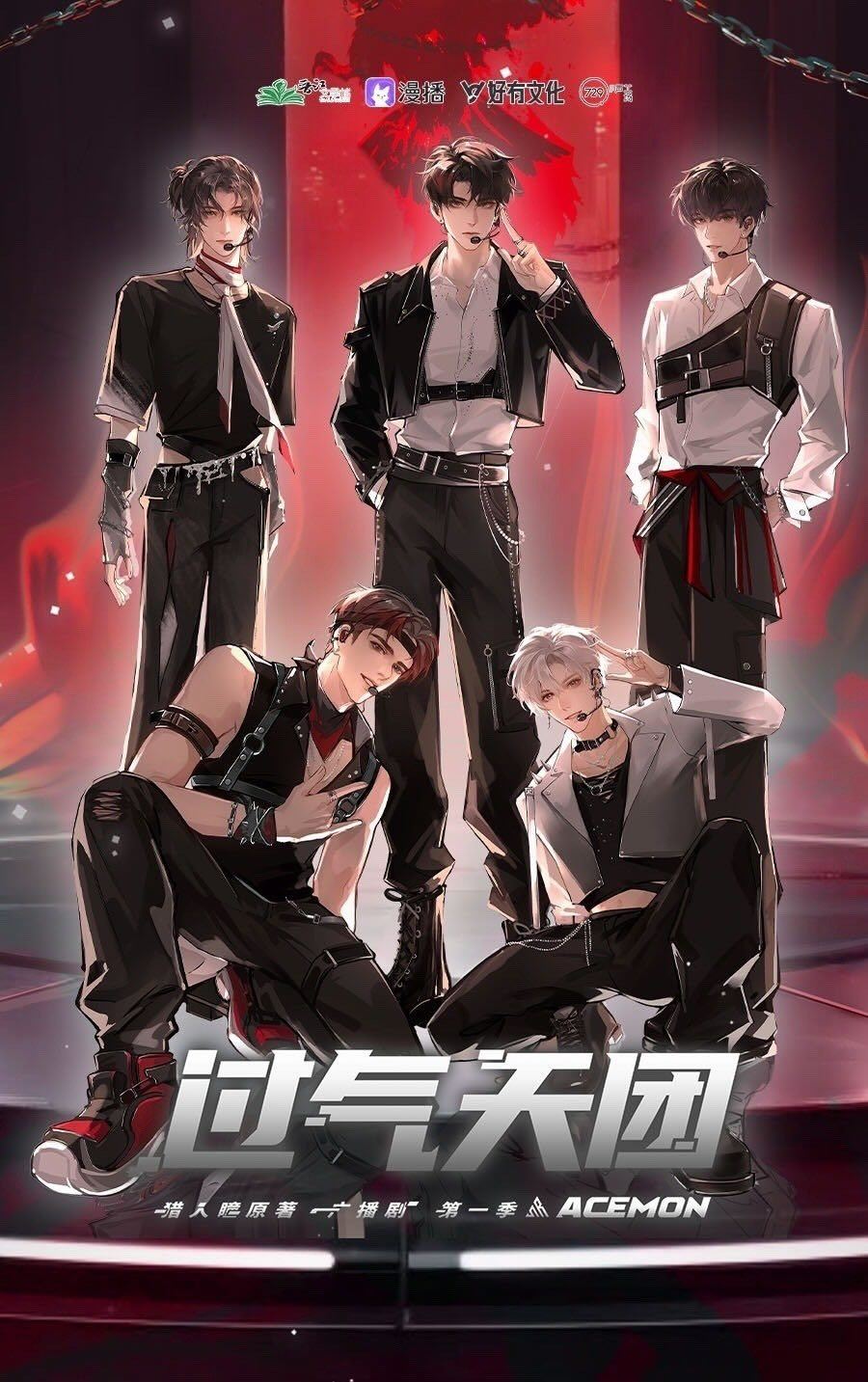
... Read More
Okay so here's the thing about this chapter—Zhu Lianzhen and Tan Qing are playing this exhausting game of emotional tag and I am SO TIRED for them but also CANNOT LOOK AWAY. The whole scene basically hinges on this one question: WHERE IS THE LINE? Zhu Lianzhen keeps saying Tan Qing crossed it, but every time he says that, the line has already moved again because Tan Qing is literally touching him and talking about their heartbeat. What killed me was the structure here. You've got the present-day tension—the Weibo post, the "do you still think you can like girls" moment—and then it CUTS to his childhood. That transition from "don't forget the agreement" straight into "when I was four years old I tried to run away from home" is not random. It's a damn plot device. We learn that Zhu Lianzhen has been isolated his whole life, surrounded by wealth but never truly free, and suddenly his insistence on keeping Tan Qing at "just friends" hits completely different. He's not protecting the friendship—he's protecting himself from something he can't control. The livestream where he accidentally declared he doesn't like girls (or anyone besides Tan Qing, apparently) isn't just comic relief, it's the inciting incident that forced this entire conversation into the open. And the ending? "When had he started giving Tan Qing a special place in his heart? Zhu Lianzhen couldn't clearly recall." Not a resolution. Just the question hanging there. The plot isn't moving forward—it's spiraling, and that's exactly what makes it addictive.
... Read More
Let's talk about Tan Qing for a second because this guy is fascinating. Zhu Lianzhen describes him as having 'unshakable composure,' but honestly it feels fake. Who doesn't lose their temper around teammates who get on everyone's nerves? Tan Qing's calmness is suspicious. Yet when he's making dumplings, there's a sliver of humanity—he chuckles at Zhu Lianzhen's dough-punching. That's a moment of genuine connection. Their relationship evolves from roommates to collaborators in the kitchen. Tan Qing hands over the apron, then takes back the knife work because Zhu Lianzhen's grip is off. It's practical but also intimate. The strawberry confusion is gold: Zhu Lianzhen thinks they're putting strawberries in the filling, Tan Qing just wants him to wash them and eat them separately. It shows how they misread each other but still cooperate. Tan Qing's obedience—the trait Zhu Lianzhen notices—isn't submission; it's survival. In a new environment, going along with others might be protective. But does he have a family conflict? The text hints he's been in the dorm the whole holiday, never went home. Is that sacrifice or isolation? Zhu Lianzhen's own family issues mirror Tan Qing's possible ones. They're both navigating belonging. The scene where Tan Qing suggests waiting until tomorrow for the confetti cannon shows patience, while Zhu Lianzhen is restless. Their dynamic balances impulse and calm. I want to know what's underneath Tan Qing's indifference.
... Read More
I've read this passage five times and I still can't breathe properly. Zhu Lianzhen waking up in a hospital bed, throat painfully dry, brain foggy, and his first instinct is to hide. He buries his hands in his hair and begs Tan Qing to treat whatever nonsense he spoke as sleep talk. The desperation in that request destroys me because we both know those words weren't nonsense. They were the only honest thing he's said in probably months. And Tan Qing — god, Tan Qing. He doesn't push. He doesn't press. He just sits there eating wontons and asks one quiet question that cuts straight through all of Zhu Lianzhen's deflection. You don't remember any of it? This is the kind of romantic tension that doesn't need physical contact or dramatic confessions. It's in the space between them, in the untouched companion bed, in the way Tan Qing wiped droplets of water from Zhu Lianzhen's lips when he was too sleepy to even open his eyes. That moment alone — feeding him water, leaning in to tell him to sleep — is more intimate than any love scene I've read. The author understands something beautiful here: the deepest emotions aren't always spoken. Sometimes they're in the silence of someone watching you sleep, in the decision to come back, in the question that hangs in the air like it has all the answers.
... Read More
This opening sequence is cinematic perfection. Midnight in the city center, Zhu Lianzhen driving past these enormous fan-made birthday displays, promotional images glowing everywhere. The author paints this scene like a film director—warm artificial light against the deep blue of night, the contrast between a superstar quietly observing from his car and the massive spectacle built for him. But then the real magic happens when the video starts playing. Paper clouds crumpled from actual sheets, a paper-cutout boy falling through the sky, a paper bird knocking him off course. Stop-motion animation described in words? That takes skill. The imagery is so tactile—you can almost feel the texture of the paper, the slight jerky movement that gives it soul. And then the music shifts to piano, night falls in the animation, the boy dreams and the landscape transforms into a starry universe. The description moves from the literal (paper cutouts in a city plaza) to the dreamlike (stardust, moonlight, red roses blooming from nothing) so seamlessly. What struck me most is how this fictional video-within-the-story mirrors Zhu Lianzhen's own journey—a boy falling into the human world, encountering obstacles, dreaming of something brighter, then taking flight toward unknown golden light. The author built an entire visual poem inside the narrative and it didn't feel forced at all. Just lush and intentional.
... Read More
Can we talk about how sharp this dialogue is? The exchange between Zhu Lianzhen and Tan Qing after the video ends is peak their dynamic. Zhu Lianzhen: "Fans say a lot of sweet things, but they're just words." Such a defensive, dismissive line, and you know he's lying to himself. Tan Qing doesn't even argue—just smiles and says nothing more. That silence says everything. Their voices are so distinct I never confused them while reading. Zhu Lianzhen speaks with this brash confidence masking vulnerability, while Tan Qing is all measured, economical words that carry double meanings. Then there's Pei Qiao on the phone—totally different energy even though we only hear one side. "Let's decide after the promotions. I'm not really in the right headspace lately." Classic Tan Qing deflection wrapped in professional language. And Zhu Lianzhen's internal monologue when he's thinking about fan culture? "He often thought about advising them to spend less on fan support." That's not dialogue but it has such a distinctive voice—reflective, slightly weary, caring in a practical way. The author never lets anyone sound the same. Even in narration, Zhu Lianzhen's perspective has this sharp, almost boyish directness while Tan Qing's moments of observation feel older, more weighted. When Zhu Lianzhen finally responds to Tan Qing's question about understanding fans with "I'm a man now," having just celebrated his birthday, there's this perfect comedic timing. It's ridiculous and telling all at once.
... Read More
I need to talk about this one line because it completely wrecked me. When Tan Qing leans in during the concert and whispers "You owe me this time" right before pulling away—that is the entire relationship crystallized in four words. Think about what that actually means. He's playing along with the fanservice, doing exactly what Koty screamed for, but the whole time he's using it as an excuse to be close to Zhu Lianzhen. The crowd thinks it's a joke. The camera loves it. But only Zhu Lianzhen hears the truth, and the reader, and it's so intimate it hurts. And then what happens after? The dressing room scene where he tries to kiss him and can't even finish because footsteps echo down the hallway. Not once, not twice but twice—almost kissed, interrupted, almost kissed again, interrupted. This man cannot even have a complete kiss without the world intruding. I'm not okay. The line that followed though—"So does that mean I can't kiss you anymore?" Said with this voice that easily swayed Zhu Lianzhen. That's not manipulation, that's just... genuine loneliness wearing a joke. How do you even fight that?

Leave a comment

You must be logged in to leave comments. or
