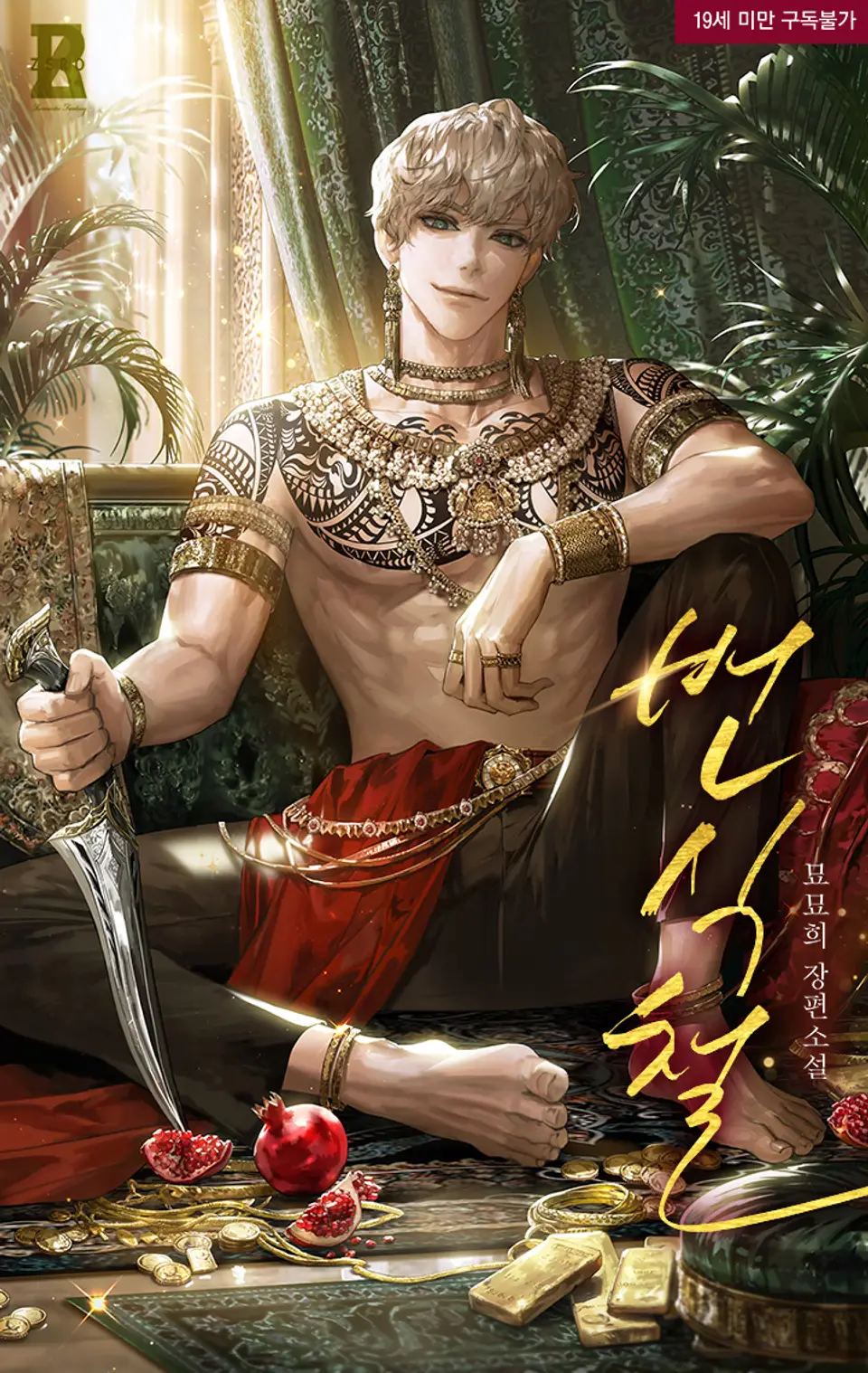
Let's be real—the worldbuilding in these chapters is so thick you could cut it with a knife. And I'm not just talking about the obvious desert oppression. The author drops us into the South with these lines: 'The South. The land abandoned by the gods. The buildings erected on the dry, cracked earth were all rough and imposing.' That's it. Two sentences and I already feel the heat, the despair, the sheer will to survive in a place that feels cursed. But then you get the Royal Palace with its high walls, the infected lurking outside, the guards rotating shifts because the heat is brutal. It's a society running on fumes. And yet, inside that grim setting, you have these three clans—Kalik in white, Aquafuran in blue, Nu in red—dressed by their godly affiliations, all gathered around a woman in gold who doesn't belong to any of them. Hiyes. The description of her immediately sets her apart, makes her a puzzle. And then there's Yasamin's 'home.' The text never shows it directly, but it haunts the chapter. Eltan thinks, 'The inexplicable place he calls 'home' is not here in the South. It's in the desert.' Even the word 'home' is used strangely—it's a sanctuary, a place even he can't enter freely. That absence builds more atmosphere than any detailed description could. And then we're inside Yasamin's study, a stark contrast to the outside world. It's dark, filled with old books, one of which he's read a hundred times. The marks on the page show his obsession, his stillness. The author notes, 'For them, living was not a dynamic act. It was more akin to a stillness.' That line reframes everything. This isn't a world of constant motion; it's a world of ancient, patient forces. The desert itself feels alive—not fertile, but waiting. When Yasamin explains to Siren that 'this land was turned back in time to a thousand years ago,' it's not just exposition; it's a revelation that the landscape holds memories, that water and life can be reclaimed. The scene of him touching her, the dark study, the cigarettes, the old books—it all feels like a capsule of preserved time. You can almost smell the dust and the tobacco. The author never over-describes; they choose precise, evocative details that make the world feel lived-in and ancient. I want to explore every shadowy corner of this desert kingdom.