Breeding Season - Reviews

Breeding Season
+Add to Custom List
Sort
Add review
... Read More
This author has somehow created one of the most compelling antiheroes I've encountered in recent fantasy reading. Yasamin is immediately established as terrifying—his fingers sharpen into claws, he crushes infected heads with his bare feet, and yet his violence is portrayed with a strange elegance that makes you root for him anyway. The blood on his platinum hair doesn't repulse; it ‘actually suited him,' like a man born from blood itself. That line alone perfectly captures how this character functions in the narrative. What fascinates me is how Yasamin's relationship with Siren unfolds. He calls her a princess with obvious malice in his tone, yet he's the one who physically shields her during the infected attack. When she sobs and apologizes for being Wilkeron—a nation that abandoned the South to its fate—he thinks to himself, ‘You're so foolishly kind.' But then he says to her face, ‘Just stay cute like you are now.' This contradiction is the whole character. He's simultaneously cruel and protective, dismissive and observant. The subjugation contract they form is fascinating too. Eltan explains it to Siren as if she should feel honored: ‘a subjugation contractor holds a higher status than a wife.' But Siren's internal reaction tells the real story—she finds dealing with people ‘uncomfortable' and just wants to survive. Their power dynamic is everything and nothing at once. She's literally his captive, yet he depends on her presence for political legitimacy. Eltan serves as the perfect foil to Yasamin. Where Yasamin is visceral and bloody, Eltan is clean and precise—literally pushing up his glasses while covered in red flesh. He's the strategist, the teacher, the one who recognizes Siren's blue eyes as valuable. Both men see Siren differently: one as a toy to amuse himself with, the other as an heir to position and usefulness. The traitor subplot adds another layer to the relationships. Yasamin's solution—scattering the survivors so the traitor will inevitably chase him—is cold but brilliant. And when Siren asks about Eltan during the chaos, Yasamin's response is pointed: ‘Why look for Eltan when I'm the one who saved you?' This isn't just protection; it's ownership. The author is building something complex here about dependency, gratitude, and blurred lines between savior and jailor.
... Read More
Okay the desert. The desert IS the main character at this point. Let me just say: I have never felt so hot reading a book. The way the author describes Yasamin's skin—"the color of porcelain shaped from grains of sand, softer than anything else"—I literally felt the heat radiating off the page. His body absorbing the sun's energy like he IS part of the desert ecosystem. This isn't fantasy worldbuilding with hand-wavey magic systems; this is visceral, environmental storytelling where the setting literally shapes what people look like and how they move. And the mansion!! A milky sandstone mansion sitting in the middle of a desert, appearing like a mirage, complete with servants who call Yasamin 'Master' and scold him for carrying a woman on his back instead of using a camel. The casual domesticity of it—Pamilla being summoned to wipe Siren's body, the old man fussing over protocol, Yasamin barking orders without even breaking stride—this is a society that has adapted to survive in hell. They have desalination technology, underground water, a ruling class that hoards everything, priests who perform rain prayers that never work. "To ask for rain… is it to make it rain?" "Even then, the rain will never come." That conversation hit me like a bucket of cold water. It's not just worldbuilding detail. It's an entire civilization trapped in a cycle of desperate faith and technological control, and Siren is about to walk right into the center of it all. The glowing mushrooms too—blue, beautiful, instantly lethal. Nothing in this world is harmless. That's the aesthetic.
... Read More
Okay, so this section hits different because it's doing three things at once and I'm still processing. On the surface, it's a continuation of Yasamin's quest—he's been at this for centuries, hearing prophecies about Aquafuran, and now he thinks he's found her. But the plot doesn't just move forward; it peels back layers. First, we get this quiet, almost mundane scene with Jin and Pamilla, which establishes the weird family dynamic of this immortal guy and his mystical companions. Then, Yasamin gets this weird moment where he *dozes off*—and for a man who hasn't slept in centuries because of his cursed existence, that's a massive plot signal. It means something is shifting, or someone is affecting him. And then we switch to Siren's POV, and the whole narrative scope widens. We learn she's not just some damsel; she's a sea monster (Siren Wilkeron), her body transforms in water, she was abandoned by her mother, and her father killed the midwife. That's a lot of backstory dropped through environmental details and her own reflections while she's bathing. The author is masterfully threading three plots together: Yasamin's external quest for a mythical figure, Siren's internal survival struggle, and the relationship plot that's growing between them. The tension comes from the intersection. He's looking for something he thinks he's found, but he doesn't know her true nature yet. She's grateful he saved her, but she's terrified of what she becomes in the water. The chapter ends on this domestic note—him combing her hair—but the plot is coiling tighter. I'm wondering if the "Circleit" mentioned will confirm her identity, and if it does, how that changes the power dynamic. Does he want a weapon, or does he want *her*? The narrative is playing 4D chess while making it feel like a slow burn.
... Read More
I need to process the emotional whiplash of Siren's internal monologue. The author does this thing where they let you hear her thoughts, and it's devastating. She goes from fear to gratitude to a bizarre, blooming acceptance, all in the span of a bath. The emotional peak isn't a grand confession; it's when Yasamin touches her forehead. She expects cruelty. She expects the 'demon' to hurt her. Instead, he presses her forehead gently and says, 'You naive thing,' because he can see her racing thoughts. That moment of being *seen*—not as a monster, not as a prize, but as a silly, scared girl—is huge for her. And then the water scene! When she transforms, she's hiding. She's terrified he'll see her scales, her tail, the 'hideous form.' She's spent her whole life being called a curse, abandoned by her mother, feared by everyone. The emotional stakes here are about vulnerability. If he sees her true form, will he reject her? Will he see the monster? The relief she feels when she decides she's 'happy in the water' is heartbreaking. It's her safe space. But then she pulls on the silk dress—a symbol of hospitality, of being treated as a 'Madam'—and her emotional wall cracks. She cries. Not from sadness, but from the overwhelming suddenness of kindness. 'He gave her medicine. He provided a comfortable place... As she pulled out the prepared clothes, she had to bite her lower lip hard to suppress the flood of tears.' That image broke me. She's accepting him, but she's accepting him through the lens of her trauma. She's thinking, 'If becoming his wife is destiny... I'll accept it.' Is that love? Or is it the love of someone who is drowning and grabs onto the first rope? It's complicated, messy, and so real. The romance isn't 'cute'; it's heavy with history and danger, but there's a tenderness there that makes me hope she learns to accept him for more than just survival.
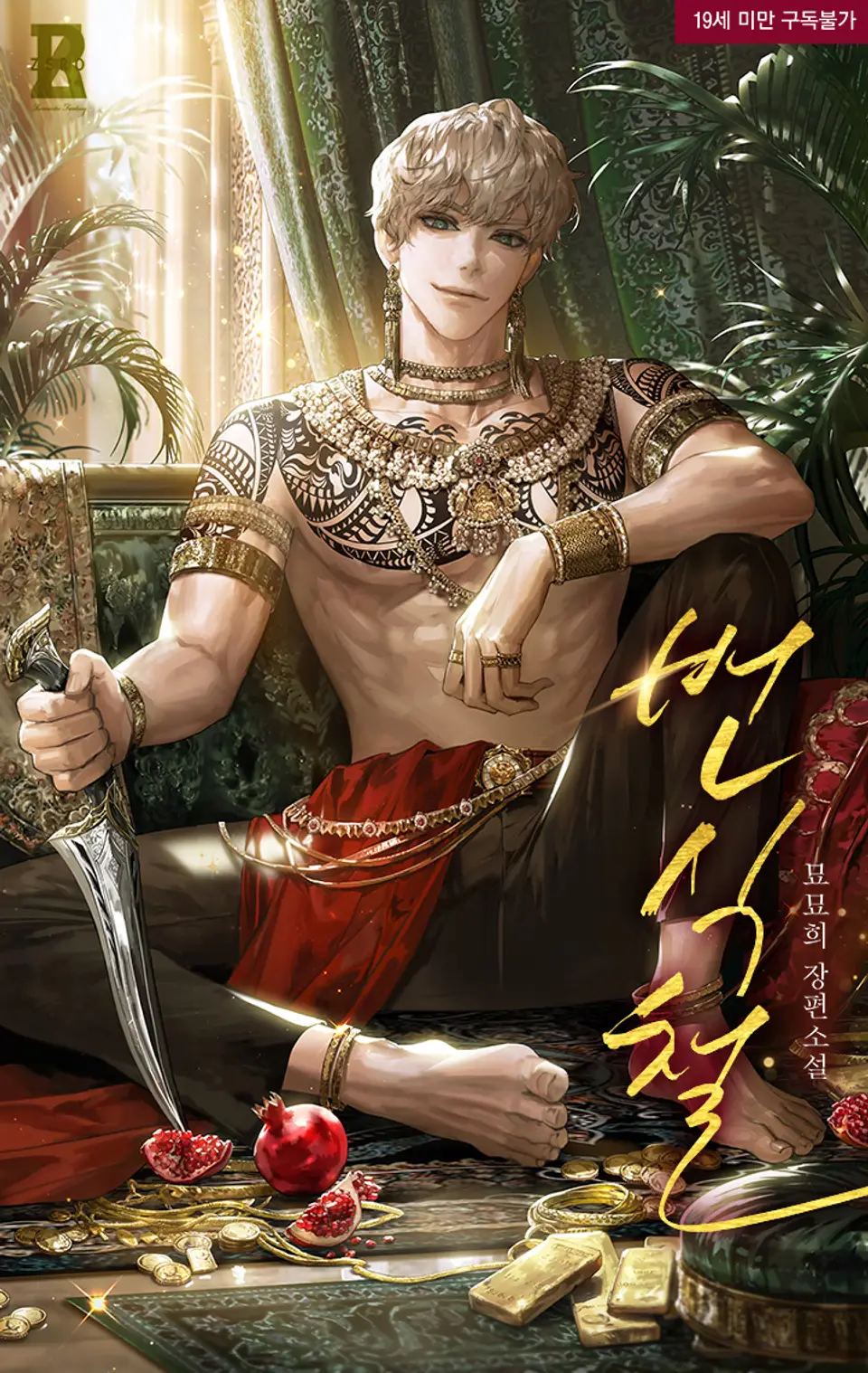
... Read More
There's this one line describing the bedroom and it's stuck in my head: "The silent bedroom felt like the cave of an evil dragon straight out of a fairy tale." I love this comparison. It reframes everything. Siren has positioned herself as the monster, the witch, the terrible woman. Yasamin is the dragon. And she's staying in his cave willingly. The fairy tale logic applies perfectly — dragons hoard, and he has hoarded her. But the subversion is that SHE is also a monster. Two monsters sharing a cave. That's the visual metaphor the author is building and I'm here for it. The book pile scene is equally vivid. Siren reclining among cushions, surrounded by titles like The Various Races of the World, On Origins, Conversations with Secretive Tribes, Beginner's Guide to Sorcery, If You Wish to Make a Fennec Fox Your Familiar, Runic Symbols, The Camellia Tattoo. This isn't just set dressing — each title is a window into the world. Fennec fox familiars. Runic scripts. Sorcery with a cost. A tattoo that matters. The world feels lived-in because the books feel real, like they could exist on an actual shelf. "A world meant solely for her unfolded at her pale fingertips, uninterrupted by anyone. The overflowing act of reading filled the emptiness in Siren's heart like nourishment." Reading as sustenance. That's such a powerful image for someone who's spent her whole life being denied basic human connection. The bath scene too — the scales creeping up her skin in water, the darkened eyes watching them. It's grotesque and beautiful at the same time. The author understands that atmosphere isn't just about describing locations, it's about describing how a character FEELS inside those locations. Siren in the bathtub isn't just cleaning herself. She's discovering acceptance in the most private, vulnerable way possible.
... Read More
The dialogue in this section is one of its greatest strengths, and the author gives each character a distinct voice that immediately signals who's speaking. Yasamin's speech is perhaps the most remarkable creation here. He speaks in short, often fragmented sentences—‘Hmm?', ‘Tsk', ‘Stay inside'—with an underlying casualness that masks his violence. When he asks ‘Do you know why the warriors follow me?' it's not genuinely curious; it's performative. His responses are dismissive and layered with double meaning. ‘Just stay cute like you are now' sounds like a compliment but reads as objectification. ‘This is everyday life' when discussing mass death is chilling precisely because he says it so casually. Siren's voice is defined by what she doesn't say as much as what she does. Her dialogue is peppered with stammers—‘U-um', ‘I- I'll try', trailing off mid-thought. She uses honorifics instinctively, and Eltan has to correct her: ‘Why do you even use honorifics? You were raised as a princess.' This isn't just character detail; it's worldbuilding through speech patterns. Her hesitation reflects her trauma and her upbringing simultaneously. Eltan's dialogue contrasts sharply. He's precise, complete sentences, explanatory. ‘The easiest choice would have been to dispose of you here—or simply set you free. But given the circumstances, there's no way around it now.' He's the narrator-figure within the story, the one who provides context and clarification. Even his physical actions—pushing up his glasses, sighing—feel measured and deliberate. The author also uses internal monologue brilliantly. Siren's thoughts often contradict her spoken words. When she thinks ‘Is she really crying over something like this?' about Siren's tears, it reveals Yasamin's misreading of her empathy. When she thinks ‘A person… another person had died' during the fight, it shows her inability to process violence. One line that perfectly captures the dialogue dynamics: ‘Why look for Eltan when I'm the one who saved you?' Yasamin isn't just asking a question; he's demanding gratitude and loyalty while simultaneously providing protection. The subtext here is enormous—dependency, obligation, possession—all compressed into one line.
... Read More
Can we talk about Angelique for a second because THIS WOMAN IS A MASTERCLASS in quiet cruelty. She's introduced to us absolutely shimmering—"perfect in every way," sculpted from "all the world's blessings," with eyes made of sweetness and lips suited for poetry. The narration explicitly tells us she's everything Siren isn't. And yet the text keeps returning to how her perfection is what protects her. "No matter what she did, she would always be forgiven." That line hit me like a physical blow because it's so brutally accurate to how real sister dynamics work—the beloved one gets away with everything while the other one punishes herself for existing. Her torture of Siren is so casually vicious too. She whispers rumors about mating with beasts at Siren's wedding and just... watches for a reaction. When Siren doesn't play along, Angelique pivots instantly to cruel compliments. And the prose about her: "Soft lips, suited for reciting poetry, twisted with malice." The author doesn't even need to show her cackling or anything dramatic. The contrast between her appearance and her actions is the horror. And then—the head rolling on the carpet. "Her head lay on the carpet, soaking it wet as it rolled. It had rolled so naturally, so effortlessly." I literally gasped reading that. Not because it was gory (though it was) but because it was the book's way of saying: the perfect sister is gone, and there is no one left to protect Siren now. The one person who tormented her is dead, and the person who's left is infinitely more dangerous. I can't even process this.
... Read More
I need to just sit with the image of this mansion for a moment. Warm sandy colors everywhere — walls, floors, ceilings — narrow high windows with colored glass. Then potted trees inside the house. Not little houseplants, I'm talking full-sized fig trees, pomegranate, palm, olive. Trees taller than a person. In a land where it rarely rains and the ground is basically sand. And then the garden outside, which Yasamin claims to have nurtured over many years, with a date palm he says is around five hundred years old. Five. Hundred. The reveal that Jin — the spirit in the lamp — granted this as a wish in exchange for a price is one of those moments where the worldbuilding just quietly rewrites everything you thought you knew about the rules of this setting. None of these beings are following normal human logic. Pamilla is a desert rat who maintains a human form and finds it exhausting. Jin is a wish spirit who serves Yasamin because he was freed from a lamp. Siren herself is… something that isn't human either, though she hasn't shown her true form yet. And yet no one treats any of them as strange. The most haunting detail for me was Siren pressing her hand against that ancient date palm and silently thanking it. This world feels lived-in, warm, and deeply strange all at once.
... Read More
I've been thinking about water in this novel and it's EVERYWHERE. The Aquafuran tribe—whose name literally contains 'water.' The rain prayer that never brings rain. The desalination machines controlled by the Aquafuran clan as a monopoly. The sapphire circlet that repels anyone without water energy. Even the pomegranate juice mixed with honey that saves Siren's life. Water is power, water is life, water is ownership, and water is mythologized into prophecy. But here's what really got me: the bone. Yasamin's arm tears open and bone extends from it like a weapon, and then it heals completely. In a world starving for water, his body produces something even more fundamental—skeleton, structure, the framework of life itself. He's not just a warlord. He's literally made of the things that outlast flesh. This connects to the prophecy in a way I'm only starting to understand: if Aquafuran is the water goddess, and Yasamin is the bone god, then Siren—the blue-eyed woman caught between them—is the bridge between two elemental forces. And the circlet. That ridiculous, stubborn headpiece that won't move from where its owner dropped it. A relic that literally refuses to be possessed by anyone unworthy. While kings and warlords and tribes maneuver over prophecies and political marriages, the circlet just… sits there. Knowing. Waiting. It's the most honest thing in the entire story. "Only the true owner can wear that circlet." Everything else is just noise.
... Read More
Let me just say this upfront: the way this arc handles the relationship development is genuinely impressive, even if the sexual content is the most obvious feature on the page. What struck me most wasn't the intimacy itself but what happens AFTER. Yasamin leaves the room, strips off his performative warmth, and becomes something entirely different — cold, calculating, empty. The narrator says it directly: "his face gradually losing all expression. He wore various expressions to match his persona, but in truth, this was closer to his essence. Nothingness. Emptiness." This is the plot's real mechanism at work here. Yasamin isn't becoming soft. He's using intimacy as a method of assessment while simultaneously hiding his true nature. And Siren? She sees right through it and accepts it anyway, because she thinks he can't possibly be sincere about her. Both of them are performing, both of them know it on some level, and that's what makes this scene a plot device disguised as romance. "The road to an unknown world is always unsettling. Even more so if it's the grim reaper who saved me from death, and the demon who pulled me from hell." This line appears early and it basically summarizes the entire power dynamic. But then there's the subplot thread Yasamin drops before leaving — the books about Sirens, the request to find more, the observation that Siren reacted sensitively to Siren-related things. And Jin's revelation that she can read runic script. "A Siren bloodline, then. But as far as I know, there are no Sirens in the Wilkeron royal lineage. Crossbreeding wasn't even possible in the first place." This is where the actual mystery plot thickens. Siren doesn't even know what she is, and Yasamin has been hunting for this answer his whole life. The bed scene wasn't just about dominance — it was data collection. Is that romantic or manipulative? Probably both. Which means, does Yasamin actually care about Siren as a person, or is she just the key to something bigger? Because honestly, the text gives me equal reason to believe either possibility.
... Read More
The stakes in these chapters are ratcheting up in the best way. On the surface, there's the ongoing threat of the infected—creatures that force the people of the South to live behind high walls, rotating guards in brutal heat. That's a constant, simmering danger. But the real tension is political and personal. Hiyes is clearly up to something. She's pressing Eltan for information about Yasamin's whereabouts, she knows about the princess, and she's advocating for the rain ceremony with a living sacrifice. Her dialogue with Eltan is laced with veiled threats and sharp observations. She says, 'If that's not the case, then there would be no reason for you to be so anxious and irritated.' She's dissecting him. Meanwhile, Eltan is caught between loyalty to Yasamin and fear of Hiyes's influence. The stakes for him are professional survival and personal sanity. For Siren, the stakes are even more immediate. She's a captive princess, brought to the South under unclear terms. Her relationship with Yasamin is ambiguous—is she a hostage, a wife, a experiment? The physical intimacy escalates quickly, but so does the emotional vulnerability. One wrong move and she could lose everything. Yasamin's immortality and power make him seemingly untouchable, but the text hints at internal conflicts. Why has he read the same book a hundred times? What is his 'home' and why does he retreat there? These questions suggest he's not as content or all-knowing as he appears. The external stakes—the possible sacrifice at the rain ceremony, the infected threat, the clan politics—clash with the internal stakes of trust, desire, and survival. Will Siren become a pawn in a ritual? Will Hiyes's machinations come to light? How long can Yasamin maintain his control while dealing with his own mysteries? The suspense is maintained through fragmented revelations and looming consequences. Every chapter feels like the calm before a storm that's been building for centuries. I'm on the edge of my seat.
... Read More
There are symbols stacked inside this section like gifts you don't know how to open. Let me try. Siren's scales. She's always hated them. Called herself a monster because of them. But in the bath, watching them appear, she finds them "slightly more tolerable." Why? Because she learns others like her exist. The scales become a symbol of belonging rather than shame — not because they changed, but because her context changed. This is the book's thesis statement about self-acceptance: your defects don't become acceptable. Your community does. "The Camellia Tattoo" — the book title itself is loaded. Camellias in literature traditionally symbolize perfection, devotion, and sometimes fatal beauty. A tattoo is permanent marking. Yasamin literally marked Siren's body with bite marks that serve as his claim. The book on his desk and the marks on her skin are mirrors — both are symbols of ownership, but one was chosen by her (reading the book, seeking knowledge) and the other was given without consent (the bites). Or was it? She didn't resist. She leaned in. "She was so lovely, fluttering her eyes and struggling." The line between resistance and surrender is thinner than either character admits. And then there's sorcery itself, introduced through the book Siren devours: "malicious sorcery inevitably rebounded onto its caster. Thus, when employing dark sorcery, a sacrifice was required to bear the retribution in the caster's stead." This isn't worldbuilding flavor text. This is thematic foreshadowing. Yasamin has been performing kindness while hiding darkness. The question the text keeps asking is: who is bearing the retribution for HIS actions? Siren, apparently. She's the sacrifice who doesn't know she's sacrificing anything. "Perhaps her mother recognized this Siren's true nature. That's why she hated, shunned, and tormented her so much." Generation after generation, women like Siren are destroyed because they're dangerous and don't know it yet. The novel isn't just a romance. It's about the cost of power you haven't learned to wield.

Leave a comment

You must be logged in to leave comments. or
