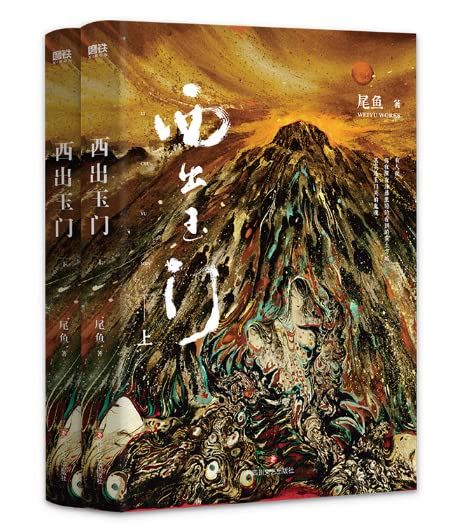
There is something deeply wrong with the landscape in this chapter, and I mean that in the most beautiful way possible.
Let me start with the description of Bailongdui itself: "The earth mounds here were covered in salt-alkaline soil, some in crystalline salt, and others in white clay. These tall mounds stretched and twisted, each at least a hundred meters long, resembling the massive body of a coiled dragon." Coiled DRAGON. The Chinese name 白龙堆 literally translates to "White Dragon Mound" and the author is NOT subtletying — this land is alive with symbolism.
And then the atmosphere: "Under the darkening twilight, the entire Bailongdui emitted a cold, pale light. The sky was empty, not even a bird in sight." No birds. Not a single one. This is a place where life literally cannot survive, and that emptiness is more terrifying than any monster ever could be.
But the moment that got me was the blood on the mound. "As darkness enveloped the area, the bloodstains on the mound suddenly sizzled and bubbled." SIZZLED AND BUBBLED. The salt-alkaline ground is so chemically aggressive that even human blood can't survive contact with it. The land itself is actively hostile. This isn't just atmosphere — it's a physical manifestation of everything wrong with this place.
Compare this to Chang Dong's earlier description of the region: "Calling it a yardang group is an understatement. It's a yardang city, notorious for difficult camping... it's said to be scarier than Longcheng."
Longcheng is already described as having more visitors, more tracks, paths worn by human feet. Bailongdui? "Ancient texts described it as a haunted place. Many passing the Ha-Luo Highway easily photographed Bailongdui, but few ventured into its core."
The author has built a hierarchy of danger here. Longcheng = dangerous but explored. Bailongdui = untouched, unhospitable, ancient, and deeply wrong. And the fact that none of the mounds have figures embedded in them yet — "The shapes of the mounds were bizarre, but none embedded with a figure" — creates this mounting dread that the real discovery hasn't happened yet, that they haven't gone deep enough.
The campfire scene is also incredibly vivid: Chang Dong setting up windbreaks, the small pot lid clattering as steam pushes against it, the water boiling and releasing the aroma of meat. In this desolate, inhuman landscape, these tiny domestic details — a pot of soup, a fire, two people eating together — feel almost radical. Like civilization itself is being recreated in the middle of nowhere.
The author is doing something masterful here: making the environment simultaneously breathtaking and genuinely threatening, while using small human details to highlight just how isolated and vulnerable these two people are.