Transmigrated into a Novel as the Scheming Villainous Second Female Lead - Reviews

Transmigrated into a Novel as the Scheming Villainous Second Female Lead
+Add to Custom List
Sort
Add review
... Read More
I need to talk about Xiao Wenjing because this character is doing something really interesting with the "second male lead" archetype. On paper, he's supposed to be the quiet, devoted guy who exists to support the female lead. But Ding Li's narration strips that away completely and reveals what's actually underneath: a calculating, sinister person who has broken Su Xiangqing's arm, injured her leg, and nearly killed her by pushing her off a cliff. And the worst part? No one else knows. Not Lu Qianchuan, not Chu Zilan, not anyone. The scene where he asks Ding Li about her injury is genuinely chilling. He doesn't ask it with concern—he asks it with calculation. "You don't remember?" Those words hung in the air like a threat. And Ding Li's internal reaction? Pure survival instinct. She's navigating a conversation with someone who could kill her and not even the other characters in the scene can see the danger. But what's fascinating is the dynamic between all four of them. Lu Qianchuan is the responsible one, Chu Zilan is the powerful protector, and Xiao Wenjing is the wolf in sheep's clothing. Ding Li is the only one who sees it, which puts her in this isolating position where she has to pretend to be the naive transmigrator while internally screaming. The moment where Chu Zilan gives Ding Li a handkerchief and Ding Li immediately thinks about how Xiao Wenjing is watching her with that look? That's such a specific kind of tension. It's not romantic tension—it's the tension of someone who knows something terrible about a person who looks perfectly normal.
... Read More
Okay, I need to talk about this plot structure because honestly it made me sit up and stare at my phone. The authors just keep layering deceptions on top of deceptions and I am HERE for it. You have the vine threads attacking the townspeople—that's the surface threat. Then Xiao Wenjing and Ding Li follow the vines and think they've found the Soul-Devouring Demon Vine. They fight through it, he stabs the heart of the tree, and THEN—bam—they fall into a trap. But wait, it's not even the real trap. The forest and the tree were an ILLUSION. The actual trial is the thorny shrub scene with the two running children. That's when Ding Li realizes: everything since they pierced the vine was bait. And the genius part? The system designed this so that even if you survive the physical threat, you still have to face your deepest fear. The illusion isn't random—it's personalized. For Xiao Wenjing, it's a memory of his past with Chu Zilan. That's when the plot does something really clever: it uses the trial itself to reveal backstory that the original novel never properly explored. The children running, the cave, the compass—each detail is a piece of a puzzle that recontextualizes the entire Xiao Wenjing/Chu Zilan dynamic. But then, right when you think the chapter is wrapping up, the lightning strike hits Ding Li. Is that part of the trial? A punishment? Or just the author being chaotic? I genuinely cannot tell and it's driving me insane in the best way.
... Read More
The opening scene is brilliantly mundane. Ding Li's morning routine is described with such specific, relatable detail that you can practically feel the exhaustion radiating off the page. Waking up at 6am, the half-hour bus ride, the packed subway, the 19-minute run to clock in one minute before the deadline. The beep of the punch clock. Ten minutes of slacking off. Lunch eaten in a rush. And the daily summary showing zero achievements, zero wins, zero income. This is worldbuilding through atmosphere - we understand Ding Li's world not through grand descriptions but through the crushing weight of routine. The overcast sky, the lightning, the rain... except it's not. "Just kidding! The weather today is clear, the sun is shining, and it's another day perfect for bosses to exploit employees while the staff wail in despair." That pivot from dramatic weather to corporate drudgery is hilarious and tells us everything we need to know about the tone. Then the transmigration hits and the world shifts dramatically. The antique-style decorations, the sturdy beams, the white robes, the flying swords. The contrast between Ding Li's modern sensibilities and this xianxia setting is where the humor lives. When she sees Lu Qianchuan in white robes with a sword, her internal monologue goes: "What's happening? Not cosplay? Transmigration? Ding Li, a struggling student, howled to the sky, covering her face with tears." The flying sword scene is particularly vivid. Ding Li clinging to Chu Zilan's waist, marveling at her slender waist, clicking her tongue in admiration - it's a moment of genuine wonder breaking through her panic. And then Chu Zilan suddenly diving downward with the sword, making Ding Li press against her back until they reach the ground. The physical comedy of it is perfect. The descent to the city reveals a world in crisis. "All the shops and houses in the city had their doors and windows tightly shut. Not a single person could be seen. The place had clearly become an empty city." And from far away, faint screams of someone being tortured. The atmosphere shifts from comedic transmigration to genuine danger in a single paragraph. The author knows how to pivot tones quickly, which keeps the reading experience dynamic. I also appreciate the visual contrast between the characters. Chu Zilan in white robes, pale and slender, with an expressionless face. Lu Qianchuan also in white, handsome but polite in a distant way. The new character - sharp brows, bright eyes, unbelievably handsome, with a poisonous tongue. Each character has a distinct visual presence that makes them easy to picture.
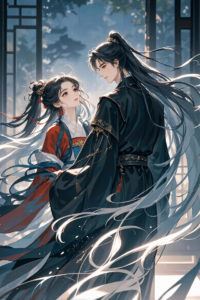
... Read More
"Immortal Master Xiao, how much longer until we arrive?" "...Before you strangle me to death." I am not okay. I am genuinely not okay. This interaction between Xiao Wenjing and Ding Li is so casually hilarious and yet it reveals SO MUCH about their dynamic. On the surface, she's using him as a human cushion and then clinging to his waist belt like a koala who has given up on life. But underneath that, there's this whole layer of tension where she's basically saying 'if I die, it's your fault' and he's just... accepting it? Like, he could've left her. He could've flown off alone. Instead he's dealing with her weight complaints while fighting vines. And then the compass scene. When he produces the bronze compass and makes it overlap with the child's version, pulling them into the illusion—that's not just plot mechanics. That's someone who has been carrying this memory alone, who can manipulate his own fears. He doesn't just observe the illusion; he INTERACTS with it. He rewrites it. And when Ding Li asks why this memory is his deepest fear instead of the obvious answer (Chu Zilan choosing someone else), his response is chilling: "You've got it wrong. The one who feared, that was only me in that instant." He doesn't explain further. He just walks away. And Ding Li, who just had a full existential crisis about the nature of cause and effect, has to scramble after him. This relationship is so uneven and so fascinating.
... Read More
Okay so let me get this straight. Our protagonist Ding Li is just a regular office worker, right? Gets up at 6am, squeezes onto a bus, endures the subway, clocks in one minute before 8am... classic corporate slave vibes. And what does she do after work? Read a terrible novel. Not just any novel - one so bad the readers spent a week scolding the author. And then she transmigrates INTO it. Of course she does. Because why would anything go smoothly? But here's the thing that actually got me - the plot structure is cleverly subversive. Most transmigration stories give the protagonist a guide, a helpful system, maybe a sympathetic character to explain things. Ding Li gets NONE of that. She wakes up and immediately faces the male and female leads. No exposition dump, no friendly NPC to explain the plot. She's just thrown into the deep end with Lu Qianchuan and Chu Zilan standing over her like she's some kind of specimen. And then the system drops on her like a ton of bricks. "Binding character Su Xiangqing." THE GREEN TEA VILLAINESS. The character readers wanted to strangle. The character whose entire purpose is to ruin lives. And Ding Li's first instinct? To negotiate. She actually tries to request a character change. "Considering that the character Su Xiangqing is not suitable for me personally..." I literally laughed out loud. This woman is so done with everything. The plot twist of her refusing to be Su Xiangqing and declaring her name is Ding Li instead? Chef's kiss. The system immediately shuts that down though. "Successful binding to character Su Xiangqing." Classic. Just when you think there's a way out, the universe slams the door in your face. And that initial task - use "Lovesickness Lure" on Lu Qianchuan? The horror. The absolute horror. What I love about this plot is how it sets up the central conflict: Ding Li vs. the System vs. the Plot itself. She's fighting on three fronts and she's already exhausted. The pacing is quick - we go from modern life to transmigration to system binding to immediate danger in just a few chapters. No filler, no unnecessary exposition. The author knows exactly what they're doing.
... Read More
I need to talk about the visual storytelling in this chapter because it is immaculate. Let me start with the opening image: townspeople with green veins surging violently under their skin, bleeding from seven orifices, limbs flailing. That's not just body horror for shock value—that's the vine making a physical statement about what it does to human bodies. You can SEE the parasitism. Then the Soul-Devouring Demon Vine itself. "Its crown was lush and vast, blocking out the sky. Twisted vines covered the tree, thick and flourishing." The fog drifting through the forest under a night sky, the green lights growing denser, the barrier shining so bright sparks would erupt. And then the sword diving downward with two heavy thuds. The physicality of it—all of it makes you feel like you're standing in that forest. But the most cinematic moment has to be the illusion sequence. The thorny shrubs, the two blood-covered children running, the narrow mountain path, the hidden cave. When young Chu Zilan turns around and Ding Li realizes what she's seeing—that moment of recognition hits like a visual punch. And then the space twisting, the compass appearing above Xiao Wenjing's palm, the entire scene shifting again. The author moves between these settings with such confidence that you never lose your bearings, even when the geography is intentionally disorienting.
... Read More
What's terrifying about this passage is how the stakes escalate without any dramatic events happening. Nothing 'bad' occurs for three years. No assassinations, no betrayals, no cultivation breakthroughs. And yet the tension is ALWAYS there, humming underneath everything like a power line about to snap. Ding Li knows what's coming. She knows Xiao Wenjing's role in the original story. Every peaceful morning at Mao hour, every snack shared with Lin Ziyuan, every glance at Qiyuan Peak's empty courtyard — she's living on borrowed time. The reader knows it too, which makes every cozy moment ache. The moment Xiao Wenjing appears at the trial and asks 'What are you looking for?' with that cold voice — the stakes just materialized. Up until now he'd been an abstract threat, a plot device, 'the malicious second male lead.' Now he's a person standing three feet away with a striking face and dead eyes. And Ding Li's response? She 'immediately suppressed her smile, adopting a thoughtful expression.' She has to perform normalcy while her entire being is screaming. This is the core tension of the whole narrative — she's a modern person with modern knowledge trapped in a story where knowledge doesn't equal power. She knows the plot but can't change it. She's cultivated for three years and is still essentially a weakling. The stakes aren't just 'will she survive.' They're 'how much of herself will she lose trying to survive?'
... Read More
Let me just say this - Ding Li's internal voice is EVERYTHING. The way she narrates her own suffering is so relatable and hilarious that I forgot I was reading about a transmigration villainess for a solid five minutes. Take this gem: "Other people pay money to read books, but reading this one costs your life!" That right there? That's the voice of someone who has been wronged by fiction itself. And then when she transmigrates, her first thought isn't "Oh my god, I'm in a novel" but rather "If this is truly transmigration, can I at least get a chance to go back and memorize the major events in history? Even if it's just the length of one song!" The contrast between her deadpan internal commentary and the actual dialogue is where the comedy lives. When Lu Qianchuan is being all polite and formal - "Miss, do not be afraid. This is Cangyun Mountain. You are already safe." - Ding Li's internal response is: "Safe? Come here and let me check whether it's safe or not." The sheer audacity. The absolute lack of filter. And then there's the system dialogue, which is delivered in that classic mechanical, emotionless way that makes everything funnier by contrast. "Wishing you a pleasant and joyful experience!" PLEASANT AND JOYFUL. Ding Li's response? "System, are you serious? You want this 'pleasant and joyful' experience yourself?" The author's voice in the narration is also worth noting. There's this wonderful meta-awareness throughout. The opening chapter literally starts with Ding Li reading a novel and complaining about the author, then she BECOMES part of that novel. The narrative voice carries that same sarcastic, self-aware tone that makes you feel like you're reading something that knows exactly how ridiculous it is. One line that stuck with me: "A villain can scheme endlessly, but one stupid idea from idiot beats everything. I have to admit, you're impressive. You're my natural enemy." Said to the SYSTEM. Of course she would roast the system. This woman would roast anyone. The dialogue between the characters themselves is more traditional xianxia fare - formal, polite, with underlying tensions. But it's Ding Li's voice that makes this read feel fresh and modern. She's the anchor, the comedic relief, and honestly the only reason I kept turning pages.
... Read More
I need to discuss Ding Li's voice because it is absolutely relentless in the best way. This woman has a modern sensibility crashing around inside a xianxia novel and the comedic timing is chef's kiss. When Lin Ziyuan tells her she has to wake up at Mao hour, her internal response: 'For a modern worker, waking up early is already difficult.' She's a transmigrated office worker who quit her job three years ago and she STILL thinks like one. The dedication to the bit is impressive. And her observations about other characters: 'this NPC is such a competent NPC!' Calling Lin Ziyuan an NPC. An actual NPC. While he's literally rolling up her bedding for her. But the voice isn't just funny — it's deeply self-protective. Every joke, every sarcastic aside, every 'heh, congratulations, my foot!' is armor. She's in a world where the second male lead will literally torture her to death, and her coping mechanism is to turn everything into a meme. The contrast with Xiao Wenjing's dialogue is stark. He says almost nothing. 'You?' 'Stop.' 'She knows I returned?' Three words, four words, five words. Maximum impact, minimum effort. And yet he's the most dangerous person in the scene. Chu Zilan barely speaks at all, which somehow makes her presence even more imposing. 'It does not matter. If you need me, come to Lingxiao Peak.' That's it. She waves her sleeves and leaves. The man who could destroy Ding Li's life gets less emotional investment than a part-time job.
... Read More
Okay so here's the thing that genuinely threw me for a loop—Ding Li transmigrates into a novel she supposedly knows by heart, right? And within the first few chapters, the system just casually drops that the plot has been "adjusted." Adjusted! Like she ordered a modification to a cake instead of her entire reality being rewritten. And honestly? I respect it. Because if the story had followed the original novel exactly, we'd just be watching Su Xiangqing get her comeuppance in the same predictable way every time. But now? Now everything is off the rails and that's where it gets interesting. The Soul-Devouring Demon Vine is a genuinely clever addition. It's not just some generic monster-of-the-week plot device—it's something that taps into psychological horror. People trapped in illusions, repeatedly falling into their deepest fears until they die. That's not action; that's dread. And the fact that it only appears at night? Classic but effective. It gives the story this creeping sense that safety is an illusion, that even daytime doesn't mean you're safe. What I found most interesting though is how Ding Li's knowledge of the original plot becomes both her greatest asset and her biggest liability. She knows Xiao Wenjing is a sociopath in disguise. She knows Su Xiangqing's fate. But the plot has shifted around her, which means her foreknowledge is only partially useful. It's like being a sports analyst who studied the old team roster but the players have all been traded. You still know the game, but the people on the field are different.
... Read More
Let's be real—the dialogue in this book works on two levels. There's what the characters say out loud, and then there's what Ding Li actually thinks, and the gap between the two is where the humor and tension live. Take this exchange: Xiao Wenjing: "What deeds? Tell me." Ding Li (out loud): "I have always deeply admired you." Ding Li (internally): *Tell you what? That you're a cannon-fodder second male lead?* That moment is perfect. She's literally flattering the most dangerous person in the room while mentally flipping him off. The contrast between her polite exterior and her furious interior creates this constant comedic tension that keeps the narrative voice fresh. And the System's dialogue is surprisingly effective for what it is. "Due to a system bug during the host's Transmigration, part of the plot has now been adjusted"—it's bureaucratic, dismissive, and infuriatingly unhelpful. It sounds exactly like a customer service bot that's been programmed to say the right things while accomplishing absolutely nothing. But the real standout is how each character has a distinct voice. Lu Qianchuan speaks in complete, measured sentences. He's the responsible one, and his dialogue reflects that. Chu Zilan says very little, and when she does, it's direct and functional. Xiao Wenjing's dialogue is sparse but loaded—every word feels like it has a hidden meaning. And Ding Li? Her voice is the most complex because it's always operating on two frequencies simultaneously. The narrative itself has this sharp, wry tone that matches Ding Li's personality. It's not flowery or overwrought. It's observant, occasionally sarcastic, and always honest about what's happening even when the characters are being dishonest.
... Read More
Let me just say — Cangyun Mountain is the dream. I read about the practice rooms on each peak, the dedicated classroom peak with a dining hall, the back mountain with caves richest in spiritual energy, large competition grounds, martial arts duels... this place has MORE amenities than my actual apartment complex. And the New Year celebration detail! 'The sect arranged lively celebrations every New Year, making it quite human-friendly.' Even the cultivators who supposedly don't care about worldly matters still get to enjoy festivals. The newly inducted disciples 'still cherished the pleasures of the mortal world.' This is a world that understands work-life balance. But the scene that really stuck with me was the disciple trial. The author paints this whole picture — sect leaders on stage, representatives from Tianji, Xianyin, and Wandu sects sitting in neat rows, disciples forming a dense crowd in the center. And Ding Li is just... scanning the crowd like she's at a convention, noticing how attractive everyone is. 'The Wandu Sect didn't sound very reputable, yet the male in front had a strikingly attractive face, with red lips and white teeth.' I literally laughed out loud. She's treating a life-or-death cultivation assessment like a fan meet-and-greet. The contrast between Qiyuan Peak (desolate, no visitors, 'politely peaceful, bluntly desolate') and Qingluan Peak (bustling, social, where she actually lives) really maps onto her whole existence — she's permanently between spaces, never fully belonging anywhere.

Leave a comment

You must be logged in to leave comments. or
