Rose of the Abyss - Reviews

Rose of the Abyss
+Add to Custom List
Sort
Add review
... Read More
Let me just sit with this for a second. The entire external conflict of this chapter revolves around a bureaucratic obstacle that sounds minor but is actually a death sentence in disguise. The military won't recognize Chu Ci's temporary ID. No subsidy. No legal protection. No record that she exists. If Chai Yuening couldn't have worked out that responsibility letter arrangement, Chu Ci would effectively be a ghost in this system—and in a world where being unrecorded might mean something far worse than mere inconvenience. What makes the stakes so quietly terrifying is that Chai Yuening doesn't seem to fully grasp how dangerous this actually is. She treats it like a nuisance. A form to sign, a line to tug, a headache to solve. She 'had no idea' what the responsibility letter was even for. She just signed it because the alternative wasn't acceptable. That's not bravery, that's love operating on instinct. Meanwhile, the infection test kit sits on the coffee table like a loaded gun. Chu Ci sees it, doesn't touch it, and walks away. Is she protecting Chai Yuening from the answer? Or is she bracing for the moment Chai Yuening finally asks the question she's been avoiding? The internal stakes—the fear, the unspoken knowledge between them—are infinitely heavier than any external threat. And that's what keeps me up at night. Not the Fog Zone, not the extinct species, not the military. It's two people in a dimly lit underground apartment, one of whom is slowly disappearing from the world, and the other who is slowly figuring out how much she's already lost.
... Read More
Let me just say this upfront: the stakes in this passage went from "dangerous mission" to "existential collapse of everything" in about three pages and I was not ready. The Military's admission that they cannot hold the outer districts is the kind of moment that recontextualizes every victory the characters thought they'd earned. Chai Yuening has been carrying guilt like a second skeleton, and now the Base is literally confirming that she was never going to be enough—that no one individual, no matter how capable, could have prevented this. The self-destruct system detail is genuinely chilling. The Base built these outer districts with a kill switch, meaning from day one there was always a contingency plan to nuke their own people rather than let the mutants take them alive. That's not strategy, that's desperation dressed up as logic. And the Floating City? The one silver lining that the major general dangles like a carrot? Retaking the surface signal towers. Against black vines that regrow overnight. Against fog zones teeming with giant mutated beasts of unknown levels. A mercenary team of six people. The author is stacking impossibility on impossibility and I'm hooked because the alternative—staying and being incinerated along with the district—is literally worse than any suicide mission. Chai Yuening's internal conflict is the core engine here. She doesn't want to run. She wanted to fight. But the math doesn't lie and she knows it. The most tense moment isn't an action scene, it's her sitting on that bed in the back of an armored vehicle, chewing her lip, listening to Lao Xiang crack jokes up front while she tries not to fall apart. That contrast—the ordinary conversation about vehicle prices vs. the apocalypse happening outside—is what makes the stakes feel real instead of theatrical.
... Read More
I have never related to a comfort scene more in my entire life. Chu Ci walking into that cabin and just sitting down beside Chai Yuening—no grand speech, no dramatic music, nothing—just straight facts delivered in that flat tone of hers. "You couldn't save those people, but that doesn't mean they died because of you." I actually sat there and stared at my screen. This is the kind of emotional honesty that most authors would ruin by making it some pretty poetic monologue, but Chu Ci says it like she's stating the weather. And yet it works. It actually works. Because Chai Yuening was drowning in guilt over the ventilation system decision, over the people she couldn't save, over the fact that her instinct was always to stay and fight while everyone else kept telling her to run. And Chu Ci basically says: you did what you could, stop punishing yourself for being human. But then Chai Yuening pushes past that and drops the real thing—the Du Xia thing. "If Du Xia is still alive, she must be waiting for us too, but I… all I can do is keep running." And the chapter just... trails off there. Not even a full stop. It's like the author knew exactly how devastating that moment was and refused to let us have closure. The friendship between these two is so quietly devastating. Chu Ci isn't warm, she isn't soft, but she shows up. She sits down. She speaks the truth even when it sounds cold. And Chai Yuening lets her. There's this whole unspoken history between them that the text never dramatizes but you can feel in every silence. "You're not here to comfort me, are you?" "Do you need it?" Two lines and I'm emotionally compromised.
... Read More
We went from city-wide invasion to personal stakes in the span of three pages and I am NOT OK. The outer district attacks are catastrophic on a macro level—seven districts lost, defenses compromised, ventilation systems weaponized against the inhabitants. But the real tension shift happens when the narrative zooms in on Chai Yuening's specific losses. Her communicator is gone. Her teammates are scattered. She saved strangers but couldn't protect the people she was with. That guilt is a ticking time bomb. And layering on top of that is the Chu Ci mystery, which operates as internal conflict. Chai Yuening can't trust what she doesn't understand, but she also can't afford to alienate someone who apparently has the power to repel beast hordes with a mist. The stakes here aren't about dying—they're about betraying your own instincts versus surviving. Every time Chai Yuening gets closer to figuring out what Chu Ci is, she risks losing her only advantage. The bathtub overflow moment is almost comedic but it's also a perfect metaphor for the situation. Chai Yuening is overwhelmed by information she doesn't know how to process, sitting in a tub that's going to flood unless someone turns it off. Someone who then walks away without explanation.
... Read More
Okay, let's talk about Ban Xiangming for a second, because THIS man is carrying SO MUCH internal conflict and I am HERE for it. Remember how Chai Yuening described him earlier—as this old fox who never did any real work? And then in this chapter, he's the one standing at the west gate, megaphone in hand, preparing to stay behind and possibly die while he escorts residents to safety? The shift in her perception alone is worth the read. But it's what he DOES that really destroys me. There's this one moment—just a flicker—when he sees You Lan in the back seat and his expression changes. Relief, maybe? Or something else? And then he quickly looks away. What is THAT about?? Is he attached to You Lan? Did he feel guilty about something? The author doesn't explain it, and honestly, I respect that. Some things you just have to sit with. Then he asks about her vehicle—"a large military model. It can fit quite a few people, Captain Chai"—and she promises to fit in as many as she can. He thanks her. He waves her off like it's nothing. And then he just... walks back into the crowd. Back to his duty. Back to whatever fate awaits him. The stakes here are REAL. We're not talking about some vague apocalypse—we're talking about HUNDREDS, maybe THOUSANDS of people who can't escape, and the military has made the utilitarian decision to raise the wall. Save the many, sacrifice the few. Classic dystopian moral quandary, but executed with such cold efficiency that it makes your skin crawl. And Jing Mu asks, "What will happen to the people inside?" And the text says "It was a meaningless question, yet it was one that countless people who had managed to escape couldn't help but ponder." That's the kind of line that sits in your chest for days.
... Read More
"All living things are fusing and evolving. Humanity is too weak. If we can't keep up with them, we will sooner or later disappear into the long river of history." Ge Heguang says this and I couldn't breathe. Not because it's dramatic — though it is — but because it's TRUE. The whole novel has been circling around this question: what does it mean to be human when humanity itself is obsolete? And the symbols keep piling up on top of each other like debris after a collapse. Think about the four bases. North, South, East, West. The cardinal directions. The foundations of the old world. And they're ALL gone now. The Desert Base swallowed by green. The Sea Base drowned beneath black vines. Each one representing a different human strategy for survival — altitude, aridity, ocean, underground — and NONE of them worked. The symbolism is almost cruel in its completeness. Humanity tried every angle and the world said no. Then there's Chu Ci herself, floating in these blue experimental tanks, preserved like the specimens around her. She IS the boundary between human and the new ecosystem. Not quite one, not quite the other. And Ge Heguang — exhausted, desperate, the last man standing in a dying world — he looks at her and sees not a monster but a QUESTION MARK. A living question mark about whether humanity has a future at all. The colored lights from the author's note — "like the outside" — that image haunts me. Light as hope, light as danger, light as something beautiful that might also destroy you. That's this whole story in a nutshell.
... Read More
The stakes in this chapter are fascinating because the author does something almost risky: they raise the stakes by temporarily lowering them, and it makes you care MORE instead of less. Think about it. Up until this point, the outer city has been running on a countdown. Self-destruct. Mutated beasts at the gates. No rescue. The tension was palpable, suffocating even. And then Chai Yuening delivers the news: the distress signal worked. The self-destruct is POSTPONED. There's still hope. Any lesser writer would have immediately introduced a new threat to keep the tension high. Instead, the author lets us breathe. Lets us feel the weight lifting. Lets Lao Xiang buy alcohol, lets You Lan get drunk, lets the whole team sit around a coffee table and imagine a future where they're not constantly looking over their shoulders. And that's when the real conflict emerges — not external, but internal. Ren Dong's trembling mouth corners. Chai Yuening's unacknowledged sadness. The ghost of Du Xia sitting empty at the table. The base's history of cruel decisions that no one discusses. The crushing uncertainty of whether this hope will actually hold. The stakes have shifted from "will they survive today?" to "what happens if this hope fails?" And honestly, that's worse. Because now we've seen what it looks like to let go of fear, and we know how much it will hurt when it comes back. Ge Heguang's line about pressing forward "by any means necessary" echoes through the whole chapter like a drumbeat. The base chose to send a distress signal instead of fighting. They chose hope over self-reliance. And the author is asking us: what do you赌 when the alternative is annihilation? What do you risk when giving up is literally impossible? Chu Ci's silence at the end — she doesn't answer Chai Yuening's question about what she was doing. She just sits there, watching the captain perform optimism like a job. What does she know that makes her happier than everyone else but sadder than anyone she knows? That's the real question hanging in the air, louder than any explosion, sharper than any mutated beast.
... Read More
I need a minute. Actually, I need several minutes because my heart is literally racing. Let's talk about that whispered line: 'If you want to leave, I can get you out.' Chai Yuening says this at the most vulnerable moment — when they're at the front of the testing line, her rationality stretched to its absolute limit, and she just needs to make sure Chu Ci is safe. She thinks she must have gone mad to even suggest it. But underneath that is the truth: she cannot bear the thought of losing Chu Ci, and she would break every rule in this world to keep her. And Chu Ci? She doesn't respond. She doesn't need to. She walks forward and passes the test. Then she chuckles. That laugh — it's not mocking, it's not dismissive. It's warm. It's relieved. It's the sound of someone who heard what was left unsaid and understood completely. The way Chai Yuening's cheeks flush afterward is the most devastating detail. She's flustered, embarrassed, but also secretly thrilled that Chu Ci didn't reject her. That tiny moment of vulnerability between two people who've seen too much death to afford normal romance? Absolutely lethal. Also — Chu Ci pressing her lips together when Chai Yuening thanks her. The silence between them when Chai Yuening can't find words. The weight of everything they DON'T say to each other is heavier than anything they do say. I'm not okay.
... Read More
Okay can we talk about Chai Yuening's dynamic with this amnesiac girl for a second? Because this is genuinely one of the most compelling relationships I've read in a while. On the surface, it's a classic protector-and-protected situation. Chai Yuening saves her, helps her walk, offers her resources and support. But there's something deeply unsettling underneath it all. This girl doesn't respond the way a normal traumatized person would. She's too quiet, too watchful, too... vacant. When Chai Yuening makes that joke about maybe they're both dead and this is all a hallucination, the girl's reaction isn't comfort or sadness—it's guilt. She looks at Chai Yuening with 'a trace of guilt flashing in her eyes' and quickly shakes her head. Why would she feel guilty for being part of someone's hallucination? I keep thinking about how the narrative frames her body language. 'The woman in the passenger seat, holding a sniper rifle'—she's constantly armed, constantly vigilant. 'Whether in Luo Kun's vehicle or hers, this young girl always liked to shrink into a corner.' She's a survivor, but not in the same way Chai Yuening is. There's something almost feral about her, like she's been through things that regular people couldn't process. And then there's the reveal about her memory loss. When she says 'I can't remember anything,' Chai Yuening's response is pure instinct— reassurance, hope, practical solutions. But the girl stares at her with 'a hint of confusion in her eyes, as if she hadn't quite understood the question.' That's when it hit me: what if she genuinely doesn't have a name to give? What if she's not hiding something, but actually empty? Or worse—what if she's something other than human? I can't stop thinking about this.
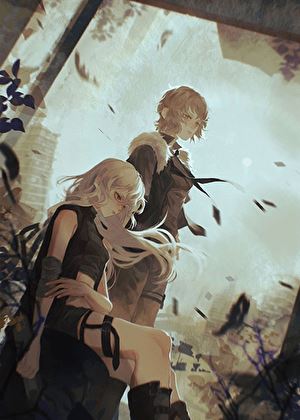
... Read More
I need to talk about this scene where Chai Yuening reaches out to smooth Chu Ci's hair after she wakes up from sleeping on her shoulder. That's it. That one gesture. A wave of "inexplicable nervousness washed over her." She pulls her hand back and looks away. That's SO much subtext packed into two sentences. These two have clearly been through things together. The Fog Zone. Ventilation shafts. Mutated beasts. And yet Chai Yuening was afraid to ask Chu Ci about why the beasts left, because "everyone has their secrets. Curiosity isn't an excuse to pry." That's not just politeness—that's genuine care. She's protecting Chu Ci's privacy even when she's curious. That's a deeply intimate kind of respect. And Chu Ci's response? She just smiles and looks out the window. No explanation needed. She knows. And then later, when Chai Yuening is on night watch, Chu Ci tiptoes in and says "So I'll keep you company." That's not just companionship. That's someone choosing to stay awake in the dark specifically because the other person needs them there. Meanwhile, the rest of the crew being their usual chaotic selves—Ren Dong bringing up Luo Kun's death to shut down Lu Qi's optimism, Lu Qi immediately firing back about Ren Dong being the talker—that's the kind of group dynamic that makes you feel like these people are a found family. They bicker, they threaten each other about jinxing things, but they're together. Always together.
... Read More
'Ren Dong, when are we getting a new one of these damn things? It's useless.' 'The Base's signal tower is buried. It's a signal problem; new or old, it's all the same.' Feels like there's no end to these damn days.' If we ever reach the end, we won't have heads left,' Ren Dong said. Holy shit, these two have HISTORY. You can TELL it. Four lines of dialogue and I already know they've been stuck in this garage-base together through worse shit than a broken radio. Lao Xiang is the loud, frustrated energy—wiping sweaty palms on his clothes, smacking the radio like it personally offended him. Ren Dong is the dry, exhausted anchor who just keeps telling the truth nobody wants to hear. Their voices are completely different and I love it. Then you've got Chai Yuening's narration, which is this whole different vibe—clinical, Observational, slightly detached but with these flashes of real emotion that sneak through when she's talking about the girl. The author gives each character a distinct register and it never blurs. Even the news broadcasts at the start have their own bureaucratic, hollow tone that contrasts perfectly with the messy human conversations happening around them. The only thing I'd note is that some of Chai Yuening's internal monologue edges toward exposition—I get it, the author needs to establish stakes—but the dialogue between the base trio is so natural and lived-in that it more than makes up for it.
... Read More
This chapter moves at a deliberate, almost meditative pace—and I mean that as a genuine compliment. There's no rush, no forced drama. The author just lets the scene breathe: the drive through the fog, the bickering to lighten the mood, Chai Yuening drifting off to sleep, waking up to find Chu Ci leaning against her, dinner, then the long night watch. The structure mirrors the actual experience of traveling. You have the arrival and settling-in phase, the warm middle section with food and conversation, and then the nighttime sequence where everything slows down even further. By the time Chai Yuening is alone in the cockpit at 2 AM, the chapter has basically held its breath. The rain starts. The wind picks up. The danger monitor ticks. And then— "The Base had chosen to believe in hope, but that" Cut to black. That rhythm feels intentional. The author spends the first half making us feel safe—the team bantering, sharing food, sleeping peacefully. Then the second half systematically strips away every comfort. Darkness falls. Rain begins. Someone has to stay awake. And the very last line refuses to let us rest. The transition from day to night is handled beautifully too. We see the sky gradually darken through Chai Yuening's window, the reddish-purple glow of the vines, the black vine flower lit up at the signal tower. By the time the rain starts, we've already felt the shift in atmosphere. The pacing isn't just good—it's sensory.

Leave a comment

You must be logged in to leave comments. or
