Legal Violation - Reviews

Legal Violation
+Add to Custom List
Sort
Add review
... Read More
So He Qing finds out Fengtang looked up Feng Lujin's resume and immediately calls him like 'ARE YOU NUTS?' and Fengtang's all nonchalant about it like 'know your enemy, know yourself.' Meanwhile He Qing is just sitting there staring at her phone like '...okay no one can save you.' This friendship subplot genuinely made me laugh out loud because He Qing is the voice of reason that Fengtang completely ignores every single time. But let's talk about the actual dynamic between Fengtang and Feng Lujin because it's SO complicated. On the surface, they're enemies — Feng Lujin is the law enforcement officer issuing tickets, Fengtang is the troublemaker getting ticketed. But the history between them goes back TWO YEARS. Feng Lujin remembered seeing Fengtang at his father's funeral in a photo on someone's WeChat Moments, and now here they are, literally grappling in the rain outside the family home. What's fascinating is that Feng Lujin has this protective instinct that he clearly won't admit to. He warns Fengtang about Director Feng and the car accident, he threatens Liu Lizhu (even if he's bluffing), and when he lets Fengtang go, he makes sure the rain doesn't hit him with that wide hood brim. Meanwhile Fengtang is all bravado — 'charge me more,' 'think carefully about whether you can handle me' — but in the flashback he's the one trembling, the one biting, the one who can't stop thinking about this encounter later. They're both pretending this is purely adversarial but every physical interaction between them screams otherwise. Fengtang 'relished the moment' of making Feng Lujin uncomfortable. Feng Lujin could 'barely hold Feng Tang anymore.' Two people who are absolutely not over each other.
... Read More
The stakes here are SO high and I keep thinking about what happens when Feng Lu Lin's secret identity gets revealed. Right now, Feng Tang is running away from him, avoiding him, getting flustered by him. But what if he finds out that the man he's been attracted to AND terrified of is actually someone with authority over him? Someone who could arrest him? Someone who could destroy his life? The traffic control changes Liu Lizhu mentions aren't just background detail—they're literally raising the stakes. More checkpoints, more surveillance, more ways for things to go wrong. Feng Tang's already operating in a gray area with his business and relationships, and now the net is tightening around him. And Feng Lu Lin? He's the one holding all the cards. He knows who Feng Tang really is, he's been watching him, he's been manipulating their encounters. But he's also the one getting impatient. 'Do you understand the rules?' he asks. What rules? And who makes them? The internal conflict is killing me too—Feng Tang resisting Feng Lu Lin but also wanting to be 'seduced' by him. He doesn't even realize he's using that word. That's not just attraction; that's danger calling to him.
... Read More
There's this one moment that I literally had to put the book down for. After the traffic stop, Feng Tang is driving home through those quiet streets replaying the whole encounter in his head — the officer's face, his voice, that strange sense of familiarity he can't place. By the time he gets home it's past midnight, the house is dark, everyone's asleep, and he's lying in bed unable to sleep because his mind won't stop circling back to this guy he met for maybe five minutes. That's not just attraction, that's something deeper and more unsettling. And then the next morning there's this family gathering where everyone's asking him about his plans and when he'll settle down, and he's just nodding along while his thoughts drift right back to the officer. The loneliness underneath all of that is palpable — his father dead, a mother who's successful but probably distant, a childhood friend who's close but maybe not enough. When he finally goes to the traffic office the next day and sees Feng Lu Lin walking toward him in daylight, looking 'more approachable' than the night version — there's this whole journey happening inside Feng Tang that the author never explicitly states but you feel it everywhere. The line 'Little did he know, this encounter was just the beginning of a series of events that would intertwine their lives in unexpected ways' — I know it's almost a cliché, but somehow it landed. Because I genuinely felt it.
... Read More
There's this recurring theme of things being hidden or disguised that I can't stop thinking about. Feng Lujin's profile says 'Play' but his bio says 'No more games' — the author literally highlights this contradiction. Fengtang appears as an innocent-looking guy with dimples but his eyes show 'arrogance and challenge, making him look like a predator in disguise.' Feng Lujin is a former military man with injuries, now playing the role of a patrol officer, but he's clearly been watching Fengtang for years. The red lanterns are another symbol that hits hard — they're switched OFF during the rain scene, which feels significant. Red lanterns traditionally represent celebration, family, warmth, but they're dead in this moment of confrontation. Meanwhile the emergency lights from Fengtang's car are still flashing, casting an artificial glow. The contrast between the natural warmth that should be inside (the reunion dinner) and the cold danger outside is stark. And the throat injury! Feng Lujin's throat is bandaged from blunt object training, which is why he DARED to speak out while holding Fengtang. His voice is described as 'hoarse, almost unpleasant' — broken. There's something deeply symbolic about a man whose voice is damaged yet uses it as a weapon, threatening whispers in the rain. The medicinal scent becoming a memory trigger for Fengtang — that's sensory conditioning, really. Years later, that smell might still pull him back to that moment. The title 'Extreme Dryness' alongside all this rain and water and frozen fish tanks feels intentionally paradoxical. It's about emotional starvation masked by surface-level composure. Both characters are starving for something they can't name, and they keep finding each other in the rain.
... Read More
The stakes in this batch operate on two levels simultaneously, and they're about to collide. On the strategic level, you've got Cen Qi running an underground club, Xia San embedded in their second-generation circle, and Feng Lulin explicitly advising caution—don't startle the enemy. This is a situation where a single misstep could cost lives, careers, possibly freedom. The fact that Feng Lulin is handling this while simultaneously managing a romantic relationship that's already producing jealous confrontations suggests he's balancing on a knife's edge. On the personal level, the stakes are just as real but expressed differently. Feng Tang's jealousy isn't trivial angst—it's the expression of someone who has found something precious and is terrified of losing it to incompetence, misunderstandings, or anyone else. When he slaps that car hood and his hand actually hurts, that physical pain is the external manifestation of internal devastation. But here's what keeps me up at night: Bai Yangyue. He's a teammate who calls Feng Lulin "Captain" sweetly, who got a chicken leg denied to Feng Tang, who apparently has met Feng Lulin's father. He's not an antagonist. He's collateral damage waiting to happen. The moment Feng Tang confronts Feng Lulin, Bai Yangyue's existence becomes a weapon whether anyone intends it or not. And the bridge memory—the accident, the five dead maintenance workers, his father's words about millions surviving around roads and cars—this feels like foreshadowing. The author is building toward a moment where the personal and political collide and someone gets hurt. I just hope it's not someone we like.
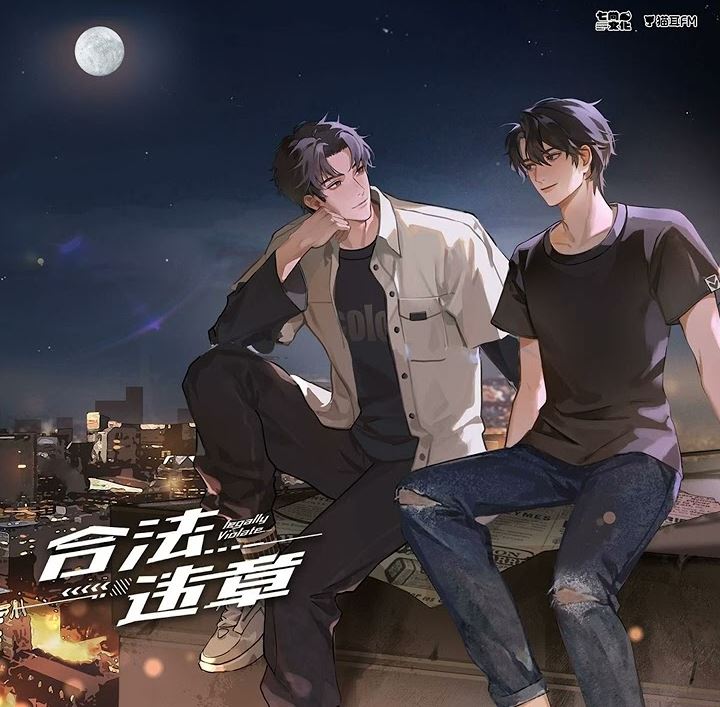
... Read More
"I miss you." Three words. That's it. That's all Feng Lulin had to say and Feng Tang was already dismantled. I keep coming back to this moment because it's so perfectly calibrated. After all the banter, the photo battles, the dirty talk disguised as casual messaging — Feng Lulin just drops this raw thing in the middle of everything and suddenly all of Feng Tang's defenses have nowhere to go. He doesn't know how to respond to honesty. He responds to sparring. He responds to control. But "I miss you"? That's surrender and it disarms him completely. And then the hand photo comes flying back at him — Feng Lulin matching vulnerability with vulnerability, sending this intimate image of his scarred fingers like he's saying *here, this is mine, do you want it?* The hormones and the longing practically radiate off the screen. Feng Tang describing how he could "practically smell the hormones emanating from the screen" — that line made me stop reading and just stare at my phone for a second. What kills me most is the voice message scene. Feng Tang sending that flirty, boastful audio about investing millions in adult films and Feng Lulin playing it out loud at work like it's the most natural thing in the world. The guilt that floods Feng Tang afterward — not because he said something wrong, but because his carelessness might affect Feng Lulin's professional life. That's love. That's actual love, not the dramatic kind but the quiet terrified kind where you're afraid your own joy might become someone else's liability. The ending with the little girl on the road — Feng Tang rushing out without even locking his car, Feng Lulin watching from across the intersection and feeling that relief — it's the same energy. These two would move heaven and earth for each other and neither of them has properly said it yet.
... Read More
Okay so let me just say—this sequence is masterfully built around absence and presence. Feng Tang keeps going to that intersection not because he has business there, but because Feng Lulin is there. Three days of it. Day one: he's flustered, speeding away. Day two: he almost trips over a curb because he can't stop looking. Day three: he finally confronts him. That's a perfect escalation arc disguised as casual daily routine. And then the twist within the confrontation—Feng Tang tries to act tough, calls him out on negligence, but really he's been the one openly parking by the roadside like some kind of lovesick fan. The scene where Feng Lulin says "I'll move the post over there" when Feng Tang asks how he'd follow him across the street? Chef's kiss. It's playful but also deeply possessive, and it reveals that BOTH of them have been doing this simultaneously. The plot doesn't need big dramatic events here—it works because the tension is in what they're NOT saying to each other. Every line of dialogue is a provocation wrapped in denial.
... Read More
Okay, so I need to talk about this balcony scene because my heart actually physically hurt reading it. Feng Lulin pretends to fall off the balcony, right? To get Feng Tang to chase him over the railing. But what made this work so well wasn't just the physical comedy of it—it was the emotional logic underneath. Feng Tang has been pushing away, saying things like "not interested" and "don't want to play," and Feng Lulin clearly saw that as a breaking point. So he does something desperate and theatrical to force a confrontation. And it works! Feng Tang actually climbs over the railing. But then—plot twist within the twist!—Feng Lulin catches him instead of falling, and they end up tangled on the floor. The fake fall becomes real intimacy. The deception becomes truth. And that moment when Feng Tang touches Feng Lulin's old scar near his collarbone? That's where the whole thing lands. It's not a prank anymore. It's a plea. Feng Lulin admits "I made a very, very big mistake," and Feng Tang thinks he's talking about the balcony stunt, but we know better. The real mistake is whatever happened before all these chapters. The plot here is doing so much heavy lifting—using a silly setup to reveal how both characters are actually feeling. Feng Tang's internal monologue about loving someone and not being able to reason with them? That's the thematic core. And the ending where Feng Lulin says "Whatever you say, I'll chase it myself" after the proverb about horses? Perfect callback. It shows he's done waiting. He's actively pursuing. The story structure here is tight because every beat moves from anger → fear → physical contact → vulnerability → unspoken understanding. No filler.
... Read More
The author has a gift for making you feel the atmosphere of a place just by describing what's NOT there anymore. The Yu family house is introduced through absence: chipped red paint, faded couplets from last New Year that are now incomplete, weeds overtaking the courtyard. This wasn't always this way — the decorations suggest a family that once cared about appearances, about tradition, about looking prosperous. Now it's all deterioration. I also love how the world feels lived-in through small details. The hawker who delivers news about Yu Fengtang's failing health. The steamed bun shopkeeper who watches the carriage for copper coins. The fact that carriages can't even enter the narrow alleys around the Yu house — this is a neighborhood that has fallen on hard times. It mirrors the family's decline perfectly. And then there's Fragrant Melody Pavillion mentioned in the background, almost casually. It's treated like the most fashionable place in town, the source of all the latest clothes and jewelry. When Zhou Yanliang used to compete with young girls for attention through her appearance, but now all those fashionable items are hanging in Qingyan's establishment instead. The power dynamics have shifted so quietly but so completely. The pregnancy details are woven into the setting naturally too — the wooden bed specially sent upstairs, the long pillow Aunt Li sews. These aren't just props; they're textures that make the world feel real and lived-through.
... Read More
Can we just appreciate for a moment how well-written the dialogue is in this chapter? Every character has such a distinct voice. Feng Tang's line "Now there's a trace. I'm a tornado" after being called 'Feng the Trace-less'—that is SO him. He can't resist turning everything into a boast, even when he's clearly embarrassed. But then he tries to compose a classical-style poem and completely chokes: "I live by the moat, you live in the Peony Mansion. Day by day, I think of you but can't see you, drinking the moat water together. When will this water end, this road is mine..." AND THEN HE FORGETS THE NEXT LINE. The narration says his mind went to childhood memories of shouting "This road is mine, this tree is mine, if you want to pass, leave a toll" at the kindergarten gate. I WAS DEAD. This is a grown man with an underworld reputation who somehow can't finish a poem because his brain short-circuited into bully-mode flashbacks. And Feng Lulin KNOWS the next line—he vaguely remembers it as "I only wish your heart is like mine, never to be betrayed"—but he doesn't say it. He just pinches Feng Tang's earlobe and asks "What do these lines mean?" knowing full well Feng Tang will snap and say "I hate you." The back-and-forth is so natural, so layered. Even He Qing's dialogue feels distinct—he's sharper, more transactional, constantly calculating. His line about buying Feng Tang a diamond-studded tape to shut his mouth? Perfect.
... Read More
Here's what's been keeping me up: the Swallowtail butterfly motif. It comes up again and again in Feng Lulin's head, and every time I read it, the stakes shift a little. "In recent days, he had been working to make Feng Tang lower his guard, exposing his soft belly and nape. Whether biting or devouring… As long as Feng Lulin wanted this person, he would have him." On the surface, this reads as romantic possessiveness. But read it again. This is someone who has spent so long armored himself against the world—literally and figuratively—and now he's choosing to let someone in. The stakes aren't just about winning a relationship. They're about whether Feng Tang can survive being truly known by someone. And Feng Lulin? His stakes are different. He's used to control, to calculation, to having everything planned. But this guy is sleeping soundly in his arms after dreaming about him twice. That's not something he can control. That's something that happens TO him. And the threat there is real—if Feng Tang pulls away, Feng Lulin might not know how to function without that leverage. He Qing's warning cuts both ways: "You might not be the same kind of people." It's not just about class difference. It's about two people who've built their identities around self-protection suddenly having to decide whether the protection is worth the cost. The conflict isn't external drama or misunderstanding. It's the terror of wanting something you've spent your whole life convincing yourself you don't need.
... Read More
Okay so let me just say—this chapter did something really interesting with pacing the mystery plot. The bit about the person who pinned Feng Tang down at the Feng family doorstep two years ago keeps lurking in the background like, of course it does. It's described as a dormant volcano and honestly that metaphor works on so many levels. Feng Tang has come to terms with it, right? He thinks it's just some person and he can't find them no matter how hard he tries. But then BAM, someone shows up at the car dealership looking for him and just LEAVES without contact info. What is the author doing to us It's giving cat-and-toy energy and I am not here for it but also I can't look away. The way the investigation thread has been simmering across chapters and then suddenly someone is literally AT his workplace and ghosts him—what a cruel little twist. It makes you wonder if this person was testing something or just passing through, or if they knew Feng Tang wouldn't be there. Also the whole subplot of Shao Jin Cheng appearing feels like the author is slowly circling back to Feng Tang's past circle. He used to be the responsible neighbor kid, now he's the Youth League secretary. That's such a small detail but it tells you everything about how these characters have aged and drifted apart. The main plot isn't just about the mystery person—it's about how all these threads from Feng Tang's history are about to converge and I'm genuinely nervous about what's coming.

Leave a comment

You must be logged in to leave comments. or
