Legal Violation - Reviews

Legal Violation
+Add to Custom List
Sort
Add review
... Read More
"Since then, every time he saw pig tail, he had the illusion that he was still a child. But he would never grow taller." I've read this sentence five times already and it just keeps getting worse. This is the emotional gut-punch of the entire chapter, disguised as a throwaway anecdote about kindergarten cafeteria food. Feng Tang tells this story so casually—just mentioning the canteen uncle who gave him extra pig tail, the promise of two pieces if he grew taller, and then the quiet revelation that the uncle died years ago. No dramatic pause, no authorial commentary. Just... facts. And that's what makes it devastating. The 'illusion' that eating pig tail creates is really about holding onto a version of himself that existed before the world got complicated. He Qing drinking thirty yuan of unlimited soda at a bar because he couldn't handle fake alcohol deals is also painfully sweet in a way I didn't expect to feel. These three boys aren't just friends—they're each other's family. And Feng Lulin watching Feng Tang tell these stories, seeing him soften, noticing how 'childish' he is now in a way that's actually joyful... there's something tender between them that I can't quite name but I'm here for. The line 'if you drink with me in the future, you can get drunk whenever you want'—is that even a real sentence or just the most Feng Lulin thing ever?
... Read More
The author really just went from one of the most physically charged scenes I've read in this book to a man finding an umbrella on his motorcycle and I am not okay with how well that transition worked. Let me walk through this. We open with Feng Tang and Feng Lulin in the car, making out like teenagers, buttons flying, red marks on collarbones — maximum intensity. Then it cuts to Feng Tang alone, doing boring administrative work for Liu Lizhu, which is basically the narrative equivalent of exhaling. He's tired. His car is a wreck. He buys a motorcycle on a whim. Falls off it. Hides his injuries. Finds an umbrella. The whole chapter is a breath held and then slowly released. That final image of the light blue umbrella with those three characters inside — it's so deliberately calm after everything that comes before it. The author knows exactly what they're doing with the tempo here and I respect it enormously.
... Read More
Let's talk about Feng Lujin for a second because this guy is doing SO MUCH symbolic heavy lifting and the text barely hints at it. He shows up on a motorcycle — literally between two worlds, the chaos of the bar and the order of the law. He carries a notebook. He SALUTES. He quotes the law about Wuling Hongguangs and McLaren P1s as if they're morally equivalent. This man is not just a traffic cop; he is ORDER itself, and Fengtang is CHAOS incarnate. Their entire dynamic is built on this fundamental opposition. And the racing thing? That's not just a hobby — it's Fengtang's rebellion, his way of asserting control in a world where he otherwise feels like everything is 'fleeting with nothing to show for it.' Meanwhile Feng Lujin represents the exact opposite: structure, consequences, accountability. When Fengtang says 'You always said to take responsibility for our mistakes, didn't you?' — that hits on multiple levels because Feng Lujin is essentially telling him to grow up. The cigarette scene with Fengtang is also rich — he's holding something that burns and dies, just like all those 'genuine' embraces he reflected on. Everything in this chapter is circling back to one question: can chaos and order coexist, or will they destroy each other? The author is laying groundwork for something bigger and I am SO here for it
... Read More
I need to talk about this ONE LINE that absolutely wrecked me: "Feng Tang was unknowingly being 'conquered' by him." Over the past few months, Feng Lulin has somehow softened Feng Tang without even trying. And the way the narration frames it—from Feng Lulin's POV, noticing this shift—is so tender and terrifying at the same time. Because Feng Tang is THIS possessive, violent, untouchable figure in the underworld, right? "Feng the Trace-less." And yet here he is, getting flustered over poems, losing his composure, letting his guard down completely with one person. The scene where Feng Lulin says "Leave me a life" after Feng Tang threatens to take everything—including Feng Lulin himself—is devastatingly sweet. Feng Tang takes half of it in, ignores the refusal part, and suddenly he's fixed. He doesn't even argue. He just... accepts it. And then later he's lying about his mom being home when really he just wants to take Feng Lulin to a love hotel. The contrast between the violent underworld persona and this guy who gets flustered over poetry recitals and wants to buy his boyfriend a fancy helmet with gambling winnings? Iconic. He Qing basically calling him out on it with "who do you want to give it to? Officer Feng, right?" and Feng Tang's immediate deflection just confirms everything. This relationship is so deeply wired into who these characters are now.
... Read More
The dialogue in this chapter is sparse but devastating. Most of what we get is internal monologue, remembered voices, phone calls. He Qing's ruckus stands out because it's so loud and chaotic compared to everything else. A diligent and hard-working police officer is a great catch! I have many cars, and I'll be your matchmaker! And Feng Tang's response—watching it with a dark face, eyes closed, cursing. The contrast between his world of calculated moves and He Qing's blunt enthusiasm creates this perfect comedic relief that doesn't undermine the tension. But the real voice is in the silence. The man at the courtyard door who never spoke, only held. His voice was so unpleasant it hurt—yes, hurt, the kind that makes you gasp. Every time he spoke close to Feng Tang's ear, the tip of his nose would brush against his cheek. This sensory detail becomes the dialogue substitute. When Feng Lu Lin finally speaks to him across the traffic: I remember you only have three points left. And Feng Tang's reply—three points for an autograph from you, not a loss. That's not dialogue, that's a confession disguised as banter. The narrative voice itself is fascinating. It belongs to Feng Tang but has this detached quality, like he's observing his own life from somewhere outside it. Moisture, the smell of medicine. Two years passed, and he became more indifferent, also tired.
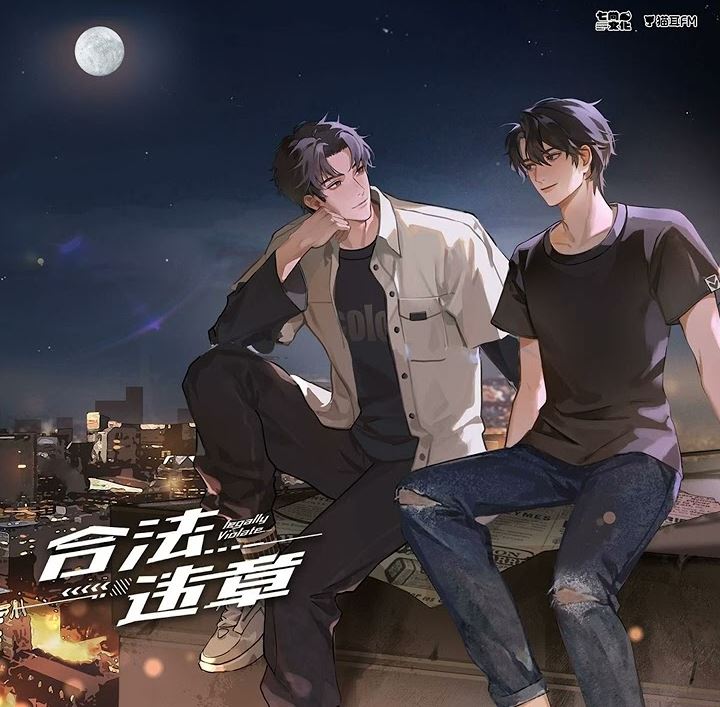
... Read More
Okay, can we just talk about this moment where Feng Lu Lin literally tells Feng Tang he wants to be close to him while walking shoulder to shoulder? Not even a subtle hint, not a disguised compliment—he just says it flat out like it's the most normal thing in the world. And Feng Tang's reaction? He tries to speed up, Feng Lu Lin matches his pace. Classic dance. This is the kind of push-pull that makes their entire relationship feel so electrically charged. Every physical proximity is both a power move and a genuine desire. The scab on his arm from candle wax—Feng Tang notices immediately and asks about it, and Feng Lu Lin barely has to explain because Feng Tang already connects it to last night. They know each other that well at this point. Then there's the whole bit about Feng Tang lying about having two boyfriends on rotating schedules just to see Feng Lu Lin's reaction. The man was SO visibly taken aback. And Feng Tang had every right to be defensive too, given that he works in a world where his reputation matters and being out isn't exactly simple. But the fact that he can make that joke here, in this space with Feng Lu Lin, shows how much trust has built between them without either of them having to say the word 'trust.'
... Read More
I have genuinely never related to a character's unhealthy fixation this hard. Feng Tang checking his phone every ten minutes, falling asleep, waking up, checking again—that is some serious attachment anxiety and the author just paints it so casually. And then the profile picture moment?? He's sitting there barely able to regulate his breathing over a cracked uniform selfie taken in a dim car after a night shift, and he calls it "blinding" and says it enveloped the entire night. This man is absolutely consumed and he doesn't even realize how pathetic it looks. But what I actually love most is the 'I've got the exclusive!' moment. When he tells his friends about the photo with such quiet pride, then immediately ducks his head to drink soup and lick crab roe off his lips while suppressing secret joy—this is the most emotionally complex scene in these chapters. He's simultaneously humiliated by having to be pursued, turned on by Feng Lulin's boldness, and secretly thrilled that this powerful traffic cop chose HIM. The contradiction is everything. Feng Lulin flipped the script completely by changing his WeChat name to 'Tang' and posting that profile picture, and Feng Tang is losing his mind over it because for once he isn't in control. That power dynamic shift is the core of this whole emotional thread and honestly? Chef's kiss.
... Read More
What struck me first is how the author uses the cross-river bridge as more than just a location—it's actually doing double duty as a narrative device. On one level, it's where Feng Lulin reflects on his father's ambitions and compares him to small hills, establishing the whole power dynamic that drives the plot. But then the traffic jam appears, the weather turns, and suddenly we're thrown into a personal crisis that mirrors the larger political tensions. The subplot threads here are fascinating. You've got Cen Qi's underground club operations running in the background, Xia San planted in their circle, and Feng Lulin carefully not startling the enemy—all of this feels like a chess game being played. Meanwhile, the personal plot explodes when Feng Tang confronts Bai Yangyue. The misunderstanding about who lives with Feng Lulin is pure comedic gold, and that moment where Bai Yangyue blurts out "I'm his dad" had me laughing out loud. The author knows exactly when to pivot from tense political maneuvering to chaotic personal drama. The real question is whether these two threads will converge. Right now they feel parallel, but with Feng Tang going to confront Feng Lulin directly, something's about to click into place. I'm curious if the underground club storyline will threaten the relationship, or if the relationship itself becomes leverage in those operations.
... Read More
Let me just say — the quiet intimacy between Qingyan and Qiu Henian in these chapters is absolutely devastating in the best possible way. Not a single dramatic confession, not a grand gesture, just a man massaging his partner's sore back at night and then quietly repositioning a pillow when Qingyan rolls over in his sleep without waking up. That detail broke me. Like, who needs fireworks when you've got someone noticing your sleeping habits and adapting to them? And Qingyan's motivation for visiting the dying Yu Fengtang? It's not revenge or anger or even forgiveness. It's something much more complicated — he wants to give the original owner of this body a sense of closure. That's such a layered emotional choice. He doesn't owe these people anything, yet he chooses compassion anyway. 'He didn't feel pity for Yu Fengtang. He had even less emotion for that younger brother and stepmother.' But he went for someone else entirely — the ghost of the person whose memories he now carries. That hits different. The scene with Zhou Yanliang is where it really gets good emotionally. She's standing there, stripped of all her jewelry and fashion, watching Qiu Henian help Qingyan across the threshold with this gentle attentiveness that she clearly never received. Her jealousy isn't just about money or status — it's about witnessing, in real time, the kind of tenderness she was denied. 'Her heart filled with jealousy and hatred.' And you can practically feel it radiating off the page.
... Read More
There's something about late night conversations on a moving vehicle that strips away all the pretense and suddenly everything feels realer than it really is. That's exactly what happened here. Feng Tang confesses his teenage rebellion like it's some shameful secret—wanted to go to jail honestly just to get attention—and instead of judging him, Feng Lu Lin just asks if the whole street buzzed when he revved the engine. That's not judgment, that's recognition. That's two guys who've been reckless in different ways understanding each other for the first time. And then the physical closeness building so naturally, pressing his face against Feng Lu Lin's back, feeling the warmth through clothes. The narrator doesn't even make it sexual or dramatic, it just IS. Cold wind, shaking over bumps, helmets coming off. I literally got that ache in my chest reading this. Also the line about Feng Tang realizing 'how foolish he had been' after the crash with He Qing—suddenly his wildness has consequences and someone else got hurt because of it. But then eating vegetarian food for half a month and He Qing saying 'I respect life' with misty eyes... that scene broke me. Not the motorcycle part, that specific quiet moment at a school gate.
... Read More
Let me just say—every single character in this batch is standing at some kind of edge and I cannot stop thinking about what they're willing to lose. Feng Lulin just risked his actual life stopping that truck. He could have been dead. His dad knew this would happen, sent him to this unit, and still couldn't protect him from himself. The stakes here aren't abstract—they're literal survival, and the family dynamics make it worse because the father's fear and the son's defiance are both forms of love that can't find common ground. Then there's Feng Tang. The text message lands and we see his whole emotional reaction—anger, confusion, a grudging respect for the cop who ticketed him. He calls Feng Lujin 'a wolf, the kind that bites without drawing blood.' That's not just an observation, that's recognition. He sees himself in this person and it makes him defensive. And Feng Wangang's warning about 'someone named Feng'—years ago, not worth mentioning. But it clearly IS worth mentioning because he follows up with 'Avoid trouble. Stay away from them.' The stakes just shifted from family drama to something historical, something unresolved that's about to resurface. What keeps me hooked is that none of these conflicts are easy. Every choice has a cost. Feng Lulin chooses duty over safety. Feng Tang chooses pride over curiosity. The father chooses control over honesty. And the question hanging over everything is: what happens when the past catches up to the present?
... Read More
I've been sitting with this chapter and the imagery keeps coming back to me. It starts raining—April and May rain, the kind that makes everything sticky and humid—and Feng Tang disappears into the car wash for entire afternoons. There's something about water in this chapter that feels loaded. Feng Tang's botched poem references the moat explicitly: "I live by the moat, you live in the Peony Mansion." A moat is supposed to be a barrier, something that keeps people out. But they're sharing the water. The boundary is porous. And then the chapter ends at a tunnel exit—the First Ring Tunnel—with a car accident involving a Rolls-Royce. Tunnels are transitional spaces, right? You're between two points, in darkness, moving toward something. That's exactly where these characters are. Feng Tang is between his underworld identity and this domestic softness he's developing with Feng Lulin. Feng Lulin is between his police work and whatever this arrangement is. And the accident itself—rear-ending a Rolls-Royce—feels symbolically rich too. The wealthy, pristine car struck from behind by something less powerful. Disruption of order. The Gabe Group's involvement signals that the underworld plotline is converging with the personal one. The rain, the moat, the tunnel, the accident—all of it points to the same thing: boundaries are collapsing, water is rising, and nothing is staying in its designated place anymore. Just like these characters.

Leave a comment

You must be logged in to leave comments. or
