He Xin Chao - Reviews

He Xin Chao
+Add to Custom List
Sort
Add review
... Read More
There's so much underneath this scene that the author isn't stating outright, and I think that's where the real power lives. The central symbol is marriage itself—as both weapon and wound. Zhang Zhen uses it as ammunition: 'To be a man and willingly marry like a woman is a disgrace.' This reveals the novel's deeper concern with gender performance and social expectation. Ji Zhen's marriage isn't just a romantic choice; it's a political act that places him outside accepted masculinity. His entire identity in this world is tied to a decision that everyone—from his brother to strangers in restaurants—considers shameful. Then there's the imagery of sight and blindness. Ji Zhen seeks 'a glance from Shen Yanqing' and gets one, but it's cold and distant. Later, when Shen Yanqing nods in agreement with the misogynists, Ji Zhen's 'eyes felt warm'—he's crying again, but this time from disappointment rather than sadness for Jiang Yunyu. The father says 'only women and unscrupulous men are hard to deal with,' and Ji Zhen's poor exam scores become another weapon against him. But then he fires back with 'Are the words of the sages always correct?'—a question that strikes at the heart of the entire philosophical system this world operates under. The coiled snakes on Jiang Yunyu's vest feel intentional too—danger wrapped in beauty, tradition and violence coexisting.十七年的情谊 can be cinched tight like a belt one moment and constrict the next.
... Read More
I am NOT okay. I am literally shaking. Let me break down the STAKES here because they are INSANE. On one level, there's the immediate conflict: Ji Zhen and Shen Yanqing just publicly embarrassed a room full of high-ranking officials and nobles. Shen Yanqing's interpretations of classical texts made people look stupid and prejudiced. Zhang Zhen's face is 'like a pig's liver.' These people do NOT forget insults. They do NOT forgive humiliation. In this world, offended nobles don't just walk away—they plot revenge. But then there's Li Mianhui. And THIS is where it gets terrifying. The Third Prince of the Great Heng Empire. The 'Jade-Faced Fox.' A man who tortures spies by hooking their tongues and slowly chopping off their fingers. A man who watches Ji Zhen with the interest of a collector who spots a rare butterfly. 'A clever yet foolish young deer... If he were caught and kept in a cage in his mansion to be tormented for fun...' He smiled. He INVITED them to dine. He said 'no matter, we can meet again another day.' This is the calm before the storm. This is the predator letting the prey think it escaped. And Ji Zhen—sweet oblivious Ji Zhen—breathes a sigh of relief. He thinks it's OVER. He has NO idea what just looked at him. Meanwhile Jiang Yunyu is seething. Shen Yanqing is grave in the carriage. Something is wrong. The carriage ride ends with 'Haven't you cause enough trouble tonight?' and Ji Zhen has no idea what's coming. The stakes are: reputation, safety, freedom, love. Everything is on the line and the reader knows it while the characters don't. That dramatic irony is KILLING ME.
... Read More
Okay, let's talk about SYMBOLISM because this chapter is DRENCHED in it and I'm not even being dramatic. THE LEGS. Ji Zhen's legs are the central symbol of this entire chapter. They've been punished—three hours of kneeling has left them numb and sore. They're exposed—trousers rolled up to the knees, white skin on display. They're TOUCHED by someone other than his husband. And they bear MARKS—red fingerprints from Ji An's massage that Shen Yanqing notices immediately and can't unsee. The legs represent Ji Zhen's vulnerability, his bodily autonomy, and essentially his territory. Shen Yanqing sees marks on them and it's like seeing graffiti on property he considers his. THE BED. This is where the power plays happen. First Ji Zhen is lying on it, vulnerable, being cared for by Ji An. Then Shen Yanqing pulls him onto HIS lap—reclaiming space, reasserting ownership. Then he tosses him back onto the bed for punishment. Then he lies down beside him afterward. The bed goes from a place of comfort (with Ji An) to a site of humiliation (spanking) to a place of reluctant intimacy (burrowing together). It's the domestic sphere, and the author uses it to show how even private spaces are battlegrounds in this marriage. THE FINGER MARKS. These appear twice—instantly significant. First, Ji An's fingers leave red marks on Ji Zhen's calves during the massage. Shen Yanqing notices them and is clearly disturbed. Then, after the spanking, 'the spanked area was now covered with raised, swollen finger marks, far worse than those on his calves.' One set of marks comes from care; the other from punishment. Both leave the same visual evidence. The author is drawing a parallel here: love and violence, care and control—they both leave traces. Ji Zhen's body is the text they're writing on. And the KNEELING. Three hours in the ancestral hall. A punishment for disrespect. But then Shen Yanqing threatens MORE kneeling. The ancestral hall represents tradition, family honor, patriarchal authority. Ji Zhen has already submitted to it once. The fact that he's now being punished AGAIN inside the bedroom—private instead of ceremonial—suggests that the real power dynamics of their marriage aren't about public propriety. They're about who controls whom in the dark.
... Read More
I need to process what I just read because my heart is literally racing. The scene where Ji Zhen 'secretly used his fingertip to scratch Shen Yanqing's palm' after Shen Yanqing dismantles everyone's prejudice with such grace? I'm not okay. That tiny gesture—so small, so private, happening in a crowded restaurant full of hostile people—carries more emotional weight than a thousand Confessions. And Shen Yanqing? He gives Ji Zhen 'a faint glance' and 'uncharacteristically didn't stop Ji Zhen from being affectionate.' UNCHARACTERISTICALLY. That word alone tells me this is rare for him. He's usually composed, controlled, restrained—but with Ji Zhen, he lets things slide. He allows vulnerability. That's huge. Then the carriage scene. Two red candles, flickering light across Shen Yanqing's handsome face, and Ji Zhen is just... mesmerized. He forgets all his worries about being 'not worthy' and feels nothing but joy. But then Shen Yanqing drops 'Haven't you cause enough trouble tonight?' and the mood shifts instantly. I love how Ji Zhen's internal monologue swings from insecurity (others probably think he's an uneducated good-for-nothing) to pure elation the second Shen Yanqing gets in the carriage. That's love. That's real, messy, inconsistent love. Not the polished kind. The kind where you feel inadequate one second and euphoric the next. And then Shen Yanqing's grave expression. What's wrong? What's coming? I NEED TO KNOW.
... Read More
What I love about this passage is how the conflict escalates without a single explosion. There's no shout-fest, no physical fight, no dramatic confession. Just a man hiding in a bookcase and slowly realizing his husband doesn't want him there. The internal conflict is doing all the work here. Ji Zhen starts as this imperious, entitled young master who can threaten servants and toss umbrellas around — and by the end he's curled up in darkness with his pride in tatters, asking a question he already knows he won't like the answer to. That's a complete emotional arc in a few thousand words. And the external stakes? They're simmering underneath. This marriage is public knowledge as a laughingstock. His family is powerful. Shen Yanqing is his superior in more ways than one. If this relationship collapses, what does Ji Zhen lose? Status, security, the only person he's apparently built his life around? The suspense about Yi Zhi is cleverly deployed — we never confirm whether there's actually anyone else in that study or whether Ji Zhen's jealousy is projecting. Shen Yanqing's denial could be genuine or could be evasion, and the text leaves us dangling beautifully. The moment where the main door opens and a candle flickers to life — that's peak tension. Your heart stops. Is he about to be caught? Is this the confrontation he's been dreading? And then it just… doesn't go the way he expects. Shen Yanqing finds him, tells him to leave, and that refusal to engage with Ji Zhen's accusations is almost more painful than any argument could be. The stakes aren't about life and death. They're about something far more terrifying: being truly seen and still being rejected.
... Read More
I've read this scene at least three times now and I still can't get over what happens between them. Not the hiding in the bookcase or the whole “where is Yi Zhi” panic — it's that one look Shen Yanqing gives Ji Zhen at the end. You know the type. That cold, patient, almost clinical gaze that says “you're being dramatic” without actually saying anything at all. And yet Ji Zhen melts every single time. The text literally says he feels like he's drunk strong liquor, that burning sensation crawling from his throat down to his lungs. What is that, if not love? Miserable, one-sided, aching love, sure, but love nonetheless. The way Ji Zhen goes from swaggering in with his umbrella toss and threats of floggings to curling up like a kicked dog in a bookcase just to catch a glimpse of his husband's daily routine… it's pathetic and devastating and I lived for it. Their whole dynamic is built on this power imbalance — Shen Yanqing barely speaks to him, comes home late, treats him like furniture — and yet Ji Zhen keeps showing up. Keeps trying. The fact that he's the youngest son of the Chief Grand Secretariat, with all that family power behind him, and yet he's completely powerless against one indifferent glance from Shen Yanqing? Chef's kiss. Also can we talk about how the marriage is already “a popular laughingstock in the capital”? The pressure from outside must be relentless and Ji Zhen still can't let go. Emotional damage level: catastrophic. I'm here for it.
... Read More
The author clearly put thought into making Ziyun Lou feel like its own character in this scene, and it works. We get the scent immediately—'the whole building was filled with fragrance.' It's opulent, it's crowded, it's the kind of place where status plays out in real time. The young marquis (Jiang Yunyu) sits in the main seat wearing that very specific outfit: plain white brocade underneath, tight black arm guards, dark blue protective vest embroidered with round coiled snakes. The description does more than establish visual texture—it tells us Jiang Yunyu is someone who carries weapon and elegance simultaneously, someone whose beauty has hardened into something imposing. 'No one would mistake him for a delicate lady because of his beautiful face anymore.' That line alone maps an entire character arc. Then the crowd dynamics. 'Waiters streamed through the space.' 'Whispers and snickers spread around the table.' The main hall is described as filled with 'onlookers who loved a good show.' This isn't a private confrontation—it's public theater. Everyone in that room is both participant and audience, and the capital's gossip network is already buzzing about Ji Zhen's forced marriage. The candlelight reflecting in Ji Zhen's eyes during his speech is such a small detail but it gives the whole scene a cinematic quality. You can see the flames dancing in his pupils as he delivers lines about heroines and mothers. It's poetry disguised as prose.
... Read More
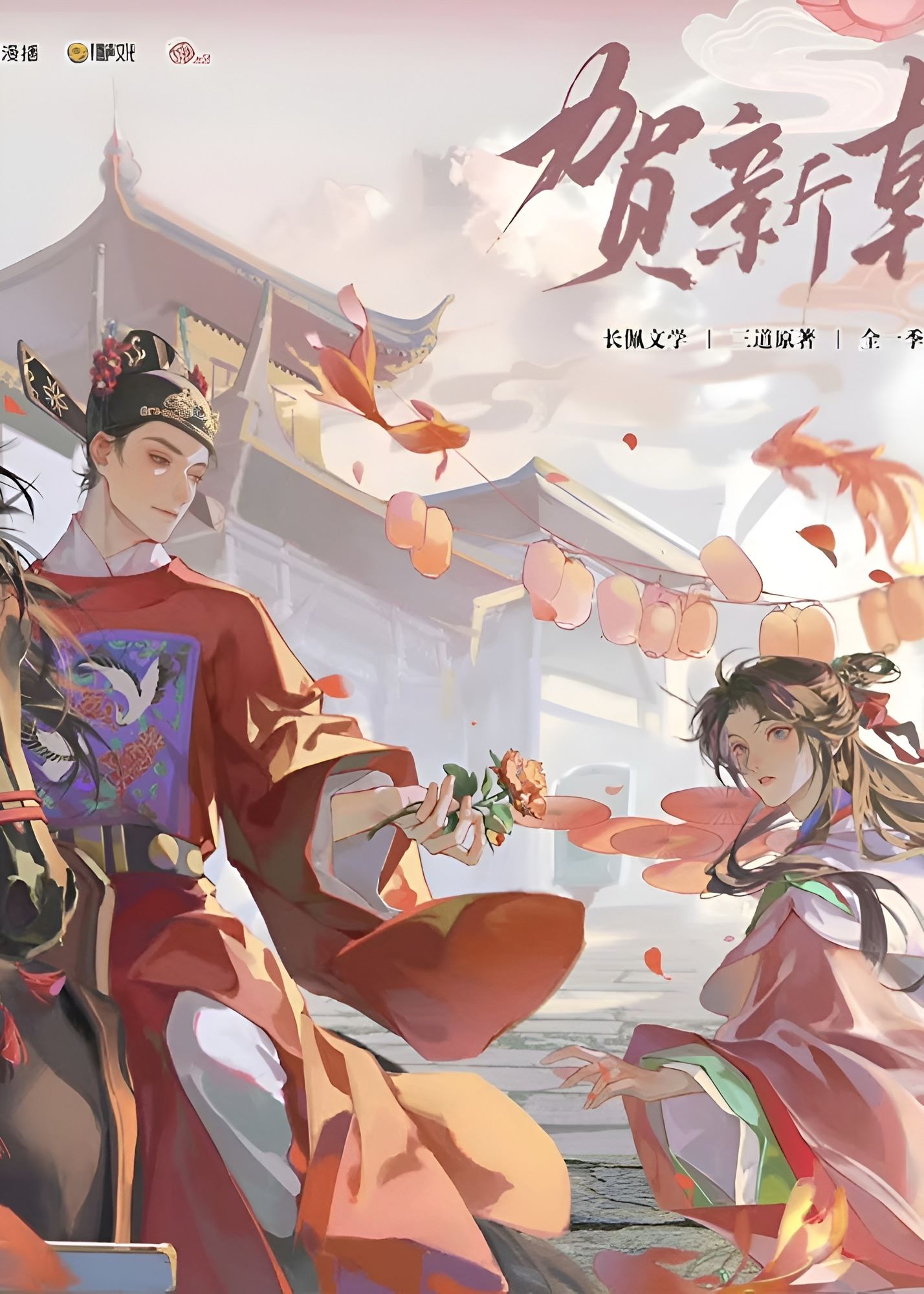
I have to talk about this parade scene because it's one of the most vivid cinematic moments I've read in forever. The author just paints this entire world in a few brushstrokes. You've got the gongs clanging, the drums, soldiers shouting, courtesans on balconies with flower baskets—and through it all, Shen Yanqing on that white horse in his red brocade robe with golden-threaded boots. 'A banished immortal descending to the mortal world'—yes. Just yes. And the peony. That flower matters so much more than I expected. It's tossed by a courtesan, Shen Yanqing catches it, smells it, smiles—and then tosses it to Ji Zhen specifically. This flower becomes this whole symbol, doesn't it? Something beautiful offered freely in spring, and now three years later it's just... memory. I also love how the sensory details work. Ji Zhen breathing hard, sweat on his forehead, pushing through the crowd, heart beating 'like a drum' so loudly he has to cover his chest. The evening clouds burning fiery red while he stares at Shen Yanqing's retreating back. The author doesn't just describe a scene, they make you FEEL the heat of that day, the chaos, the overwhelming brightness of it. Every word is saturated in color and sound. It's literally impossible not to see this scene playing out like a film.
... Read More
Can we just PAUSE and appreciate the cinematic quality of these chapters because I am OBSESSED with the visual storytelling. The Ziyun Lou scene is filmed like a movie. You have the bustling restaurant suddenly falling into SILENCE—'Kacha. The carved window of a private room on the second floor was pushed open, followed by a slow and crisp sound of applause.' I can HEAR that. I can see everyone looking up in unison. The camera pans upward and there he is: leaning against the window sill, dark robe, fox-like eyes, that unsettling smile. The contrast between the warm candlelight and Li Mianhui's cold gaze is *devastating*. When Ji Zhen looks back before leaving, 'The candlelight beside him flickered, illuminating his smiling face and his fox-like eyes that held no warmth.' NO WARMTH. That line haunts me. Then the carriage. 'Two red candles were lit, and as the wheels rolled, the candlelight flickered across Shen Yanqing's handsome face.' Warmth, intimacy, privacy—completely different atmosphere from the public tension of the restaurant. The author uses lighting as emotional punctuation and it WORKS. The world-building details are also top tier. We get the Imperial Academy, the crown prince Li Muwei (solemn and steady), the third prince Li Mianhui (ruthless and cruel), the Great Heng Empire's social hierarchy—all woven naturally into Ji Zhen's observations without any info-dumping. You learn about Li Mianhui's torture methods through rumor and gossip, which feels authentic to how information spreads in this world.
... Read More
I keep coming back to the pacing of this sequence because it's masterfully controlled. Let me walk through the escalation: First, we open IN MEDIA RES with Ji Zhen already crying. No setup, no explanation—we just drop into raw emotion and then the author backs up to give us context about his seventeen-year history with Jiang Yunyu. That opening line about touching 'the warmth of his own tears' is devastating because it happens AFTER Jiang Yunyu has already left. We feel the absence immediately. Then the journey to Ziyun Lou—a brief, almost casual transition. He sees Chi Jin, the great horse, and wants to touch it but can't because its owner has 'already parted ways.' This is symbolism doing double duty: the horse represents something beautiful and untouchable, mirroring exactly how Ji Zhen feels about both Jiang Yunyu and Shen Yanqing. Inside the restaurant, the tension ramps up in stages. Zhang Zhen's opening jab → Ji Zhen's rebuttal → the crowd's fearful silence → Jiang Yunyu's attempt to remove him → Shen Yanqing's entrance → the devastating agreement. Each beat escalates the emotional stakes while the external conflict stays contained to one room. The cliffhanger ending—'as if they had returned to their teenage years of bickering' cut off mid-thought—is classic web novel structure. It leaves you hanging but also creates this eerie sense of déjà vu, as if nothing has changed when everything has fundamentally shifted.
... Read More
Can we just talk about how little these two actually say to each other and how much it communicates? Shen Yanqing asks three questions in this entire passage. 'Where did you learn that?' 'Saw what?' And that's it. Three questions and they reveal everything. The first one is casual, almost detached—he's physically touching Ji Zhen but mentally elsewhere. The second one is sharper, more probing. He KNOWS what Ji Zhen saw. The narration tells us 'Shen Yanqing knew full well what he was doing.' So why ask? Because he enjoys the power of making Ji Zhen squirm. And Ji Zhen's responses? He stammers. He changes the subject. He literally redirects his attention to Shen Yanqing's body instead of answering. That's not just shyness—that's survival instinct. He's learned that honesty gets him punished or rejected, so he deflects. Meanwhile Shen Yanqing never presses him on what he saw. He just moves on. The dialogue here is so economical but so loaded. Every pause matters. Every unspoken word screams. And then there's the flashback dialogue—or lack thereof. Shen Yanqing doesn't say a single word to Ji Zhen in that parade scene. He just nods and tosses a flower. Three years later, that nod is the most intimate thing either of them has shared. The author understands that sometimes the most powerful dialogue is what isn't said at all.
... Read More
The pacing here is absolutely vicious in the best way. Let me walk through how the author builds this entire emotional avalanche. Chapter starts almost comedically—Ji Zhen can't even hear Madam Shen at first, he's just zoning out, then suddenly there are paintings of beautiful women being unrolled in front of him. The first few sentences feel light, almost domestic. He's genuinely admiring art. Then BAM: 'You and Yanqing have been married for almost three years. It's time to get him a concubine.' The pivot is so fast your stomach drops. There's no warning shot. No gradual buildup. Just the floor falling out. From there, the acceleration is relentless. Ji Zhen fires back → Madam Shen slams the table → Ji Zhen delivers the death-line about keeping vigil → Madam Shen orders the ancestral hall → Ji Zhen kneels from morning to evening → Shen Yanqing doesn't come home → Ji Zhen waits for nothing. Each beat hits harder than the last because the author keeps removing escape hatches. There's no moment where Ji Zhen thinks, maybe I can compromise. Maybe I can accept one. No. Every door closes. Then we cut to Shen Yanqing's perspective and the pacing changes completely—it slows down, becomes measured, almost bureaucratic. He's dealing with his parents like a diplomat handling a hostile negotiation. This contrast is deliberate. Ji Zhen's section is fire and impulse; Shen Yanqing's is ice and calculation. But both are forms of love. The chapter ends mid-action—Ji Zhen stirring soup. No resolution, no callback to the confrontation, just this quiet domestic moment that somehow carries more emotional weight than anything that came before. The author trusts the reader to sit with the aftermath without spelling it out. That's confident storytelling.

Leave a comment

You must be logged in to leave comments. or
