Formless - Reviews

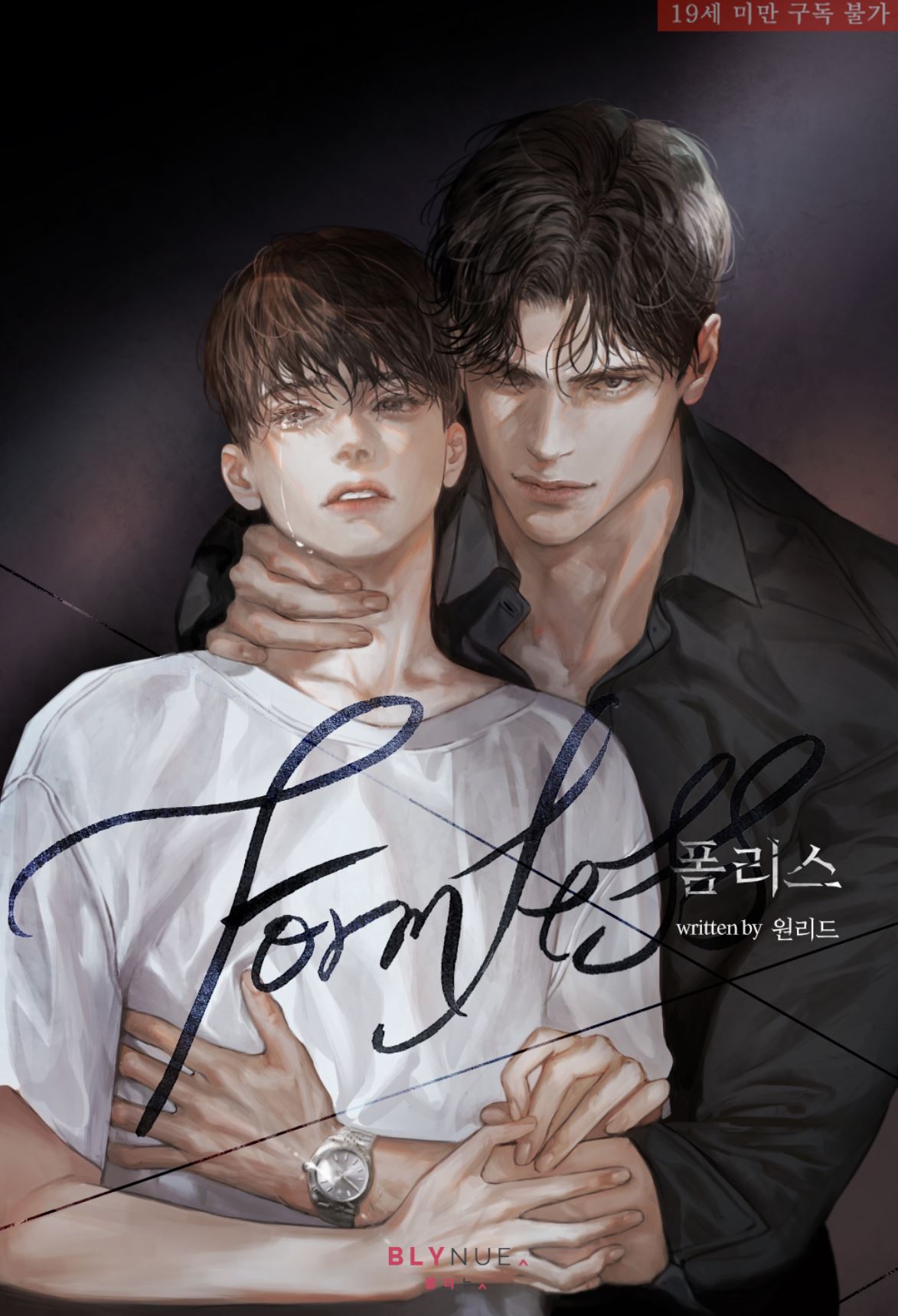
Formless
+Add to Custom List
Sort
Add review
... Read More
Can we talk about how DISTINCTIVE these two characters sound when they speak? Kangwoo has this incredible range between playful and threatening that never feels inconsistent because it IS consistent—he's genuinely affectionate AND genuinely controlling, and the author lets both truths exist simultaneously. His lines are short, punchy, often statements rather than questions: "Sunbae, how about if you just follow me around?" "Working at a company is very shitty." "Should I teach you again?" He doesn't waste words. Even his tenderness comes through in commands: "Get up." "Sit on my knees." "Don't get upset." And Heewoon! His dialogue is all hedging and deflection: "Oh, it's not like that." "I'm having fun..." "It would be hard to not join them..." The ellipses aren't just punctuation—they're personality. Heewoon speaks in qualifiers because he's always measuring his words against Kangwoo's reactions. Even his internal monologue is cautious: "He must hide information about his coworkers from Kangwoo." The most brilliant dialogue moment though is probably the entire exchange about the company dinner: "You should ask for permission first." "...Huh? How can you not go to a company dinner if you work at a company." "You're really out of your mind." Heewoon's confusion is so genuine and so adorable, and Kangwoo's deadpan response is perfection. The humor lands because it's TRUE to their dynamic—he actually IS out of his mind for not understanding the power move he just walked into.
... Read More
"Are you really crying?" "It's because I ate something spicy." This exchange destroyed me. Like, it's such a small moment but it carries the ENTIRE emotional weight of the chapter. Heewoon is alone on a Friday night, eating cup ramen and watching variety shows, and he's so lonely he starts crying. And when Kangwoo walks in and asks if he's crying, his first instinct is to BLAME THE SPICY NOODLES. Not to say 'yeah I missed you,' not to admit he was sad. Just deflect immediately. And Kangwoo? He POSTPONED HIS WORK to come back because he thought Heewoon might be crying. That's... that's actually really sweet in a weird way. He saw the empty ramen cup and immediately thought his person was upset. The fact that Heewoon wasn't having a party alone but was just sitting there eating snacks and feeling sorry for himself—Kangwoo caught that vulnerability instantly. The part that wrecked me though was when Heewoon finally admits "It wasn't very fun" after Kangwoo asks. Heewoon has to hear himself say it out loud to realize it. That moment of self-awareness where he's sitting there surrounded by his favorite things and it still wasn't enough—that's the kind of lonely that hits different. And then Kangwoo pulls him close and calls him Sunbae and everything shifts again. The tenderness after the sadness, the way Kangwoo makes Heewoon feel seen even when he's being controlling... these two are a mess together and I love it.
... Read More
Okay so I need to talk about Kangwoo because THIS man is a masterpiece of terrifying contradiction and I am here for it. Like, he comes at Heewoon with pliers and threats, Heewoon is literally peeing himself from fear, and then what does Kangwoo do? He takes a shower, puts on comfortable clothes, and says "Come here and have dinner." The whiplash is actually insane. The dinner scene is where everything about their relationship crystallizes for me. Kangwoo is touching Heewoon's face — gently, really — checking his bruised lips, sweeping his bangs up to look at his forehead. And Heewoon is trembling the entire time because this same man was threatening him five minutes ago. Kangwoo even says it outright: "Using money is good, but when dealing with people, using violence is the best." And then he PATS his head and calls it a compliment. The man is unhinged AND he knows it. But what gets me is the formal language thing. Kangwoo notices that Heewoon only switches to formal speech when he's scared. "Sunbae, you only use formal language when you get scared. Are you scared now?" And Heewoon just admits it. This small detail tells you SO much about their whole dynamic — Heewoon uses politeness as armor, and Kangwoo knows exactly when it's up and when it's down. The way Kangwoo humiliated him about peeing himself during dinner though — "You can't even hold your pee. Do I have to help you with your bathroom needs too, Sunbae?" — that's not affectionate at all. That's predatory. He's stripping away every layer of dignity while acting like he's being sweet about it. I'm sitting here like WHAT do I do with this relationship
... Read More
what is wrong with this world and why does everyone want to hurt heewoon Let me collect my thoughts. The external conflicts in this batch are MULTIPLE. We've got debt collectors who came to Heewoon's house. We've got loan sharks with bizarrely smiling faces. We've got an academy leader who tricked Heewoon into drinking by hiding alcohol and pretending to throw it away. This man told Heewoon he 'won't be able to handle a social life'—what kind of manipulative garbage is that?? Kangwoo's exact reaction: "What a fucking bastard." I agree. I AGREE. But the internal conflict is what's really eating me alive. Heewoon keeps getting hurt—physically, emotionally, financially—and every time he just… takes it. He doesn't fight back. He doesn't run. He endures. And Kangwoo sees this pattern and decides, apparently, that the solution is to become the thing Heewoon endures instead. The stakes here are HUGE and they're escalation after escalation. Last we saw, Heewoon was dealing with debt. Now he's physically injured (that bruised, swollen face), he's been manipulated into drinking, he's sleeping on sofas because he's too hungover and depressed to function, and Kangwoo is essentially trapping him in this protective cage where he has to report before meeting anyone. Is it healthy? Absolutely not. Does it make me want to scream at the page? Also absolutely yes. The cliffhanger at the end—with Kangwoo's hand on Heewoon's bare skin, the morning light, the intimacy that's equal parts tender and controlling—leaves me in SHREDS. What happens next? Does Heewoon start slipping away from this control? Does Kangwoo's protectiveness become possession? Are they both just using each other to survive? I need to know. I need it now. My hands are shaking.
... Read More
Let me just say this chapter has the highest stakes per word ratio I've encountered in a long time. We start with Heewoon's back against a ceiling drip, wrists marked, unable to open his eyes, and the reader is thinking: is this captivity? Is this violence? Is this romance? The answer keeps shifting and that's the entire conflict engine right there. The external stakes are obvious—Kangwoo threatens to kill 'those other guys,' wants to confine Heewoon at home. But the INTERNAL stakes are where this chapter truly excels. Heewoon is terrified AND yearning. He's trembling AND he stays. He tells Kangwoo his wrist hurts and Kangwoo bites it and Heewoon doesn't pull away. That push-pull between safety and danger is the core conflict and the author sustains it across every single interaction. The morning after is where the stakes get even more interesting. Heewoon wakes up and can't remember parts of the night—he's physically compromised, hungover, vulnerable. But he remembers the drunk antics. He knows he behaved badly and Kangwoo saw it. Now Kangwoo holds that knowledge. The power imbalance isn't just physical anymore, it's psychological. Heewoon owes him. Heewoon is exposed. And yet—the porridge. Kangwoo ordered porridge for the hangover. He texted the mother to cover for him. The conflict isn't resolved, it's complicated, and that complication is infinitely more compelling than any simple resolution ever could be.
... Read More
The sensory details in these chapters are INSANE. Let me just start with the entryway scene when Heewoon leaves Kangwoo's house: 'a wide garden filled with the strong scent of grass as night fell' and 'the heating in the room was so intense that the slightly cooler air was a welcome relief.' The contrast between the oppressive, over-heated interior and the crisp December air outside immediately establishes two different worlds—one claustrophobic and controlled, the other vast and honest. Kangwoo's house is spotless ('not a speck of dust could be seen') which feels like a metaphor for how carefully curated and controlled everything is in his life. Heewoon doesn't belong in that spotlessness. Then there's the dog. 'Seo Kang-woo's dog, who had been lying down, sensed his presence and jumped up.' Heewoon is SCARED of the dog and deliberately doesn't look at it. A guard dog that responds to HIS arrival—but Kangwoo's direction. Heewoon is treated like an intruder in the one place he's supposed to be staying. The mother's kitchen scene is another masterclass in atmosphere: 'a sweet and savory smell filled the air,' the kitchen light on 'at this hour,' steam rising from the pot. This warmth and light feels almost dreamlike compared to Kangwoo's sterile environment. But it's ALSO tinged with something off—why is the mom up this late? Is she waiting for him? The domestic light becomes almost uncanny. And the winter setting throughout—December, the padded jacket, the scarf wrapped tightly, the cold approaching—creates this constant sense of exposure. Heewoon is always trying to protect himself from something, whether it's the cold or Kangwoo or his own circumstances. The library study scene is surprisingly vivid too: the spacious desk, the contrast between school library and Kangwoo's study room. Even the academic environment has been absorbed into Kangwoo's world.
... Read More
Okay, let's talk about Kangwoo for a second because this character is doing SO MUCH with very little dialogue. He walks up, sees Heewoon crying, and instead of some grand emotional speech, he basically says 'people are looking because a grown man is crying' and drags him to the car. That's it. That's the whole move. And yet — and YET — the way he handles Heewoon afterward is where the real character work happens. He hands him tissues. He lets him cry without demanding explanations. He comments on his clothes in this weird affectionate way ('you look like a bunny today'). When Heewoon tries to bolt, Kangwoo tugs his nape and cups his face in one hand. No apology. No 'I'm sorry I was rough.' Just... touch. That's their language. And Heewoon's realization — 'While he always swallowed back his tears in front of his mother, it felt so natural to cry in front of Seo Kangwoo' — that line is a whole relationship arc compressed into one sentence. The mother-son dynamic is built on protection and silence; the Kangwoo dynamic is built on presence and permission. I'm already emotionally compromised and this is only chapter 104. Also, the aunt as a character moment: her line 'Your mom knows how hard you work, and she must have not wanted to burden you unnecessarily' reveals everything about the family's communication patterns in three sentences.
... Read More
There's a symbolic thread running through this whole chapter that I can't unsee now. It starts with blood—Kangwoo bites Heewoon's lip until it bleeds, then LICKS it clean. Blood as intimacy, blood as consumption, blood as the price of closeness. Then there's the alcohol, which Heewoon drinks not for pleasure but as a numbing agent. 'If this somewhat hazy feeling was due to the alcohol and it acted as a barrier to the dark emotions that seemed ready to burst into tears at any moment, then it was better not to stay sober.' That sentence alone contains the entire theme of this story: self-medication as survival strategy. And then the money. Five million won that should feel like relief but feels like another kind of debt. Kangwoo's line about it is the thematic key: 'The person who's working the shit out of himself has the smallest share.' That's not just commentary on Heewoon's situation, that's a thesis statement. The system rewards those who take, not those who endure. The damp hoodie is the final symbol—the visible proof that Heewoon cried but tried to hide it by washing his face, and only made it worse. You can't wash away what you're feeling. It just spreads.
... Read More
The shrimp scene is one of the most chilling relationship moments I've read. Let me explain why. Kangwoo is literally feeding Heewoon. But this isn't care—it's dominance dressed as intimacy. Watch the choreography: Heewoon can't even hold chopsticks steady because his throat hurts, so Kangwoo takes over. He peels the shrimp, places it on Heewoon's rice, then holds Heewoon's hand and guides it to his mouth. "You can grab it with your hand"—as if Heewoon doesn't already know how to eat. As if the real question isn't whether he can feed himself, but whether he'll obey when told to open his mouth. And Heewoon complies. "Heewoon obediently gobbled it up." That word—obediently—is doing so much heavy lifting. This isn't a loving partner helping someone sick. This is someone trained to submit. But here's what makes their dynamic so toxic: Kangwoo genuinely believes he's being tender. "Why are you embarrassed because you peed?" His voice is gentle. He pats Heewoon's hair. He brings Heewoon clothes that are too loose—almost maternal in their practicality. The author is showing us how abuse doesn't announce itself with growls and slaps; it creeps in through kindness that feels like love until you realize you've never actually been asked what you want. Heewoon's internal monologue reveals the cognitive dissonance: "It was Kangwoo himself who made him this way." He's blaming himself for surviving. When Kangwoo asks "Are you going to cry?" and Heewoon answers in a croaky voice, the power imbalance is absolute—not just physical, but psychological. Kangwoo gets to define reality: Heewoon's pain is his fault, his job loss is his problem, his body is Kangwoo's to navigate. By the end, lying side by side in bed, Heewoon is terrified but trapped. The shadowy arm that follows him to the edge of the mattress isn't reaching out—it's corralling. And the wrist hold in darkness? That's not affection. That's inventory.
... Read More
The stakes in this sequence are deceptively simple on the surface—money, a blocked card, a part-time job—but they run deep into psychological territory. Heewoon's external conflict is financial survival; he needs cash for transportation, phone bills, feeding himself. But the internal conflict is far more complex: his need for Kangwoo's approval versus his fear of him. Every interaction is a tightrope walk. Kangwoo holds all the cards—literally and figuratively. He gave Heewoon the blocked card, knew he'd need help, orchestrated the whole situation. The stakes escalate when Kangwoo mentions throwing him out the window. It's not just about losing accommodation; it's about exposure, abandonment, returning to a mother who suspects something. Heewoon has nowhere else to go. That's the real tension: he's trapped by dependency. What does he stand to lose? His dignity, his safety, his relationship with his mother, his own sense of self. Kangwoo represents both salvation and threat. When he says 'if you make drunk antics,' the stakes become physical. Heewoon must comply, stay sober, behave—but the pressure to please Kangwoo might force him to drink. The conflict is circular: to get money, he must please Kangwoo; to please Kangwoo, he risks losing control. There's no clear exit. The author maintains suspense through ambiguity—we don't know Kangwoo's full intentions, only his immediate power. Each whispered question, each dismissive gesture raises the stakes. The conflict isn't resolved; it's suspended, hanging over Heewoon like a blade.
... Read More
This passage moves at two speeds simultaneously. On the surface, it's glacial—a meal stretching into silence, shrimp being peeled one by one, questions asked and answered in monosyllables. Underneath, it's a countdown. Every pause, every avoided eye contact, every ordinary action (brushing hair, bringing clothes, finding a phone) carries the weight of impending violence. The author uses structural asymmetry brilliantly. The middle section—the flashback to the dental procedure, the forced sex, the beating—is compressed into fragmented sentences that hit like punches. But the present timeline slows down to almost unbearable detail: the clattering chopsticks, the spoon slipping, the texture of steamed egg, the exact moment Heewoon realizes his job is gone. This isn't accidental pacing; it's the narrative equivalent of a predator circling prey. The slower the present moves, the more we dread what happens next. The phone notification sequence is a masterstroke of tension architecture. First one message, then another, then a flood. Each KakaoTalk popup is a small detonation. The reader pieces together the conspiracy faster than Heewoon does—which creates that delicious, agonizing dramatic irony. When Kangwoo asks "What's wrong?" and Heewoon stammers about the messages, we know exactly what's happening. Heewoon is only just connecting the dots: the loan sharks weren't real. Kangwoo sent them. Or rather, Kangwoo sent people worse than loan sharks. The ending structure is where the pacing finally snaps tight. Three short paragraphs, each shorter than the last, moving from Heewoon's isolation to Kangwoo's approach to the physical contact. The rustling sounds, the shadow, the wrist hold—each beat reduces the word count while increasing the threat level. By the final fragment ("Giv"), we're cut off mid-word, mid-moment, mid-breath. The structure itself becomes the trap. Just like Heewoon, we're left hanging in darkness.
... Read More
The stakes in these chapters are suffocating and I need to sit down. Let's be real - Heewoon has NO winning moves here and the author makes that crystal clear. External conflict first: Heewoon is trapped physically and economically. He can't call the police because Kangwoo took his phone. He tried to send a message saying "someone died" and got a loan ad instead. The author uses that absurdity brilliantly - in a situation of genuine danger, the system offers him personal loans. "Loan from 100~3000. Contact ARS." The dark humor of it highlights how alone Heewoon actually is. But the INTERNAL conflict is what keeps me up at night. Heewoon's body is trembling, his face is bruised, his lips are bitten raw - and yet when Kangwoo touches his forehead gently instead of slapping him, Heewoon doesn't fight back. "Even if his mind was abstract, he couldn't bring himself to hit him." This is the core conflict: survival instinct versus moral instinct, fear versus something else he can't name. The rising stakes: every scene raises the question higher. Will Kangwoo hurt him more? Will he actually escape? What does Heewoon want beyond survival? The chapter ends with "I came back because I forgot to say something" and Heewoon nodding like everything is normal. The stakes aren't just physical safety anymore - they're psychological survival, identity, the question of who Heewoon becomes when he's forced to adapt to this person. "A groan escaped Woo Heewoon's lips as his bruised ass was pressed down, and the space between his butts hurt." The physical reality is inescapable. Every movement has consequences. Every choice leads deeper in. And the author won't let us forget it for a single page.

Leave a comment

You must be logged in to leave comments. or
