For My Birthday, I Was Gifted Five Husbands - Reviews

For My Birthday, I Was Gifted Five Husbands
+Add to Custom List
Sort
Add review
... Read More
Okay so I need to talk about this absolute chaos of a birthday scene because HOLY. Three separate marriage proposals hitting Eugenie on her 24th birthday? That is some next-level author move. Like, you set up the contract angle early and I was already intrigued, but then having all THREE eligible bachelors arrive back-to-back is just... theatrical perfection. It reads like a rom-com directed by someone who absolutely loves drama. The pacing here is wild. We go from devastating betrayal (Peter cheating right at the funeral, wow) to cold legal realities (no husband = no inheritance) to a birthday where suitors are literally lining up at her apartment door. The shift from tragedy to comedy is so sharp it's almost jarring, but it works. It keeps you on your toes. And that contract reveal?? A promise made with her mother?? That's the kind of hook that makes you immediately scroll to the next chapter. Who was the contract with? Why didn't Eugenie know? What was Theodora Norton planning? I have so many questions and the author is just sitting there being mean about it. Also small note: Alfred and the Duke exchange a knowing look like they planned this?? That adds another layer. Is this coordinated? Is there more going on behind the scenes? I love a plot with hidden connections.
... Read More
Okay so the morning after scene absolutely killed me in the best way. We just went through this incredibly intense intimate chapter with Percival essentially transforming into some kind of... I don't even know what word fits, but definitely not 'gentleman mode' and then BOOM he's waking up apologizing like a child who got caught eating cookies before dinner. The contrast is everything. The night before he was describing himself as a 'beast,' literally saying he wanted to knot her and suck all her milk out — and then in daylight he can barely meet her eyes. His shame is palpable, like he's horrified by what his own body did to the woman he married. But here's the thing that really got me: he's still CAREFUL. Even while apologizing profusely, he's wiping her down, making sure she's comfortable, checking if she's in pain. That's not just guilt, that's genuine tenderness breaking through the embarrassment. And Eugenie's reaction? She doesn't even scold him. She just asks practical questions like 'is this what you meant by monster blood?' and then casually mentions Alfred was a gentleman — which is simultaneously the funniest and most devastating comparison. She's literally using her ex-husband's courtesy as a measuring stick for her current husband's lack thereof. Percy's face must have gone through about twelve different colors. The whole dynamic of 'what happens when the monster blood fades' vs 'who am I when I'm myself' is such rich territory. I want to know how much of his behavior was genuine desire vs magical compulsion, and whether he even knows the difference himself. That scene where she feels an 'unexplainable hunger' afterward though? Made me sit up. Is she affected too? This contract thing is going deeper than any of them expected.
... Read More
I keep coming back to this image: Eugenie receiving a hundred red roses from Alfred, immediately thinking about using them as bath additives. Is this character depth or is the author making a statement? I think it's both. Roses symbolize romance, passion, courtship—all the traditional markers of a marriage plot. But Eugenie's first instinct is utility. Her mother's things, her research, her inheritance—all practical concerns. The romance she's being offered literally goes in the bathwater. There's also the magic ore depletion running through everything. The Empire is built on something finite that's running out. And Eugenie's entire social position is similarly finite—her father died, her protections are gone, and the laws are actively consuming what little she has left. It's all about scarcity. Carter's smile described as 'sunshine passing through ice' is another image I can't shake. Light but cold. Warm but unreachable. That's their whole relationship in one phrase. And the contract—made by her mother, kept by the Duke and Magnus, seemingly anticipated by Alfred too. There's a generational theme here. The mothers and grandmothers are making moves from beyond the grave while the current generation deals with the consequences. Eugenie thinks she's making her own choices but she might just be the latest player in a game her mother started. That last line—'Why would my m—'—cut off mid-sentence. The story itself refuses to finish her thought. I think that's intentional.
... Read More
Let me go back to the beginning of this chapter because everything clicks when you re-read it. Eugenie thinks her mother was just an ordinary woman—impoverished family, overwhelmed by her husband's extravagance. But the letters prove otherwise. Theodora Norton didn't just happen to help five of the most powerful men in the empire. She did it on purpose. She collected debts the way other women collect jewelry. And she directed them all toward one goal: securing her daughter's future. Now look at how each man relates to Eugenie. Alfred calls her 'Brother' is busy with campaigns and speaks casually about war and fairness. Magnus is her academy rival, prideful but clearly flustered—his pale skin can't hide those reddened ears when she directly asks if he wants to marry her. Cassius is this charming, slightly sinister boutique owner who smiles too much and mentions he operates in 'fields not yet regulated by law.' Carter is the golden childhood friend who somehow hasn't aged out of his boy-next-door energy. And the Duke? Silent until the end, but his displeasure at Cassius says volumes about class tensions. But the real relationship drama is Eugenie herself. She went from feeling guilty about Carter yesterday to coldly plotting to crash her stepsister's wedding today. That's not callousness—that's survival mode. Her amber eyes sparkling when she decides to take control? That's a character who's done being a pawn.
... Read More
The structure of this section is honestly masterful and I want to dissect it because the author knows exactly what they're doing. You open with an EXTREMELY explicit sex scene—hot, thick, messy, full of bodily fluids and heavy musky scent—and then you just... cut to black. Eugenie falls asleep. And what does she dream of? Her mother. Not a romantic dream. Not a pleasant memory. A traumatic one from when she was fourteen. The transition is seamless because sleep literally bridges the two, but emotionally it's a jolt that works perfectly. The dream sequence itself is roughly 600-700 words and it moves at a different speed than the rest—it's fragmented, echoing, with that train whistle drowning out key dialogue, which mirrors how trauma memories actually work in your head. Then she wakes up and there's Alfred, sunlight, breakfast, scar conversation—that's the calm after the storm. And then BAM, chapter break, new room, new husband, colder tone, tea instead of food. The pacing between Alfred and Percival scenes couldn't be more different: one flows like warm honey, the other is stiff and formal with loaded pauses (“…” used constantly). It's almost like the author is using structure to tell us something about each husband without saying it outright. And that ending with Percival asking her to call him by his first name while blushing? Perfect cliffhanger energy for what's clearly going to be a longer arc with him.
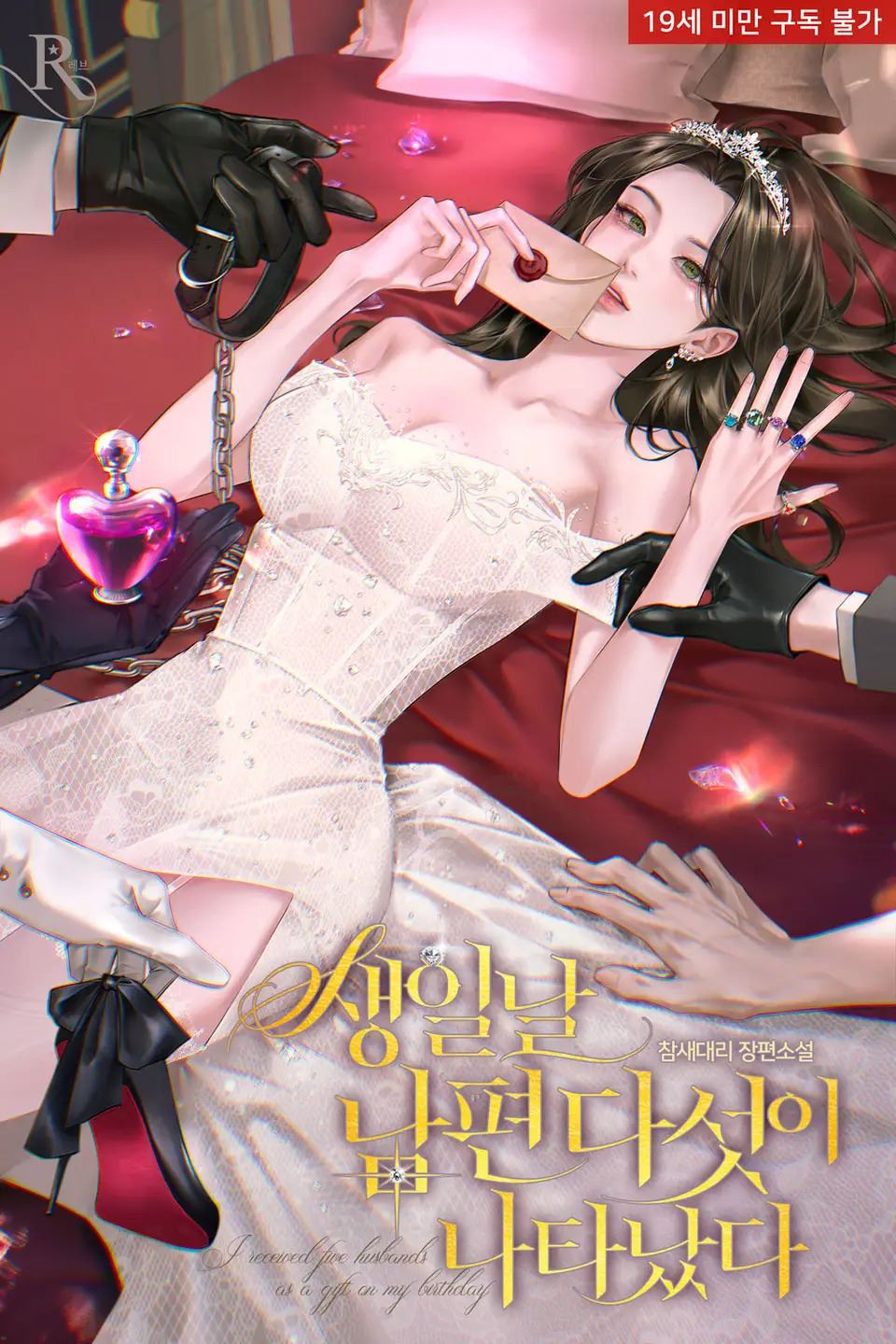
... Read More
Let me paint the scene for you because the author really pulled out all the stops here. Four imposing men already filling a small room, and then the door opens and Cassius arrives like he walked out of a fairy tale—cherry blossom-colored hair, movements like a refined dancer, offering a bright yellow evening primrose bouquet. The color contrast alone is cinematic. Then Carter appears with anemones and daisies, and Eugenie's internal thought—'Surrounded by what seemed like a garden of men'—that's not just a metaphor, that's a visual frame. But the real showstopper is the wedding crash scene. Five men in perfectly tailored ceremonial outfits, shimmering under the lights 'as if all the lighting was meant solely for them,' flanking Eugenie in the Hero's Million Diamond Dress—a legendary treasure said to 'instill courage to defeat even the Demon King.' The 88-year-old Marquis leaping up in astonishment. The crowd erupting. Agatha's dignified weeping shattering into rage. The worldbuilding is equally striking. This is an empire with legal polygamy (unused since the Emperor), a temple that produces priests but whose family members can still court outside its traditions, a magic ore monopoly that makes the Empress untouchable, and a Dark Merchant's guild whose future mistress is apparently being decided in a bedroom. Every detail feels lived-in and functional. I can see this as a drama. I can literally see the camera angles.
... Read More
Okay so this whole scene hinges on this chain that Eugenie can pull to signal stop, right? And the plot twist is that it literally falls off at the worst possible moment. I mean, that's dramatic irony hitting you over the head, but I can't deny it works. It's like the author knew exactly how to remove the safety valve at peak tension. But let me talk about what really got me. The knotting mention—that's not just flavor text. The author drops this detail about monsters mating and how the male changes to prevent escape of seed, and Eugenie's internal panic about contraceptives being useless is actually a legitimate plot concern, not just cheap titillation. The whole ‘is she pregnant or not' thread is simmering underneath. And the transition from consensual (however heated) to completely out of control when the chain drops? That's a structural choice that pushes the scene into darker territory. The author doesn't shy away from showing her trying to crawl away and him pulling her back. It's not a neat resolution—it ends on ‘I'll keep feeding you here from now on,” which feels like a threat wrapped in a promise. The plot doesn't tie things up cleanly, and honestly? That's what makes it stick with me. “Then just to the step before knotting.” That line is the turning point. Before that, Eugenie still has agency—she's negotiating, pulling the chain, pleading. After that? She's being swallowed whole by the narrative. The author basically tells us: the contract was never about consent, it was about inevitability. And I kept flip-flopping on whether that was brilliantforeshadowing or just edge-chasing.
... Read More
Let's talk about the moment Eugenie literally SMASHED her ex-fiancé's head with her textbook at her own father's funeral. I screamed. I genuinely let out a noise. All this buildup—grad school stress, working late, him saying 'I'm proud of you, I'll wait'—and then BOOM. Right in front of her stepmother and stepsister, with the coffin right there. And her response isn't to cry or beg or anything you'd expect. It's: 'Buckle up.' And then *whack*. It's such a perfect character moment. This is a woman who is done. She doesn't waste time on self-pity, she wastes time on Peter. I love her so much. But then the sadness creeps in afterwards, doesn't it? She's drunk, yelling at a lawyer about 500-year-old inheritance laws, ranting about how reliable men are always taken. She slams her fist on the desk and then just... collapses onto the floor cursing the ceiling. That's when you realize she's not just angry, she's completely alone in this. And then her birthday happens. The roses, the proposals, the chaos—and underneath all of it, this desperate need for connection. She almost asks Carter. She almost says yes to any of them just to solve her problems. That's not romantic, that's lonely. The emotional whiplash from 'I'll smash your head with a bag of books' to 'please don't leave me like this' is exactly what makes this story work. It's messy and real and I'm here for it.
... Read More
I need to talk about the moment Eugenie bows to her five new husbands and says thank you. Like, I wasn't prepared for that hit. On the surface, it's a business arrangement — they helped her, she married them, everyone's satisfied. But the way she phrases it reveals so much about her character. She says she'll help them in return, and if they meet someone they truly like, she'll divorce without hesitation and without demanding alimony. And the text literally says their expressions looked like they'd bitten into a sour lemon. That detail broke me. Because it means they DON'T want to be released from this contract. Despite the absurdity, despite the physical obligations they're now bound to, these men don't want out. Which means something has already shifted between them and Eugenie, even before the honeymoon has properly begun. And then there's the mother's letter. God, the letter. "You will have multiple husbands, unlike your mother, and live like a queen. Safely and happily. For a long time." This woman spent her entire life unloved by a cheating husband, and her dying wish was for her daughter to have a different story — one where SHE gets to choose, where SHE is protected, where she has POWER. The emotional weight of a mother who knew her own life was a tragedy and refused to let her daughter repeat it... I can't. The blank page too — that silent space where Theodora couldn't bring herself to write the painful truth? That's the kind of thing that stays with you.
... Read More
I need to talk about Eugenie's mother because this woman haunts every single page even though she's been dead for most of the story. The image of young Eugenie watching her mother cry over a handsome bastard—that's the origin story of everything. "The one who loves more is always the loser." That line cracked me open. It's the foundational lie this entire family passes down like heirloom jewelry. But then her mother does something unexpectedly radical on her deathbed. She doesn't just curse men—she says "I'll make sure you don't live like your mother did." And then the bizarre part: "I've prepared everything for you. Perfect men. Not just one, but several." Eugenie thinks she's having hallucinations. Makes sense. Who would believe this? But the fact that she says "I've prepared" suggests something concrete. A plan. Arrangements. Maybe even the five husbands themselves are part of this preparation? The most devastating emotional beat for me is Eugenie at her father's coffin. She considers shedding tears, calculates for three seconds, then decides against it because she has no eye drops. That's not coldness—that's a woman who has armored herself so thoroughly that even grief feels inconvenient. She graduated valedictorian with no parents in the photo. She moved out and requested tuition coverage like it was a business transaction. And yet—the opening scene shows us a version of Eugenie who is completely vulnerable, completely consumed by pleasure, completely surrounded by people who want her. Is this liberation? Is this what her mother planned? Or is this some elaborate trap she walked into blindly? I keep wondering: does Eugenie actually feel anything for these men, or is she performing devotion the way she performs everything else in life?
... Read More
I want to talk about pacing, specifically this scene's masterclass in removing the brakes. The author sets up a control mechanism—the chain—early and lets us see it function a few times. Eugenie pulls it, Percival responds. We learn the rhythm: tension builds, she pulls, he eases off. It becomes a metronome we can predict. Then—whoosh—the chain falls. No warning. No slow realization. One beat she's reaching for it, the next her wrists are pinned and the tempo doubles. That structural choice is everything. The author could have had her lose the chain gradually, fumbling, dropping it piece by piece. But no—they let the clasp fall in one catastrophic moment. It's a literary equivalent of cutting the safety rope mid-climb. And the pacing after that? Brutal. Short sentences. Onomatopoeia (“Thud! Thud!” “Splash, splash!”). Fragments that mirror her fragmented consciousness. The author is making us feel the loss of control through the prose itself—you can't read this section slowly. Your eyes want to race, just like Eugenie's heart rate. But here's where I have a question for the author: why does the scene end on ‘I'll keep feeding you here from now on' instead of a climax? It's a cliffhanger disguised as a conclusion. The structure says ‘this is the end of the chapter' but the content says ‘oh honey, we've just begun.' “Ugh, ahh! Just as the sounds of their friction grew louder with each thrust, the chain slipped from her fingers.” One sentence. One loss of control. The entire pacing of the scene pivots on that clause.
... Read More
Let's talk about Eugenie because WOW. On paper she should be the blandest heroine ever—cool, composed, unemotional graduate student who doesn't cry at funerals. But that's the whole point, right? The author is building this iceberg character where everything important is underwater. Her verbal takedown of Apollin at the wake is absolutely chef's kiss. Watch this: "If you were involved with a man who had a dying wife, do you think you'd have any noble dignity?" She didn't even raise her voice. She just... dismantled that girl's entire existence in two sentences. And then she follows up with the biological parent dig. Cold. Calculated. I love her already. But here's what gets me—the relationship with her father is the real tragedy. He's not just a scumbag, he's a man whose beauty worked on women systematically, and his own wife couldn't escape it. The mother's deathbed warning about men isn't just bitterness, it's genuine survival instinct passed down like a curse. Eugenie inherited her mother's amber eyes AND her trauma. And Peter! Poor sweet Peter Lamburg with his gentle smile and his promise to wait. He's the last decent man she'll ever truly trust before everything changes. The engagement postponement for her thesis feels like the last normal moment before the spiral begins. I also can't stop thinking about the five husbands. We get such brief sketches—Southern Admiral's brother, Northern Duke war hero, possibly illicit younger businessman, artistic rival, childhood friend who became a priest. That last one in particular is giving me ALL the tension. A childhood friend who watched her grow up and chose priesthood? The guilt and desire in that dynamic must be exquisite.

Leave a comment

You must be logged in to leave comments. or
