Himegi-san a Bride from the Future Begs Me to Confess My Love to Her Again - Reviews

Himegi-san a Bride from the Future Begs Me to Confess My Love to Her Again
+Add to Custom List
Sort
Add review
... Read More
Okay so let me just say — the whole number-on-the-chest thing is weirdly powerful for character development. Not because it's romantic or whatever, but because it ACTUALLY changes how they interact. When Touka-san reveals her chest and the number drops from 60 to 55 because she spooked the Ouji family with future knowledge, that's not just worldbuilding — that's a constraint that makes her CAREFUL around Ha-kun. She literally can't just drop spoilers because every slip costs her time in this timeline. And honestly, the "call me Touka-san" moment? Chef's kiss. She starts off trying to force "My Beloved Touka" which is peak over-the-top and immediately shows her confident, slightly teasing personality. Then she accepts "Touka-san" as a compromise, and you can SEE the shift in their dynamic — from formal distance to something warmer. Ha-kun is still flustered (of course he is), but there's a genuine closeness forming here. The most interesting part though? She won't tell him WHY she came to this timeline. She says "I have a purpose" and bows and apologizes. That tells me SO much about both characters. Touka-san is clearly carrying some heavy burden, and Ha-kun respects her enough to not push — but you can feel he's dying to know. This is the kind of secret that will either bring them closer or tear them apart depending on what it turns out to be.
... Read More
The stakes in this section are layered in a way that's easy to miss on a first read. On the surface: will Ha-kun believe her? That's the immediate question driving the scene. But underneath that is SO much more. If she's telling the truth, he's about to lose her to another version of himself—or rather, he's about to BECOME the person who marries her, which means all the current pain of rejection gets reframed as a temporary obstacle. That's either the most hopeful thing or the most terrifying thing depending on how you look at it. "Even though I knew it was just my own ego, I didn't want to lie to myself." This line came right after he'd mentally given up on her. And then she shows up claiming to be his future wife. Of course his ego is confused. Of course he wants to believe her but can't bring himself to fully commit to it. The internal conflict is what's killing me here. He wants to believe because believing means there's a future with her. He can't believe because if he's wrong, he loses the coping mechanism of just moving on. Every time he starts to accept it, something pulls him back—his father's casual confirmation, the video of the kiss, the pocket watch. "With trembling hands, I tried to return the red smartphone to its owner, but instead, I found myself staring at her face——precisely, staring at her lips." That sentence. That is not a sentence about time travel. That is a sentence about a sixteen-year-old boy who has never kissed anyone and just watched himself kiss the girl he likes six years in the future. The stakes aren't about saving the world here—they're about a kid figuring out whether he gets to be happy or not. And the external conflict? We don't know yet. What brought her here? What happens if the future changes? But that pocket watch... that's clearly important. And I have a feeling we're going to learn why she really came back very soon.
... Read More
The way this section spans Date 5 through Date 7 and covers so much ground without feeling rushed is impressive. Date 5 is basically the exposition dump — figuring out the phone situation, discovering the SIM card paradox, learning about the unusable money. It could easily have been boring info-dumping, but the author breaks it up with humor (the fake Japanese-Sumerian call prank) and genuine tension (realizing they're stuck with limited resources). The pacing here is functional but never draggy because each discovery leads naturally to the next problem. Date 6 shifts into action — the shopping trip. This is where the narrative breathes more. We get character moments, internal monologues about love and irrationality, the card shop scene with its small climax of the 200,000 yen sale. The structure here moves from problem to solution to new problem (need clothes now), which keeps momentum. Date 7 starts with the conclusion of the card sale and moves into clothing shopping. The transition feels natural because the money from the card directly enables the next activity. What I appreciate most is that the author doesn't rush the emotional beats. The realization about love ('Love is really something that can make people irrational') comes after a full scene of interaction, not as a random thought. And the ending lands on a quiet, warm note rather than a cliffhanger — which is a bold choice for a serial novel but it works because the emotional arc of these three days feels complete.
... Read More
Okay, I need to talk about Ha-kun because this man absolutely deserves every bit of happiness Touka is willing to risk her timeline for. Let me paint you a picture: her husband — her actual HUSBAND — is sitting there in a tuxedo on their wedding day, and he's smart enough to immediately figure out the time travel rules, his wife's grandmother literally keeps praising him, AND he works a part-time job just to buy his future sister-in-law a hundred-thousand-yen gift card for winning a violin competition. I'm not even joking when I say this guy is unreal. Like, what kind of person is this? He's kind, he's supportive, he gently encourages Touka to do whatever she needs to do, and he kneels in seiza on the floor waiting for her to come back from the past. That's not just devotion, that's a full commitment. But here's what really got me — when Touka leans in to kiss him before leaving, the narration says: "For Ha-kun, it's just a minute of an event, but for me, it means being apart for two months. To say I'm not going to be lonely would be a lie." And she presses her lips against his with all her heart. That contrast — sixty seconds for him, sixty days for her — that is gut-punch level romance right there. The fact that she's willing to leave him for two months of subjective time just to fix something in the past shows how deeply she cares. And he? He's just sitting there trusting her completely. Also can we talk about how the grandmother actually likes him? This woman who 'dislikes humans' according to the text is praising him left and right. That's saying something. The Touka-Ha-kun-Harune triangle is honestly so wholesome it hurts. Ha-kun promised Harune the gift card, Touka confiscated it like a responsible older sister, and now Harune is begging Touka to pass on a message from the past. This family dynamic is everything.
... Read More
The dialogue in this text is genuinely one of its strongest features. Every character has a voice that's instantly recognizable, and the banter between Touka and Ha-kun is particularly sharp. Take this exchange right after she gets back from shopping: "Well, I have to admit that you deserve some credit for protecting me from that guy. As expected of my Ha-kun." "Thank you." "But I really can't accept that last line. 'The correct answer is the one who protects the princess — it was the prince!' gave me goosebumps!" That's such a natural, lived-in conversation. Touka praising him, then immediately pivoting to roasting him for something cringey he said. That's how actual couples talk. It's warm but it's also cheeky. And the grandmother's voice is SO distinct. Just reading her lines you know it's her: "I don't have to tell you that much." "If you have a problem with it, give it back." "Hmph, that was an unnecessary remark. I wonder who you take after…" She's grumpy, dismissive, deflective — classic grandmother energy but dialed up to eleven. The fact that she explains time travel rules with that attitude instead of treating it as some sacred teaching moment is hilarious and perfectly in character. Then there's Harune, who gets fewer lines but each one pops: "Y-Yeah. I made a promise that I'd give it to her if she won the violin contest, so I worked hard to get it." "Stingy!" She's bratty but lovable, and you can hear a high school girl in every word. The narration itself also has a great voice — Touka's internal monologue is self-aware and slightly dramatic without being overwrought. When she says "somehow, I feel like I'm being given a pretty convoluted excuse" about the grandmother watching from a distance, that's pure comedic timing in prose form.
... Read More
Let's talk about how this author manages to not let you catch your breath for a single second across these chapters. Date 10 starts with Touka going into a toilet—which the TN helpfully flags—and we're immediately thrown into panic mode when she comes out looking like a completely different person. The tension is MAXIMUM. You're holding your breath. Then—cut to Date 11, and suddenly it's just... normal. They're buying tickets. Sitting in a movie theater. Eating takoyaki. It's almost comically calm after the previous chapter's chaos, and I initially thought it dragged. But then I reread and realized: this calm IS the point. Ha-kun is trying to pretend nothing weird is happening because if he stops moving, he'll have to actually process what's going on. That's not slow pacing—that's psychological realism. The movie sequence works as a breather that also builds tension in parallel. While the characters watch a film, we're watching HA-kun watch HER, and every glance is loaded. The pacing here is deceptively slow—it feels like nothing's happening, but everything IS happening. Then Date 12 drops us right back into high-stakes territory with the clerk recognizing Touka's advice and Himegi getting confused. The author bounces between tension and calm like a heartbeat monitor. One moment you're sweating, the next you're sighing, and then—surprise, takoyaki order creates a new problem. This rhythm kept me reading at 2 AM. No jokes.
... Read More
I'm still not over the "Hawawawa" line. Like, I physically groaned when I read it. The old fortune teller predicted it verbatim — a moment of pure astonishment where he'd be rendered speechless, making this ridiculous sound — and then it happens exactly on schedule, with the alarm going off in his pocket like a cosmic punchline. But it's not funny in a silly way. It's funny in the way that makes your chest ache. Because what is he actually reacting to? A girl he's been quietly pining after is sitting in his living room in a wedding dress, claiming to be from six years in the future. Of course he's going to make a dumb noise. Anyone would. And the worst part — the most heartbreaking part — is that he immediately regrets it. "I should have asked the Old woman to tell me the future developments." Not the plot twist. Not the time travel. The actual outcome. He doesn't care about the mechanics of it all; he cares about whether she chooses him. That's the emotional core of this entire chapter, and it's buried under all the supernatural chaos. There's also this quiet devastation in the detail that she rejected him earlier. He remembers that. He's still carrying it. And now she's here, in a white dress, telling him she's from a future where apparently they're supposed to be together. The gap between what he experienced today and what she's describing must feel unbearable. I kept re-reading that section and just feeling this tug in my stomach. "I wanted to monopolize this smile all to myself." He thinks that while she's smiling at him. That line wrecked me. He's still in love with someone who just told him no, and now she's somehow become someone he might never get to know because she's from a timeline he hasn't reached yet.
... Read More
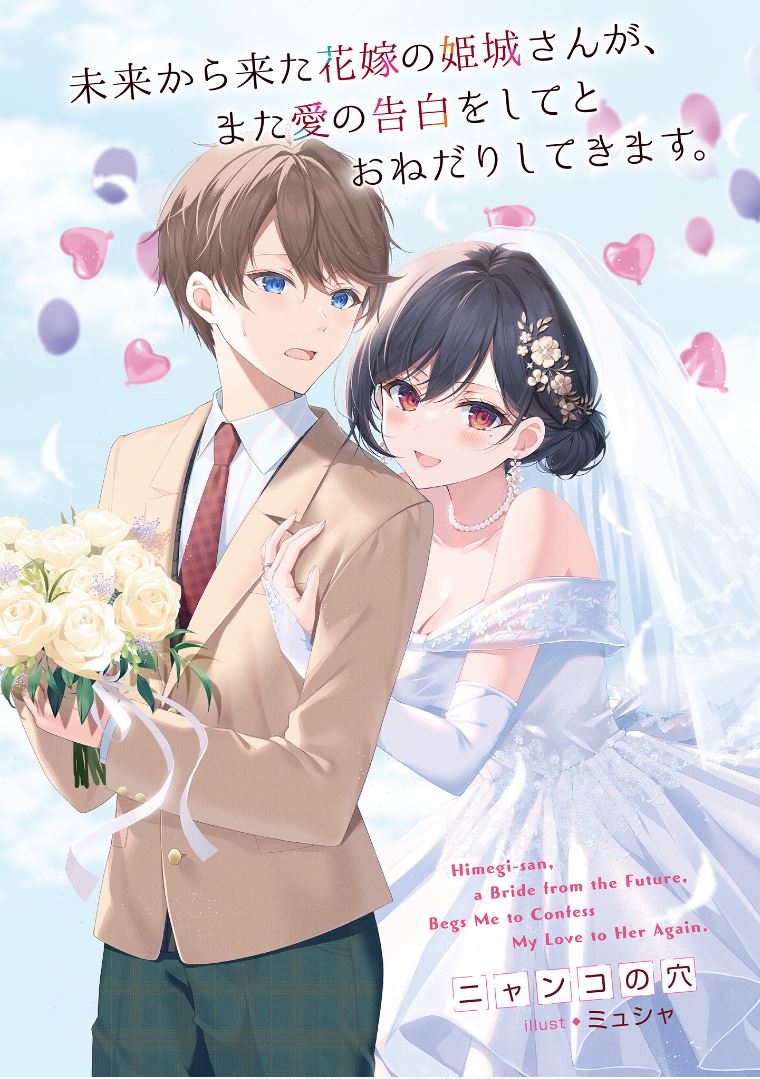
Okay, so. I need to just sit with this scene for a second. Hakuba walks into his own house and finds the girl who literally just rejected him today… wearing a wedding dress. Eating his family's food like she lives there. My brain is still trying to process this. What hit me hardest isn't even the time-travel reveal — it's the way she looks at him. That smile. The text says he's been watching her for a long time, and yet here she is, in the flesh, across from him in his own living room, saying "Welcome back" like she belongs there. There's this weird intimacy in it. She's not some random bride; she's claiming a future with him. But he doesn't know that future. He only knows the girl who turned him down. And then the detail about the number '60' on her chest. I know it's a bust measurement — the author makes sure we understand that — but it's such an odd thing to include. It grounds this absurd supernatural moment in something physical, almost crude. She's not just a mystical figure; she's a woman, fully realized, and he notices. Which is both funny and kind of devastating because it shows how much he's been paying attention to her. The parents are also fascinating in how casually they accept this. While Hakuba is having a full existential crisis, his mom and dad are just… eating premium sushi. That contrast is so sharp it almost made me laugh out loud. They're not scared. They're not confused. They've apparently already made peace with whatever this is. Which raises the question: have they seen this before? Or is there something about the future Hakuba doesn't know yet?
... Read More
"It's not that big, of course." SAYS THE GIRL WHO JUST SHOWED HER BREASTS TO Prove A POINT ABOUT NUMBERS. Okay but seriously, the dialogue in this section is genuinely excellent. Touka-san has this incredible voice — she's blunt, unapologetic, and absolutely fearless in how she talks about things most people would die before mentioning. "My bust size is an H-cup with a measurement of 95. Also, I think I was an F-cup back in high school." ...what... what kind of person just VOLUNTARILY shares this information??? And she delivers it with such a flat, matter-of-fact tone that it's funnier than if she were being coy about it. Ha-kun's voice is equally distinct — he's the perfect straight man, always flustered, always overthinking, and his internal monologue is where the comedy lives. "I don't want to imagine it, but I wonder if aliens or zombies will show up eventually" — this is the kind of random existential panic that makes him so likable. He's grounded while everything around him is going bonkers. And the exchange about the smartphone passcode being his birthday? That's a small detail but it tells us something HUGE about their relationship in the future. Someone from his future recommended her a phone AND used his birthday as the lock code. The implications are Wild and the author doesn't even need to spell it out.
... Read More
I need to emphasize how the author turns DAILY ACTIVITIES into high-stakes scenarios and I am HERE for it. Going to a movie—STAKES. Buying drinks—STAKES. Ordering takoyaki—OH MY GOD, STAKES. The clerk recognizing Touka's advice and directing it at Himegi? That's a ticking bomb. One wrong word and the whole carefully constructed facade collapses. But what makes the stakes feel genuinely terrifying rather than manufactured is that Ha-kun has NO WAY OUT. He can't just leave. He can't explain. He can't even breathe easily. Every interaction is a negotiation between maintaining normalcy and preventing catastrophe. When he says 'rip rip rip' opening his wallet and Himegi glares at him—those are tiny conflicts, sure, but they add up. The reader starts feeling like even a sneeze could blow everything apart. And the emotional stakes? Even higher. He's falling for someone who is simultaneously his wife and a stranger. He's protecting a woman who is literally herself from six years ago. He's trying to keep both versions of Touka alive in his world without letting them collide. The internal conflict alone would break most people, and he's doing it while making small talk about trading card games. I'm genuinely worried about what's coming next. The pressure is building and there's nowhere left to deflect it.
... Read More
Kanako Chikada is immediately my favorite character and I only just met her five pages in. She's short, she looks like a middle schooler, she films people without permission, she threatens to strangle him or throw him off the fifth floor — and yet she also clears out the classroom so he doesn't have to face humiliation in front of his club members. She's the most complex person in this story and I am here for it. Their dynamic is everything. He calls her names in his head, pretends to resent her, but the moment she does something even slightly kind, his gratitude floods out so fast it's adorable. "A sense of gratitude for my considerate childhood friend welled up within me." Bro, you're impossible. You genuinely can't process kindness without deflecting. And then there's Himegi. The description of her is so carefully curated — model figure, flawless personality, athletic, the unquestionable number-one Madonna of the school. She's basically perfect on paper. And that's exactly why the rejection hurts. He didn't just lose to another guy; he lost to an ideal. There's no rivalry to plot against, no clear antagonist. Just... her polite, gentle refusal. What fascinates me is the contrast between these two girls in his life. Himegi is distant, unreachable, treated like a goddess. Kanako is chaotic, present, unpredictable. One makes him want to be better and the other makes him want to be someone worth teasing. Both of them know something he doesn't want to know about himself. Also can we talk about Harukawa? He appears for like two seconds and already feels like a looming presence. Handsome, popular, dating Kanako. The triangle is forming and I need to see where it goes.
... Read More
I need to talk about the confession scene because it hit me harder than I expected. Ten seconds. That's all it takes. She listens, she responds with this gentle, almost practiced politeness, bows her head, says she's sorry, and walks out into the orange evening light. And he's just standing there realizing he hasn't even thought about how she might feel during all of this. "Even at this point, I had only been thinking about myself." That line ruined me. It's the moment he actually sees himself clearly for the first time in the scene, and it's devastating because he only sees himself through the lens of his own embarrassment. What got me most was the cherry blossom imagery. "In a season slightly early for cherry blossoms to fall, the feelings of a certain boy were scattered." The metaphor is so obvious and so perfect — the flowers falling too early mirrors his feelings scattering before they even had a chance to fully bloom. I couldn't stop thinking about that image for hours after reading it. There's also this strange, quiet tenderness in how Himegi treats him. She doesn't mock his name, she doesn't laugh at his dream of being a magician performing for free in Las Vegas. She was the ONLY one who listened sincerely during introductions. That tiny detail matters more than anything else in the story because it tells us why he fell for her — not just her looks, but the fact that she saw him when nobody else did. The rejection isn't cruel. That's what makes it worse. If she'd been mean, he could hate her. But she was kind, and kindness in rejection is somehow more irreversible than cruelty ever would be.

Leave a comment

You must be logged in to leave comments. or
