Himegi-san a Bride from the Future Begs Me to Confess My Love to Her Again - Reviews

Himegi-san a Bride from the Future Begs Me to Confess My Love to Her Again
+Add to Custom List
Sort
Add review
... Read More
Okay so I've been thinking about objects in this passage and man, the author is loading up on symbolism without being obvious about it. First: the wallet. Ha-kun has been carrying the same Velcro wallet for ten years since elementary school. It's described as a 'steadfast friend' that's been with him through good times, tough times, and joyful times. That's not just character flavor text—that's his entire emotional arc compressed into one accessory. He's stuck in time, literally carrying things from his past into his present, and this worn-out wallet is the physical proof of continuity in a world that's falling apart around him. Then there's the wedding ring. Touka comes out of the restroom without it. Immediately. Not mentioned again until you notice it's gone. The ring represents her commitment, her identity as someone's wife, and its absence signals that she's become someone new—someone who can exist alongside her younger self without causing a paradox... or so we think. The ring's disappearance is probably the biggest symbolic shakeup in the whole batch. And the handkerchief—she lends HIM a handkerchief, but he gave HIS to her earlier. It's a cycle of giving and receiving, a physical exchange of intimacy between two people who are separated by time and circumstance. She's touching something that carries his scent; he's using something that carries hers. They're physically connecting without either of them knowing the full truth of what that connection means.
... Read More
I need to talk about the bra scene. THE bra scene. Because I am NOT okay. So Himegi just STRIPS in front of Ha-kun like it's the most normal thing in the world, shows him the number on her chest, and then casually discusses her cup size? Like, bro, she's out here dropping bombshells left and right. First she reveals she's a time traveler, then her grandma is a WITCH, then she basically forces him to look at her chest, and then she's just casually saying "I was an F-cup back in high school" like she's ordering coffee. But here's the thing that actually hit me — there's genuine tenderness underneath all the comedy. When she asks him to stop calling her "Himegi-san" and wants him to call her "Touka-san," her face changes. She smiles, and the text says she looks at him with a GENTLE smile, and his heart skips a beat. That's not just rom-com setup, that's real emotional grounding. She's stuck in a timeline with a countdown, she has some undisclosed purpose, and the one person she's connecting with is this awkward kid who bought her underwear yesterday. "I felt my heart skip a beat at her gesture." — and I'm over here losing my mind. The slow burn is REAL and I'm not ready for it to resolve.
... Read More
I have never laughed this hard at a character description in my life. Touka is absolutely not a Doraemon — she's more of a Gian energy and the narrator literally says so. The way she handles money is iconic. First of all, she confiscates a rare card from "a certain guy" who was apparently trying to do sugar dating, and then she sells it without hesitation. When Hakuta-Ouji points out that the card was bought with HIS money, her response is just 'Any problem?' and 'What's mine is mine, what's yours is mine.' That is not the dialogue of someone who's sweet and gentle — that's the dialogue of someone who has absolutely no chill about money and she is NOT apologizing for it. But here's the thing that made me actually soft: despite all this boss energy, she's also deeply responsible. She's been managing their finances together since they started living together, which means this isn't some one-month fling — this is a couple with established routines. The fact that she's worried about running into herself at the shopping mall shows she's thinking ahead about consequences, even while being stubborn about coming along anyway. And the narrator? He sees all her troublesome sides and his exact reaction is 'my fondness for her didn't diminish; on the contrary, I found myself falling for her even more.' That line hit me like a truck. He's fully aware she's a handful and he's completely sold. The power dynamic is clearly her in charge, but the affection is genuinely mutual. I'm here for it.
... Read More
That number on Touka-san's chest. 55. Then it'll be 54, then 53... It's the most elegant piece of symbolism I've seen in a while, and I think most readers will overlook it because the scene plays for laughs. Here's what I think it really represents: the impossibility of holding onto anything. Touka-san is literally counting down the moments she gets to spend with someone she clearly cares about. Every conversation, every shared meal, every awkward blushing moment — they all cost her. She's burning through her time with each day, and the ultimate tragedy is that she CAN'T even tell him WHY she came. The secret she's keeping is what keeps her connected to her purpose, but it's also what keeps them from being fully honest with each other. The penalty system adds another layer — it's not just the countdown, it's that she gets PUNISHED for trying to help. She revealed future knowledge to the Ouji family and lost FIVE DAYS as a result. So she's not just racing against time, she's walking on eggshells, terrified that any attempt to change things will cost her more of the time she has left. That's not just a cool sci-fi mechanic, that's a metaphor for how hard it is to protect the people you care about without losing yourself in the process. "When the number reaches 0, I'll return to the timeline I came from." Sixty days. She has fifty-five days left. And she can't even tell him what she's doing here.
... Read More
The dialogue in this section is genuinely hilarious and I need to highlight specific lines because they reveal so much. First, Touka's threat: 'If you diss my phone any further——I won't hesitate to use force.' With a subtle smile, but her eyes aren't smiling. That single line establishes her personality instantly — she's playful but also genuinely sharp, and the narrator notices the discrepancy between her smile and her eyes. Perfect characterization in two sentences. Then the fake call scene where the narrator does this absurd Japanese-Sumerian bit: 'Like, I'm giving it my all at the Mesopotamia Stadium in my country~' and 'The tempura in Japan, the sweets were delicious!' This is comedic gold and it serves a real purpose — it establishes that the narrator is quick-thinking and has a silly sense of humor, which contrasts nicely with Touka's more pragmatic energy. But the dialogue that really sells their dynamic is this exchange: 'Even if you want to sell it, you'll need parental consent.' / 'I see. So, I'll be a minor right now.' Deadpan. Absolute deadpan from both of them. They're discussing the absurd implications of time travel like it's a normal Tuesday. And Touka's money philosophy: 'What's mine is mine, what's yours is mine.' That's not just a joke — that's a character statement. It tells us everything about how she operates and how their relationship functions. The narrator's internal voice is also distinct — self-deprecating, observant, occasionally exasperated but always affectionate. His commentary like 'Oh come on, Future Me, what are you doing...' while also being deeply in love creates a voice that's both funny and sincere.
... Read More
This chapter opens with such a vivid, almost cinematic sequence — Touka leaving the chapel with that mixture of anxiety and hope, then dashing into a dimly lit hotel restroom cubicle to activate the time travel. The contrast between the bright, hopeful chapel and the dark, cramped bathroom is故意的. It's this weird liminal space — a restroom during a wedding — that becomes the portal, and that's such a clever choice. Who would've thought the birthplace of this entire timeline jump would be a toilet stall? Then she emerges into the past and the sensory shift is immediate. Her eyes hurt from the darkness, she's wearing a wedding dress in a world that hasn't seen this version of her yet, and the taxi driver's confused face when she hands him money from a different era — these are the small, grounded details that make the worldbuilding breathe. The fact that she notices the ten-thousand yen bill has Yukichi on it rather than the current denomination is the kind of细节 you'd miss but perfectly captures the dislocation. The Ouji family home appears as a white house, and it's striking how domestic and warm it feels compared to the cold mechanics of time travel. Breakfast scenes, mothers with morning sickness, fathers rushing to work — this world isn't built on epic fantasy landscapes, it's built on the intimacy of everyday life, which makes the stakes feel all the more real. The TV news segment showing Ha-kun as a "Mysterious Beautiful Magician" with pixelated footage of the shopping mall incident — that scene is pure visual storytelling. It connects their shared past to the present without a single exposition dump, and the image of him being led away in handcuffs on national television is both funny and strangely poignant.
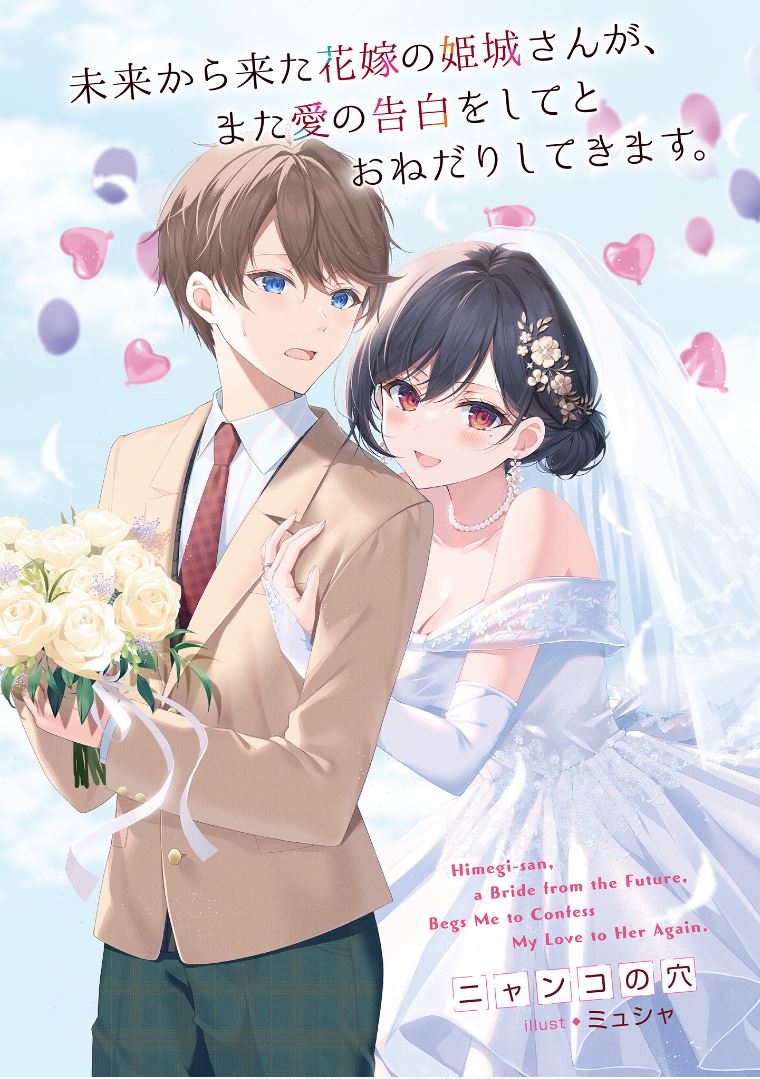
... Read More
Okay I need to talk about the structure of this revelation because it is WROUGHT. First she dumps the twin siblings thing on him. Like, casual Tuesday conversation level—"those kids are your sister and brother." He's already reeling from the smartphone future-proof nonsense but now his ENTIRE family structure is apparently fake? No, wait, his mom is actually pregnant. Oh. Then she pivots to the wedding video. And here's where I genuinely did a double-take. She doesn't just show him they're friends in the future—she shows him THEIR WEDDING. With him as the groom. The man she describes as "pitiful" looking. The one who can't even touch girls' hands in the present but in the video is placing a ring on her finger like he's done it a thousand times. "——In the video on the screen, 'me' and her were kissing." I literally said out loud "wait WHAT" when I read that. Because the narrator himself says he has no memory of this happening, which means either: 1. This is an elaborate fabrication to mess with him (possible, given he keeps thinking that) 2. The future is already set and he's about to live it (terrifying) And the BEST part? He tries to stop the video mid-kiss. She literally pleads "Wait! The best part is coming!" and he's just sitting there paralyzed. That is such a perfect beat. The pacing here is chef's kiss. She teases, reveals, teases again, then drops the whole future-bride bombshell and he can barely form words. No info-dumping, just escalating proof after proof until he just... surrenders. "I raised both hands in surrender." But the question that's been eating me since: who filmed that video? Her younger sister, apparently. So this future version of her sibling is also around. That's a thread I want pulled. Also—the pocket watch at the end? A physical time travel device? Of course there's a gadget. I hate that I'm not surprised. Honestly this chapter made me stay up past my bedtime reading it. The narrative arc from "you're crazy" to "I raise both hands in surrender" is so clean.
... Read More
What hit me the hardest in this arc was Touka's quiet realization that she's an outsider in her own past. She time-travels back six years, expecting nostalgia, but instead feels something stranger — freshness, uncertainty, and this gnawing awareness that none of it is truly hers anymore. The line where she thinks, "I understood that I was an outsider in this world and that I couldn't stay for long" — that destroyed me a little. She's standing right next to the person she loves most, and yet she's separated from him by years of experience he hasn't earned yet. Then there's Ha-kun, and that final moment where he looks at her and says, "Welcome to the world of six years ago." The fact that he already knows what she's doing — that he's been part of this before — adds this gorgeous layer of bittersweet devotion. He's guiding her back to a moment he himself lives through for the first time, and his smile at the end isn't just sweet, it's almost heroic. He's choosing to trust her completely. And Touka's internal monologue about how "in the unseen future, there will be a version of me who smiles just as much as he does right now" — that's the kind of emotional shorthand that makes you put the book down and just stare at the ceiling. She's not just surviving the timeline, she's betting everything on a future she hasn't seen yet. The family dynamic with her parents-in-law accepting her so warmly also warmed my chest. When they welcome her with open-hearted smiles after she shows them Harune's video, it contrasts so sharply with the tension of her mission. She's carrying the weight of changing fate, and meanwhile her father-in-law is just worried about whether she's eaten enough breakfast.
... Read More
There's something really profound about the setup here that I want to sit with for a moment. Touka doesn't get a time machine because she wants to save the world or prevent a tragedy. She gets it on her WEDDING DAY — the happiest moment of her life — and her entire motivation for using it is tied to something deeply personal and domestic: her cancelled birthday party six years ago, and her sister's lingering regret about it. That choice of motivation matters. It's not cosmic. It's intimate. It's about family, about making sure a little girl gets to play the violin at her own birthday, about erasing a moment of collective sadness. And the rules themselves read like a metaphor for how regret actually works: You can only go back in one-year increments. You can't go back to yesterday or six months ago. You can only visit moments you can vividly remember. The watch ties time travel to memory and emotional resonance. This is brilliant on a thematic level. The story is basically saying: you can only rewrite the past when you remember it clearly enough to feel it. And the closer the memory, the more painful — or meaningful — it is to revisit. The pocket watch itself is a powerful symbol. It's a PENALTY for winning a duel — she earned it through conflict, not received it as a gift. Her grandmother calls it one of her many magical items but frames the explanation as a penalty. Time travel as consequence. As burden. As something that comes with rules you didn't choose. And then there's the 60 days vs. 60 seconds rule — the cruelest and most beautiful detail. For the world, she's gone for a blink. For her, she lives two months away from everyone she loves. That's essentially what grief feels like too, isn't it? When someone you love is gone, the world keeps moving in seconds while you're stuck in an extended present of absence.
... Read More
The shopping mall sequence is such a grounded, ordinary setting and that's exactly why it works. The author takes us to this large shopping mall 'located a bit outside the suburbs, not very convenient' — which immediately feels real and specific. It's not some glamorous location, it's just where regular people go. And the card shop within it, which the narrator hasn't visited since elementary school, triggered this wave of nostalgia that I totally felt reading it. I love the visual of Touka wearing a mask and sunglasses as her 'secret plan' to avoid being recognized. The narrator's internal response — 'Perhaps, she's more of a klutz than I thought?' — paints this whole picture of two people who are clearly not suave time-traveling spies but just regular folks trying to navigate an impossible situation. The contrast between the extraordinary premise (time travel!) and the utterly mundane execution (buying clothes, selling cards, dealing with cash) is what makes this world feel alive. The card shop scene especially has great sensory details: the store manager's trembling hands, his widened eyes, the serious expression as he examines the card. You can feel the weight of the moment — this card, worth 200,000 yen, is the difference between being broke and having actual resources in a time period where you shouldn't exist. And the clothing store with the 'cute and stylish female clerk' greeting them with a cheerful 'Welcome~' — these background details make the world feel fully realized. It's not just a backdrop for the time travel plot; it's a real world with real shops and real clerks and real prices.
... Read More
I think the most interesting conflict in this story isn't the romance rejection or the fortune-teller mystery — it's the one happening inside his head, and it all circles back to his name. "Hakuba Ouji." A name that means Prince on a White Horse. A name so flashy that people can't help but react to it. He's been mocked for it his entire life, and now he's terrified that Himegi rejected him because of it. Not because of who he is, but because of what his name makes him look like to the world. This isn't just insecurity — it's a fundamental conflict about identity. Every time he lies about his name (giving Harukawa's name to the fortune-teller), he's running from himself. And every time someone mocks it, even Kanako, it validates this fear that he's not taken seriously as a person. The external conflicts mirror this. The fortune-teller investigation is a test — can he prove that something mysterious is real, or will it turn out to be another scam? Either outcome feels like it would confirm something about himself. If the fortune-teller is real, maybe there's something magical about his life that he hasn't noticed. If it's a fraud, then maybe nothing in his life is as meaningful as he hopes. The stakes here are emotional rather than physical, but they feel just as high. He's not fighting for his life — he's fighting for the right to be seen as someone worthy of love, of respect, of a name that doesn't make him an instant punchline. And that's why I can't stop reading. Because underneath the romantic comedy setup and the mystery subplot, there's a boy who just wants to be someone real.
... Read More
The stakes in this chapter are layered in a way I rarely see done this cleanly. On the surface level, it's a romance problem — will she choose him? But underneath that, there's this much bigger, more unsettling question: if someone from the future is standing in your living room claiming you two end up together, what does that do to free will? What does it do to choice? Hakuba is already at a disadvantage. Today, this same girl rejected him. His emotional baseline is hurt and confused. And now she's showing up as a future version of herself, wearing a wedding dress, acting like they're supposed to be together. The power dynamic is completely skewed. He doesn't know the future she's describing. He can't verify any of it yet. All he has is her word and that ridiculous number on her chest. And then there's the parents. Their calm acceptance is probably the most unnerving detail in the whole chapter. Why aren't they more reactive? Are they in on something? Do they know about this future and just… went along with it? That silence from them adds a whole other layer of mystery and threat. The ordinary world around Hakuba is already compromised. The fortune teller's prediction adds another thread of stakes — she foresaw this exact moment, which means either the future is fixed and unavoidable, or she's manipulating events to make it happen. Either way, Hakuba is caught between forces he can't control: a woman from six years ahead, a seer who knows too much, and a family that seems to already know something he doesn't. The question hanging over everything is simple and terrifying: if the future is already written, does any of this matter? And if it's not — if this is just one possible version — then what has he just walked into?

Leave a comment

You must be logged in to leave comments. or
