Himegi-san a Bride from the Future Begs Me to Confess My Love to Her Again
+Add to Custom List
Novel Info

Summary

... Read More

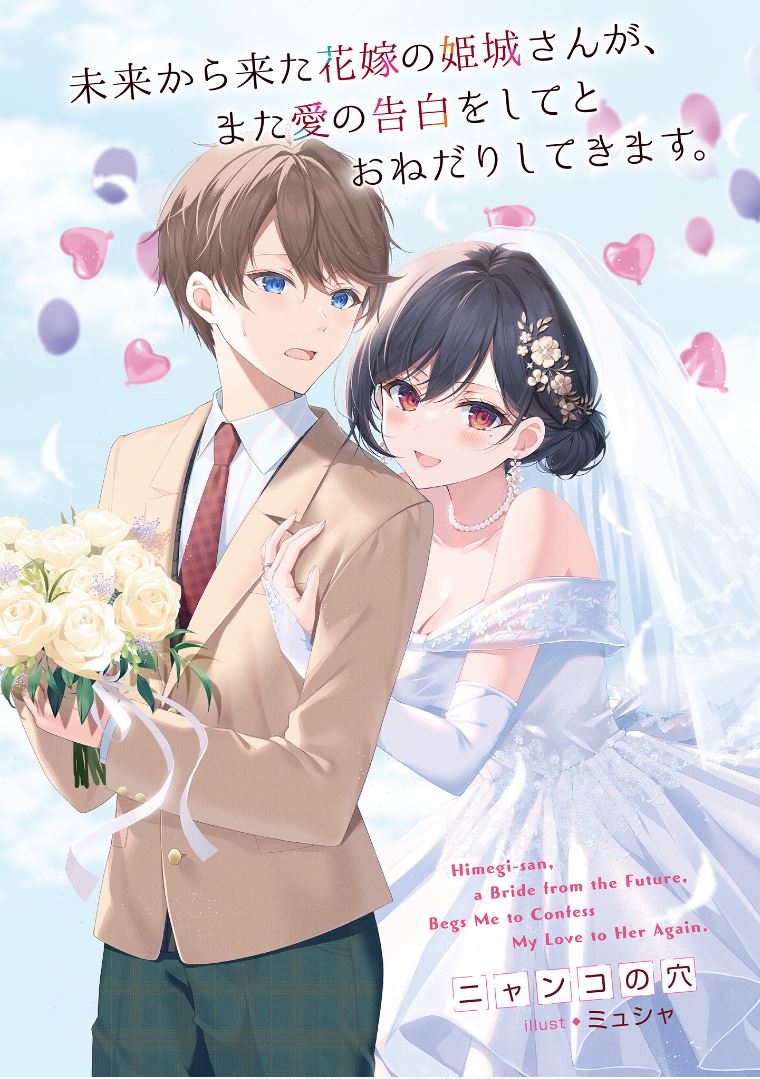
Hakuba Ouji is a high school student with an unusual name that invites ridicule, leading him to adopt the nickname Pitiful Prince in self-deprecating jest. He is a member of the Magic Research Club and harbors a secret ambition to become a professional magician who performs free shows for children. On his second day of school, he experiences love at first sight with Touka Himegi, a stunningly beautiful and athletic student whom he considers unattainable. Despite her perfect reputation, Himegi politely but firmly rejects his confession, leaving Ouji devastated and embarrassed. His childhood friend, Kanako Chikada, a cynical and sharp-tongued vice president of the Newspaper Club, witnesses the rejection and records it for a potential article. She coerces Ouji into investigating a popular local fortune teller by promising him a rare plastic model kit as a reward.

Ouji locates the fortune teller, an elderly woman in a black robe who claims to possess genuine mystical abilities. After Ouji attempts to deceive her by providing a false name, she correctly identifies his true identity and birthdate without any prior information. She predicts that in exactly one hour and eight minutes, Ouji will meet his destined partner and be left speechless. Ouji dismisses her as a skilled manipulator rather than a psychic, paying only the nominal fee of five hundred yen for a talisman before departing. He sets an alarm on his phone to mark the predicted time, expecting no further significance from the encounter.

Upon returning home, Ouji is shocked to find a sushi delivery from the most expensive restaurant in town, exactly as the fortune teller had predicted, despite his family never ordering such luxuries. Inside his home, he discovers Himegi sitting in his living room dressed in a full wedding gown. His parents treat her presence as completely normal, and Ouji faints from the sheer absurdity of the situation. When he recovers, the woman in the wedding dress introduces herself as Touka Himegi from six years in the future. She claims to have traveled back in time using an antique pocket watch inherited from her grandmother, who is revealed to be a witch. To prove her identity, she shows Ouji a video on a futuristic red smartphone depicting their wedding ceremony, confirming that he is indeed her husband.

As Ouji processes this reality, Touka explains the mechanics of her temporal displacement. A magical number is etched onto her chest, serving as a countdown timer that indicates how much time she has remaining in this timeline. The count decreases daily, and she is currently at fifty-five days, having already lost five days as a penalty for inadvertently revealing future information to Ouji and his family. She reveals that her purpose for traveling back is crucial but remains withheld for now, asking Ouji to trust her while she adjusts to life in the past.

Practical challenges immediately arise. Touka possesses no valid currency, as the banknotes she carries are from a future fiscal year and cannot be used in the present. Her futuristic smartphone is also non-functional, with apps disabled by magical constraints and mobile networks unavailable due to a paradox involving identical SIM cards. Ouji helps her navigate these issues by selling a rare trading card she confiscated from his future self, securing funds for their immediate needs. The two begin living together at Ouji's house, with Touka adapting to domestic life while Ouji grapples with the impossibility of his circumstances. Despite the initial shock, Ouji finds himself drawn to Touka's confident and affectionate demeanor, which contrasts sharply with the reserved high school girl he previously knew.

The narrative establishes a central conflict centered on the finite nature of Touka's stay and the unknown reason for her return. As they spend more time together, Ouji must balance his current life as a student and magic club member with the reality that his future wife is currently staying in his home. The story moves toward exploring how their relationship evolves under the pressure of impending separation, while Ouji begins to uncover the deeper mysteries surrounding the pocket watch, his grandmother's magical legacy, and the specific events that led to his marriage to Himegi in the original timeline.

Latest Release
DateGroupRelease
2026-10-01hiraeth translations c63
2026-10-01hiraeth translations c62
2026-10-01hiraeth translations c61
2026-10-01hiraeth translations c60
2026-10-01hiraeth translations c59
2026-10-01hiraeth translations c58
2026-10-01hiraeth translations c57
2026-10-01hiraeth translations c56
2026-10-01hiraeth translations c55
2026-10-01hiraeth translations c54
2026-10-01hiraeth translations c53
2026-10-01hiraeth translations c52

Community Reviews

Rating(0 / 5.0, 38votes)
5 stars
0(0%)
4 stars
0(0%)
3 stars
0(0%)
2 stars
0(0%)
1 stars
0(0%)

Popular reviews

... Read More
Okay so let me just say — the whole number-on-the-chest thing is weirdly powerful for character development. Not because it's romantic or whatever, but because it ACTUALLY changes how they interact. When Touka-san reveals her chest and the number drops from 60 to 55 because she spooked the Ouji family with future knowledge, that's not just worldbuilding — that's a constraint that makes her CAREFUL around Ha-kun. She literally can't just drop spoilers because every slip costs her time in this timeline. And honestly, the "call me Touka-san" moment? Chef's kiss. She starts off trying to force "My Beloved Touka" which is peak over-the-top and immediately shows her confident, slightly teasing personality. Then she accepts "Touka-san" as a compromise, and you can SEE the shift in their dynamic — from formal distance to something warmer. Ha-kun is still flustered (of course he is), but there's a genuine closeness forming here. The most interesting part though? She won't tell him WHY she came to this timeline. She says "I have a purpose" and bows and apologizes. That tells me SO much about both characters. Touka-san is clearly carrying some heavy burden, and Ha-kun respects her enough to not push — but you can feel he's dying to know. This is the kind of secret that will either bring them closer or tear them apart depending on what it turns out to be.
... Read More
The stakes in this section are layered in a way that's easy to miss on a first read. On the surface: will Ha-kun believe her? That's the immediate question driving the scene. But underneath that is SO much more. If she's telling the truth, he's about to lose her to another version of himself—or rather, he's about to BECOME the person who marries her, which means all the current pain of rejection gets reframed as a temporary obstacle. That's either the most hopeful thing or the most terrifying thing depending on how you look at it. "Even though I knew it was just my own ego, I didn't want to lie to myself." This line came right after he'd mentally given up on her. And then she shows up claiming to be his future wife. Of course his ego is confused. Of course he wants to believe her but can't bring himself to fully commit to it. The internal conflict is what's killing me here. He wants to believe because believing means there's a future with her. He can't believe because if he's wrong, he loses the coping mechanism of just moving on. Every time he starts to accept it, something pulls him back—his father's casual confirmation, the video of the kiss, the pocket watch. "With trembling hands, I tried to return the red smartphone to its owner, but instead, I found myself staring at her face——precisely, staring at her lips." That sentence. That is not a sentence about time travel. That is a sentence about a sixteen-year-old boy who has never kissed anyone and just watched himself kiss the girl he likes six years in the future. The stakes aren't about saving the world here—they're about a kid figuring out whether he gets to be happy or not. And the external conflict? We don't know yet. What brought her here? What happens if the future changes? But that pocket watch... that's clearly important. And I have a feeling we're going to learn why she really came back very soon.
... Read More
The way this section spans Date 5 through Date 7 and covers so much ground without feeling rushed is impressive. Date 5 is basically the exposition dump — figuring out the phone situation, discovering the SIM card paradox, learning about the unusable money. It could easily have been boring info-dumping, but the author breaks it up with humor (the fake Japanese-Sumerian call prank) and genuine tension (realizing they're stuck with limited resources). The pacing here is functional but never draggy because each discovery leads naturally to the next problem. Date 6 shifts into action — the shopping trip. This is where the narrative breathes more. We get character moments, internal monologues about love and irrationality, the card shop scene with its small climax of the 200,000 yen sale. The structure here moves from problem to solution to new problem (need clothes now), which keeps momentum. Date 7 starts with the conclusion of the card sale and moves into clothing shopping. The transition feels natural because the money from the card directly enables the next activity. What I appreciate most is that the author doesn't rush the emotional beats. The realization about love ('Love is really something that can make people irrational') comes after a full scene of interaction, not as a random thought. And the ending lands on a quiet, warm note rather than a cliffhanger — which is a bold choice for a serial novel but it works because the emotional arc of these three days feels complete.
... Read More
Okay, I need to talk about Ha-kun because this man absolutely deserves every bit of happiness Touka is willing to risk her timeline for. Let me paint you a picture: her husband — her actual HUSBAND — is sitting there in a tuxedo on their wedding day, and he's smart enough to immediately figure out the time travel rules, his wife's grandmother literally keeps praising him, AND he works a part-time job just to buy his future sister-in-law a hundred-thousand-yen gift card for winning a violin competition. I'm not even joking when I say this guy is unreal. Like, what kind of person is this? He's kind, he's supportive, he gently encourages Touka to do whatever she needs to do, and he kneels in seiza on the floor waiting for her to come back from the past. That's not just devotion, that's a full commitment. But here's what really got me — when Touka leans in to kiss him before leaving, the narration says: "For Ha-kun, it's just a minute of an event, but for me, it means being apart for two months. To say I'm not going to be lonely would be a lie." And she presses her lips against his with all her heart. That contrast — sixty seconds for him, sixty days for her — that is gut-punch level romance right there. The fact that she's willing to leave him for two months of subjective time just to fix something in the past shows how deeply she cares. And he? He's just sitting there trusting her completely. Also can we talk about how the grandmother actually likes him? This woman who 'dislikes humans' according to the text is praising him left and right. That's saying something. The Touka-Ha-kun-Harune triangle is honestly so wholesome it hurts. Ha-kun promised Harune the gift card, Touka confiscated it like a responsible older sister, and now Harune is begging Touka to pass on a message from the past. This family dynamic is everything.
... Read More
The dialogue in this text is genuinely one of its strongest features. Every character has a voice that's instantly recognizable, and the banter between Touka and Ha-kun is particularly sharp. Take this exchange right after she gets back from shopping: "Well, I have to admit that you deserve some credit for protecting me from that guy. As expected of my Ha-kun." "Thank you." "But I really can't accept that last line. 'The correct answer is the one who protects the princess — it was the prince!' gave me goosebumps!" That's such a natural, lived-in conversation. Touka praising him, then immediately pivoting to roasting him for something cringey he said. That's how actual couples talk. It's warm but it's also cheeky. And the grandmother's voice is SO distinct. Just reading her lines you know it's her: "I don't have to tell you that much." "If you have a problem with it, give it back." "Hmph, that was an unnecessary remark. I wonder who you take after…" She's grumpy, dismissive, deflective — classic grandmother energy but dialed up to eleven. The fact that she explains time travel rules with that attitude instead of treating it as some sacred teaching moment is hilarious and perfectly in character. Then there's Harune, who gets fewer lines but each one pops: "Y-Yeah. I made a promise that I'd give it to her if she won the violin contest, so I worked hard to get it." "Stingy!" She's bratty but lovable, and you can hear a high school girl in every word. The narration itself also has a great voice — Touka's internal monologue is self-aware and slightly dramatic without being overwrought. When she says "somehow, I feel like I'm being given a pretty convoluted excuse" about the grandmother watching from a distance, that's pure comedic timing in prose form.
... Read More
Let's talk about how this author manages to not let you catch your breath for a single second across these chapters. Date 10 starts with Touka going into a toilet—which the TN helpfully flags—and we're immediately thrown into panic mode when she comes out looking like a completely different person. The tension is MAXIMUM. You're holding your breath. Then—cut to Date 11, and suddenly it's just... normal. They're buying tickets. Sitting in a movie theater. Eating takoyaki. It's almost comically calm after the previous chapter's chaos, and I initially thought it dragged. But then I reread and realized: this calm IS the point. Ha-kun is trying to pretend nothing weird is happening because if he stops moving, he'll have to actually process what's going on. That's not slow pacing—that's psychological realism. The movie sequence works as a breather that also builds tension in parallel. While the characters watch a film, we're watching HA-kun watch HER, and every glance is loaded. The pacing here is deceptively slow—it feels like nothing's happening, but everything IS happening. Then Date 12 drops us right back into high-stakes territory with the clerk recognizing Touka's advice and Himegi getting confused. The author bounces between tension and calm like a heartbeat monitor. One moment you're sweating, the next you're sighing, and then—surprise, takoyaki order creates a new problem. This rhythm kept me reading at 2 AM. No jokes.
See all reviews

Custom lists

See all custom Lists