After Marking the Protagonist A - Reviews

After Marking the Protagonist A
+Add to Custom List
Sort
Add review
... Read More
I need to talk about how this author controls tension because honestly it's a masterclass. The entire chapter is basically one continuous scene — two people talking in moonlight near some rose bushes — and yet it reads like a thriller. How?! Let me break it down. The author opens with a physical detail (the snake coming out) to establish danger immediately. Then slows everything down to almost nothing — Ji Chenxi asking if Chi Zhuo will come out, Chi Zhuo refusing, the silence between them. This false calm makes the subsequent escalation hit so much harder. When Chi Zhuo finally grabs his hand, your heart does that thing where it skips and then pounds all at once. The pacing trick I appreciate most is the countdown. Ji Chenxi silently counts down "Three... Two..." and right before "One" lands, Chi Zhuo acts. This tiny structural beat gives the reader hope and then yanks it away — classic but executed perfectly. And then the author PULLS BACK again with Chi Zhuo refusing the suppressant and the doctor offer, creating a breathing room that feels almost cruel after that spike. Then comes the pheromone request, which is the emotional peak, and the author delivers it in short, clipped exchanges. "Yes." "No regrets." Just two words each, and somehow that's worth a thousand paragraphs of description. The final image of the suppressor ring being unclasped? No fanfare, no dramatic music — just that single action that implies everything about to happen. This is how you write tension without relying on action sequences or external threats. The entire conflict is internal, between two people who want different things from each other, and the author lets that simmer for pages before letting it boil.
... Read More
I cannot stop thinking about the dynamic between these two. Ji Chenxi is wearing a silver hair disguise, playing the role of a fragile omega, but his spirit beast has "ridiculously sharp senses" — which means he's hyper-aware of exactly how dangerous Chi Zhuo is. And Chi Zhuo? He's in full alpha heat mode but still says "Get lost" and later tells Ji Chenxi to step back because he doesn't want to scare him. The contrast is INSANE. The most revealing moment for me was when Chi Zhuo lets go of Ji Chenxi's hand before he can use his spiritual power. That's not just self-control — that's instinct. Even half-mad from heat, his body chose to protect rather than consume. And Ji Chenxi notices this. He literally thinks: "I respected anyone who treated omegas properly." That one line reframes everything we thought we knew about this character. The book painted him as cold and ruthless, but here he is being tender toward someone he thinks is defenseless. Meanwhile Ji Chenxi's internal voice is so delightfully chaotic. He starts off cold, calculating, waiting for the perfect excuse to deal with Chi Zhuo. But somewhere between the hand contact and the pheromone request, he gets pulled into the game himself. When Chi Zhuo says "I guess you could say I fell for you at first sight" — Ji Chenxi gets EXACTLY what he wanted to hear, and he knows it. The dynamic has shifted from predator/prey to something way messier. I love that neither of them is being fully honest with the other, and yet both are exposing real vulnerabilities. That's not a typical romance setup — that's two broken people circling each other in the dark.
... Read More
The opening scene is absolutely gorgeous. Let me just paint it for you: afternoon, soft breeze, golden sunlight across the estate, servants moving quietly. This is a wealthy setting - we're not talking about some humble cottage. There's a half-round stone pavilion in the garden. Tea. Books. White roses in full bloom behind the reader. The visual composition is so deliberate. Ji Chenxi with silver hair gleaming in the sun, blue eyes lowered to his book, slender fingers turning pages. The sunlight paints his lashes gold. He looks even more breathtaking than the flowers. That comparison isn't accidental - the author is telling us this man IS art, part of the landscape, something to be observed. And then Su Yu enters the frame. Boisterous, restless, drinking flower tea (which is apparently what everyone drinks here?), making noise. The contrast between them is immediate. One is motion, one is stillness. One is golden light and shadow, the other is just... bright. The book itself is described with care - black cover, old golden trim, yellowed pages, strange flowing script. It feels like an artifact, something precious and out of time. That's how Su Yu judges it at first glance: an antique. But then Ji Chenxi reveals it's not ancient writing - it's nonsense in the common tongue. Which means the mystery goes deeper than anyone realizes. The estate setting matters because it's insulated. Closed off. Perfect for secrets to fester. And that afternoon tea setup - two hours of Su Yu waiting, Ji Chenxi reading - it creates this bubble where nothing happens except everything is about to change. April 29th. The birthday party. The meeting. All looming. I want to see more of this world. What does the rest of the estate look like? What's the political situation? Who are these alphas and omegas? The hints are delicious but I need more.
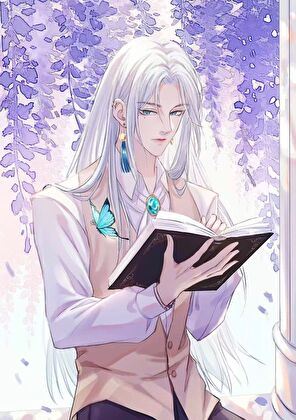
... Read More
Let's talk about how this story handles its AAs. The marking thing — Ji Chenxi himself admitted that at first it "had this undertone of intimacy or flirtation" — and now he full marks Chi Zhou out of sheer spite? There's something deeply satisfying about that. It's not romantic, it's not tender. It's pure, unfiltered "you touched my earring so now you belong to me" energy. But what really got me is the twin introduction scene. Shade just stares at Ji Chenxi's cat charms, his eyebrow piercings, his silver hair, trying to categorize him. "Are you actually… sweet-cool style?" This is the first time I've felt genuinely amused by a character assessment that completely misses the mark. Ji Chenxi is a glacier and Shade is just… vibing. There's no chemistry here, just two very different people bouncing off each other, and honestly? I want to see more of that dynamic. The story hasn't given me any obvious romantic tension yet, but the Chi Zhou thread is simmering. And that line — "he wanted to mark me" — spoken so casually, like it's nothing — that's the kind of underplayed intensity that makes me want to throw the book across the room and immediately pick it back up.
... Read More
I need to talk about this opening scene because the author just painted one of the most vivid ambush sequences I've read in a while. We open mid-crisis—a photon cannon strike coming out of nowhere, Shade dodging, Nether keeping the ship steady—and we're immediately pulled into the chaos. But here's what's brilliant: the author doesn't just give us explosions. They give us the floating rock zone, this massive field of debris where any ship heading to Andromeda A-756 has to pass through. It's described as perfect for an ambush, which makes the whole setting feel alive and threatening. The visual imagery keeps building. Nanoseconds of nebula light flashing past the round window, photon blasts almost hitting the command center forcing full 360-degree ship rotations, the gradual shift from ‘playful' strikes that seem like a cat teasing a mouse to actual lethal intent. I can see this like a film sequence—the slow realization dawning on Shade that these aren't random pirates looking for loot, they're professionals herding them somewhere. And the worldbuilding details drop naturally throughout the tension. We learn about S-level spiritual power requirements for bufferless jumps, how military outposts near floating rock zones can be temporarily compromised, the fact that pirates can't crack special security codes and have a half-day window before alarms trigger. None of this feels like exposition dumps because it's woven into survival decisions. The floating rock zone itself becomes a character—ancient, treacherous, and currently weaponized by whoever wants Chenxi dead.
... Read More
"AO… there's a difference." That line. That single line. I need everyone to understand what just happened there. In the middle of an alpha's heat-induced crisis, barely able to stand, Chi Zhuo manages to drop this one sentence that simultaneously reveals he's onto something, is choosing not to react to it, and is somehow more dangerous than ever. That's dialogue that does triple duty. And then there's the whole pheromone exchange. Let's talk about how the author makes this sound intimate without being explicit. "Can you… release a little pheromone?" The hesitation, the ellipsis — it sounds like a request, but it carries the weight of something far more primal. And Chi Zhuo following up with "Don't worry—I can hold it fairly well. If you're worried, you can step back a little" is just—how is he this polite while completely losing his mind? The dialogue here creates this insane contrast between word choice (gentle, careful) and subtext (starving, desperate). Ji Chenxi's voice is equally good. His line "So do you want my pheromones because you like me, or just because you need them to calm yourself?" feels like he's genuinely curious AND genuinely threatening at the same time. That's the thing about his dialogue — it always has two layers, and the reader is supposed to feel like they're catching the second layer just slightly after the other character does. The author also does something clever with silence. Chi Zhuo's long pause before answering "I guess you could say I fell for you at first sight" — the narrative explicitly calls out that he "hadn't expected to be asked so directly." That admission through pacing alone tells us more about his character than any monologue could. Every line here serves character, relationship, AND plot simultaneously. That's rare. Most authors can't handle that kind of density and still make it sound like natural speech.
... Read More
I need to talk about how this chapter redefined the entire conflict structure, because what starts as a simple ‘mercenaries get ambushed' scenario evolves into something far more dangerous. Let me trace the stakes escalation because it's genuinely impressive. Initial stakes: survive the pirate attack. Simple enough—two mercenaries, one ship, hostile forces. But then Shade figures out these pirates aren't after money. The stakes shift: these attackers want Chenxi specifically. Now we're not talking about random bandits; we're talking about targeted assassination. The floating rock zone isn't just dangerous terrain—it's a hunting ground weaponized by someone who knows exactly where Chenxi will travel. Then comes the family conflict reveal, and suddenly personal survival merges with political destiny. Chenxi isn't just fighting for his life; he's caught in a succession war between alpha siblings and their military backers. His older brother wants him dead because Chenxi's the legitimate son and therefore the heir, even though Chenxi himself doesn't want the throne. The second sister's military faction is apparently pleased with how things are going—maybe even ‘ nudging events along.' This isn't just an ambush; it's a proxy war using pirates as pawns. But the chapter's real stakes innovation happens at the end. Chenxi reveals he has S-level spiritual power—the highest tier—meaning he could theoretically perform a bufferless jump that only Alpha elites can attempt. But he's never piloted a real ship before. The stakes become: trust an untested pilot with S-level power and thirty percent odds, or hand over your client and lose your reputation forever. Every option leads to disaster. That's when you know the author has created genuine tension—you're not just worried about whether they survive; you're wondering which survival choice will cost them the most.
... Read More
Okay so the power dynamic flip in this fight is absolutely delicious and I need to talk about it. Chi Zhuo walks in here already at his limit, forcing himself to hold back because he thinks he's dealing with an omega. He's been playing nice, being careful, and Ji Chenxi just… lets him walk into the trap. The moment that ring comes off and the roses flood the air, something in Chi Zhuo snaps. Not just because his pheromones were hijacked—it's the betrayal. The realization that he was played for a fool. And honestly? You can't blame him. I would've lost it too. But then Ji Chenxi—oh man. He's all smug and mocking through the whole fight, needling Chi Zhuo with words like 'Didn't you just say you liked me?' Pure psychological warfare. He's not even fighting seriously, just toying with him. And that smile... that terrifying, shameless smile that says he knows exactly what he's doing and he's enjoying every second. Then the yin-yang bead shatters. That's when everything changes. The teasing disappears, replaced by something cold and heavy. 'This was my favorite thing. My very favorite.' And suddenly Ji Chenxi isn't playing anymore. He marks Chi Zhuo—not out of desire, but as ultimate domination. An alpha marking another alpha is completely different from the intimate AO marking Chi Zhuo was threatening. This is cruelty weaponized. And the best part? Ji Chenxi is the one suffering after. The tequila taste clings to him, makes him sick, but he can't show it. He has to maintain that smile. The person who thought he was in control is the one paying the price. Power shifts, but nobody walks away clean from this.
... Read More
Okay so this premise has me absolutely hooked. We have Ji Chenxi reading some mysterious book with weird script, and it turns out the book is describing real events and people? Like, the Chi Zhuo situation? That moment when Ji Chenxi realizes the nonsense might actually be true? Chef's kiss. The meta layer here is genius. But let's talk structure. The setup gives us all these mystery elements in quick succession: the strange script, the predictions about Chi Zhuo, the engagement situation, the April 29th birthday party that's apparently some kind of turning point. It's efficient without feeling rushed. I love how the protagonist discovers that he's apparently supposed to be some cannon-fodder top who dies fighting over a man. That revelation alone completely reframes everything. The timeline is interesting too. April 29th is the day everything changes - the protagonist meets. So we're essentially watching someone who knows the future trying to navigate around it? That's classic predestination tension. And Ji Chenxi's attitude about the whole thing - he's not panicking, he's analytical. That makes him way more compelling than a typical protagonist. What really works is how the book-within-the-book functions. It's not just exposition; it's active plot device. Every page Ji Chenxi turns reveals something that changes how he sees his world. Chi Zhuo goes from being a weird illegitimate kid to supposedly an SSS-rank alpha ruler of the underground? That's a massive shift. And the fact that the real Chi Zhuo is supposedly more hidden, more dangerous than the fictional version? That means the book is giving incomplete information - which means Ji Chenxi can't fully trust it. I want to know what happens next at that birthday party. The stakes feel real now. If the book is right, this isn't just some social event - it's where the entire narrative pivots.
... Read More
I need to talk about the cat charms on Ji Chenxi's wrist. Nine of them, tiny silver felines dangling from his bracelets, and the narrative makes sure we notice them at least twice. Why? Because this character spends his days arranging flowers and painting — traditional markers of refinement, patience, aesthetic sensibility — but he also has a restraint with chains on him and he marked someone who tried to mark him first. The cats are soft. They're playful. They're almost ironic against everything else about his presentation. Then there's the money. 9.99 million Star Coins. Nearly half of it goes to the mercenaries. The story keeps reminding us that safety has a price tag, that even imperial princes have to pay to be protected on a planetary exploration. And the fact that scholars mostly fund themselves through financial clans while the real danger is outsourced to people like Nether and Shade — that's a world-building detail that says something about hierarchy and dependency. The marking itself is the biggest symbol here. It's humiliation weaponized. It's also intimacy forced into submission. And Ji Chenxi's casual delivery of "Because… he wanted to mark me?" reduces an act that carries emotional weight down to a simple equation of payback. I don't know if the story is critiquing that logic or endorsing it, but it's definitely asking us to sit with the implications.
... Read More
The atmosphere in these chapters is unreal. I keep coming back to the sensory details because they do so much heavy lifting without ever feeling like a textbook dump. Start with the wall scene: chi-zhuo's pheromones are described as "tequila-laced" with a "coppery edge of blood." That single phrase does three things at once—it tells you what drug was used, it hints at violence already in progress, and it makes your mouth water and your skin crawl at the same time. Then there's the garden, which feels like a completely different world. The yin-yang fish earring catching light, the silver hair framing that face "too striking for anyone to look away from," the suppressor ring dulling but not erasing the faintest hint of roses. Every detail is coded. The rose garden specifically is doing something brilliant—most of the bushes have thorns and cut him up, except one tree. One tree that offers shelter. Of course the only safe spot in a garden full of pain is right there, and of course that's where Chi Zhuo ends up half-conscious, bleeding, surrounded by thorns he couldn't escape. I love how the physical world mirrors the emotional one. The suppressor ring on Ji Chenxi's neck is described as uncomfortable, biting his skin—and it literally slips a trace of his rose-scented pheromones when he tugs at it. The world is pressurized. Everything is contained, restricted, barely held together. And yet the imagery is gorgeous. Rose petals drifting. Silver hair. Blood mixing with scent in the night air. It reads like a painting you can step inside.
... Read More
Okay so this whole chapter just reframed everything I thought I knew about Ji Chenxi. He walks in here like he owns the place—this silver-haired, coolly dressed guy barely reacting to photon cannons firing at their ship—and then casually drops that multiple people want him dead and he's basically unbothered about it. The siblings are losing their minds while he's sitting there reading the display screen like he's at the opera. That calmness isn't just personality; it's survival. He's been playing chess in a room full of alpha heirs his whole life. What's fascinating is how he positions himself in this family dynamic without even trying. His older brother thinks Ji Chenxi is harmless, someone to eliminate quietly while ignoring the second sister with her military backing. But look at what just happened—someone tried to murder him in transit and he's still breathing. That's not luck. That's someone who knows exactly how dangerous these waters are and survives anyway. Shade's reaction says it all: ‘No wonder so many people want him dead… he's so calm.' It's not even a compliment; it's recognition that this kid operates on a different wavelength entirely. The sibling trio dynamic is also doing a lot here. Nether won't sell out their client because mercenary honor matters more than survival—that's the code. Shade's pragmatic to the point of wanting to throw Chenxi under the bus for self-preservation. And Chenxi? He's using both of them as cover while figuring out which brother's behind this. He's already analyzing motivations—ruling out the second sister because her style is too calculated, pointing to the older brother's impulsiveness instead. He reads people like others read starship manuals.

Leave a comment

You must be logged in to leave comments. or
