After being forced to marry an ugly husband (BL) - Reviews

After being forced to marry an ugly husband (BL)
+Add to Custom List
Sort
Add review
... Read More
I need to talk about this scene because it's one of the most layered interactions I've read in a while, and honestly it made me re-evaluate everything I thought I knew about these two. After Qingyan visits Chen Yu and sees that baby—Xiao Jiuliang, who looks exactly like Chen Yu—the dinner conversation with Qiu Henian is painfully understated. Qingyan brings up the baby incident, mentions how Yinglan's newborn was ugly at first, and Qiu Henian just says "Hmm" twice. Not dismissive, exactly. More like... processing. Absorbing. Then the bedroom scene. Qingyan is restless, tactile, trying to initiate but Qiu Henian keeps redirecting him. Biting his fingertips, covering his eyes, telling him to sleep. And then Qingyan asks the question that changes everything: "Is it because of that herbal soup?" The silence in the dark is deafening. And then Qiu Henian kisses him and takes control completely. What does this mean? I think it means Qiu Henian is taking active steps toward helping Qingyan have a child—maybe even his own. But the fact that he won't explicitly confirm it, the fact that he silences the question with physical intimacy instead of words, creates this enormous emotional complexity. Is he being tender? Is he being manipulative? Or is he just a man who doesn't know how to verbalize something this vulnerable? Their dynamic has always had this push-and-pull quality, but here it's reframed. Qingyan is the one asking questions, seeking clarity, and Qiu Henian is the one controlling the pace—not just physically but emotionally. And yet, the herbal soup detail suggests Qiu Henian is already investing in their future together in a way that goes beyond romance. That's either deeply committed or deeply calculated, and I love that the text won't tell us which. Meanwhile, Yang Huai's entrance shatters this private bubble entirely. Here's the man who, in the original storyline, helped destroy Qiu Henian. And now he's walking into the village like he owns the place, laughing heartily at the birthday banquet, completely unaware that Qingyan sees him as a threat.
... Read More
Can we just talk about the chestband scene for a second? Because I'm still not okay. The way Qiu Henian sees that red strap—that's not just visual, it's symbolic shorthand for a whole unspoken language between these two. Qingyan only wears it when he wants intimacy, right? So seeing it on his sleeping form is like a silent invitation wrapped in exhaustion. And Qiu Henian's reaction? Regret for not being quicker, then calm acceptance, then a kiss before sleep. It's so tender and so frustrating. I love how the author doesn't dramatize it with dialogue or big gestures—just the shift of fabric, the glance, the decision to wait. That restraint says more than any confession could. It's built on trust, on reading each other's silence. And then the next morning, the whole household dynamic shifts subtly: Qingyan eating in the outer kitchen with Li Shen, avoiding the table, still tired from yesterday but already moving into caretaker mode for Yinglan. Their emotional world is wide enough to hold both private longing and communal care without either diminishing the other. That's rare. Also—53 eggs, then 50. Odd numbers are unlucky. That detail broke me a little. It's so specific, so human. These people aren't just characters; they're living in a texture of small choices. I keep thinking about what that chestband means now, with Yinglan's grievance lurking in the background. How do you hold desire when someone else's pain is suddenly in the room? The scene after the bath feels like a breath held.
... Read More
Something keeps appearing across these chapters and I can't stop noticing it. Medicine. Bodies failing. Dreams you can't remember. The relationship between what we put into ourselves and what happens beneath the surface. Qiu Henian takes sedative herbs every day. He has terrible dreams but remembers none of them. Is the medicine helping or numbing? The old doctor says to adjust it according to his condition — meaning his body is the gauge, not his mind. His consciousness is unreliable. But his body knows. His pulse tells the truth even when his dreams don't. Then Liu Xiang's body becomes the battlefield in an entirely different way. His pregnant belly is the evidence of betrayal, the physical proof that something happened inside him without his consent — not through force, but through manipulation. The shopkeeper fed him sweet words the way he fed him extra pieces of dried meat. The sweetness was the trap. By the time Liu Xiang discovers he's carrying a child, it's too late for medicine to help. The old doctor says so plainly: "It's too late." There's this parallel between Qiu Henian's unseen dreams and Liu Xiang's unwanted pregnancy — both are internal processes happening without the person's full awareness or consent. One is psychological, one is physical, but both represent loss of bodily autonomy in different registers. And then Qingyan's body — sore lips, aching tongue, trembling in Qiu Henian's arms after their passionate encounter. His body is a site of pleasure and vulnerability, yes, but also of trust. He lets himself be held. He lets himself shake. There's a politics to that surrender that the novel seems to understand on some instinctive level. The poisoning subplot (which we only glimpse) adds another layer — someone literally trying to poison Qiu Henian's body while he's already managing medication and insomnia. The body as target, the body as witness, the body as something to be protected or destroyed. What is a body, really, when everyone around you has reasons to want it weakened, controlled, or eliminated? That question hangs under everything.
... Read More
The stakes in this chapter are layered like an onion and I am CRYING through all of them. On the surface: a marriage ending. But the real stakes go way deeper. Aunt Li knows Qin Liangchuan had an accident and lost his memories. She's giving him a chance—tomorrow they'll sign papers, but first she wants him to remember. When she says "He told me he was sorry and that it would have been better if he had remembered us mother and daughter earlier," the weight of that is suffocating. He had a chance to come back to them and chose not to. But then there's the mystery stakes—which are escalating FAST. Qiu Henian's nightmare isn't just a nightmare. Blood, wailing, prayers. This is connected to something far bigger than a marital dispute. And that inscription under his "unknown identity" mark? Something is literally hidden beneath his surface. The fact that Qingyan noticed it dim and could barely read what appeared underneath means the author is setting up a reveal that's going to recontextualize everything. "A big stone has been weighing on my heart. Now, finally, it has been moved away." Aunt Li feels relief. But the reader? We just got hit with three new mysteries at once. I'm not okay.
... Read More
I need to talk about this one moment. Qingyan is pumping the bellows, sitting on that low stool, and he's just... looking at Qiu Henian. The text says his profile was deep and restrained, and his eyes were like a lake with endless secrets behind it. Endless secrets. ENDLESS. And Qingyan himself is spiraling about whether Qiu Henian knows about his calligraphy hiding spot, but what I keep coming back to is the physical proximity — they're cooking together, side by side, in this warm flickering light, and Qingyan notices every detail of him while trying desperately not to. That's not just suspicion, that's someone whose heart is doing gymnastics. Also the scene where Qiu Henian quietly pulls up the blanket over Qingyan before leaving to read next door? HE NOTICED HE WAS COLD. He didn't say anything about the paper or the secret or whatever else he might suspect, but he made sure his sleep was comfortable. I'm not okay.
... Read More
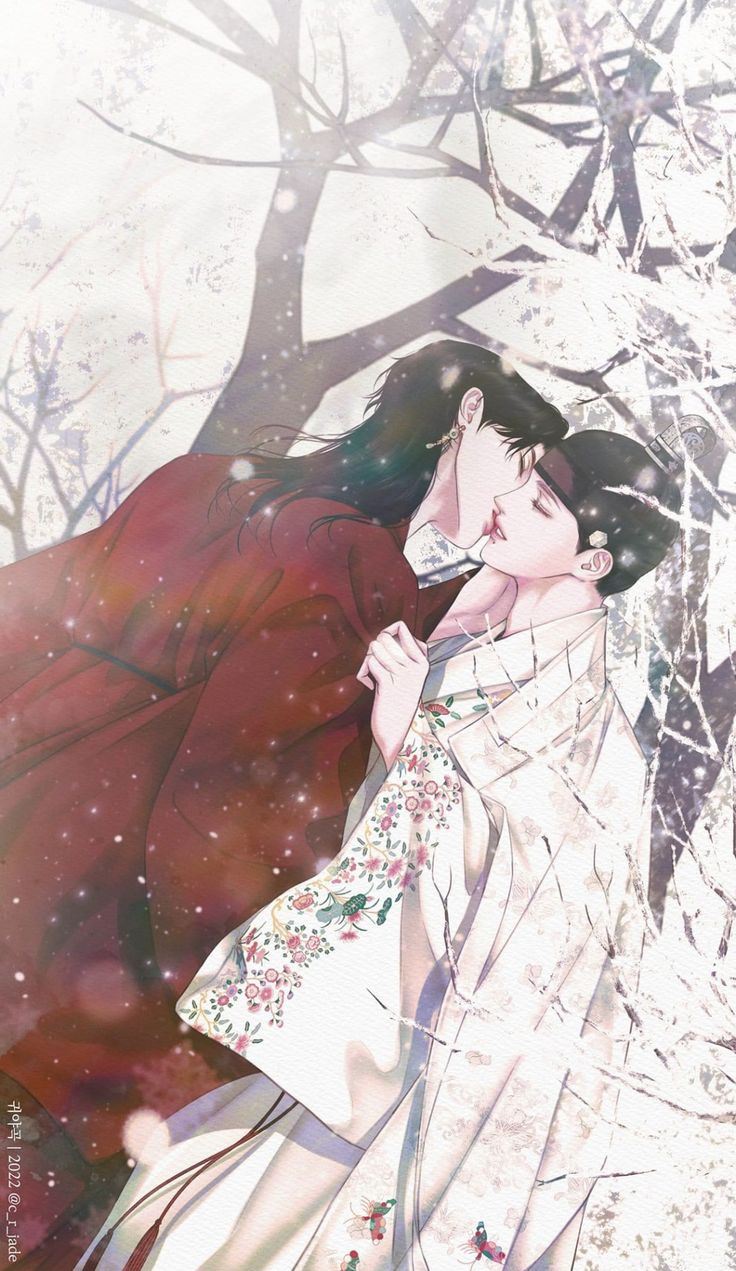
The bathroom and bedroom scene in these chapters is one of the most visually striking pieces of writing I've read in a while. Let me walk through why. It starts with sensory details — warm room, sound of splashing water, the rustling of dressing robes. Then Qingyan is inside the bed curtain, peeling off clothes, applying scented ointment, letting his damp hair half-dry. The author doesn't shy away from physical description: 'The skin recently immersed in hot water glowed faintly red, soft and smooth, seemingly capable of squeezing out water.' That line made me shiver. But what really elevates this scene is the contrast between inside and outside the curtain. Qingyan is visible as a shadow, a silhouette — we see him through the fabric, fragmented. Meanwhile Qiu Henian is entirely outside, his presence communicated through sound (water stopping, footsteps approaching) and then through a single devastating action: the book dropping to the ground with a SNAP. That book, 'Records of Mountains and Rivers,' is such a perfect detail. It's the thing Qiu Henian was holding — something intellectual, composed, controlled — and it falls the moment he sees Qingyan in that vulnerable, prepared state. The control shatters visually before it shatters emotionally. And then the aftermath — Qiu Henian picking up the book, smoothing the creases, placing it 'meticulously' on the round table. He's trying to regain composure, to restore order. But the damage is done. When he looks back at Qingyan, his gaze has changed completely: 'no longer the deliberate calmness from before but seemed filled with a deep, aggressive, and dangerous intensity.' The transition from domestic warmth to charged danger in three paragraphs is masterful. I kept imagining the lighting, the shadows, the way a director would frame this.
... Read More
Okay so here's the thing that has been eating at me — Qingyan's calligraphy secret. The setup is SO tight. He's been sneaking around with calligraphy paper, practicing in secret, and when the moment hits where everyone wants couplets written, he's frozen because he literally can't do it yet. And then Qiu Henian casually drops that he'll write them instead? Perfect rescue. But THEN — the reveal that Qingyan FORGOT TO PUT AWAY THE PAPER DURING CLEANUP DAYS AGO. My stomach dropped. That's not just a plot device, that's the author laying out a slow-burn landmine and watching the character walk toward it. And what's wild is that Qiu Henian said NOTHING. Went to read next door instead. Did he notice? Does he know? The chapter ends with this quiet tension that's somehow louder than any explosion scene I've read lately. Also minor note: the whole Spring Festival couplet subplot feels like it's building toward something bigger than just holiday prep, you know?
... Read More
I keep coming back to the snow. 'It was snowing again outside.' Not just once—again. This isn't the first time snow has fallen in this story, and the recurrence matters. Snow is isolation, yes, but it's also purity, a blanketing silence that hides everything beneath it. Their relationship is growing in this winter world, and the snow keeps falling like a reminder that the world outside doesn't know what they're building. It also marks time—each snowfall is a chapter marker, a sign that life keeps moving even when you're trapped inside. The bath water is another symbol I can't shake. Qingyan emerging from hot water, chest tightening, skin glossy, moving 'like a small animal.' Water as transformation, as vulnerability. She's exposed, literally and figuratively, and he's the one tending to her. Then her clothes become wet—not from water this time, but from tears. The boundary between the intimate and the painful dissolves. Her fear leaks out through her skin the way water soaks through fabric. And that fish legend they read—the black fish falling from the sky, the red fish battling it mid-air, blood draining into the earth until the ground turns red—how is that NOT symbolic of what's coming? Kidnappings, violence, bloodshed on the horizon. The story is telling us through bedtime reading what the plot is about to deliver. Genius.
... Read More
I have to give major props to how each character's voice is so distinct here. Like, you could cover the names and still know who's speaking. Qin Lan's dialogue is so warm and practical - 'Just fry a couple more vegetable dishes,' 'This sauce is from Risheng Zhai, just what I was craving.' She's nurturing, observant, always thinking about feeding people. Even when she's emotional, her lines come out practical first. Qin Liangchuan has that officialdom polish - 'Thanks to you, our family can reunite. You've taken care of them both these days.' Very measured, very proper. But then when he's really stressed, his dialogue gets fragmented - 'Lanzi, you... sigh.' The pause tells you everything. Aunt Li's voice is the most interesting though. She's usually quiet but when she speaks, it carries weight. 'I also thank Lanzi. Others say she's been raised with so much effort, but actually, without her, I wouldn't have been able to keep going.' That's not dramatic, that's just true, and it hits harder than any speech. And Nannan's lines! 'Mom, why are you crying? Nannan's chicken leg is for you, don't cry.' Perfect child logic. You immediately understand this kid's heart.
... Read More
Let me just say this upfront: the stakes in this book are REAL and they keep escalating in ways I didn't expect. On the surface, Qingyan's conflict is simple — he's hiding his identity in a village that would reject him, he's entangled with a married man, he's dealing with physical pain and emotional confusion. But look at what's actually at stake beneath that: Identity — his handwriting would expose him as educated, which in this world means dangerous. The villagers are already talking about him, dissecting his past. One wrong move and the whole carefully constructed life he's built collapses. Safety — that frozen well. The slips, the falls, the physical vulnerability of a body that hasn't quite adapted to this new world. When he's carrying two buckets of water alone, he's not just risking a spill. He's risking exposure, injury, everything. Heart — and this is the biggest one. Qiu Henian is everything Qingyan wants and everything that could destroy him. "Should I grit my teeth and bear it, let him come again?" This isn't just about physical pain. It's about choosing between self-preservation and the possibility of being loved. The stakes here are the oldest stakes there are. The author never lets us forget any of this. Even the quietest moments — sweeping a courtyard, eating melon seeds, practicing calligraphy — carry the weight of everything that could go wrong. That's how you build suspense without action scenes. You make the ordinary feel dangerous.
... Read More
Okay so this chapter is doing something really clever with parallel storytelling. On one hand you've got Qingyan at the Liu family wedding, all vibrant and alive and helping in the kitchen like he's part of this community. And on the other hand, cut to the Wang household—dark, bleak, absolutely suffocating. The author doesn't even explicitly say 'meanwhile' or anything, they just SLAM you from the joyous wedding to Wang Heyao rummaging through his wife's pockets for spare change. That contrast hits hard. But the real plot twist I need to talk about is Wang Heyao's reaction when he's about to punch Shen Min. Instead of actually hitting him, he stops. His expression changes, eyes light up, and he starts muttering about 'such a good way to make money.' What does that mean, though?! Is he planning to sell Shen Min? Put him to work? The text literally ends with someone locking the door from the outside while humming, which is such a chilling detail. It's not even clear if that's Wang Heyao anymore or someone else entirely. And then there's Qingyan's subplot with the carriage drivers—he actually got somewhere! He left a deposit, got two taels accepted as a guarantee, and is now waiting for news about whatever investigation he's been pursuing. The author is weaving multiple threads together here and I'm genuinely curious where they all converge. The matchmaker's son recognizing Qingyan's family from the Lantern Festival? That man at the bride's table who finds Aunt Li familiar? These loose ends are being planted but not pulled yet, and it's driving me crazy in the best way.
... Read More
Can we talk about how GOOD the dialogue is between Qingyan and Qiu Henian? Like, after Qingyan absolutely dismantles Zhang Ju in public, he comes home and still has to deal with this grumpy master who is clearly trying to act aloof but absolutely cannot resist checking on his wife. The exchange is hilarious: "Don't think that just because you're showing off your bare chest to me, I'll soften up. Let me tell you, I'm angry!" And Qiu Henian's response: "So, everything went smoothly?" — completely ignoring the emotional display like the man's been training for this. Then the cherry on top: "Can I still get a kiss after making you angry?" And Qingyan just... fine. Tiptoe kiss. Back to anger mode. This is the most realistic couple interaction I've read. Two people who are clearly deeply affectionate but also have actual separate emotions and boundaries. And Xiao Zhuang in the background just eating potato shreds and watching his drama queens master and mistress be weird — absolute scene. "I dare not be happy." — this line had me wheezing. The kid's emotional restraint is a character trait at this point.

Leave a comment

You must be logged in to leave comments. or
