Summary

... Read More
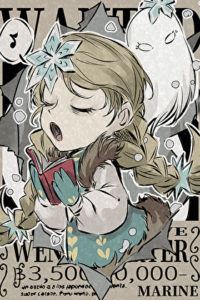
Wendy Carter is a player trapped in the Hunger Holo-Simulation, a virtual reality game based on the survival mechanics of Don't Starve. Bound by a system that forces her to manage hunger, sanity, and health, she must find a companion to hold her Telltale Heart, which serves as the key to her resurrection. If she dies without a companion holding the heart, she faces permanent deletion. After selecting the Pirate world mode, Wendy spawns in the Goa Kingdom. Lacking the ability to swim due to her Devil Fruit-like powers, she is stranded on land. She survives by gathering resources, crafting items, and summoning the ghost of her twin sister, Abigail, to fight off threats. After three days of solitary survival, she reaches Windmill Village and is taken in by Garp, a Marine Vice Admiral, who mistakes her for a homeless orphan. Wendy’s life changes when Garp’s son, Monkey D. Dragon, returns home. Dragon is a young revolutionary with ambitions to liberate humanity. Recognizing Wendy’s unique abilities and her need for a companion, the two form a bond. Wendy gifts Dragon her Telltale Heart, establishing him as her primary partner. However, Dragon’s revolutionary duties call him away. Before leaving, he warns Wendy to hide her abilities and advises her to stay safe. Wendy, viewing their separation through the lens of game mechanics, interprets his departure as a map-expansion opportunity and resolves to find him again. Accompanied by Garp, Wendy travels to Loguetown, the site of Pirate King Roger’s execution. There, she encounters Kuzan, another Marine Vice Admiral, and observes the world’s shifting political landscape. After the execution, Wendy decides to seek a new companion to aid her exploration. In a dark alley, she meets Donquixote Doflamingo, a pirate with the power to control strings. Recognizing him as a Devil Fruit user, she immediately asks him to be her companion. Doflamingo, intrigued by her innocence and power, accepts. He introduces her to the Donquixote Family, a pirate crew with a hierarchical structure of executives. Wendy integrates into the crew, utilizing their resources to craft advanced items and expand her technological capabilities. She plunders the family’s treasury for gems, gold, and bones, items essential for crafting in her system. Doflamingo permits this, viewing Wendy as a kindred spirit due to her noble background and tragic past, which mirrors his own fall from grace as a former Celestial Dragon. He sees her as a project to be cultivated, while Wendy simply views him as a valuable resource provider and teammate. The story highlights the contrast between Wendy’s gamified perspective and the serious, dangerous world of One Piece. While Doflamingo plots revenge and political domination, Wendy focuses on survival mechanics, farming, and crafting. Her interactions with the crew’s executives, such as Vergo and Trebol, are marked by her obliviousness to their moral ambiguity. She treats them as NPCs or fellow players, demanding materials for her recipes without understanding the violent means by which they are often obtained. As Wendy continues to explore the world with Doflamingo, she remains driven by her goal to unlock the full map and find her way back to Dragon, all while navigating the perilous politics of the pirate world with a child’s naive confidence.

Latest Release
DateGroupRelease
2026-08-11shanghai fantasy c58
2026-08-11shanghai fantasy c57
2026-08-11shanghai fantasy c56
2026-08-11shanghai fantasy c55
2026-08-11shanghai fantasy c54
2026-08-11shanghai fantasy c53
2026-08-11shanghai fantasy c52
2026-08-11shanghai fantasy c51
2026-08-11shanghai fantasy c50
2026-08-11shanghai fantasy c49
2026-08-11shanghai fantasy c48
2026-08-11shanghai fantasy c47

Community Reviews

Rating(4.2 / 5.0, 6votes)
5 stars
3(50%)
4 stars
1(17%)
3 stars
2(33%)
2 stars
0(0%)
1 stars
0(0%)

Popular reviews

... Read More
I keep coming back to the worldbuilding in this passage because it operates on two completely different frequencies simultaneously, and the collision between them is where all the magic happens. On one level, you have the One Piece world—Mary Geoise, Celestial Dragons, the Goa Kingdom, Loguetown, the Donquixote Family. This is a world with real history, real political tension, real class hierarchy that people die under. Corazon's backstory about his family being hunted, his mother dying from scavenging in trash bins, Doflamingo killing his own father—this is the weight of the actual One Piece universe pressing down. But then there's Wendy's layer. The system panel. The map that generates holographically. The companion mechanic. The event log that records 'Celestial Dragons' Secret ①: The Donquixote Brothers' like it's a quest marker. To her, this entire world with all its suffering and politics and celestial dragons is just... gameplay. She's thinking about unlockable skills that require materials from specific regions. She's wondering if she can read a regular map. She's planning her next companion like she's building a team in an RPG. The scene where Wendy discovers Doflamingo's crafted map scroll is particularly vivid. The Cartography Table—made simply with a compass and wooden planks, just a crafting recipe she thought was basic utility—but because Doflamingo is bound as her companion, it automatically generates a chart of everywhere he's ever been. The author describes this with such matter-of-fact warmth, like it's just another cute game mechanic, when really it's a devastating narrative device. Doflamingo's entire life's journey, laid bare, sitting on a shelf next to blank map scrolls, and he has no idea. And the ash cans! I can't stop thinking about the visual of those. Beautiful blue triangular structures adorned with entwining vines and seashell-shaped flowers, placed around the Donquixote base like decorative garden pieces. Corazon noticed at least three. People walk past them every day and have no idea. The contrast between the aesthetic beauty and the morbid function is so sharp it almost hurts. Wendy chose these designs because they were pretty skins, not because she wanted to memorialize her sister in any meaningful way—she just liked how they looked. The world feels alive because it doesn't care that Wendy is a player. The world keeps operating on its own terms—Celestial Dragons exist, Karp exists, Dragon is out there somewhere—completely independent of her game mechanics. That's what makes it feel real. The game layer is hers alone.
... Read More
The stakes in this passage operate on at least four different levels simultaneously, and the author never lets us forget any of them. Level one: Corazon's undercover mission. He's been pretending to be mute to infiltrate the Donquixote Family and take down Doflamingo from within. If Wendy tells Doflamingo that Corazon can speak, his entire operation is compromised. This is immediate, concrete, life-or-death stakes. Corazon explicitly thinks about this: 'If Wendy told Doflamingo, he would easily become a suspect in Doflamingo's eyes.' Level two: Wendy's ignorance as a threat. Wendy doesn't know Corazon is undercover. She doesn't know the political implications of Celestial Dragon history. She doesn't understand that asking Doflamingo about Mary Geoise could trigger something catastrophic. Her very lack of awareness is a danger to everyone around her. She's a walking bomb of innocent questions. Level three: Doflamingo's secret past. The author reveals through Corazon that he and Rosinante were exiled Celestial Dragons, that their father was murdered, that their mother died scavenging. This is Doflamingo's deepest wound, the origin of his entire personality and his hatred for the world. And Wendy has the map that proves he's been to Mary Geoise. She already knows. The question is whether she'll accidentally reveal that she knows. Level four: the meta-stakes of the game itself. Wendy's event log just registered 'Celestial Dragons' Secret ①: The Donquixote Brothers' as a new storyline. This means the narrative itself is tracking these revelations as plot progression. The stakes aren't just within the story—they're about whether Wendy will 'complete' this storyline and what that completion looks like from a gamer's perspective versus a human one. The scene where Corazon snaps his fingers to isolate the sound is the perfect visual metaphor for the entire conflict. He's creating a bubble of safety, a private space where the stakes can be discussed without Doflamingo's influence. But Wendy immediately punctures that bubble by asking about the silence. She can't help herself. She's wired to notice mechanics, to identify plot opportunities, to push forward. And then she asks him to be her companion. After everything. The stakes just escalated from 'Corazon might be exposed' to 'Corazon might become permanently bound to a player who treats human relationships as game mechanics.' That's not just dangerous—that's existentially threatening. What does 'companion' mean to Wendy? And more importantly, what will it mean to Corazon if he says yes?
... Read More
The dialogue in this passage is doing something really sophisticated, and I want to talk about how Corazon and Wendy are literally speaking different languages even when they're using the same words. Take this exchange: "Corazon, you're Doffy's younger brother, right? Have you been to Mary Geoise? Is Doffy actually a Celestial Dragon?" Wendy asks this completely casually, the way you'd ask someone about the weather. And Corazon's response—his footsteps halting, his body stiffening, pupils contracting—is the entire dramatic weight of the scene carried by a single character's physical reaction. He can't even form words properly. The silence between his frozen reaction and his eventual speech is where the real dialogue lives. Then later: "Because of the map," Wendy answered truthfully. Then, after a few seconds, she widened her eyes in surprise. "Corazon, you can speak!" The comedy of this moment is that Wendy is genuinely surprised Corazon can speak, as if this is the most notable thing about the entire conversation. She just heard a story about Celestial Dragon exiles and murdered parents, and her takeaway is 'hey, you talk!' The author's use of narrative voice is equally sharp. When we're in Corazon's perspective, the prose is weighted and careful—words like 'uncomfortable tightness,' 'unsettled,' 'grave expression,' 'struggle.' Every sentence carries the weight of his undercover existence. But when we switch to Wendy's POV, the voice becomes light and mechanical: 'event log,' 'companion candidate,' 'hint,' 'plot progression.' The narrative voice itself becomes a character, and the clash between the two voices is the source of all the tension. And the humor! The author's note at the beginning is basically the author breaking the fourth wall to tell us 'Turkey is seeking a substitute for familial affection' with a sunglasses emoji. That tonal whiplash—from the serious narrative to the casual author commentary—is part of the voice. It's like the author is winking at us while the characters are living through something genuinely painful. Wendy's dialogue is particularly distinctive because it's so flatly literal. She never uses metaphor, never reads subtext, never embellishes. 'This is my sister Abigail's ash can.' Period. No qualification, no emotional framing, no attempt to make it sound less weird. That's her voice—pure information delivery, zero emotional modulation. And that's what makes it so unsettling.
... Read More
"This is my sister Abigail's ash can." I am not okay. I am literally not okay right now. Let me just sit with that sentence for a moment. Wendy says it with the same cheerful tone she uses to describe her cooking. She's standing next to this beautiful little blue triangular cabin with entwining vines and seashell-shaped flowers, placing petals inside it like it's some kind of garden ornament, and it's literally her dead sister's remains. And Corazon—poor, mute, secretly-terrified Corazon—just stands there processing that this girl who gave him a flower crown that apparently boosts mental state is also mass-producing urns with different aesthetic skins. The [Seaside Cabin] skin. The [Bird's Nest] skin. She has multiple because the skins are pretty. The author's note says Corazon is 'somewhat seeking a substitute for familial affection' and I think that's the most heartbreaking thing about this entire scene. Wendy offers him a flower wreath, calls him 'Doffy's younger brother,' mentions she has an older sister who can't speak either—and Corazon is so starved for any kind of normal human warmth that he instinctively bows his head to receive it. He's accepting the crown, accepting the connection, accepting the replacement, while simultaneously being absolutely horrified by the ash cans. And Wendy? She genuinely doesn't understand why he's shaken. She thinks she's being nice. She thinks she's making a friend. The tragedy isn't that she's malicious—it's that she's incapable of reading the emotional weight of her own actions. "You haven't met my sister, have you?" she asks cheerfully. Corazon has to process that the sister is literally inside the decorative jar. I need a moment. That's all I have to say.
... Read More
Okay, I need to talk about how brilliantly twisted the plot mechanics are here. Wendy is this absolute chaos agent walking around treating life-and-death secrets like they're just quest notifications, and the narrative keeps pulling the rug out from under us because we keep forgetting she's operating on a completely different layer of reality than everyone else. The moment Corazon spills his entire backstory—Celestial Dragon exiles, murdered father, hunted family—and expects some kind of emotional response? Wendy just sits there like, 'Ah, a new character is starting to deliver plot exposition.' The author absolutely murdered me with that line. It's so casually devastating. Corazon is pouring his soul out, reliving trauma he's carried since childhood, and Wendy's internal monologue is literally just checking her event log for a new storyline unlock. And then the companion system reveal! She immediately pivots to 'do you want to become my companion?' after he just confessed his deepest secret. The comedic timing is impeccable, but what's actually happening here is so much darker when you think about it. Wendy genuinely doesn't understand that she's weaponizing his vulnerability without even trying. She sees a plot opportunity; he sees someone finally listening. The map scroll mechanic is also such a clever narrative device. Doflamingo unknowingly handing her the keys to his entire past through a craft table he didn't even realize was special? That's the kind of plot convenience that feels earned because it's built into the world's logic. And Mary Geoise showing up on the map—of course it does. Of course the one place Wendy hasn't been is the most important place in this world. But here's what's keeping me up at night: Wendy said she won't tell Corazon it's for sharing maps. She's going to have him draw on the scroll directly. Is she lying to protect him, or is she just treating him like another piece of equipment? The plot isn't telling us whether Wendy has any awareness of what she's doing. And that ambiguity is where the real tension lives.
... Read More
这段我真的反复看了五遍,不是因为 I couldn't understand it, but because the pacing is so deliberately calibrated that I needed to slow down and appreciate how the author structures the information reveal. Let me go back to the beginning and拆 this apart. Chapter 40 opens with Corazon's perspective, establishing Wendy through other people's labels—little thief, spoiled, holds grudges. This is the classic misdirection setup. We're being told what to expect, so when we meet Wendy and she's actually polite and refined, bowing and lifting her skirt, the dissonance hits immediately. The author doesn't rush this. We get Doflamingo's explanation about her noble background, we get Corazon's private observations about her cooking and crafting, we get the flower crown scene—all of it building a portrait of someone who doesn't match the rumors. Then Chapter 41 pivots to Wendy's POV and the pace completely transforms. Suddenly we're inside a gamer's head, processing everything through system mechanics and event logs. The transition from Corazon's tense, emotional perspective to Wendy's cheerful, detached one is jarring by design. It's supposed to make us uncomfortable. We just spent a chapter building empathy for Corazon's confusion, and now Wendy treats his entire worldview as background noise. The pacing of the Corazon revelation scene is where the author really shows their craft. He hesitates. He isolates the sound with his Silence Fruit. He takes a deep breath. He speaks. Each beat is deliberate, giving us the weight of his decision. And then Wendy's response—barely any emotional fluctuation, just a practical question about why he can't speak normally. The contrast between his gravity and her nonchalance is the structural engine of this entire passage. And then the companion proposal. Right after he shares his deepest secret, she asks if he wants to be her companion. The pacing here is almost cruel in its efficiency—no breathing room, no moment of connection, just straight into the next game mechanic. But that's the point. The author is controlling our emotional experience by controlling the rhythm of information delivery. We want a moment of human connection between Corazon and Wendy, and the author denies it because Wendy doesn't operate on that frequency. The chapter ends on Corazon's silence—'he fell into silence, unsu'—which is a perfect structural cliffhanger. We're left hanging on whether he'll accept, and more importantly, whether Wendy even understands what she's asking.
See all reviews

Characters

See all characters

Custom lists

See all custom Lists