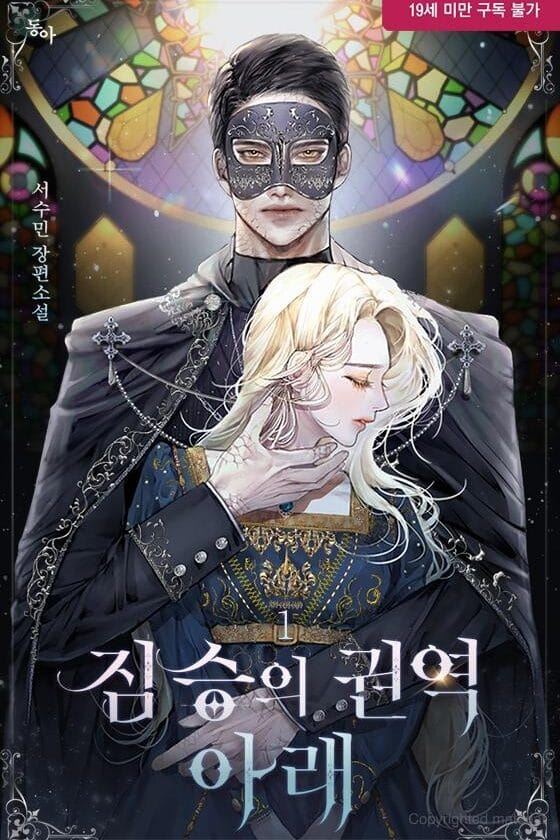
Under the Beast’s Realm
Novel Info
  • Author:
  • Status:Ongoing

Summary

... Read More
Valetta Irpman harbors a deep hatred for Leonard Carnies, the Empire’s celebrated hero who slew the last evil dragon. Her animosity stems from the death of her brother Friedrich, who perished during that same mission. Friedrich had been reluctant to join the campaign, sensing danger, but Leonard’s desperate pleas convinced him to go. Friedrich died saving Leonard’s life, leaving Valetta orphaned and alone. After their parents’ death, Friedrich had been her sole protector and family. His loss shattered her world, and she has since lived as a servant in the household of her aunt and uncle, the Dampierres, alongside her cousin Irmina, who resents her.

The story opens with Leonard capturing Valetta after she ran away for a month to avoid him. He forcibly consummates their marriage, driven by a frantic need to possess her and prevent her from escaping again. Leonard is tormented by a curse inflicted by the dying dragon: his appearance has twisted into a monstrous, scaly form with slitted eyes, invisible to those who hate him but visible to everyone else. The curse also erodes his mind, leading to eventual death. A magical text reveals that only the love of the one who hates him can break the curse. Valetta, who despises him, is immune to the curse’s visual effects, making her the key to his survival.

Four years prior, Valetta’s life was upended by Friedrich’s death. She lived in poverty under the Dampierre roof, enduring humiliation from Irmina and neglect from her relatives, who stole the condolence money meant for her. At a royal ball, Leonard reveals his cursed face to Valetta, who sees him as he once was. He pleads for her help to break the curse. Revolted and enraged, Valetta rejects him, wishing only for his suffering and death.

Seeking escape from her miserable existence, Valetta accepts a marriage proposal from Eric Rigius, a marquis heir who seemed kind. However, Irmina intercepts Eric’s letters and manipulates the situation. The Dampierres collude with Leonard, who offers a massive bride price. They sabotage Valetta’s wedding to Eric, replacing the groom with Leonard at the altar. Bound by social law and threats from her uncle, Valetta is forced into the marriage. That night, Leonard asserts his dominance over her, driven by possessive rage and fear of losing her again.

The next day, Valetta attempts to flee and file for annulment, but her uncle traps her in a room, threatening to sell her into prostitution if she resists. Locked away, she realizes she has no allies; Friedrich is dead, and her family has betrayed her completely. Leonard continues to pursue her aggressively, unable to accept her rejection while grappling with the curse’s grip on his sanity. Valetta remains steadfast in her hatred, viewing Leonard as the enemy who destroyed her family, even as he claims she is the only one who can save him. The narrative establishes a tense dynamic where Leonard’s desperation clashes with Valetta’s unwavering resentment, set against the backdrop of political intrigue and supernatural curse.

Latest Release
DateGroupRelease
2026-10-03dusk blossoms c13
2026-10-03dusk blossoms c12
2026-10-03dusk blossoms c11
2026-10-03dusk blossoms c10
2026-10-03dusk blossoms c9
2026-10-03dusk blossoms c8
2026-10-03dusk blossoms c7
2026-10-03dusk blossoms c6
2026-10-03dusk blossoms c5
2026-10-03dusk blossoms c4
2026-10-03dusk blossoms c3
2026-10-03dusk blossoms c2

Community Reviews

Rating(0 / 5.0, 37votes)
5 stars
0(0%)
4 stars
0(0%)
3 stars
0(0%)
2 stars
0(0%)
1 stars
0(0%)

Popular reviews

... Read More
The Friedrich-Leonard relationship is absolutely the emotional backbone here, and it's devastating. They're described as brothers, having been through everything together. But now Friedrich is furious — not just because Leonard killed his unit and got cursed, but because Leonard married his sister without telling him, weaponizing the marriage as both protection and coercion. And Leonard? He's already lost himself. The text says it clearly: 'the monster inside him finally breaking free.' He knows what he's doing is wrong — 'If anything, Leonard should have treated the sister Friedrich left behind with the deepest care and respect' — but the curse is rewriting his instincts. What's terrifying is that part of him isn't fighting it as hard as he should. When he looks at Valetta crying, his mind goes blank. Not with tenderness, but with something darker that he fights against. Then there's Daniel, who gets shut down fast. 'Message received.' His disappointment flickers across his face when Friedrich says a 'decent man' must be found for Valetta. We get the sense that Daniel had his own designs, and Friedrich just drew a line in blood. The worst relationship is probably Leonard-Valetta. She hates him because he killed Friedrich. He's terrified of himself because of the curse. They're trapped in a room together, married on paper, with no way out. And the reader just sits there screaming internally.
... Read More
So Leonard just hands Friedrich a lifted suspension document and drops the bomb that his sister was molested in the marketplace, right there? This is the moment everything crystallizes for me. The author is playing a long con across multiple layers: first you have the political machination — the Count of Dampierré selling off his own niece to the lecherous Crown Prince Joseph — then the forced marriage, then Leonard's curse eating him alive. Three separate strings being pulled at once. What's clever is how the plot treats Valetta as both victim and pivot. She's not just a MacGuffin being passed between men; every character's motivation revolves around controlling her, but she's also the one who discovers the pen and decides to arm herself. That moment when she locks the door and tucks the ballpoint into her clothes — the plot finally gives her a sliver of agency. She can't win physically, but she won't be entirely helpless. And then Leonard's scene with Tobias, where the 'cure' turns out to be something that would require physical intimacy with the very woman he's supposed to protect. That's not just dramatic irony; it's the author deliberately constructing a trap with no clean exit. Every solution introduces a worse problem. I love that. It makes you want to keep turning pages just to see what happens next. Also — the detail that all unused rooms are locked and the steward has lost the key? That's not lazy writing. That's someone deliberately eliminating escape routes. The whole setting becomes a pressure cooker. Brilliant.
... Read More
The way the author handles the flashback before diving into the wedding night is something I need to talk about. We open with Valetta crumbling, sinking deeper into the mire, and then Leonard appears. The tension builds quickly — he's tall, he doesn't leave, he locks the door metaphorically by just refusing to move. The pacing in that first section is tight, almost claustrophobic. Every line adds pressure. Then — Bam — we're suddenly before Friedrich died. Eighteen-year-old Valetta, bright and laughing, buying strawberries. The shift is so sharp it nearly gave me whiplash, and that's exactly why it works. The author uses that brightness to make the return to the storeroom feel even darker. You feel the loss of that innocence viscerally because we just spent time in it. But here's what I appreciated most: the flashback doesn't linger. It's efficient. We get the key emotional beats — Friedrich's warnings, the house with the apple tree, the market day, the village harassment — and then it cuts back. No dragging. No unnecessary exposition. The author trusts us to connect the dots. The pacing within the wedding night scene itself is also worth noting. It moves from psychological dread to physical confrontation to something almost tender with the blood on the sheets, and then resolves into this quiet, aching stillness. Leonard pretending to sleep while Valetta stays awake all night — that final beat is where the real horror lives. Not in violence but in the silence after. The chapter ends on that unresolved tension and I immediately wanted to turn the page.
... Read More
I am not okay. I repeat: I am NOT OKAY. Let me just... let me just get this out before I collapse. There are three moments in these chapters that have completely wrecked me and they hit in this order that I need to explain: First—the carriage ride. The text says "It had rained that day too — just like today." Do you understand what this parallel structure does? It drags us BACK to the moment of trauma without ever showing it. We get fragments: "Why was it only you?" "He died because of you." The metallic scent of blood. Her throat feeling ripped open. Four years of this memory compounding, and ALL of it is carried on the sound of rain against the carriage roof. I swear I could hear that rain. Second—Friedrich's promise. "Just wait. When I return from this campaign..." The ellipsis does SO MUCH work there. It's everything unsaid, everything promised, everything that will never be delivered. And Valetta's internal voice—"The promise you made that day was one you were never meant to keep." That line absolutely shattered me. It's so gentle and so devastating. And third—the vomiting. Like, the author has her drink champagne to calm her nerves and of COURSE it makes it worse and she runs into the garden and bends over among the bushes and what strikes me most is how PHYSICAL this grief is. It's not metaphorical. Her body is rejecting the world. The orange sunset reflecting in the fountain water, the music drifting like a lullaby, the creeping fatigue making her head foggy—this is trauma in a body. Not in a mind, in a BODY. Then Irmina blurts out that Leonard is cursed, and Valetta's first thought isn't schadenfreude. It's hope. "She wanted it to be true, but she didn't believe it." She would PREFER him to be suffering. And yet when she finally confronts him—when he's standing there, transformed, afraid, asking if THIS finally eases her hatred—she can't do it. The emotional journey in these eight chapters is: rage → grief → disgust → something she can't name yet. I'm so emotionally compromised right now.
... Read More
The internal conflict here is devastating because Valetta's entire identity has been built around survival and loss. The text literally says her life can be summed up in a single word and then spends the next few paragraphs making sure we understand exactly what that means. Mother at two. Father at ten. Brother at eighteen. Each death a new layer of grief she had to learn to carry, and now Friedrich — the last one, the one who was supposed to be her anchor, the one who promised her a happy home — is gone because of Leonard. But the external stakes are rising right alongside her emotional ones. She's trapped in a fraudulent marriage. She's being taken to an estate run by a cursed man who physically intimidates everyone around him including his own knights. The Count Dampierre incident shows that other nobles will lay hands on her and Leonard's reaction — murderous, immediate — means this isn't over. She's caught between people who want to use her and a husband who may or may not be dangerous. What makes this work is that the author never lets us forget what Valetta stands to lose. When she's lying on Leonard's bed, the text describes the heavy curtains, the luxurious furniture, the fine carpets — this is a gilded cage and she knows it. Her only escape route was running away, and we already know that won't work. The stakes keep climbing because every door closes while the walls literally close in around her. That final locked door click? That's the sound of her world narrowing to a point.
... Read More
"Very well then… In the name of the Divine, I now pronounce you man and wife!" Okay wait, the priest heard her shaking her head NO, heard her cry out, and still just went for it? Who gives a priest the authority to override a bride who is actively refusing? The whole scene plays like some kind of dark parody of wedding ceremonies. She literally couldn't even say the vows—shook her head, barely coherent—but somehow that's not enough to stop the show. This isn't a marriage, it's a hostile takeover dressed up in ceremonial robes. The real plot twist though isn't the forced marriage itself—that's standard isekai/romance trope fare. It's the layers of deception beneath it. Friedrich is dead. Irmina took his place as Eric Rigius's bride, and Valetta got Leonard Carnies as her 'compensation.' Her own uncle and aunt orchestrated this swap. They fed her lies, exploited her grief, and locked her in a storeroom like an animal. The Dampierres aren't just cruel—they're calculated. Count Dampierre says it himself: she's grateful just to be Grand Duchess, as if that's something to be thankful for when you've had your entire life stolen from you. What's fascinating is how the political backdrop amplifies the personal betrayal. Leonard Carnies is basically a living legend—dragon slayer, rules the North, so powerful that even the Emperor tried to get him killed through a suicidal mission. Marrying Valetta to him wasn't just about securing a position; it was about trading a girl she didn't care for to gain favor with one of the most powerful men in the Empire. The marriage was always going to be void, but in this world, void doesn't matter when the priest has already spoken and the Knights are applauding.
See all reviews

Custom lists

See all custom Lists