Triangle Scandal - Reviews

Triangle Scandal
+Add to Custom List
Sort
Add review
... Read More
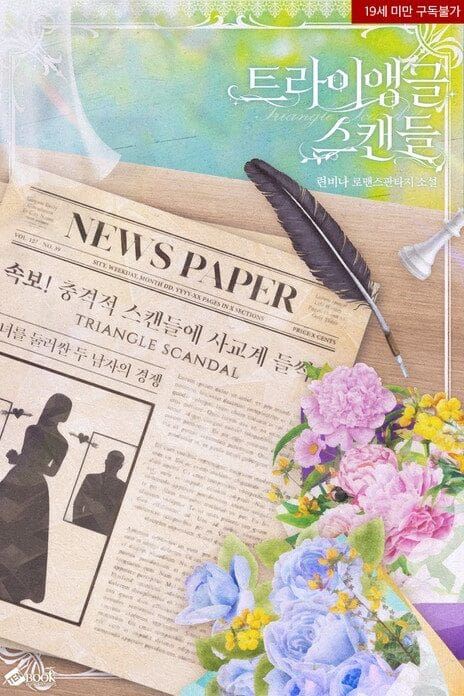
The narrative voice in this book is SO distinct and I love it. Dione's internal monologue reads like someone gossiping to their best friend at 2 AM—rapid-fire, self-deprecating, completely unfiltered. Take this line: 'So, naturally, she had never imagined something like this would happen for real.' THAT is the voice of a woman who has read too many romance novels and now her life has become one and she is NOT HAPPY ABOUT IT. The Crown Prince's dialogue is equally telling—'Sit.' Just 'Sit.' Three letters and a period and you know immediately he's not the warm type. And then his pivot to asking about Duke Schwitz after pretending to discuss diplomacy? The author uses dialogue to show what characters won't admit out loud, which is honestly one of my favorite writing techniques. The grandmother's voice echoing in Dione's head—'How many times is this now?'—is delivered through memory but it lands like dialogue because it's so specific and sharp. And the newspaper headline style writing in Chapter 1? '[Breaking News] Heiress to the Marquisate, Dione Estellon, revealed to be in a secret relationship with Raihan Elvirtein, the 4th Prince?!' The question mark at the end is the author winking at the reader like 'yes, I know this is dramatic, deal with it.'
... Read More
I need to sit down. The emotional core of this story is so quiet and so devastating and I didn't expect to feel THIS much from just seven chapters. Let me just say it: the image of Dione alone in the mansion, tapping her toes waiting for the newspaper, and then coming downstairs to find her butler and maid HIDING it from her—that hit me harder than any dramatic confession scene ever could. These people who've served her family for years are protecting her from pain. And earlier, when she thinks about her grandmother's last wish, when she remembers her grandmother saying 'you'll find someone to spend your life with someday'—and then realizing her grandmother NEVER got to see her in a real relationship—I just. The emptiness she describes after her grandmother dies isn't just about being alone in a house. It's about realizing that all those casual lovers, all those distractions, were just ways to not feel the hole inside. And now the one real connection she's had (even if it was drunk and chaotic) is the one that's going to change everything. The newspaper headline is basically her private nightmare made public. I'm already emotionally invested and we're not even at the romance part yet.
... Read More
There's so much water imagery in this section and I think it's deliberately chosen. The sea represents everything that's swept them both away—from the playful splashing that starts as innocent fun to the big wave that drenches them both and forces them into the inn. Water is uncontrollable. You can't fight the tide. And that's exactly what's happening with Dione and Raihan. The wet clothes are such a perfect symbol too. She's worried about her dress becoming see-through, about propriety, about dignity—and then NONE of it matters because they end up in the same room, in the same bed, with nothing between them. The clothes that got wet had to be changed; the boundaries that got wet had to be renegotiated. And then there's the theme of sleep and awakening. Dione falls asleep completely vulnerable on the sofa, and when she wakes up, she's in a different position, a different reality. Raihan watches her sleep and sees her true self—the kind, clumsy, beautiful person beneath all her noble composure. Her waking is almost like a rebirth into this new understanding of herself and her feelings. The line about her emotions "moving separately from reason" is the thesis of the whole section. She's a person who plans, who calculates, who tries to maintain distance for practical reasons—and yet her body, her heart, her very breath is telling her something entirely different. The sea doesn't care about her plans either. Neither does love.
... Read More
What makes this passage genuinely tense is that there are stakes layered on top of stakes and the protagonist knows it. On the surface there is a newspaper scandal that could damage Prince Raihan's reputation as an irresponsible man who leaves behind women. That sounds small until you remember this is a world where elderly nobles will latch onto gossip like lifelines and the next emperor has a reputation for strong brotherly bonds. If Raihan looks bad, the political consequences ripple outward. But underneath that is Dione's own survival. Her grandmother's will requires her to marry in order to inherit the marquisate, and there are no collateral branches to fall back on. She has to marry someone, which means every romantic entanglement is also a strategic calculation. And then Yurik enters the frame with his own weaponized affection. His condition—that she not sleep with Raihan—sounds possessive but it is also framed as a genuine service. He is offering to solve her problem, and the price is her availability to someone else. Dione accepts immediately because she has no choice, but the reader is left wondering what this actually costs her. Is Raihan still in Essen because of political reasons or personal ones? Does Yurik know about the will? The crown prince and Yurik are close, and Durant is the kind of person who knows things, which means Yurik could easily know about the marriage requirement and be positioning himself as the safe option. Or maybe he genuinely likes her and the timing is just catastrophic. The suspense here is maintained perfectly because no character has all the information, not even Dione, who is narrating most of this scene. We are all guessing, all of us leaning forward, waiting to see whether this is going to resolve into something stable or tear everyone apart.
... Read More
"Hey." "What." "I'm bored, want to try dating for a bit?" "Sure." ... "But it doesn't feel any different from when we were friends." "Let's just break up." "Okay." This is the single most efficient exchange of dialogue in the entire novel. Four lines. Four exchanges. And in roughly forty words, the author establishes an entire history between Dione and Ray, defines the tone of their relationship, and gives us one of the most honest portrayals of casual intimacy I've ever read. Every character's voice is distinct here and it's not accidental. Dione's dialogue is blunt, practical, occasionally dry—"I'll just let him do as he pleases. If I go to him, it'll only look stranger." She doesn't decorate her speech. Even her internal monologue is direct. When she says "It's a mess" (via Leticia, but reflecting Dione's own assessment), that's pure Dione. Raihan's voice comes through most powerfully in his letter, which the author includes in full. And what a letter it is. The opening is polite but not stiff. He references their past conversation. He mentions acquiring a mansion almost as an afterthought. He invites her to a restaurant they'd previously discussed. He signs off with this incredibly disarming postscript: "If you think I'm not doing well, feel free to tease me." That PS is the entire character in one sentence. He's confident enough to invite teasing, vulnerable enough to admit he might be struggling, and clever enough to frame it as an obligation on HER part rather than a plea. The voice is warm, slightly playful, and utterly self-aware. Leticia's dialogue has a different rhythm—more exclamatory, more reactive. Her "Whaaat?!" and her huge sigh and her direct "It's a mess" all mark her as the most emotionally expressive person in Dione's circle. She's the pressure valve. And then there's the narrative voice itself—this third-person limited perspective that slips into Dione's head with such casual intimacy. The author's voice feels like a friend telling you a story at 2 AM, not a narrator delivering exposition. Even the transitions between scenes feel conversational, like someone pausing to take a sip of tea before continuing.

Leave a comment

You must be logged in to leave comments. or