Trap of Deception - Reviews

Trap of Deception
+Add to Custom List
Sort
Add review
... Read More
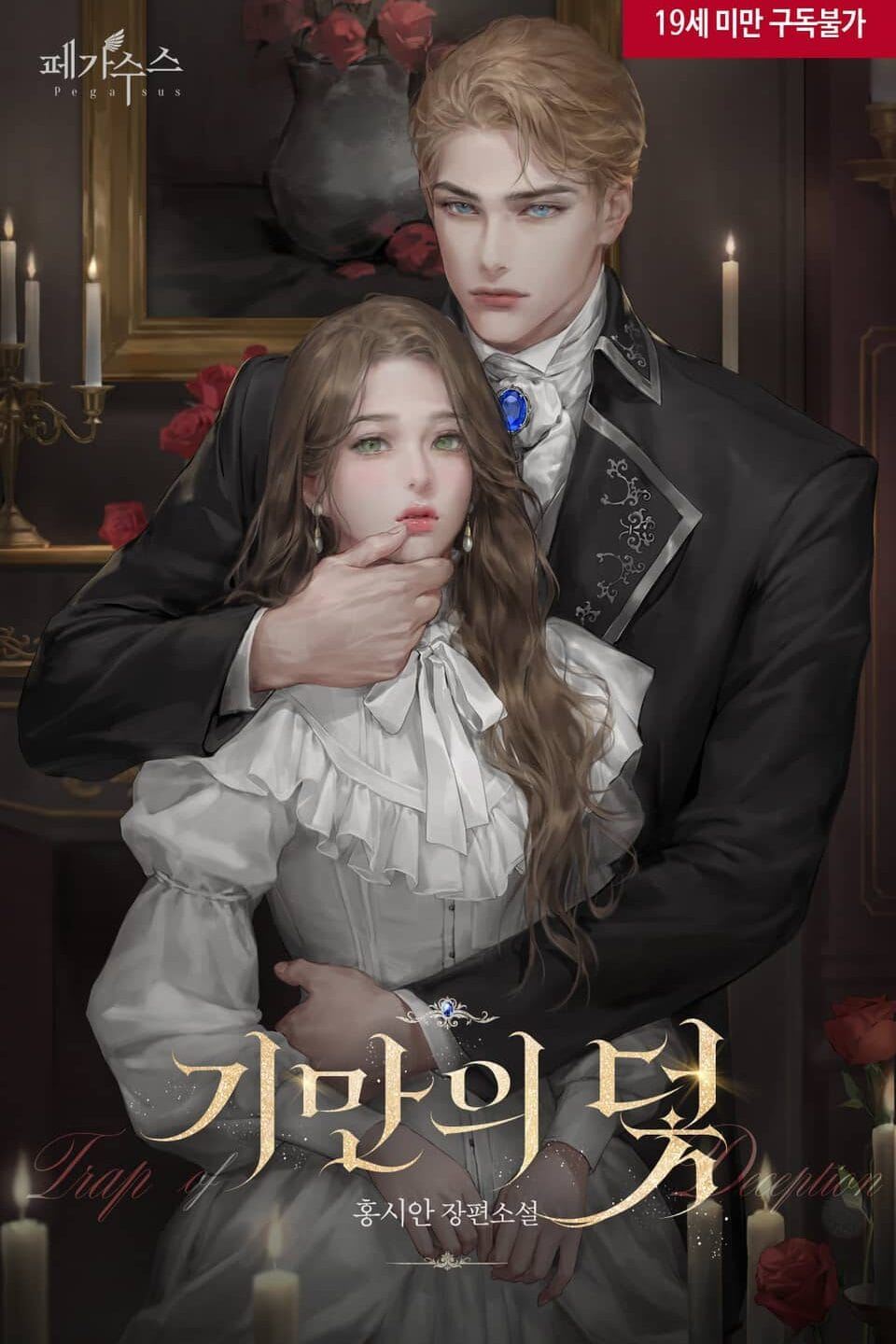
There's so much symbolism packed into these few chapters it's almost suffocating. Let's start with the leather straps. Aila finds them on the Duke's desk. They're beautiful—blue, soft, gold-embossed—but they're clearly meant for binding. She touches one and feels a pull, not just curiosity, but recognition. 'How did she know it was hers?' Dantalion wonders. The blue strap represents the bond he intends to forge with her. It's an accessory, yes, but it's also a collar. He's thinking about 'taking turns fastening them one by one on her body, wearing nothing but thread.' That's not romance; that's consecration. He's preparing to mark her as his. Then there's the nightingale. Classic symbol, right? A bird with a broken wing, cared for but caged. Dantalion tends to it, but he also controls its environment. He sharpens the perch, gives it better feed—not to set it free, but to keep it alive longer so he can hear it sing. 'You must obey well,' he tells it. The bird peeps in response. It's a metaphor for Aila's entire existence: nurtured only to be contained. But the deepest symbolism is in the memory manipulation. Dantalion reveals he altered Georg's memories eight years ago to cover his tracks. He erased a death, invented a murder. 'He made him believe that the boy he had kidnapped had tried to escape but was eventually shot and killed.' This is the theme of the story laying bare: reality is what the powerful say it is. Aila's life has been shaped by lies—from her father telling her she's cursed, to the Duke fabricating the past to keep her close. He built a 'perfect castle of deception to blind the bird's eyes.' But here's the twist: he didn't just manipulate Georg; he manipulated *time*. He waited. He let Aila grow up in suffering, let her become the person he wanted. Is her pain part of the design? The snowstorm outside represents this erasure. It covers the ground, hides the tracks, makes everything white and silent. Dantalion is curious what Aila will choose when the storm hits. Will she break? Will she flee? Or will she finally understand who holds the leash? The text asks: What makes us who we are if our memories can be rewritten? Aila thinks she's staying to protect her mother, but is that choice truly hers, or is it just another layer of the deception? The symbolism is tight, almost claustrophobic. Every object—the straps, the bird, the snow—is a thread in the web Dantalion is spinning. And Aila is walking right into the center of it, touching the silk, wondering why it feels so familiar.
... Read More
So let me get this straight. Georg thinks he got lucky. He thought he stumbled into this opportunity on his own merits, right? But the duke literally set a trap from the beginning. "That father probably believed he had been lucky. But that luck was merely the result of a calculated design from the beginning. A trap set by his master. And two prey that had fallen into it. At least one of them would certainly have their throat cut." I literally sat up in bed when I read that line. This isn't some simple workplace drama. The entire setup—the expensive carriage fare gouging, Georg finding this job, the lace incident, everything—feels like pieces on a chessboard that someone very patient has been moving for a long time. And Aila, poor thing, she has no idea she's already inside the board. What fascinates me is the dual narrative structure here. We follow Aila arriving at the castle, being shown to her nightmare quarters, getting bullied by other maids right away, but then we cut to the greenhouse scene with Roderick and Duke Dantalion, and suddenly the genre shifts. It's like the story was playing one kind of book and then revealed itself as a completely different one. The duke's line about Georg was chilling: "Let something tempting slip by him. Make him so tempted that his eyes roll back. Make him go crazy unable to resist devouring it immediately." This reads like psychological torture preparation. He's not just going to destroy Georg—he's going to savor every step. But here's what's keeping me up: the bird in the cage. The nightingale with a broken wing and shackled ankle. The duke personally covered it with black cloth when Roderick looked at it. That bird has to mean something. And Roderick thinking about how the bird's "disposal would also come" made my stomach drop. Who is the nightingale? Is it already in the castle? Because the timing feels way too neat for it to be a coincidence.
... Read More
Let's talk stakes because they are REAL. Aila is pregnant. She runs away. She has no alpha pheromones. The doctor literally tells her she will lose the baby. This isn't some vague threat—this is biological fact in their world. And she knows it. Every step through that snow, she's making a calculation: my life vs. my baby's life vs. his wrath. She chooses to come back because the alternative is her child dying. But here's what makes it so tense—the Duke knows this too. He knows she's pregnant. He knows she needs pheromones. And he withholds them. For days. That's not just punishment, that's torture with a deadline. Her body is literally counting down, and he's watching. The maids even say it to her: "You should think of the child in your womb." Which means everyone in that mansion knows what's happening and nobody is stopping him. The scene where she's crawling toward the door, clawing at it, and they drag her back while being politely civil about it—"It would be better if you went inside"—that's the peak of tension in these chapters. She's dying and the conflict isn't even dramatic or loud. It's quiet. Controlled. Everyone is smiling and helping her while slowly killing her. And then when the pheromones hit, it cuts off like a lie. Like he's toying with her from somewhere in the house, just enough to keep her alive but not enough to save her, until he decides to appear in person. What does he want from her? What does he stand to lose if he lets her go? And that ending flashback—with the shackles, the beaten child—was that her with her father? The text says "children who get beaten by their fathers are common as dirt" but then focuses on Aila. Is she the child? Or is that a different memory? The stakes keep rising and I genuinely don't know what the bottom is anymore.
... Read More
okay so this scene with Dantalion and Aila… i kept rereading it because the power move was just layered. He touches her lip, says 'make all the sounds you want,' but it's not kindness. it's ownership dressed as permission. and Aila's reaction? trembling, nodding, feeling like she should obey… she's terrified of losing whatever twisted favor he's showing her. that moment when she almost confesses and he cuts her off—‘just keep doing it like this from now on'—she physically flinches. why? because the cold look replaced the smile. she knows that switch means punishment. it's not romance; it's a cage she can't name. and Georg's subplot with the merchant? total opposite energy. he's loud, shameless, tries to flirt his way out, then gets beat down. both men use women as currency—Dantalion psychologically, Georg financially. but Aila's silence screams louder than Georg's curses. what's worse: being controlled by a duke who pretends to care, or being sold by a father who only sees profit? i don't know. that's why this stuck with me.
... Read More
There's so much symbolism packed into these chapters that I can't stop thinking about it. The shackles on Aila's ankles—they've been removed now, but they've left a permanent mark. Her weakened ankle that causes her to trip isn't just a physical detail; it's a metaphor for how trauma lingers even after liberation. She may have escaped one form of captivity, but the damage follows her everywhere. The laundry itself is symbolic in a way I can't quite shake. White shirts, fine fabrics—symbols of the duke's purity and status—gets ruined by mud and dirt. Aila, who feels equally 'stained' by her father's crimes and her own perceived failures, scrambles to clean what can't be cleaned. The impossibility of fully restoring what's broken is right there in that spilled basket. Then there's the identity theme running throughout. The duke doesn't immediately recognize Aila—eight years have changed both of them. She's no longer the scruffy little girl; he's no longer the enchanted boy but a cold, calculating lord. Yet something must connect them across time. The text asks: can people truly escape their pasts? Or do we carry our histories in our bodies—in scars, in mannerisms, in the way we flinch? And Georg represents a different kind of enslavement. His greed chained his daughter long before any iron did. The circle of abuse continues—not because Georg is evil in some cartoonish way, but because he's blind to anyone's pain except his own.
... Read More
I keep thinking about Aila and I can't stop. There's this moment—mid-conversation with her father—where the text says she 'quickened her steps with an anxious expression.' She's been working at the ducal castle, probably having a relatively safe life compared to what she had before. She's weaving lace, trying to make something for her father. When she meets him in the dark, she 'pulled out pieces of lace from her bosom and held them out.' That image—her holding out these small, handmade pieces of lace like an offering—hit me like a physical blow. She genuinely thinks this will satisfy him. She genuinely thinks she's doing the right thing. And Georg? He 'crumpled in displeasure' and shook the lace away, demanding to know if she spent her days playing instead of working. He doesn't see his daughter. He sees a failed investment. But the scene that wrecked me was when he said, 'Instead of thinking about throwing off your clothes in front of the duke to catch his eye, what kind of comfortable nonsense are you spouting?' And she was so pale, so trembling. The text says 'the color drained from her face' and she shook her head in disbelief, saying 'But... I'm a beta... The duke would never...' She's not saying no because she's morally opposed—she's saying no because she doesn't understand how a duke would ever want someone like her. That's the internalized abuse talking. That's the lifetime of being told she's worthless resonating through her bones. Then the slap. The text describes it with such clinical precision: 'With a tearing sound, fire blazed across her cheek and her body flew as though bounced.' Fire. Tearing. Bounced. These are violent, dehumanizing words. And she can't breathe. She's been beaten before—'Even though she was used to being beaten this much'—but this time it's different because the demand has escalated. It's not just money anymore; it's her body. The worst part? When he stops because 'I shouldn't damage the face too much,' she's relieved. She's grateful he's stopping. The fact that her baseline for safety is 'he didn't ruin my face' tells you everything about her history. When he threatens to find her mother and kill her in front of her, she agrees to everything. 'Words barely squeezed out between her gasping breaths.' I'm not okay. Aila deserves so much better and I don't know if this story is going to give it to her.
... Read More
the stakes here are dual-track and equal desperation. Aila's internal war: confess a years-old deception and risk everything, or stay silent and lose herself slowly. the external pressure is Dantalion's unpredictable mercy, which feels more dangerous than outright cruelty. then Georg's arc—his external conflict is literal survival. he owes money he can't pay, to a man who threatens dismemberment. ten days. the pacing tightens like a noose. what's brilliant is how both conflicts mirror each other: one is psychological, one is physical, but both revolve around a woman as the object of exchange. Aila doesn't speak, but she's the axis both men orbit. the suspense isn't just 'will Georg survive?' or 'will Aila confess?' it's 'what happens when these two plots collide?' the author doesn't rush. lets tension simmer. makes you feel the weight of every unspoken word, every threat left hanging. this isn't about big battles; it's about small moments that crack open whole lives.
... Read More
The atmosphere in these chapters is thick enough to choke on, and I love it. We start in this narrow, drafty maid's room—Aila's personal hovel—and move into the opulent, shadowy halls of the Duke's mansion. The contrast isn't just visual; it's thermal. Aila remembers the 'hut where she used to live' where she'd have to shiver in rags, so the mansion's warmth feels like a luxury she doesn't deserve. But then you get Dantalion's perspective, and the world shifts again. His bedroom is where he sheds his public skin. He's in a wooden bathtub, servants applying fragrant oils, the smooth fabric of his robe. It's sensual, almost ritualistic. And then he goes to the desk. The lighting changes. The mood cools. He touches the box of leather straps. The description of the straps is so specific—'thin leather... ornate patterns embossed in gold leaf... small silver buckles.' They're accessories, but they're also restraints. The text lingers on the texture: 'So soft... felt like touching expensive silk.' It's a tactile trigger for him. He's already dressing her in his mind. Then there's the nightingale. This little bird with the broken wing, wrapped in white cloth, sitting under a black cover on the nightstand. Dantalion brings it inside from the greenhouse because the winter is coming. He treats it with a tenderness that mirrors how he wants to treat Aila—careful, precise, possessive. 'Warm, fragile, and soft. If he applied just a little more pressure, it would be crushed completely.' The imagery here is brutal in its gentleness. And then the snowstorm hits. 'Midnight. Snow was already pouring down outside, covered in deep darkness.' The storm in Ishelbach is a character in itself. It's the 'most brutal period of the year,' sweeping away everything without a trace. Dantalion watches it and wonders what choice Aila will make when driven to the edge. The setting is mirroring the plot. The cold is closing in. The storms are externalizing the internal turmoil. And Aila? She's standing in her doorway, seeing the snow, realizing 'it's already deep winter.' She's unaware that the real storm is about to hit her life. The world-building here isn't just about magic systems or political factions; it's about climate and confinement. Everyone is trapped in their own way—Aila by her father's abuse, the bird by its wing, Dantalion by his obsession. The snow covers everything, erasing footprints, hiding secrets. It's perfect.
... Read More
Okay so let me just say — the plot twist here is genuinely brutal and I'm still processing it. Georg sells Aila to a merchant for 120 silver coins, feels smug about it, then IMMEDIATELY loses ALL the money gambling. And instead of the story giving us some relief — like oh thank god the deal falls through — nope. He pivots to getting a job at the ducal castle and decides to bring Aila along as a servant instead. Think about how layered that is. On the surface it looks like a better outcome: she won't be married off to that creepy older merchant anymore. But read between the lines and it's actually WORSE. At least the merchant transaction would have taken her AWAY from Georg forever. Now she's going to work UNDER him, still chained, still trapped, still subjected to his violence but with zero escape routes. The narrative is basically taunting us with false hope and then yanking it away. And that ending? "The clear winter sky was bright, and the streets overflowed with such vitality that even the cold winter wind couldn't dampen the liveliness." This is the exact kind of cruel dramatic irony that makes me want to throw the book across the room. Everyone else is living, breathing, free — and Aila is about to walk into that castle as a prisoner with a dagger pointed at her. The author is setting something up and I am NOT ready.
... Read More
Okay, I need a minute. Georg just absolutely DESTROYED Aila in this chapter and I am not okay. Let me just say it straight: the way the author structures this entire section is masterful storytelling. We've got three narrative threads weaving together, and they converge in the most devastating way possible. Thread one: Aila getting the news. The boy she secretly cared about, the one she was protecting without even fully admitting it to herself — he's dead. Shot by a hunting rifle. Eight years ago. Georg laughs while telling her, and I swear to god my blood ran cold. Not because of the laughter, but because of how casually he disposes of her emotional world. "You got used by someone who was going to die anyway." Oof. That line landed like a physical blow. Thread two: Dantalion's POV. Cut to the Duke, coldly observing his "bird," having already placed informants everywhere tracking her every move. Three months of battlefield smoke and he still didn't miss a single report about her. This isn't just obsession — it's surveillance-level devotion wrapped in aristocratic indifference. And then he's ordering the elimination of those three guards who harassed her. The parallel is delicious and terrifying: he watches her suffering with the same intensity that Georg weaponizes it. Thread three: the warehouse memory. This kid, this nameless boy she once met, tells her "You'd better never cross my path again" with murderous intent, then walks away. Aila weeps in the dark afterward, confessing to herself that she lied — she was glad he was there, she hoped he'd stay. This memory, bookended between the present-day devastation and Dantalion's predator-calculations, creates this gorgeous tragic echo. The boy who warned her… the man who is now hunting for her… are these two figures haunted by the same moral wound? The plot structure here is tight. Every reveal builds on the last, and the author never gives Aila a moment to breathe before slamming the next door. Brigitte reassigning her to clean the Duke's study? That's not random punishment — it's narrative inevitability. The storm is coming, and I am NOT ready for it.
... Read More
Let's talk about Aila for a second because wow, she's complex. Here's this girl who's been through hell—her father sold her into servitude, she's carrying physical scars from shackles and beatings, and yet she's fiercely independent in her own quiet way. She's not some damsely character waiting to be saved. When she runs to find her father after encountering the duke, that's not naive trust—that's desperation, yes, but also the only person she has left in this world. And the duke! God, the duke is fascinating. On the surface he's calm, almost gentle with Aila. He touches her bruised face tenderly, massages her anklet-scarred ankle, tells her not to worry about ruined clothes. But underneath that soft voice and that practiced smile, there's something razor-sharp. He's toyed with her in this encounter, letting her tremble before offering mercy, asking pointed questions about whether she committed 'some other crime.' Is he genuinely intrigued by her? Does he suspect her identity? Or is he playing some longer game? Then there's Georg—Aila's father. The man who brought this disaster upon himself and his daughter eight years ago, and who is now threatening to punch his own daughter for working too slowly. The contrast between him and the duke is staggering. The duke, despite being the powerful aristocrat who could destroy Aila's life, shows more humanity in this one scene than Georg ever has. That's devastating writing.
... Read More
Okay so the prologue starts with Aila trudging through a blizzard while pregnant, which is already dramatic as hell, but then—plot twist—the gate literally opens by itself when she touches it. Like, what? That is such a weird detail. At first I thought it was some atmospheric thing, but then inside her old room, the pheromones hit her and she passes out on rugs that were *clearly placed there on purpose*. Rugs. On the floor. Who puts rugs on a floor knowing an omega will collapse there? And then the next day, she can't see the Duke at all. Days pass. She's literally begging at doors, being dragged back by maids who are weirdly polite about it. It's not even angry cruelty, it's cold, calculated ignoring. And then—when she's literally on the floor dying, pheromones suddenly flood the room, just enough to give her a taste, then cut off. Like a leash yank. That's when the Duke finally appears. "You worked so hard to run away, but you're giving up already?" — bro. You hid the fact that she was pregnant from her, made her flee through a blizzard, let her nearly die, and your opening line is a question like this is a game? The mastermind energy here is unreal. And then at the end of the chapter there's a hard cut to... childhood abuse? A broken hut, shackles on her ankles, bruises? That's a brutal pivot. We go from gothic romance tension to raw trauma flashback in one beat. I didn't see that coming at all. The pacing is honestly addictive. Every section ends on some kind of hook that makes you immediately open the next one. Even the prologue itself has mini-hooks every few paragraphs. It's like the author knows exactly when to pull the thread.

Leave a comment

You must be logged in to leave comments. or
