To the Sister Who Will Be Deposed - Reviews

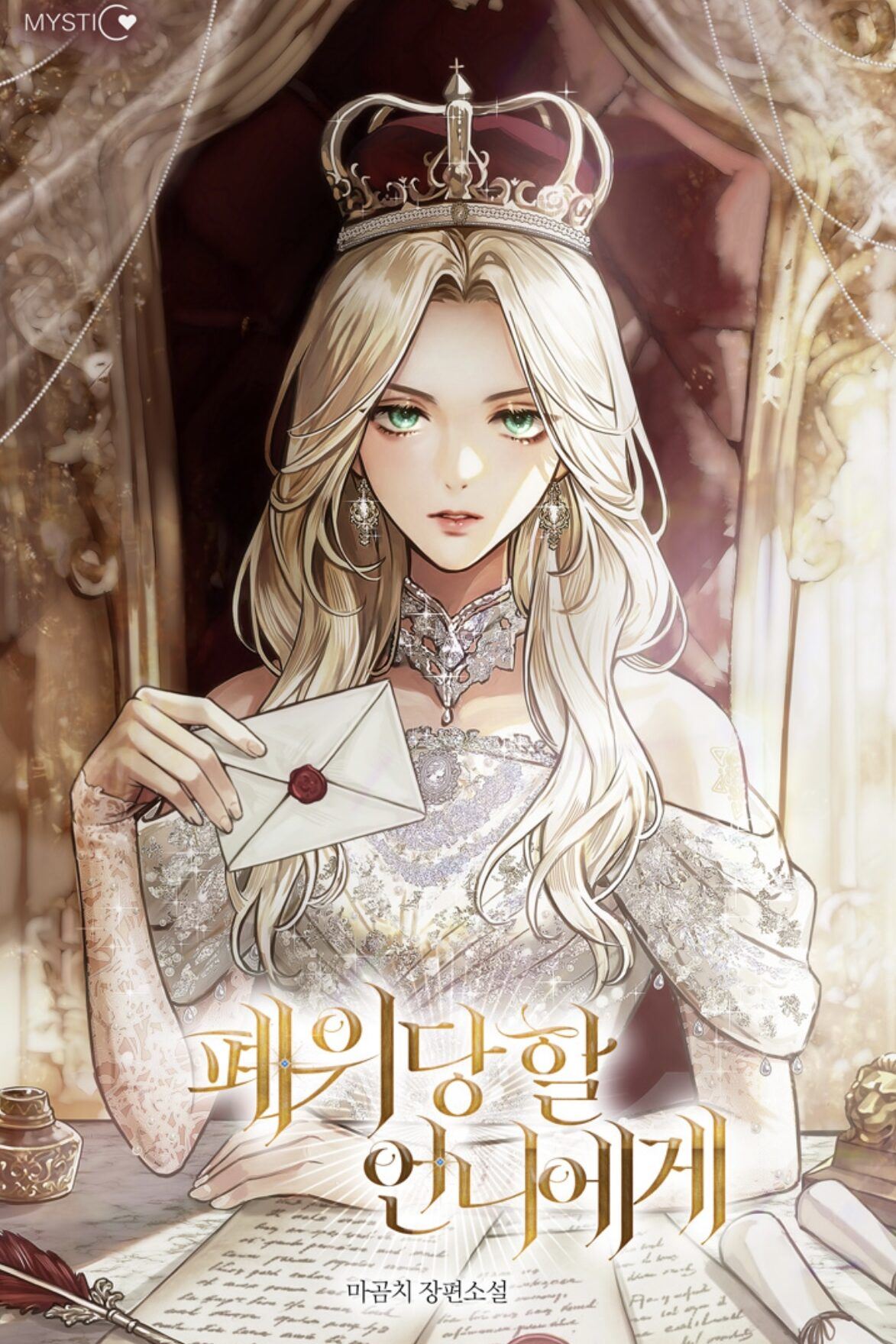
To the Sister Who Will Be Deposed
+Add to Custom List
Sort
Add review
... Read More
The stakes in this section are ABSOLUTE MADNESS and I love it. Let's list what's actually at risk here, because the list is terrifying: Cornwell — literally thrown into an arena to be killed by gladiators. He tried to pin his crimes on Wilcock, and Wilcock discarded him instantly. Zero loyalty in this empire. Aiden — Mary already sees him as a threat. She couldn't tolerate his victory, so she weaponized the Feeding Competition to remind him (and everyone) who holds power. The text literally says she'll "try to kill you again" once his glory fades. She is NOT subtle about her hostility. Evelyn — playing the most dangerous game possible. She's aligning with a war hero, manipulating the Emperor, exposing corrupt nobles, and positioning herself for the throne. If any of this goes wrong, she doesn't get a second chance... well, actually she DOES have a second chance thanks to reincarnation, but the stress of living this life twice is clearly weighing on her. Mary — the Emperor herself. She's bored. That's the most dangerous kind of ruler. When the text says her green eyes finally show "a faint light" at the arena spectacle, that should scare everyone. A bored emperor who finds entertainment in human suffering is a recipe for catastrophe. And beneath all of this: the people of the capital. Desensitized. Addicted to gambling on human lives. Aiden realizes the city he fought to protect is "nowhere to be found" — replaced by something grotesque. That's not just a personal stake, that's an existential one. The question hanging over everything: how many people have to die before the board flips?
... Read More
I want to talk about how this passage controls momentum because it does something really clever. The opening with Jack is fast — sharp dialogue, boots on stone, escalating tension. Step. Step. The onomatopoeia itself creates rhythm. Jack is pacing, he's agitated, and the prose mirrors that. Then Evelyn speaks and everything shifts. Her voice is calm, measured, and that contrast makes her feel dangerous in a completely different way. The flashback to Maron's visit is a deliberate breath — slower, quieter, almost tender. Maron has watched Evelyn grow up. He has no children of his own and feels compassion for her. This moment of genuine human warmth makes the return to the present hit harder. And then the audience chamber scene — this is where the pacing becomes almost suffocating. Long silences. Short exchanges. Mary tapping her fingers. Evelyn forcing her face not to twist. The prose itself slows down, matching the unbearable tension of walking into a room where your executioner is sitting on a throne. What's remarkable is how the author uses Evelyn's second-life knowledge as a pacing device. Because she remembers future events, we get dramatic irony constantly. We know Mary will eventually burn her alive. We know the treasury will be ruined in three years. Every calm surface interaction is undercut by this foreknowledge, which means the reader is always experiencing TWO timelines simultaneously — the peaceful present and the catastrophic future. That double exposure creates a kind of narrative anxiety that never resolves. The chapter ends on an unfinished note — "only the people around them grew stiff with tension in the unc..." — and it just cuts off. No resolution. No relief. You're forced to keep reading. This is how you write tension that sticks to your ribs.
... Read More
Okay, so let me just say this upfront: the premise is ABSURDLY GOOD. A rebirth/revenge story where the protagonist has already lived two lives and failed both times? That's not just fresh—it's brutal because we know exactly what kind of hell she's survived. Chapter 1 opens with this LETTER from Evelyn to her half-sister Mary. A letter she'll NEVER send. And right away, you're hit with this devastating line: "Even an arrow that loses its target will eventually lodge itself somewhere, and it was painfully obvious where your anger would turn once you lost the object of your hatred." That's the whole thesis of this book in one sentence. Mary couldn't destroy her parents' memory, so she destroyed Evelyn instead. But here's what really sold me on the plot structure: Evelyn doesn't get a fresh start. She gets her THIRD life, and she's not starting from zero—she's starting from TRAUMA. In life one, she was loyal and got burned. In life two, she submitted and got burned. Life three, she decides the only way out is to BECOME the thing that kills her. That reversal! From victim → submitter →... well, you know what she becomes. And the reveal about Robert? Oh my god. The guy she trusted with her heart, her future, her last coherent thought before flames engulfed her—and he was in on it the WHOLE TIME. "I'm grateful you fell in love exactly as planned." Said with a SMILE. Like he was complimenting a painting. The pacing in these first chapters is also smart. We get the execution scene through FLASHBACK inside the tower, which means the tension of 'what happens next' is replaced by the tension of 'HOW will she survive differently this time?' Every conversation she has with Robert is layered with dramatic irony—we know his true colors, and watching her carefully navigate him like a landmine field is genuinely nail-biting. Also, the ending of Chapter 2 where she sets her goal: 'I have to become Emperor.' That's a MAJOR pivot. This isn't just revenge anymore. She's rewriting the entire game board.
... Read More
Okay so let me just say — the stakes in this passage are ABSOLUTE. We're not talking mild inconvenience here. Jack insults a princess and his punishment? Tongue cut out and exiled from the capital. And Mary, the current emperor, delivers this sentence while literally tapping her fingers on the armrest like she's deciding what to order for lunch. But here's what got me truly unsettled: Evelyn KNOWS this. In her first life, she let Jack's insult slide because she didn't want someone to die over something petty. And the text tells us straight-up that in her second life, after Jack was just reassigned to the main gate instead, he was executed anyway for taking bribes. So his fate was sealed regardless. Evelyn's calculation isn't about saving him — it's about her own peace of mind. That's a completely different kind of stakes. "He's going to die anyway. There was no need to feel guilty." But then immediately: "It was simply a compromise for the sake of her own peace of mind." BROKEN. The whole scenario with Mary is where the real terror lives. We know from Evelyn's first life that Mary "smiled with delight as she burned her alive." That image is just casually dropped into the narrative like it's nothing, and yet it's probably the most horrifying line in the entire passage. Evelyn walks into the audience chamber knowing her half-sister killed her entire family and now sits on the throne, and she has to bow and play the submissive prisoner. What I love is how the tension never drops. It goes from Jack posturing → Evelyn summoning the captain → the flashback revealing Evelyn's plan → the audience chamber scene → Mary's chilling indifference. Each beat raises the pressure. And the ending where Mary basically says "your residence will soon be decided" — that's not comfort, that's a threat wrapped in politeness. Every interaction in this text is a minefield.
... Read More
I need to talk about the green eyes thing because it kept appearing and I couldn't shake it. Mary says to Evelyn: "the color of your eyes really is exactly the same as mine." And then the text says "Two pairs of green eyes met in the air." This isn't just a physical detail — it's thematically loaded. They share the same father, the same eye color, but one sits on the throne and the other is locked in a tower. Same blood, opposite fate. It's about how inherited traits don't determine destiny, but social structures do. The tower itself is the biggest symbol, obviously. It's called a "tower" but everyone knows it's a prison. Jack even says it outright: "They may call this place a tower, but it's a prison all the same." The naming is a lie — the empire dresses up its cruelty in elegant language. And Evelyn, who has lived this twice, sees through the naming completely. Then there's the clothing motif. Evelyn asks for "a set of outdoor clothes" because she can't meet the emperor in nightclothes. Nightclothes = the vulnerable, trapped self. Outdoor clothes = the persona she needs to wear when stepping back into the world. She's constantly negotiating between who she is and who she must appear to be. The food slot is another one that haunts me. Evelyn speaks through a narrow opening in an iron door. She's reduced to a voice behind metal. And Jack hears only her voice — he can't see her face, can't read her expression. This power of partial visibility runs through everything. Evelyn controls what people see and don't see. And the line about the audience chamber being decorated with gold leaf that will cover every wall in three years when the treasury is ruined — that's symbolic of the empire's trajectory itself. Extravagance masking collapse. Beauty built on ruin. Evelyn has seen the future and is trying to change it.
... Read More
Robert's dialogue in this section is absolutely electric. Can we talk about how casually cruel he is? "If this becomes difficult for you to watch, just say the word. I'll escort you out." On the surface this sounds protective, but the subtext is so layered—it's manipulation wrapped in chivalry, and Evelyn sees right through it. Her response, "If you're only going to talk nonsense, then go hand that in to one of the attendants," is perfectly sharp. She doesn't even dignify his comment with engagement. That's Evelyn's voice right there—controlled, dismissive, refusing to give anyone the satisfaction of seeing her flinch. And then Robert's laugh—"Ha!"—he bursts out laughing at his own cruelty. He's genuinely enjoying himself. The line "What's enjoyable about a wager when the outcome is already obvious?" is delivered with such casual menace. He's not just saying he knows who wins; he's saying he controls the game. Meanwhile Evelyn's dialogue with Mol is quieter, almost tender—"Go ahead." No explanation, no judgment. Just permission. It shows that beneath her hardened exterior, she still recognizes when someone else is breaking. The narrative voice itself is interesting too. It stays close to Evelyn's perspective but allows us these sharp cuts into her memories—the past-life vomiting, the clenched fists. The author uses free indirect discourse so well here, blending narration and thought until you can't tell where one ends and the other begins. It makes Evelyn's psychological journey feel immediate rather than reported.
... Read More
The blessing on Mary's hand glows faintly under the red canopy — and I can't stop thinking about what that imagery means. A blessing from the gods, presented as divine favor, but Mary herself says 'who was a god to choose her?' She wasn't chosen by her parents. She was discarded. The 'blessing' might as well be a brand. The red canopy is doing a lot of work too. Red everywhere — her hair, the canopy, the blood that's about to be shed in that training yard. It's the color of power and violence wrapped into one. Mary sits beneath it like a queen on a throne made of warning signs. And then there's Evelyn in that dark purple robe, hiding her platinum hair beneath it. Purple and gold — imperial colors — concealed, disguised. She's literally covering her identity to meet an ally in a shabby shop. Meanwhile Mary is on display under that canopy, all visible power and invisible emptiness. The emptiness theme is what ties this whole passage together. Mary feels nothing after her revenge is accomplished. Evelyn survived by becoming something hard inside. Lilia's world collapsed and she had to rebuild herself around rage just to keep functioning. Everyone in this story is hollowed out in different ways — by abandonment, by loss, by the sheer weight of surviving something that should have destroyed them. "How am I supposed to deal with this emptiness?" Mary asks, and I think that question applies to every major character in this book.
... Read More
The pacing in these chapters is a masterclass in controlled acceleration. You start with this quiet, almost intimate scene between Evelyn and Lilia—soft lighting, green eyes, whispered promises—and then instantly you're wrenched into Mol's panicked entrance about the new maid arriving. Boom. Reality check. Then Evelyn dismisses her, we get a full paragraph of cold exposition about Mary's psychology and the previous life's dynamics, and just when you're settling into that oppressive rhythm, the Head Attendant appears like a storm cloud in the doorway. The scene shifts from private chamber to palace corridor to imperial audience hall, and each transition is seamless but jarring in its own right. But what really sold me was the second half. After Mary's devastating 'hunting for sport' metaphor and Robert's terrifying walk-and-talk with Wilcock, you'd think we'd linger on the aftermath. Instead? We cut straight to Evelyn explaining a grotesque execution ritual to her two maids like she's reading a recipe. The tonal whiplash is intentional, I'm sure, and it works because it mirrors Evelyn's own emotional fragmentation. One moment she's building alliances, the next she's casually discussing state-sanctioned cannibalism. The structure doesn't give you breathing room, and that's precisely the point—you're supposed to feel as disoriented and dread-soaked as she is.
... Read More
Let's be real for a second: the dialogue in this book is not just functional, it's forensic. Every line is a blade being drawn slowly. Take Evelyn's exchange with the Head Attendant. He comes in all formal and law-bound, trying to shut her down, and she just… deflects. 'Then how about asking Her Majesty?' Pure verbal judo. She doesn't argue, doesn't threaten, she just hands him a mirror and watches him squirm. And Mary? Her voice is so distinctly cruel in its casualness. 'Leave it be.' Four words that carry the weight of absolute power. But the real standout is Robert. That short, brutal walk with Wilcock—'The place beside Her Majesty will always belong to me,' then later, 'And don't touch the princess. She's mine.' It's not shouted; it's murmured. Which somehow makes it infinitely worse. The author understands that true menace doesn't need volume. Even the minor characters have distinct voices: Mol's flustered warmth, Lilia's clipped precision, Wilcock's oily deference masking razor ambition. And the narrative voice itself? It's tightly bound to Evelyn's perspective, which means we get her internal monologue dripping with sarcasm and cold calculation, but also those rare moments where the prose slips into something almost poetic—like describing Mary's crown reflecting 'brilliant light' while she discusses torture. The contrast is deliberate, and it elevates every conversation into a duel.
... Read More
There's something beautifully grotesque about how the author uses the sun as a recurring image for this regime. Mary is described as 'the sun of the Empire,' wearing a crown that shines like the sun, draped in crimson. But this is a sun that doesn't nurture—it consumes. The Feeding Competition itself is the perfect symbol of the Strovana empire: beautiful pageantry on the surface, but underneath it's cannibalism. People literally devouring each other's suffering for entertainment and profit. And the irony of the pardon—that ultimate carrot—is just devastating. The author is saying something about power here: it doesn't just demand obedience; it demands participation. By offering the pardon and the prize money, William isn't just running a show—he's turning every spectator into a participant, a co-conspirator. The commoners who came expecting an execution and left betting on corpses—they're not victims; they've been recruited. Even the nobles who object to commoners winning money are still part of the system. They're just angry they didn't get to design it. Evelyn's dress is embroidered with blue flowers 'evoking the arrival of spring'—right before she watches human beings reduced to drooling animals. The juxtaposition is intentional. Spring, renewal, beauty—all of it set against absolute degradation. The author is showing us that this world hasn't ended despite all the cruelty—it's evolved, become more sophisticated, more normalized. That's the real horror. Not the blood, but the adaptation. Evelyn doesn't vomit anymore. She watches.
... Read More
There's something so specific and haunting about how this book handles atmosphere. It doesn't dump worldbuilding on you—it sneaks it in through tiny, almost casual details that stick to your ribs. The very first sensory note: "Unlike the warm spring air outside, the tower of the Imperial Palace where Evelyn resided was filled with a biting chill." One sentence. That's it. But suddenly you feel the temperature shock, the isolation, the symbolism of warmth existing only outside walls she can't leave. And then: "The old windows failed to keep out the cold that seeped in throughout the dawn. The rattling of the window frame made her frown instinctively." God, I can hear that rattling. It's not just set dressing—it's Evelyn's environment actively harassing her even as she sits in contemplation. The world is AGAINST her, and the architecture knows it. Then there's this absurdly perfect image I keep returning to: "A shriveled leaf that hadn't been there moments ago was now stuck flat against the glass." Evelyn is looking at it from inside the tower. The leaf is trapped against the glass, unable to get in or fly away. That's... that's Evelyn. In one image. I haven't stopped thinking about it. The banquet hall description is similarly efficient. Crimson carpet, gilded throne, every gaze fixed on her with curiosity, hostility, or pity—but not reverence. The imperial authority is everywhere (the throne, the titles, the ceremonial announcements), yet Evelyn is completely stripped of power within it. She walks that carpet as a prisoner dressed in borrowed dignity. And the sensory detail of Robert's scent—"a faint scent of capel flowers drifted from him"—is chilling because that's the scent of a place where they once promised each other a future. The flowers don't smell different. Only Evelyn's memory of them has changed. The world stays the same; her relationship to it is what mutates.
... Read More
Okay I need to talk about this Feeding Competition because holy hell. The Sands family used to be nobility—actual barons—and now they're just... Numbers. 1, 2, 3, 4. Stripped of names, stripped of dignity, reduced to gambling tokens for the entertainment of the capital. But the most chilling part isn't the spectacle itself. It's the family dynamics on display. Number 4—who we now know is the daughter—grabs her own father by the trouser leg and DRAGS HIM DOWN. Not in defense. In competition. She's willing to physically take down her own blood to reach the pillar first. And then Number 2 and Number 3—a mother and her son—get tangled up on the bridge. The crowd screams at Number 3 to push his mother off. PUSH HIS OWN MOTHER OFF. They're not even pretending anymore that these are human beings. Number 5 wins because he's the youngest and apparently has the least social conditioning. He just tears open the box and eats. Pure instinct. While everyone else freezes, paralyzed by the absurdity of eating food off the ground after climbing a pillar, the child just... acts. Nature versus nurture, and nurture lost spectacularly. Evelyn understood this perfectly when she told Robert: "Children are creatures driven by instinct." She weaponized their own psychology against them. The people who would protect a child become the very thing that makes him unbeatable. I love how ruthless she is about this.

Leave a comment

You must be logged in to leave comments. or
