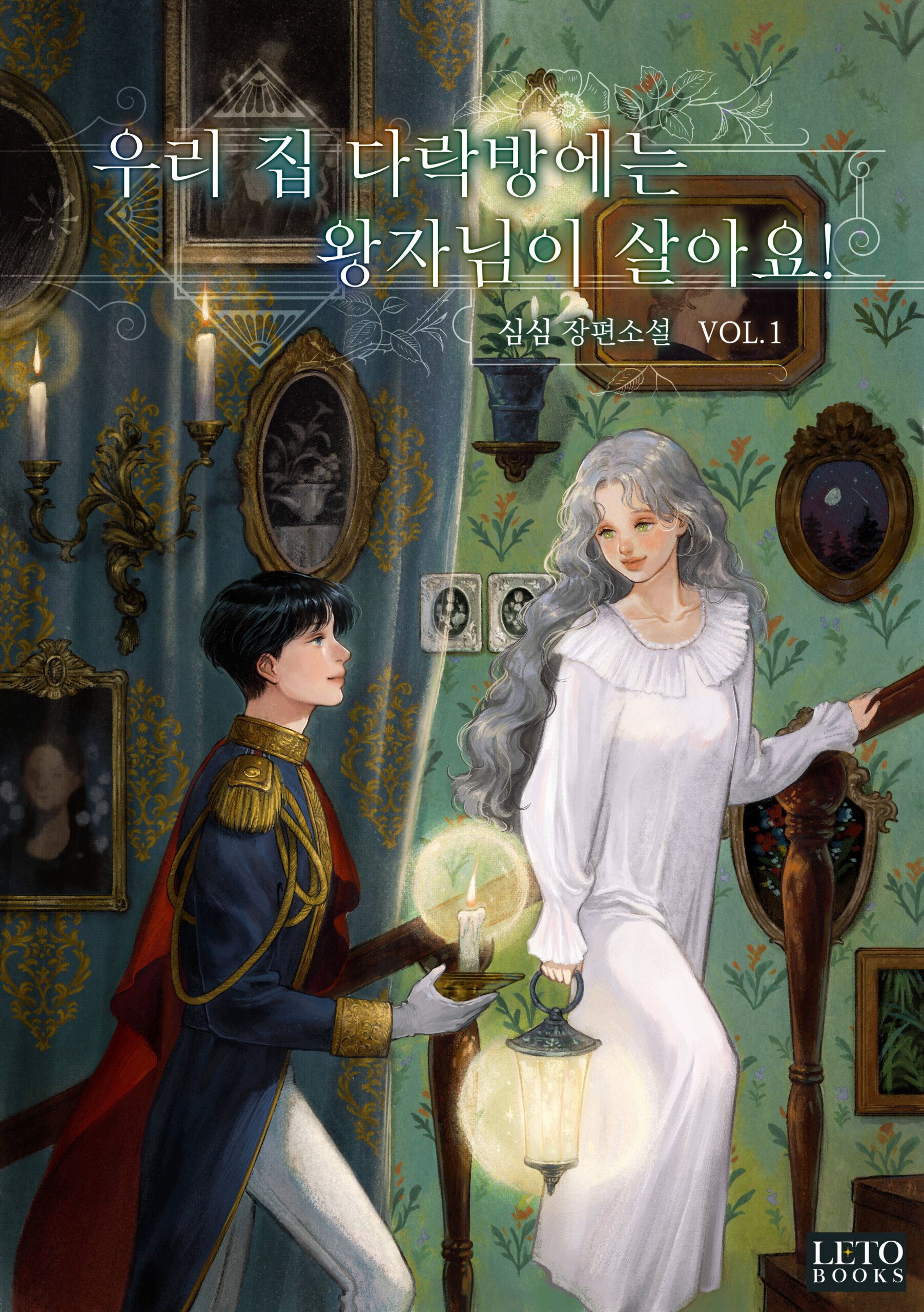
There’s a Prince Living in Our Attic!
Novel Info
  • Author:
  • Status:Ongoing

Summary

... Read More

Alisa Ludendorff is a thirteen-year-old girl living in the port city of Montrau, Westroben. Her life began to unravel three years prior when her mother, Roxia, a celebrated lead actress of the Royal Globe theatre company, vanished after the family’s financial fortunes collapsed due to war-disrupted trade routes. Alisa’s father, Edward, died of illness shortly after, leaving Alisa in the care of their senile great-aunt. Custody of the estate was seized by Alisa’s uncle, Robenson, who forced Alisa into servitude under the household maids, Hannah and Mary. Despite her harsh treatment, Alisa maintains hope for her mother’s return, a hope anchored by daily visits to a mysterious gentleman in a black top hat who hides his face behind a scar and shares stories with her under an ancient yew tree. On her thirteenth birthday, the gentleman gifts Alisa an elaborate period costume, but the presents are stolen and destroyed by Hannah when she catches Alisa returning home.

Seeking refuge in the attic during a thunderstorm, Alisa discovers an unconscious boy dressed in fifteen-century royal attire. The boy, Eden Reuben Roben, is the Crown Prince of the Roben Empire, separated from his timeline in the year 1655. Eden reveals he was drugged and exiled by the scheming Countess of Fenton, only to materialize in Alisa’s attic centuries later. Initially, the two children are wary of each other; Alisa is distressed when Eden mistakes her for a maid, while Eden is confused by the decay of his ancestral estate. Their tension dissolves when they sneak into the kitchen together for bread, bonding over a shared meal and the chaotic misfortunes that follow, including incapacitating Hannah with a mouse and a well-timed shove.

The next morning, Eden has vanished, leaving only his handkerchief behind. Alisa deduces that he returned to his own time and resolves to live her life without regret, focusing on her goal of becoming a famous actress so her mother might hear of her. Meanwhile, in 1655, Eden is confined to a luxurious estate in Roben, surrounded by servants who are secretly spies sent by his uncle to monitor his every move. Eden endures this gilded cage with silent frustration, his mind occupied by memories of Alisa and the strange girl from the future.

Back in 1905, Alisa’s path shifts when Mrs. Ashford, the owner of Madame Marigold clothing shop, recruits her for a modeling shoot after discovering her striking silver hair and pale green eyes. Alisa uses the opportunity to reconnect with the gentleman in the top hat, visiting his residence to return a lost item. She learns that he is struggling with a broken fence and a persistent white cat. As Alisa navigates her new interest in performance and her growing bond with the mysterious gentleman, the narrative explores the intersecting lives of a girl trying to reclaim her future and a prince trapped by his past, both seeking agency in worlds that seek to control them.

Latest Release
DateGroupRelease
2026-10-03dusk blossoms c49
2026-10-03dusk blossoms c48
2026-10-03dusk blossoms c47
2026-10-03dusk blossoms c46
2026-10-03dusk blossoms c45
2026-10-03dusk blossoms c44
2026-10-03dusk blossoms c43
2026-10-03dusk blossoms c42
2026-10-03dusk blossoms c41
2026-10-03dusk blossoms c40
2026-10-03dusk blossoms c39
2026-10-03dusk blossoms c38

Community Reviews

Rating(0 / 5.0, 22votes)
5 stars
0(0%)
4 stars
0(0%)
3 stars
0(0%)
2 stars
0(0%)
1 stars
0(0%)

Popular reviews

... Read More
"These cowardly tears. Look at them, only surfacing now that it seemed Eden wasn't going to leave right away." Alisa calling herself cowardly for crying because the immediate danger has passed—that line captured something so true about how grief actually works. We don't always cry when things are worst. We cry when we finally feel safe enough to. And Eden noticing this, offering her a scone without saying anything about it, that's the kind of quiet care that hits different. I also need to address the physical proximity shift in this chapter. They start a hand's width apart. By the end, she's grabbed his collar, they've jumped into a river together, and he's carrying her out. The intimacy isn't romanticized or sexualized—it's desperate and practical and somehow more intimate than any touchy-feely scene ever could be. The moment that really got me though was when Eden sees the wound on his arm and immediately changes the subject. He won't let her see him hurt. And Alisa notices anyway but doesn't push. She just... waits. Lets him redirect. That restraint is everything. And then later, walking back toward the estate in the rain, he's furious at himself for bringing her into this mess. "The sweet in your mouth is sweet, but it's only ever a fleeting sweetness." He's already preparing to lose her, already calculating the distance. But she's still there, still pointing at things, still trying to make him smile. God, I love this pairing.
... Read More
There's this one line that won't leave my head: 'His eyes were like the sea. In shadow they looked like the deep ocean floor, and when the lantern light touched them they shimmered like sunlight on the water's surface.' What does that even MEAN on a thematic level? Think about it—Alisa has spent her whole life being looked AT with suspicion, with cruelty. Hannah yanks her ears, Mary locks her away, everyone assumes she's lying. But this boy? He looks at her. Really looks. His eyes are vast and ancient and alive, and for the first time someone sees HER, not the 'thief' or the 'maid' they assume she is. That's not accidental. The author is screaming about recognition, about being witnessed. And then there's the attic itself—this forgotten space where old things go to gather dust. But it's also where two lost souls find each other across centuries. The drawing on the wall, half-hidden, waiting for someone to notice it again. The radio playing news about a theatre company while Alisa dreams of fame—'If word of me reaches my mother's ears, she'll surely come back.' She wants to be seen by the world because the people who should see her don't. The boy offers that seeing, and I'm not okay with how much that moved me.
... Read More
This batch delivers one of the most satisfying plot developments in the series. The time-stop ability that Alisa accidentally unlocks is brilliantly woven into the narrative. What I love is how the mechanics feel earned rather than convenient - she doesn't just discover it, she stumbles into it while emotionally overwhelmed, which mirrors classic magical realism traditions. The sequence where she flips the vase and water droplets freeze mid-air is pure cinematic storytelling, and the immediate consequence of random rainfall ties the supernatural element to tangible world effects. The subplot threads are converging beautifully here. The mysterious man who takes her in remains appropriately shadowy - we get details like the childlike blanket preparation and elaborate dinner, but nothing concrete about his identity or motives. Meanwhile, Alisa's escape from the abusive household creates a ticking clock: she has nowhere safe to go, which forces her toward Eden and the attic. The parallel structure of two young people hiding wounded interiors - Alisa running from violence, Eden running from political arranged marriage - gives the plot its emotional backbone. The footbridge encounter with the black top hat man is a masterful callback that recontextualizes everything. Alisa recalls "that strange sensation" and how she "needed to cross that bridge and face the man in the black top hat" - this suggests the time-stop wasn't random but fateful, tying her choices to larger cosmic mechanics. The author isn't just writing a coming-of-age fantasy; they're building a puzzle where character psychology and magical systems are inseparable. My only mild critique is that Eden's confession about his betrothal lands slightly melodramatic, but it's earned through the preceding tension of their starlit picnic. The plot rewards careful readers who noticed earlier hints about royal arrangements.
... Read More
This chapter is a masterclass in pacing variation. It starts almost painfully slow—Alisa crying quietly, Eden eating a scone in silence, the conversation drifting like they're both afraid to touch anything real. Then the instructor story drops, and suddenly we're in the middle of a violent flashback told through memory gaps. After that comes the river scene, which is pure kinetic energy: jumping, falling, drowning, grabbing, swimming. And then the aftermath—wet, shivering, walking through a dark village with Alisa getting distracted by straw roofs like nothing catastrophic just happened. The author knows exactly when to accelerate and when to let the reader breathe. My favorite pacing choice is the ten-second pause. Eden tells Alisa to stand still for ten seconds while he has an internal crisis about her face. Ten seconds of narrative time that contains an entire emotional avalanche. And the chapter ends not with a bang but with a guard shouting and Eden's sharp internal click of his tongue—a tiny sound that signals the next crisis is already loading. What really works is that the chapter never lets you settle into one emotional register. You go from tender to horrifying to adventurous to funny to worried in the span of a few pages, and it never feels chaotic because each beat earns its place. The hunting story establishes why Eden can't stay. The river jump establishes why he can't leave Alisa behind. The estate arrival establishes the new stakes. Three movements, one chapter, zero fat.
... Read More
'You will be happy, without fail.' I need a minute. That's it. That's the line. That's the whole chapter. Roben says this in response to Alisa begging him not to leave her, and it's the most heartbreaking thing I've ever read. Not because it's a promise—because it isn't. He never actually says yes. He deflects, he dodges, he talks about his name being a pseudonym and points across the street like the answer is in Madame Marigold's sign. But then he says those words, and they sound like a vow and like a eulogy at the same time. Like he's seen this play out before and he knows how it ends, and he's trying to give her something real even though he can't give her himself. And Alisa—god, Alisa—she hears it and she bows her head because she's afraid if she looks at him she'll cry. She's thirteen and she already knows what it feels like to lose things after they're gone. This time she held on. This time she didn't lose it. And Roben's answer to her asking for a guarantee of his presence is 'you will be happy'? What is he protecting her from? What does he know that she doesn't? I'm not okay with this and I need the next chapter immediately.
... Read More
I've been thinking about this exchange for like twenty minutes and I keep coming back to it. Eden says "Don't smile." Alisa, bewildered, stops mid-smile and asks "Like this?" with this devastated expression. And Eden internally screams because she looks unbearably endearing and he has to say "Ten more seconds" just to buy himself time to process his own feelings. This is peak dialogue writing because it accomplishes three things in barely twenty lines: (1) it reveals Eden's emotional incapacity—he can't handle genuine warmth without panic, (2) it shows Alisa's empathy through her immediate compliance and willingness to adjust, and (3) it creates this incredibly tender, awkward moment that feels nothing like typical romance novel banter. Their voices are so distinct too. Eden's internal voice is sharp, self-deprecating, full of rhetorical questions and dashes. Alisa's dialogue is direct, practical, occasionally giddy. When she says things like "I'm really good at finding my way, Eden!" with the fist pump—that's a kid who's genuinely excited about the adventure. Eden's response is always deflection. "On bad days I used to get annoyed just watching Mary eat a baguette. I completely understand." He's trying to explain why he told her not to smile, and instead he's talking about his sister eating bread. Of course he is. The humor in this scene is also worth noting—the author doesn't take themselves seriously even during heavy moments. The picnic basket, the hard scone, the whole absurdity of two people in soaked clothes discussing whether she should keep making that face. It's funny without undermining the emotion. That balance is rare.
See all reviews

Custom lists

See all custom Lists