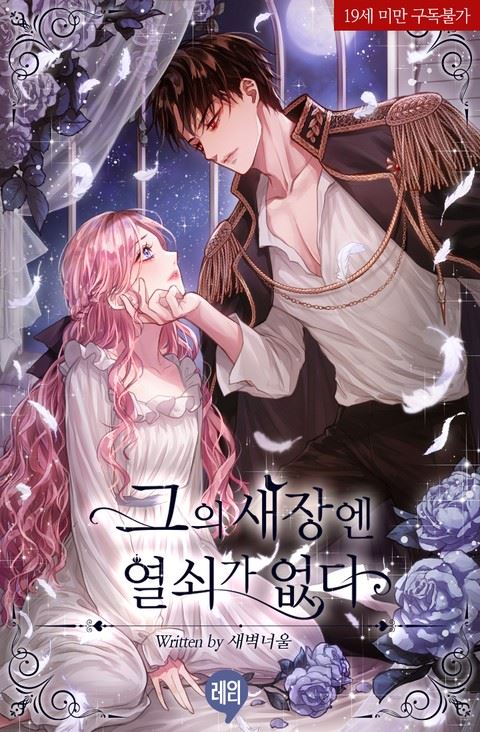
There is No Key to His Cage
+Add to Custom List
Novel Info

Summary

... Read More

Elena Helios is a woman who has lived two lives. After a tragic death in her previous life as a poor orphan from South Korea, she is reborn into the Estel Empire. Despite having a second chance, her new existence is no better. She spends over twenty years enduring abuse at an orphanage before escaping to live a nomadic life with her only friend, Aiden. Their freedom is shattered when they are both captured by illegal slave traders at a port. During the chaotic auction, Elena is sold for an exorbitant sum of ten million Luna to a mysterious buyer, separating her from Aiden. She is taken to a dark, cold chamber where she is held captive against her will.

The captor is Decarus de Scylla, the Grand Duke of the Ardeo Principality and a collateral relative of the imperial family. Renowned throughout the empire as a perfect, charitable, and handsome ruler, Decarus hides a disturbingly obsessive and psychopathic nature. He claims Elena is his destined bride, a declaration that leaves her bewildered and terrified. For days, he subjects her to psychological torment, withholding food to break her spirit while simultaneously expressing affectionate devotion. Elena, initially defiant and hostile, spits in his face and curses him, but her resistance is met with cold manipulation rather than physical violence. Her body weakens from starvation, forcing her to accept his food when her survival instinct overrides her pride.

A pivotal turning point occurs when Elena, driven by desperation, begs Decarus to untie her, promising to love him if he releases her. Decarus unties the ropes, only to tighten them again moments later, revealing that he anticipated her betrayal. He had orchestrated her emotional breakdown deliberately. When Elena finally collapses, weeping and begging for release, he embraces her, telling her that she should have begged from the beginning. He then carries her from the cell to his lavish mansion, marking a shift from imprisonment in darkness to confinement within luxury. Upon arriving, Elena learns the truth she had dismissed earlier: Decarus is indeed the Grand Duke she had hoped would rescue her. The man she despised is the very authority figure she believed could save her from illegal detention.

Trapped in the Grand Duke’s residence, Elena attempts to adapt strategically. She realizes that open hostility is futile and begins to feign compliance to buy time. She befriends Jane, the head maid, who becomes her sole confidante and teacher. Through Jane, Elena learns to read and write in the imperial language, discovering her natural talent for languages. Jane reveals that Decarus was left alone at age eleven after his parents died under suspicious circumstances, providing context for his loneliness but not excusing his actions. Elena continues to search for a way to escape and reunite with Aiden, using her studies to understand the geography and politics of the duchy.

The core conflict remains the power imbalance between Elena and Decarus. He views her defiance as endearing, referring to her as a wild cat he must tame. He enforces his claim over her through a bet made during their first encounter: because she doubted he was the Grand Duke, she promised to marry him if he proved himself. Decarus takes this promise literally and threatens to accelerate their wedding whenever she disobeys him. Their interactions are characterized by his possessive intimacy and her internal resistance. He forces her to eat, touches her hair, and intrudes on her private moments, while she struggles to maintain her sanity and desire for freedom. Elena understands that Decarus is dangerously obsessed, yet he also displays moments of genuine vulnerability and care, complicating her ability to simply hate him.

As the story progresses, Elena’s situation becomes increasingly precarious. She is isolated from the outside world, cut off from any possibility of contacting Aiden or seeking legal aid. Decarus controls every aspect of her environment, from her meals to her education. She begins to learn more about the political landscape of the empire, including rumors about the Emperor’s declining health and court intrigues. Despite her improved literacy and the comforts of the mansion, Elena’s primary goal remains escape. She navigates the social hierarchy of the household with caution, relying on Jane for information and support. The narrative establishes a tense dynamic where Elena is caught between her hatred for her captor and the unsettling realization that she is becoming dependent on the limited kindness she receives from him and his staff.

The story sets the stage for a complex romance and psychological drama. Elena is no longer just a victim of kidnapping but a participant in a twisted courtship defined by obsession and power. Decarus’s actions suggest that his pursuit of Elena is driven by a deep-seated fear of abandonment rather than simple malice. Meanwhile, Elena’s resilience shines through as she refuses to completely break, maintaining her inner self despite her outward compliance. The presence of Aiden serves as a lingering hope and a source of conflict, as Decarus remains unaware of Elena’s prior relationship with him. The tension builds as Elena attempts to manipulate her circumstances to either escape or survive, while Decarus works to solidify his hold on her heart and body, convinced that their union is inevitable and destined.

Latest Release
DateGroupRelease
2026-09-27citrus aurora c38
2026-09-27citrus aurora c37
2026-09-27citrus aurora c36
2026-09-27citrus aurora c35
2026-09-27citrus aurora c34
2026-09-27citrus aurora c33
2026-09-27citrus aurora c32
2026-09-27citrus aurora c31
2026-09-27citrus aurora c30
2026-09-27citrus aurora c29
2026-09-27citrus aurora c28
2026-09-27citrus aurora c27

Community Reviews

Rating(4.2 / 5.0, 35votes)
5 stars
13(37%)
4 stars
15(43%)
3 stars
7(20%)
2 stars
0(0%)
1 stars
0(0%)

Popular reviews

... Read More
The dialogue in this passage is absolutely razor-edged. What makes it work is how differently these two people use language—one weaponizes it, the other survives with it. Elena's lines are all performance and panic. "I'll love you too" is delivered like a theater audition, and the narration even tells us she draws on her college theater club experience. Her voice shifts from bitter mockery ("You crazy bastard") to desperate bargaining to full breakdown. Notice how her sentences fragment as she loses control: "Stop! I said stop!!!" becomes just "Save me." The dialogue architecture mirrors her psychological collapse in real time. His dialogue is almost eerily calm. Three-word sentences dominate: "Yes, immeasurably." "Because I love you." "Good girl." "You will stay here with me forever." He rarely raises his voice because he never needs to. Even his cruelty is delivered in gentle registers: "Did you really think I would untie you?" said with what sounds almost like affectionate teasing. The most devastating exchange is the negotiation scene. She offers love; he asks what she'll give. She thinks she's outsmarted him. The dialogue here has this awful dramatic irony—we watch her construct an elaborate strategy while he watches with the patient amusement of someone who already knows the ending. His final line before tightening the ropes: "May our love be eternal." After KISSING HER HAND. The juxtaposition is so grotesque it loops back around to being brilliant writing. The maids' dialogue is almost comically deferential: "My lady, please… If we don't assist you, we'll be killed." Their voices sound nothing like his. They're victims too, just ones who've learned to survive by being useful. That single line reveals his entire power structure in three words.
... Read More
Can we just take a moment to appreciate the absolute ENERGY of this dynamic? He keeps patting her head and calling her cute and comparing her to a well-behaved puppy and she responds by SPITTING in his face. That is the kind of couple energy I live for. Like, most heroines in these situations are either crying or being weak. Not Elena. She's got claws. Even when she's starving and weakened, she's still cursing him out and trying to threaten him with the police bureau. And his reaction? He just... finds it adorable. "You're still mischievous." "Lovingly." Sir, she JUST SATANIC-SPIRITED YOU. But here's the thing that actually disturbed me — there ARE moments where his behavior isn't purely evil. When she's crying and he says "When you cry, it makes my heart weak" and actually wipes her tears away... that wasn't performative. That was raw. And then he leaves with the food anyway. "This won't do. I'll come back tomorrow." He's withholding food as punishment/control but he ALSO can't stand seeing her suffer. This man is a walking contradiction and I am obsessed. Their power dynamic is so beautifully toxic — he holds all the cards physically and politically, but she holds something he doesn't expect: genuine defiance that he seems to find irresistible rather than threatening.
... Read More
I've been thinking about the symbols here. There's so much about ownership. Elena is basically a prized possession. The phrase "bride bought with money" sums up the theme of the story so far. She isn't a partner; she's an acquisition. Decarus keeps using language of value and ownership. He calls her "precious," he treats her like a doll, he inspects her like merchandise. But there's also the theme of hunger. Not just food hunger, but a spiritual or emotional hunger. He says he wants to "eat" her. It's a vampire trope, obviously, but it's also about consumption. He wants to consume her life, her autonomy, her very self. He wants to absorb her into his world. And the red eyes—the "burning like the sun." It suggests something supernatural, something dangerous. The color red is associated with danger, blood, and passion. It's everywhere in his description. Meanwhile, Elena is associated with blue ("blue eyes, like lakes"). Water vs. Fire. He is the destructive force; she is the thing he tries to drown or boil. The setting also plays a part. The large mansion, the locked doors, the view of the servants from the window. It's a cage. She watches them pass by, unable to join them. She is separated from the normal world. The painting on the ceiling she stares at is a symbol of her stagnation. She is lying still, looking up, trapped. The "bet" itself is a symbol of the arbitrary nature of their conflict. To her, it was a joke. To him, it was fate. This highlights the disconnect between them. He lives in a world where rules and deals matter; she is just trying to survive. It's a clash of worldviews. I think the story is exploring how love can become a form of imprisonment. Decarus thinks he is loving her by keeping her, by marrying her. He thinks this is romance. Elena knows it's captivity. The tragedy is that he genuinely believes he is doing right by her. That makes him scarier than a villain who just wants to hurt her. He's a villain who wants to worship her, and that's a lot harder to escape from. What do you think? Is there any chance she can change his mind, or is he too far gone?
... Read More
I have to talk about the plot progression here because this batch is essentially Elena realizing there is no way out. We have been building up this mystery of where she is and who Decarus is, and now it just hits her in the face—literally. The scene where he corners her against the wall and talks about the "bet" is the turning point. Up until now, the plot has felt like a slow burn of confusion for Elena, but this moment crystallizes everything. She thinks she made a joke about whether he was the Grand Duke, and he treats it as a binding contract. That is such a classic, twisted plot device. It forces the narrative into a box: she can't just leave because now there's a "wager" involved. It raises the stakes massively. If she refuses him, she isn't just defying a captor; she's breaking a promise in his eyes. I love how the author uses the dialogue about the wedding to shift the genre from a captivity thriller to a forced marriage romance in one sentence. "The wedding. Yours and mine." Just drop that and see what happens. It recontextualizes every previous interaction. He wasn't just keeping her locked up; he was preparing for this. It makes the whole backstory feel more sinister. Did he plan this the whole time? Or is he just this delusional? I really hope the plot isn't just going to be a loop of "he kidnaps, she resists." We need some external conflict soon, or Elena needs to start finding cracks in his armor. Otherwise, it's just two people in a room forever. Is there an actual escape plan forming, or is she just going to wait him out?
... Read More
"You smell nice. Makes me want to eat you." Oh my god, Decarus is such a menace. I need to talk about the dynamic between him and Elena because it is absolutely suffocating, and I mean that in the best way. The relationship here is so unbalanced. He is towering over her, physically and metaphorically. Look at the physical descriptions—he compares his skin to silk and flour, while she is trembling like a kitten. The power differential is huge. But what I find fascinating is his behavior. He is cruel, yes, he invades her space, he forces the kiss, he ignores her pleas. But there is this weird undertone where he actually *wants* her to want him. When he says, "You'll soon come to like it too," it's creepy, but it reveals his own desperation. He needs her approval. He trapped her, but he can't just treat her like an object because he keeps saying she's his "angel" and his "precious bride." He is trying to mold this relationship into something romantic on his terms, while she just wants to survive. And Elena! I feel so bad for her, but she's also showing some spine. She slapped him. Can we appreciate that? After he kisses her forcefully and tries to move her to the bed, she slaps him and calls him trash. That is a moment of defiance. It's not a lot, but it's something. It shows she hasn't broken completely. Their dynamic is this dance of violence and twisted affection. He pushes, she pulls away, he gets amused, she gets scared. It's toxic as hell, but I can't look away. What kind of person does she have to become to get out of this situation?
... Read More
This passage is a masterclass in tension escalation, isn't it? On the surface, it's a captivity story. But peel back one layer and you find something far more devastating: the entire narrative is structured around manipulation operating on multiple levels simultaneously. Elena attempts to manipulate him into untying her by offering love. The plot lets us believe she might actually succeed for about three seconds—his hands move behind her chair, the ropes loosen—and then WHAM. He tightens them again. That moment when he asks, "Did you really think I would untie you?" is one of those gut-punch reveals that recontextualizes everything that came before. We thought we were reading a hostage negotiation; turns out we were watching a predator let the prey think it had found an exit. But then the real twist hits: her breakdown isn't a defeat—it's exactly what he engineered. When she sobs "save me," his cold reply is "You should have begged like this from the beginning." He didn't fall in love with her; he studied her. Every iteration of her resistance—defiance, negotiation, feigned submission, full breakdown—was a variable he accounted for. The plot isn't about captivity at all. It's about the systematic dismantling of a person's autonomy through psychological conditioning disguised as romance. And the structure doesn't stop there. The next chapter shifts location entirely—from the chain-linked chair to the bedroom, from ropes to his physical embrace—and the power dynamic remains identical. He catches her attempting to flee the bed the same way he caught her earlier tactics. The narrative is a series of closing doors. Every escape route leads deeper into his control. That is remarkably tight plotting.
See all reviews

Custom lists

See all custom Lists