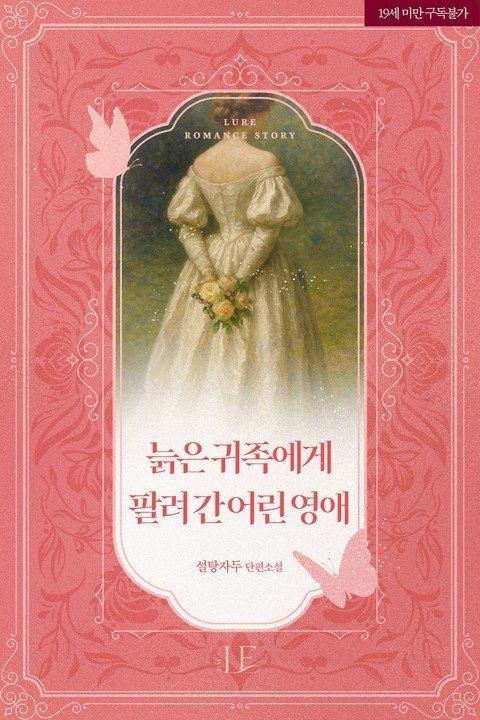
The Young Lady Sold to an Old Noble
+Add to Custom List
Novel Info
  • Author:
  • Status:Ongoing

Summary

... Read More

Rosaline, a twenty-year-old noblewoman from a minor family, is sold by her parents to Earl Balzac, a wealthy fifty-year-old widower, in an arranged marriage intended to secure financial stability for her family. Despite her initial resistance and distress at being traded like property to an older man she does not know, the wedding proceeds without her consent. Upon arriving at the Earl’s townhouse in the capital, Rosaline prepares for her first night with dread, expecting the cold indifference of a consummation motivated solely by the need for heirs. However, her fears shift to confusion and eventual overwhelming sensation when Earl Balzac enters her chamber. Unlike the frail, pale nobles she expected, Balzac is a physically imposing man with dark skin, thick grey hair, and a robust, muscular build developed through a lifetime of martial arts. He commands her to submit, and despite her trembling hesitation, he initiates their sexual union with intense vigor, effectively breaking down her resistance through overwhelming physical pleasure.

The wedding night marks a radical transformation in Rosaline’s understanding of her body and marriage. Earl Balzac teaches her to respond to his touch, insisting she address him as "Honey" rather than by his title. Through persistent and forceful intimacy, he brings her to powerful orgasms, leaving her bewildered by the intensity of sensations she never knew existed. By the end of the night, Rosaline’s initial revulsion has been replaced by a deep, awakening lust. The narrative then reveals that this transformation was not limited to the first night; over the following months, their daily sexual encounters further solidified her dependency on his physical presence. Rosaline becomes increasingly lüstful, finding herself unable to satisfy her growing desires with the Earl alone due to his busy schedule managing the Earldom.

As her desires escalate, Rosaline seeks release elsewhere, leading her to the stables where she encounters Edward, a young stableboy with honey-colored hair. Despite his protests about the danger of being caught by his master, Rosaline overpowers his reluctance, using her status and her own insatiable hunger to initiate sex with him in a straw-filled stall. This act represents a significant deviation from her initial role as a submissive wife, showcasing her transformation into an active pursuer of pleasure. The encounter is frantic and driven by her newly awakened libido, leaving her exhausted but satisfied. However, the secrecy of their arrangement is short-lived, as Earl Balzac discovers them in the stable shortly after Edward departs.

Rather than punishing Rosaline for her infidelity, Earl Balzac reacts with amusement and affection. He acknowledges her heightened desires as a natural consequence of their passionate life together. In a pivotal shift, he permits her continued relations with other men, viewing it as a necessary outlet to keep her satisfied while he attends to his duties. He even playfully suggests providing her with sexual toys modeled after his own form. The story concludes with Rosaline fully embracing her role as the Earl’s lustful wife, who enjoys both her husband’s potent sexuality and the freedom to explore other partners under his watchful, approving gaze. Her initial misery at being sold has completely evaporated, replaced by a contented existence defined by physical gratification and the security of her position within the Earldom.

Latest Release
DateGroupRelease
2026-10-03dusk blossoms c4
2026-10-03dusk blossoms c3
2026-10-03dusk blossoms c2
2026-10-03dusk blossoms c1

Community Reviews

Rating(0 / 5.0, 11votes)
5 stars
0(0%)
4 stars
0(0%)
3 stars
0(0%)
2 stars
0(0%)
1 stars
0(0%)

Popular reviews

... Read More
The conflict structure in these first three chapters is built on layers and the stakes keep rising even when you think they've peaked. On the surface, the conflict is obvious: Rosaline vs. her parents, Rosaline vs. Earl Balzac, Rosaline vs. her own body. But the deeper conflict is something else entirely—it's Rosaline's EXPECTATIONS vs. reality. She braced herself for a fat, perverted old noble who would treat her like an object. What she got is... a skilled, disciplined man who happens to be physically overwhelming but seemingly respectful in his own brutal way. The Earl even asks "Are you curious about other men too?" which is such an unexpected moment of vulnerability from someone who has every reason to be purely dominant. The stakes escalate beautifully. In Chapter 1, the stakes are her emotional survival—will she break under this forced marriage? In Chapter 2, the stakes become physical and psychological simultaneously—she's being penetrated by a stranger and her body is reacting in ways she can't control. And in Chapter 3, the stakes shift again: will she lose herself completely to this pleasure, or will she find something more? What makes the tension work is that the author NEVER lets us fully trust either character. Earl Balzac is described as having lost two wives before. Two. That's not nothing. Is he dangerous? Is he cursed? Is he just unlucky? And Rosaline—she starts Chapter 1 absolutely certain she despises this situation, but by Chapter 3 she's reaching his chest muscles to steady herself and realizing sex feels GOOD. That internal conflict between who she thought she was and who she's becoming is the real story here, and it's gripping.
... Read More
I am not okay with the dialogue writing in this book because it is genuinely excellent and I didn't expect that from a romance novel opening. Let's start with Earl Balzac's voice. When he says "You received sex education at home, right? It's essential for producing an heir," that's not just exposition—that's CHARACTER. This is a man who views marriage as duty, who approaches intimacy with practicality, who doesn't sugarcoat anything. His dialogue is direct, commanding, almost clinical. But then he follows it up with "Let's start calling each other 'Honey' now. We're married, after all" and suddenly there's this weird warmth underneath all the commands. And the handprint threat? "Every time you call me 'Earl,' I'll leave a handprint on your bottom." That's not just dominance—that's FLIRTING disguised as discipline. The man is playing a game and he KNOWS he's playing a game. Rosaline's dialogue on the other hand is mostly fragmented. Gasps, stutters, incomplete sentences. "I-I don't know, hng…!" This is intentional—the author is showing us a woman who has LOST the ability to form coherent thoughts because her body is taking over. Her speech patterns literally dissolve as the chapters progress. By the end of Chapter 3, she's not even pretending to resist verbally. The supporting characters' voices are even more interesting. Her mother Madame Mier speaks in this enthusiastic, almost manic tone—"Being admitted into Earl Balzac's Earldom is a blessing, a blessing!" She genuinely believes she's doing her daughter a favor. That disconnect between her optimism and the reality of what she's selling is horrifying and darkly comic at the same time. The author never mocks her outright; she just lets her words hang there and the reader does the judgment.
... Read More
I need to sit with this for a moment because the emotional layering in these first chapters is actually insane and I didn't see it coming. "She felt as if she were a brothel worker, so shameless. But the more she thought herself shameless, the more her body responded, releasing clear fluids." This line. This single line. It captures the entire tragedy and beauty of Rosaline's situation in one sentence. She's being sold like merchandise, forced into a marriage with a stranger old enough to be her father, and her OWN BODY is betraying every thought she has about resisting. That's not just physical—it's psychological destruction layered on top of physical experience. And the worst part? She's not wrong to feel shame. The narrative makes you FEEL her internal conflict. She hates that she's responding. She hates that her husband is doing this to her. But she also can't stop. Then there's Earl Balzac's perspective, which the author barely gives us directly but we can infer. He's a widower who lost two wives, has grown sons, has been abstinent. He chose a YOUNG virgin wife deliberately. Is he a villain? Is he a predator? Or is he just a man who followed the brutal social rules of his world and is now trying to do his duty while discovering something unexpected? The most emotionally devastating moment has to be when Rosaline reaches his chest to steady herself during climax and suddenly realizes—"Sex felt so good." After everything. After the trauma, the forced marriage, the shame. Her body found joy anyway. That's both heartbreaking and kind of revolutionary for a character like her.
... Read More
There's something deeply moving about watching Rosaline discover herself. Not just physically — though the text is unapologetic about that — but emotionally. She starts this chapter unsure, almost ashamed of her own reactions. "Rosaline forgot her shame" — that line hit me. She HAD shame, and then she FORGOT it. That's the entire emotional journey in six words. The Earl doesn't break her down; he helps her forget the conditioning that made her feel guilty for feeling pleasure. And when he whispers "I'm looking forward to it. Our child," and she responds with this barely-conscious "Hehe, yes... That's right, Honey..." — that's not submission, that's trust. She's letting go. The ending where she talks about keeping a toy shaped like his member inside her all day? That's not just horny writing, that's a woman who has found something that makes her feel complete. She literally says "Her heart felt as full as the seed inside her. It truly was a happy marriage." Happy. Not just satisfied. Not just surviving. Happy. And that emotional payoff — earned through an entire chapter of physical intimacy — is what makes this more than just smut.
... Read More
'You're supposed to receive my seed, not pull away.' That line. Simple. Commanding. No flowery language, no pretending. The Earl speaks in short, direct sentences that leave no room for negotiation. And yet, moments later he's calling her "cute" and planning to commission a replica of his member as a toy because she wants it so badly. The contrast between his harsh commands and his sweet actions is what gives him voice. Rosaline's dialogue follows a similar pattern — she starts with fragmented breaths and apologies, gradually forming actual sentences as she gains confidence. "I love it, your thick member feels so good" — that's a character who has learned to vocalize pleasure, and watching that happen across one chapter is genuinely satisfying. The stableboy Edward barely gets any dialogue beyond stammering excuses, which makes sense — he's a side character, a device, not a fully realized person. But the Earl and Rosaline? Their banter is natural. You can hear their voices in your head. The author knows how to write dialogue that reveals power dynamics without needing exposition.
... Read More
Let me just say this outright: the opening of this novel is a masterclass in misdirection and the pacing is absolutely ruthless in the best way. Chapter 1 opens with this EXTREMELY dark, almost documentarian tone—explaining how noble daughters are treated as commodities, how arranged marriages work, how girls get sold to men old enough to be their fathers. It reads like a history lecture. Then it drops Rosaline's name and we get this visceral, explicit scene of her already married and experiencing pleasure with Earl Balzac in a STABLE. A STABLE. Not a bedroom, not somewhere romantic—straw, horses whinnying nearby, animals. The contrast between the cold exposition and the raw physicality of that scene hit me like a truck. Then Chapter 2 completely rewinds us. We go back to Rosaline's POV, her parents forcing her into this marriage, her despair, her running to her room. The narrative structure here is doing something really clever—it shows us the DESTINATION first (she ends up enjoying this), then takes us on the journey of HOW she gets there. By the time we reach Chapter 3's wedding night, we already know from the prologue scene that Rosaline will survive and even THRIVE physically, which changes how we read every moment of her anxiety and trembling. The pacing between scenes is also worth noting. We go from the stable scene → flashback to her childhood/home life → wedding ceremony blur → townhouse arrival → bath scene → waiting in the bedroom → the Earl's entrance. Each transition is clean, each scene serves a purpose. No filler. The author could have spent three more chapters on the wedding preparations but chose not to. Instead, we get straight to the confrontation between these two characters, and the tension builds from the very first step on the hallway floor.
See all reviews

Custom lists

See all custom Lists