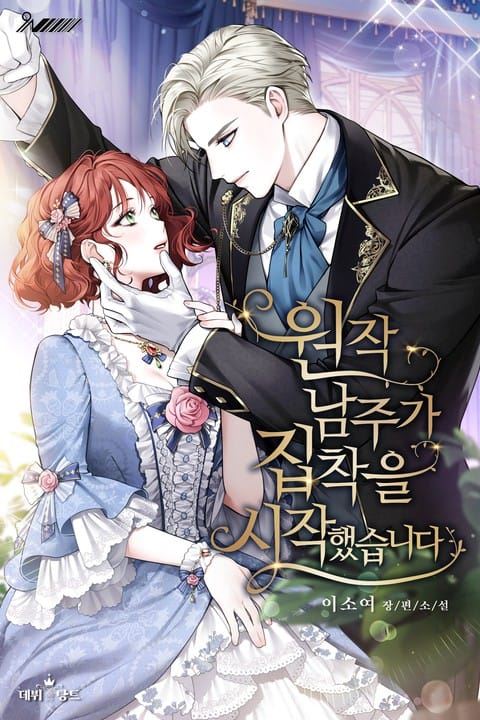
The Original Male Protagonist Started to Become Obsessed
+Add to Custom List
Novel Info
  • Author:
  • Status:Ongoing

Summary

... Read More

Han Woori, a former office worker from South Korea, reincarnates into the world of a tragic romance novel titled "Duke's Secret Seduction." Instead of assuming the role of the heroine, Lady Violet, she awakens as Evelyn Berge, a supporting character from a fallen baronial family. Evelyn is destined to harbor an unrequited, obsessive love for the novel's male lead, Duke Rashid Egenhart, and ultimately murders him with a dagger on the eve of his wedding to Violet before being executed herself. Determined to avoid this grim fate, Han Woori resolves to suppress any romantic feelings for the duke and instead ensure that Rashid and Violet follow their original plotline, hoping that a correct storyline will allow her to return to her previous world.

Duke Rashid Egenhart is the Empire's First Duke, a descendant of dragons known for his unparalleled beauty, immense wealth, and arrogant, volatile personality. In the original narrative, he dismisses Evelyn with contempt, focusing solely on Violet. However, the course of events shifts dramatically due to Han Woori's interference. Having lived through Evelyn's childhood, she actively works to rehabilitate Rashid's rude manners and temper, guiding him through his youth with the patience of a guardian rather than a suitor. This long-term influence inadvertently molds Rashid into a more refined and capable leader, creating a deep, albeit complicated, bond between them that defies the original story's parameters.

In the present timeline, Evelyn serves as Rashid's personal secretary, a position she accepts out of financial necessity to support her family. She aims to keep her distance, viewing Rashid as a dangerous employer best avoided. Despite her efforts to remain professional and distant, Rashid finds himself increasingly fixated on her. He notices her competence, her unique defiance, and the subtle changes in her personality compared to the timid woman described in his past records. His interest manifests in persistent attention, culminating in a series of proposals that confuse and alarm Evelyn, who is desperate to maintain her role as a mere background character.

The central conflict arises from the divergence of fate. Evelyn possesses a latent, terrifying power unique to her: the ability to pierce the heart of a dragon descendant with a single blow. While she intends to use this knowledge solely for self-preservation, Rashid begins to suspect that Evelyn is hiding something significant. Their interactions become charged with tension as Rashid oscillates between professional reliance on her skills and personal possessiveness. He rejects the advances of other noblewomen, such as Lady Cecilia, while simultaneously pressuring Evelyn to acknowledge their unconventional relationship, leaving her trapped between her desire for survival and the growing reality of his affection.

Key turning points include Evelyn's accidental discovery of a scar on Rashid's chest, a wound inflicted five years prior by unknown assailants. This revelation connects to the original novel's plot regarding the vulnerability of dragon blood and reinforces Evelyn's fear of her own lethal potential. Furthermore, rumors circulate in high society that Evelyn is the duke's mistress, a scandal that Rashid neither denies nor clarifies, further entangling her in his social sphere. The dynamic between them shifts from employer-employee to a complex emotional struggle where Rashid demands intimacy and Evelyn strives for autonomy.

As the story progresses, the trajectory moves away from the original tragic romance. Evelyn realizes that simply waiting for Violet to appear is insufficient because Rashid's behavior is fundamentally altering the narrative. She must now navigate a delicate path: preventing her own doomed fate while managing a duke who refuses to let her go. The narrative explores the tension between predetermined destiny and free will, as Evelyn fights to survive in a world that views her as insignificant, only to become the central figure in the duke's life. Her journey is no longer about passive avoidance but active manipulation of fate to secure a future where she is neither a murderer nor a victim, but an independent individual.

Latest Release
DateGroupRelease
2026-10-03dusk blossoms c136
2026-10-03dusk blossoms c135
2026-10-03dusk blossoms c134
2026-10-03dusk blossoms c133
2026-10-03dusk blossoms c132
2026-10-03dusk blossoms c131
2026-10-03dusk blossoms c130
2026-10-03dusk blossoms c129
2026-10-03dusk blossoms c128
2026-10-03dusk blossoms c127
2026-10-03dusk blossoms c126
2026-10-03dusk blossoms c125

Community Reviews

Rating(0 / 5.0, 44votes)
5 stars
0(0%)
4 stars
0(0%)
3 stars
0(0%)
2 stars
0(0%)
1 stars
0(0%)

Popular reviews

... Read More
The stakes in this premise are absolutely brutal and I love it. On the surface, Evelyn just needs to stay away from Rashid and let the original plot play out. Simple, right? Wrong. Because Rashid is now proposing to HER instead of the actual heroine. Every time he gets closer, the timeline shifts. The original story's events are destabilizing. If she successfully redirects him toward Lady Violet, does that mean she has to watch him love someone else? Does that mean she goes back to her original world? Or does changing the plot have consequences she hasn't considered? The internal conflict is equally intense. Evelyn KNOWS that the original Evelyn died for loving Rashid. She swore never to fall for him. But he's not the same Rashid from the book anymore—he's sharper, more aware, and he's choosing HER. The danger isn't just that she'll repeat the original character's fate. The danger is that she's starting to feel something she doesn't want to feel, and if she does, the book's logic might force her back toward that same ending regardless of what she decides. And then there's the external threat looming: the assassination attempt on Rashid that the original story hinted at. Evelyn knows a killer is coming—the one who will ultimately stab him. But she also knows that in the original timeline, SHE was the one who did it. Was it really her? Or was the original Evelyn manipulated? Now she's walking around this man who wants to marry her while carrying the secret that she's supposed to be his murderess. Every interaction is a minefield. The physical stakes are real too—she HAS the ability to kill him. One blow to the heart. The power is dormant but terrifying. She's the most dangerous person in the room and she doesn't even want to use it. That's some serious dramatic tension right there.
... Read More
I need to discuss what this story is actually about, because on the surface it's a romance with time travel elements, but dig one inch deeper and it becomes something far more troubling. Let's start with the dragon. Everyone keeps saying it, but have you actually considered what it means? Rashid is described as 'the living jewel of the empire' - beautiful, rare, coveted. But he's also a beast. A creature of legend. And Evelyn possesses the power to 'pierce the heart of the dragon.' This isn't just a cool combat ability; it's the central metaphor for the entire narrative. The dragon must be killed. The beautiful, charismatic, dangerous man must be destroyed. And the woman who loves him will do it. The tea cup scene is where this symbolism becomes unbearable. Rashid pressing his lips to the porcelain where her fingers touched it - that's not romantic, readers. That's vampiric. That's consumption. He's absorbing what she leaves behind because he can't tolerate absence. And the tea goes cold while he stares at it. Time stops for him when she's gone. But she's already planning her escape. Now let's talk about Veronica. A mystical cat who guards the bedroom door and only answers to her master? That's not comic relief. That's a symbol of the barrier between Evelyn and true intimacy. She can get close, but she can't access him. The cat knows she's temporary. The cat knows she's already failing. And the harbor! Port Borten, fifty years outdated, controlled by economic leverage rather than military force - this is the empire itself. Old infrastructure, maintained by money and deals, barely holding together beneath the surface. Rashid's power comes from building new systems, while the old systems crumble. Is that why Evelyn is drawn to him? Because beneath his dragon nature he's creating something new? Or because she's drawn to the same destructive creativity that will eventually destroy her? The childhood flashback is where all this symbolism converges. Eight-year-old Rashid climbs trees and demands affection. He doesn't know how to ask; he only knows how to take. And ten-year-old Evelyn promises to be kinder, thinking she can rewrite fate through small kindnesses. The author is showing us that love without understanding is just another form of possession. That taming a dragon doesn't make him less dangerous; it makes him more attached. Every beautiful image in this story is also a threat. Every moment of tenderness contains the seed of betrayal. That's the theme. That's the wound. The dragon doesn't die because he was never alive. And Evelyn will kill something that was always a reflection of herself.
... Read More
Let's talk about what's actually at risk here because the stakes in these chapters are多层-layered in ways that keep me up at night. On the surface level, Evelyn's conflict is straightforward: she wants to quit her job and leave the duke's household before the original plot consumes her. She's prepared her exit strategy. She even asked her friend Tory to help find new employment. But Rashid has now blocked that path. "Do you think I'll let you leave?"—that line redefines EVERYTHING. The conflict shifts from external (navigating noble society, avoiding the plot's tragedy) to interpersonal (a man who won't let her go). But the real stakes are deeper. Evelyn is a woman from a fallen noble family who has survived by being invisible and pragmatic. She's worked three years as a secretary, endured gossip, maintained her dignity while eating peanut cookies alone at her desk. She built a life on the premise that she doesn't belong in this world of balls and romance novels. And now someone—someone with the power to destroy her or protect her—is looking at her like she's something worth keeping. That terrifies her more than any scandal could. Because if she lets herself want this, and then loses it, she won't just be a background character anymore. She'll be someone who had something and lost it. And Evelyn Berge has spent her whole adult life making sure she never has anything she can lose. Meanwhile, Rashid's stakes are different but equally dangerous. He's using her as a shield from his mother, the Empress, but his behavior suggests he's developing real feelings he can't control. If he loses her, he loses both his protection AND something he didn't know he wanted. That's a double stake that could make him reckless. The Imperial Ball is coming, and I have a very bad feeling about what happens when the Empress discovers the truth.
... Read More
I need to talk about the most fascinating character dynamic I've encountered in forever because the author absolutely murdered me here. Adult Evelyn claims she harbors no personal feelings for Rashid. Says it three times! Thrice! And yet - AND YET - she's internally spiraling about whether he's looking at her with anything other than amusement when she mentions jealousy. The cognitive dissonance is SO thick you could cut it with a knife. This woman is lying to herself with the precision of a master swordsperson. But let's go deeper. Little eight-year-old Rashid? Oh, he's already showing us who he is. When Lady Mariware rejects him, he doesn't cry. He climbs a tree and demands Evelyn be kind to him. Translation: he wants affection, but the only language he knows is dominance and entitlement. 'Maybe you want a little more affection?' Evelyn asks, and he turns crimson. The boy understands exactly what he's feeling and is terrified of it. Here's what breaks my heart: Evelyn sees this and thinks SHE can fix him. She's projecting her adult knowledge onto a child who will either break her or break himself. And that kiss? When he jumps into her arms and kisses her suddenly? That's not romance, folks. That's possession. That's a dragon claiming what he considers his. She panics internally while outwardly accepting it. And THEN she sighs and accepts her fate. The tragedy is written into those two lines. Meanwhile, adult Evelyn still hasn't processed that kiss from eight years ago. She's still flustered, still confused, still trying to maintain professional boundaries while standing in a bathroom catching glimpses of sculpted abs. Nothing has changed! She's trapped in the same pattern! And Rashid - oh, brilliant Rashid. The scene where he watches her leave, stares at her teacup, and presses his lips to the porcelain where her fingers touched it? That's not the cold duke from the novel. That's someone who's been quietly observing, testing, waiting. He knows she's different now. He knows something has shifted. And he's enjoying it. Their relationship isn't love story; it's a chess game where both players think they're winning, but the board was built for a third outcome entirely. Honestly, I'm emotionally compromised and I need to lie down.
... Read More
'I've known you for fifteen years, but I'm always amazed by your survival skills.' — this line alone should be framed. Rashid's dialogue is one of the most entertaining things in this book. Every sentence he speaks is calibrated, whether he's dismantling a count during negotiations or subtly asserting ownership over his secretary. He calls Evelyn's tea 'truly terrible' in front of a nobleman, then immediately follows it up by personally serving her tea and saying it's good enough only for him. That's not just flirtation, that's psychological warfare disguised as politeness. And the best part? Evelyn matches him blow for blow. Her line about billing for overtime separately and demanding a bonus because 'bonuses make competent employees even more competent' is the kind of dialogue that makes you want to cheer. She's not playing the shy maiden role at all — she's a woman who has survived fifteen years of being tormented by this man and is still standing, still negotiating, still quoting his own words back at him. The banter between them has this razor-sharp quality where nothing is ever just what it seems. Even 'Would you like some more tea?' at the end isn't just a polite offer — it's loaded with everything they've never said directly. Meanwhile the side characters like Count Kalante sound appropriately stuffy and dismissive, which makes the contrast with Evelyn and Rashid's dynamics even sharper. The author clearly understands that dialogue isn't just about what characters say, it's about what they're NOT saying.
... Read More
There's something really well done about how this story builds its atmosphere through small, mundane details that somehow make the whole world feel lived-in. The Egenhart ducal estate isn't described with sweeping architectural paragraphs—I get it from textures: the lace-trimmed sleeve of Cecilia's expensive dress brushing against Evelyn's plain work uniform, the lukewarm tea Robert brings, the stacks of paperwork on Evelyn's desk, the sounds of footsteps echoing down the hallway. These are the details that make it feel like a real place where people actually live and work, not just a backdrop for romance. And the office scene with Adelio bursting in, the butler pretending not to see anything while staring at the ceiling, the vast empty space where Evelyn's laughter bounces around like an echo—that's cinematic without being overwrought. The author trusts the reader to feel the weight of these spaces through action and gesture rather than exposition.
See all reviews

Custom lists

See all custom Lists