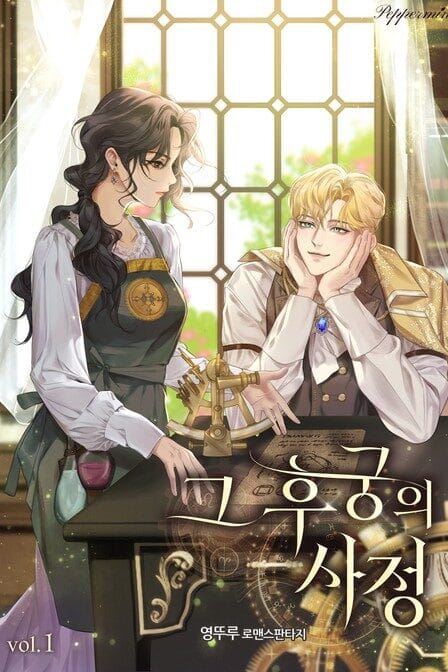
I need to talk about Lucia because something shifted in this batch and I can't unsee it.
In the earlier chapters, Lucia was brilliant and stubborn and righteous, but she was also contained—trapped in her bookstore, trapped in her family's expectations, trapped in a world that gave her ideas but no power to act on them. Aristide represented a kind of doorway, a chance at something bigger. Even their confrontation about the harem researchers was her speaking truth to power from within the walls of her shop.
But the Earl Siabon scene changed something fundamental.
"Your attitude is poor. But that will fix itself after a few beatings."
He says this casually. Like discipline is a training regimen. And Lucia—she doesn't cry. She doesn't beg. She reaches behind her, finds a metal candlestick, and SWINGS IT.
Blood drips from his forehead. She holds the candlestick like a sword with both hands, trembling but standing her ground. This is the first time she physically fights back against a man who wants to use her, and the image of her as this terrified but defiant figure in a dim room with blood on the floor is seared into my brain.
What's fascinating is how this connects to her relationship with Aristide. Earlier, she called him a coward for not fighting the societal opposition to women's rights. And now here she is—physically defending herself while he watches from his golden palace, powerless in his own way. He can offer knights. He can offer assassins. But he can't walk through that door himself.
The power dynamic between them is intoxicating. She rejected his offer to investigate her. She declined his knights. She's trying to solve her own problem with blanket ropes and smuggled skewers. And he's sitting in his study twirling a fountain pen, furious that he can't just fix it.
"D*mn it," he says, and storms out. That's it. That's the most powerful man in the nation, reduced to a curse word because the woman he cares about is making him feel useless.
And Marisa—oh god, Marisa. The woman who enforced the system now finds herself holding her daughter's hands, trying to comfort her in the only way she knows how. "Don't think you're special." Is that cruelty or protection? Is she preparing Lucia for a hard life or dismissing her pain?
I think it's both. Like all the best mothers in literature, Marisa is simultaneously the problem and the only source of warmth Lucia has left.