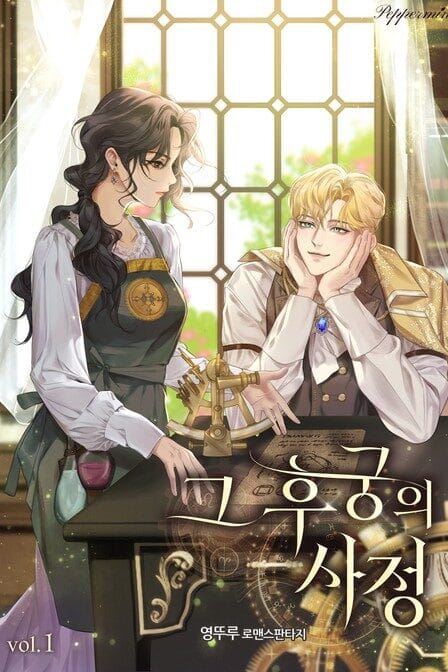
So That Bad Ending Was Not The End?
+Add to Custom List
Genres:
Novel Info
  • Author:
  • Status:Ongoing

Summary

... Read More

May Louise is an ordinary maid working at the Duke of Hale mansion, known for her stutter, loneliness, and lack of friends. Her life changes when Attorney Dominic Vicenti arrives with news that her maternal grandfather, Walter Prieto, has died and left her his entire estate, including Prieto Castle and substantial wealth. May’s mother, Emily, had legally severed ties with Walter seven years prior, which delayed the discovery of May’s existence as the heir. Initially suspicious and hesitant, May eventually signs the inheritance papers after the lawyer advises that refusing would involve more bureaucratic hassle. She also learns that her mother’s debts have been transferred to her but will be settled before the inheritance is finalized.

May struggles to decide whether to remain at the ducal mansion or embrace her new status. Her master, Aiden Hale, the third young master of House Hale, is capricious and cruel, treating May with a mix of dependence and contempt. He isolates her from other servants, subjecting her to emotional manipulation and petty punishments. When Aiden abruptly cancels a promised seaside trip and orders May to avoid him until his departure, she sees an opportunity. With the help of Butler Benedict, who recognizes the toxicity of Aiden’s behavior, May submits her resignation. Benedict gently corrects her belief that Aiden hates her, suggesting he simply does not know how to express care, and provides a farewell letter for Aiden.

<<22>

May relocates to the inherited mansion in Almar, a coastal city known as the Ghost Mansion due to rumors of Walter’s spirit. Inside, she discovers a cursed silver compass that exhibits malevolent properties, causing her physical distress through violent episodes of fever and unnatural urges. Additionally, she witnesses the ghost of her grandfather, Walter, wandering the halls in a state of lingering resentment. Unable to hire help due to the mansion’s ominous reputation, May posts an advertisement and hires Johan Diaz, a golden-haired man who claims he can be considered a woman if necessary. Johan is secretly a priest of the goddess Hecate and an ex-temple thief with the ability to detect and neutralize cursed objects.

Johan recognizes the compass as a powerful thought-form and stays to investigate while covertly protecting May. He performs cleaning duties and observes May’s deteriorating condition, eventually realizing the compass is driving her to self-destructive states. During a seaside walk, May suffers another episode, and Johan carries her to a nearby room, proposing they consummate a relationship to alleviate her symptoms. May, though hesitant due to her innocence and the impropriety of the situation, agrees. Their encounter provides temporary relief, but Johan remains focused on neutralizing the compass.

Meanwhile, Aiden Hale returns from his trip and discovers May’s resignation. Furious at Benedict for facilitating her departure without his direct approval, Aiden confines himself to his room. His brother Derrick confronts him, revealing that Aiden’s behavior stems from unacknowledged attachment to May. Derrick manipulates Aiden into believing May belongs to him and that retrieving her is rightful possession, setting the stage for a confrontation. The narrative follows May’s attempts to manage the cursed artifacts and her growing bond with Johan, while Aiden’s return threatens to disrupt her fragile new life.

Latest Release
DateGroupRelease
2026-10-03dusk blossoms c60
2026-10-03dusk blossoms c59
2026-10-03dusk blossoms c58
2026-10-03dusk blossoms c57
2026-10-03dusk blossoms c56
2026-10-03dusk blossoms c55
2026-10-03dusk blossoms c54
2026-10-03dusk blossoms c53
2026-10-03dusk blossoms c52
2026-10-03dusk blossoms c51
2026-10-03dusk blossoms c50
2026-10-03dusk blossoms c49

Community Reviews

Rating(0 / 5.0, 30votes)
5 stars
0(0%)
4 stars
0(0%)
3 stars
0(0%)
2 stars
0(0%)
1 stars
0(0%)

Popular reviews

... Read More
Can we just take a moment to appreciate how GOOD Johan sounds when he talks? His voice is instantly distinguishable from everyone else in this story, and it's primarily because he never takes anything seriously—not even himself. When the old man in the temple tuts at him for wearing a veil improperly, Johan's response is basically: 'Fine, I'll pretend to be a woman then.' That line alone tells you everything about his character—defiant, sarcastic, quietly mocking the institutions around him, and absolutely unbothered by consequences. And the coachman! His dialogue is so grounded and practical compared to everyone else. 'Tell them to ask the priests for a blessing! And don't associate with the broker!' He's giving genuine, frantic advice while May is just smile-nodding her way through it. The contrast between his superstition and May's reluctant curiosity creates this really natural dialogue dynamic. Then there's May's interaction with the compass itself—which, yes, is an inanimate object but it TALKS to her in a way. 'Terrible,' she mutters, and the chain rattles back. 'It's really terrible...' and it trembles. It's almost comedic at points, but also deeply unsettling. The dialogue between human and cursed object becomes this weird intimacy that neither of them wants. The narrative voice overall has this great balance—wry observations from Johan's POV, nervous vulnerability from May's. They sound like totally different people thinking out loud, which keeps the dual-perspective structure from ever feeling muddled.
... Read More
Let's talk about voices, because this author clearly understands that dialogue isn't just information delivery—it's identity. May's dialogue is a masterpiece of nervous deflection. Watch how she constructs sentences under pressure: 'It, it's true...' Stuttering becomes character. Then she pivots to over-explaining—'I've never seen the sea before, so I'm really looking forward to it'—as if adding enthusiasm compensates for the lie. Her voice shifts from broken single words to desperate paragraphs. You can hear her sweating through the text. Benedict, meanwhile, speaks in clipped, deliberate statements. 'It's not at all that he hates you.' 'Master Aiden just... doesn't know how.' Periods. Full stops. The man doesn't waste syllables. His voice is weathered authority, and when he adds that note to May's file, the action itself speaks louder than any dialogue could. Aiden's voice is scattered throughout the chapter in回忆 fragments—'you look like a rain-soaked dog,' 'don't even show your face until the day you see me off.' These lines are memorably cruel, and they're delivered with this casual entitlement that makes them hit even harder. The mole on his left eye when he narrows his eyes—this is the kind of visual detail the author weaves into dialogue description to make scenes cinematic. And the coachman! Oh, the coachman's voice is pure local color. 'Tsk,' 'Ah!', whispering ghost stories like neighborhood gossip. His dialogue is the opposite of Benedict's precision—it's loose, exaggerated, superstitious. Four distinct voices in one chapter. That's craft.
... Read More
Okay first—let's appreciate the visual storytelling here because the author does NOT miss. The 'Ghost Mansion' description is doing SO much heavy lifting. On the surface it's gorgeous: expansive sea views, sunlight streaming through long windows, everything basking in what seems like the sun god's protection. And then there's the dust, the unsettling black painting hanging at the center of the stairs, and of course the cursed compass that refuses to stay gone. The contrast between the picturesque exterior and the creeping wrongness inside is giving me major gothic novel energy and I am HERE for it. But the temple scene? Chef's kiss. The golden statues of the sun god flanking the entrance, the long lines of believers, Johan's sharp golden eyes hidden behind a brown wig and a veil—this entire sequence feels like a film set. And the worldbuilding details are woven in SO naturally. You learn about the empire's religious reform, the suppression of other faiths, the sun god being more of a political tool than a genuine deity, and Johan's own goddess Hecate—all while he's just standing there looking judgmental at a building he's about to rob. The atmosphere is thick with tension, faith, and quiet rebellion all at once. The image of the grandfather's ghost wandering the mansion in semi-translucent silence, light passing THROUGH him, is haunting in the best way. Every detail serves the mood.
... Read More
I have never in my life wanted to both scream and cry while reading a single chapter. The pacing here is manipulative in the best possible way. You're still riding that high from the intense intimate scene—May's completely lost in it, every nerve ending firing—and then BAM, she wakes up. But it's not a soft landing. It's jarring. Her body is heavy, her mind is hazy, and then the memories come flooding back and she's spiraling. The shift from 'stars burst before her eyes' to 'I want to disappear' happens so fast it's disorienting, and that's intentional. The author wants you to feel May's whiplash. And then—cut to Dominic in a lawyer's office, listening to sobbing clients about messy divorces. For a second I thought we'd left May entirely behind. But no, the chapter loops back to Herman asking about 'that child,' and suddenly Dominic's professional detachment cracks just enough for us to see he's been carrying this all along. The structure is like a spiral: we start in passion, drop into vulnerability, pull out to the wider world, then spiral back to the emotional core. It's exhausting to read, which I think is exactly the point. By the time Herman says 'I missed opportunity after opportunity,' I was a complete mess.
... Read More
The dialogue in this chapter is deceptively light. On the surface, Herman and Dominic sound like they're just bantering—joking about lifespan, marriages, whether May is pretty. But read between the lines and it's devastating. Herman keeps circling around the real question without asking it directly. 'Doesn't she look lonely?'—he's not asking about May's living situation, he's asking whether Dominic cares. And Dominic's deflections are so telling: 'I simply hadn't forgotten. Memories aren't something I can discard just because I want to.' That line. That is a man who has been holding onto something for over ten years and refuses to admit it out loud. His voice is always so controlled, so measured, but every time Herman pushes, a crack appears. And Herman—god, Herman is playing 4D chess while pretending he's just making small talk. The coughing fit, the joke about living five more years, the forced cheerfulness about going for a walk—all of it is a performance. He wants Dominic to choose, to act, to care openly. But the old man is also sick, and he knows time is running out, which adds this desperate urgency beneath every casual remark. The dialogue between May and Johan in the morning is different energy entirely—playful, teasing, intimate. 'Do you want it that badly?' and her flustered 'Yes, yes... Yep...'—it's so natural, so alive. These two have a rhythm that's completely their own.
... Read More
The sensory writing in this chapter is absolutely unreal. I kept having to pause because the images are so vivid they basically play like a film in your head. Let me start with the bedroom scene—the way the author describes May's physical state: 'her entire body was placed under her hot hands,' the sticky heat, the wet sounds, the way her vision flickers. It's crude in the most honest way possible. You can feel the sheets, the sweat, the exhaustion. And then the morning after—'aching with dull pain,' 'feels like the day after doing a ton of laundry'—that comparison made me laugh out loud because it's so grounded, so relatable. This isn't glamourized fantasy sex; it's human bodies doing human things. Then the transition to Herman's room hits different. The prosthetic leg being attached, the glass of water, the coughing—that domestic, almost hospital-like atmosphere creates such a stark contrast to the previous scene. It grounds the story. This world feels lived-in. You can tell the mansion has weight to it, history in its walls. The compass buzzing around May like an anxious little creature is such a weird, specific detail that makes everything feel surreal and real at the same time. I'm invested in every corner of this setting.
See all reviews

Custom lists

See all custom Lists