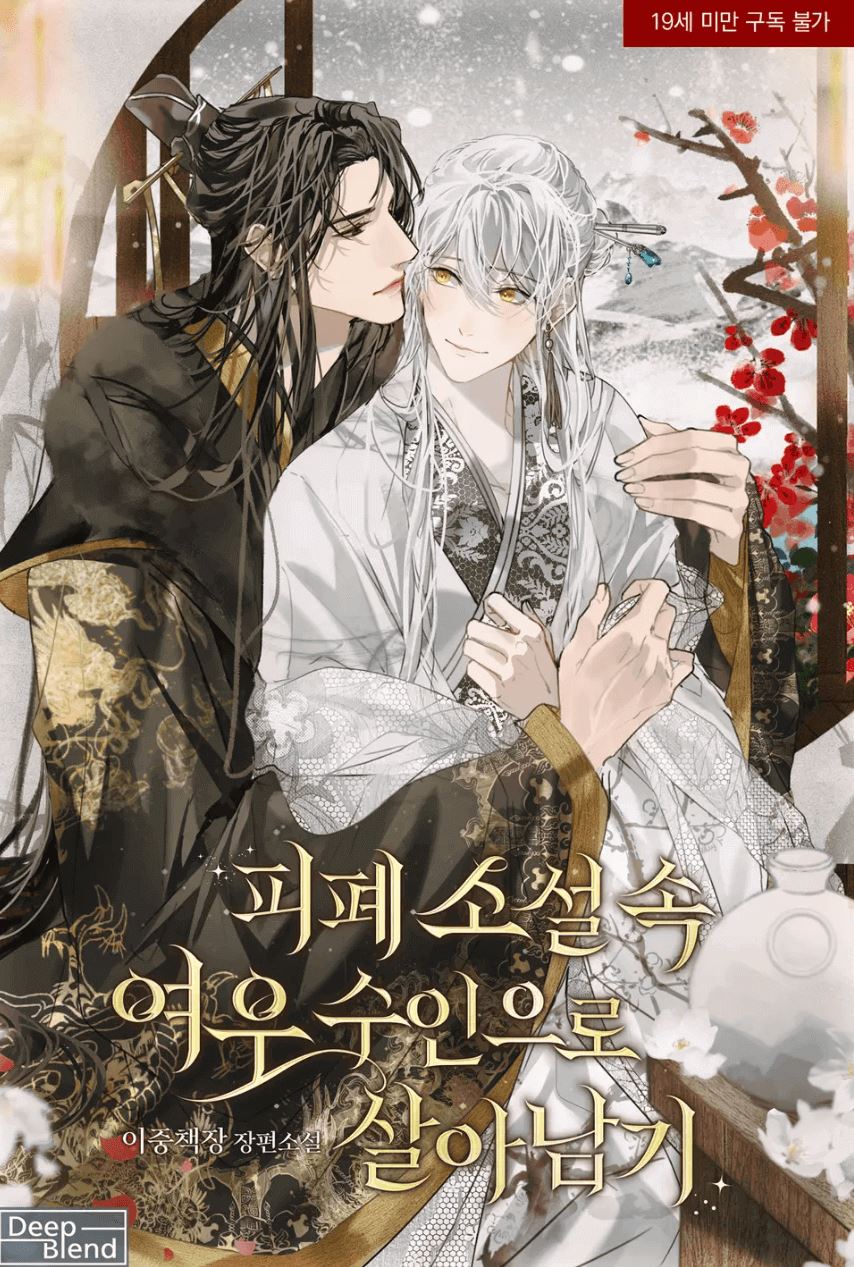
Surviving as a Fox Beast in an Abusive Novel
+Add to Custom List
Novel Info
  • Author:
  • Status:Ongoing

Summary

... Read More

A man living a lonely life in modern Korea, marked by his albinism and years of abandonment, finds solace in reading a fantasy novel titled The Way of the Gods. Hoping for a heartwarming story, he instead encounters a brutal yaoi narrative where the protagonist, Dori, a white fox beastman, suffers under the tyrannical Emperor Haban before dying tragically. Deeply moved by the shared sense of isolation and the cruel fate of the white fox, the reader falls asleep wishing for Dori’s happiness. Upon waking, he discovers he has transmigrated into the body of Dori, a white fox born into a village of red foxes who is ostracized for his unique appearance. The original Dori had been chased out of his village and dragged into the imperial palace to endure Haban’s abuse, a fate the new Dori is desperate to avoid.

Initially residing in the red fox village, Dori observes the hostility of his father, the village elder, and his twin brother Hori. He also encounters Wonwoo, a childhood friend who had promised to be Dori’s mate but instead chose to marry Hori to secure power within the village. Dori’s primary goal becomes escaping the village before the events of the novel unfold, specifically avoiding the day he is cast out and meets Haban. He attempts to build a quiet life, gathering small treasures and planning to flee after Hori’s wedding. However, Wonwoo’s behavior shifts dramatically from the original story; he becomes obsessed with Dori, rejecting Hori in favor of forcing a mate bond with the white fox. During the wedding preparations, Wonwoo breaks into Dori’s room and attempts to mark him, but the ritual is interrupted by Hori, causing the half-formed bond to fade.

With his savings stolen and his safety compromised, Dori flees the village on the night of the wedding, transforming into a fox to evade pursuit. He runs deep into the mountains, hoping to put distance between himself and the palace forces. Unbeknownst to him, he enters the exact location where the original Dori first encounters Emperor Haban. Haban, known as a cold and ruthless tyrant who purged his court upon ascending the throne, is hunting in these woods. When Haban spots the white fox, he orders his men to capture it alive, recognizing the animal as an auspicious sign. Dori, terrified by the memory of the novel’s abusive scenes, flees in panic, narrowly dodging arrows and horsemen. He collapses from exhaustion and fear just as Haban approaches.

Haban, intrigued by the rare white fox, commands that it be taken to the palace without harm. Meanwhile, back in the modern world, the original reader awakens in his bed, believing the transmigration was merely a vivid dream. He dismisses the terrifying encounters with Wonwoo and Haban as fiction. However, Dori remains in the novel’s world, captured in a cage and brought to a physician. The physician reports that the fox is suffering from snake venom and exhaustion but is recovering. Haban watches the sleeping fox with a mix of curiosity and obsession, unaware that the creature possesses a human soul. The narrative shifts between Dori’s struggle to survive in the hostile imperial environment and the reader’s mundane life, which is subtly affected by his connection to the fox. Dori’s presence in the palace sets the stage for a confrontation with Haban, forcing him to navigate a dangerous political landscape while trying to alter his tragic fate.

As days pass, Dori remains confined, cared for by a servant named Haewon who brings him food. Dori attempts to remain invisible, fearing Haban’s wrath. However, Haban’s interest in the fox grows, leading to frequent visits to the chamber where the animal is kept. The dynamic between the captor and the captive begins to shift, not through romance as in the original text, but through a complex interplay of fear, survival, and unspoken understanding. Dori realizes that simply enduring the plot is no longer an option; he must actively change his circumstances. The original story’s bad ending hangs over him like a shadow, but his knowledge of future events gives him a fragile hope. He begins to observe Haban’s patterns, looking for weaknesses or opportunities to escape the palace entirely. Meanwhile, Wonwoo, rejected and furious, vows to find Dori, adding another layer of danger to his already precarious situation. The story moves toward a tense standoff where Dori must decide whether to flee or confront the emperor, potentially altering the course of the empire and his own destiny.

Latest Release
DateGroupRelease
2026-10-03puffberry c174
2026-10-03puffberry c173
2026-10-03puffberry c172
2026-10-03puffberry c171
2026-10-03puffberry c170
2026-10-03puffberry c169
2026-10-03puffberry c168
2026-10-03puffberry c167
2026-10-03puffberry c166
2026-10-03puffberry c165
2026-10-03puffberry c164
2026-10-03puffberry c163

Community Reviews

Rating(0 / 5.0, 44votes)
5 stars
0(0%)
4 stars
0(0%)
3 stars
0(0%)
2 stars
0(0%)
1 stars
0(0%)

Popular reviews

... Read More
Let me just say this upfront: the stakes in these chapters are TIGHT and I was genuinely worried about the fox. Like, actual physical worry. When Dori is flopping onto the cushion after his tantrum, already drained from two steps and a tail flick, and Haewon is shouting about raw beef while Dori is trying not to throw up—the tension between survival and dignity is exhausting to read. On the personal level, Dori's conflict is razor-sharp. He knows the original story. He knows what happens to the fox. He knows Haewon will help him escape and then... disappear. The text says it plainly: "having read the story, he couldn't bring himself to use this young man for survival when he knew everything." That's an incredibly sophisticated moral conflict. It's not "should I escape or not"—it's "should I save myself at the cost of someone else's life, knowing exactly how it ends?" And the fact that Dori is too weak to even mount a proper escape plan because he's literally starving makes it even more agonizing. But the political stakes are what elevate this from personal drama to empire-level tension. No empress. No heir. Only two brothers left. The throne built on spilled blood. The ministers already maneuvering, sneaking children into the palace, trying to secure positions while the emperor is distracted. Every conversation between Haban and Yoon Gak carries the weight of succession. When Haban says "not only your position, but your life would be at risk," he's not bluffing—this is a world where familial love and political survival are mutually exclusive. And then there's the Haban-Dori conflict, which operates on three levels simultaneously: emotional (does the emperor care about the fox?), physical (will the fox survive neglect?), and narrative (will Dori follow the original story's plot or break free?). All three are unresolved and all three are escalating. The cliffhanger with the flipped bowl isn't just comedic—it's the moment where Dori's last act of defiance (refusing the raw meat) leads to chaos. What happens next? Does he starve? Does he eat? Does Haban find out? The stakes have never been clearer or higher.
... Read More
Let me just say this scene is cinematic as hell. You have Haban descending from his horse, his face hidden in backlight—"only the sharply defined jawline beneath the shadow was visible, and it looked chillingly cold." The author could have just said 'Haban looked scary' and moved on but no, they painted the WHOLE picture. Wind tugging at his garments, the fox's fur shimmering white, those molten golden eyes meeting his gaze. And the setting itself—the imperial hunting grounds, the mountain, the net circles around the base. This isn't just 'a forest.' The fact that Haban conducted a thorough search of the entire mountain using only his MEMORY of where something should be tells you everything about his desperation. He's been looking for something his entire life and this white fox might be the answer. Then you cut to the physician's room—"a bitter scent soon filled the room," rare herbs, the moonstone-like lamp in the corner. The contrast between the cold outdoor hunt scene and the warm (if tense) indoor medical scene is masterful. You can feel the temperature change between rooms. The author isn't just describing places, they're making you LIVE in them.
... Read More
I need everyone to pause and appreciate the absolute tragedy of Dori's internal monologue right here. This man is literally being held captive by the most dangerous person in the novel world, and his brain is going "actually... he's really handsome?" "Every feature was exquisite. Especially those jet-black eyes, even darker than the raven hair he had desperately wished for in his past life!" The fact that he's assessing HABAN'S PHYSIQUE while trapped in a cage like it's a normal Tuesday is both hilarious and heartbreaking. He's been through so much in his previous life — poverty, hardship, probably loneliness — and here he is, in a body that isn't even human, finding himself drawn to the very person who in the original story will make his life a living hell. And then the tail. OF COURSE the tail betrays him. "His excited tail puffed up and wagged lightly." Dori is literally a fox who cannot control his own body language around the man he should be terrified of. The disconnect between his brain ("he's dangerous, run") and his body ("look at those nice eyes") is peak comedy and peak tragedy simultaneously. But beneath all the humor, there's something genuinely tender here. Dori spent his whole life never having anything, never having anyone, and now here's this terrifying emperor who feeds him, cares for him (in his own twisted way), and happens to look like a romance novel cover model. The fact that Dori is at least considering "maybe I should indulge a little" shows how starved he is — not just for food, but for connection, for safety, for someone to choose him. The romance hasn't even started properly and I'm already emotionally compromised.
... Read More
'Foxes loved the cold. They loved it so much they rolled around in the snow bare-bodied.' That opening line—quoted from the original novel within the novel—is doing SO much heavy lifting. On the surface, it's just establishing lore about foxes. But read it alongside Dori's situation and it becomes devastating. Foxes love the cold. Dori is a white fox in a red village. He doesn't just endure the cold—he belongs to it. While every other fox is warm in their fur, socialized, celebrated, married off to suitable partners, Dori is the one who rolls in the snow unbothered because he has nowhere else to be. The cold isn't punishment; it's home. And that's the tragedy—the world rejected him so thoroughly that rejection became his natural habitat.
... Read More
The color symbolism in this opening is so deliberate it's almost aggressive. Dori is white in a village of red foxes. The reader is pale in a world of dark-haired, dark-eyed people. Both exist in spaces where their very bodies mark them as outsiders. The white fur isn't just a physical trait — it's a metaphor for the kind of difference that can't be hidden, can't be disguised, can't be tolerated by a community that values uniformity. But here's the thing: the cover of the original novel shows Dori as beautiful. 'A snowy white mountain in the background, with a white fox sitting gracefully.' The white is meant to be admired, romanticized even. But inside the story, that same whiteness is what makes Dori unwanted. The contradiction is the point — beauty and difference are treated as separate things by the characters in the story, but the narrative knows they're the same thing. The ice motif is also significant. Dori sees his reflection in frozen water — the white fox looking back at him. Ice is both beautiful and dangerous, and it's the boundary between states (solid/liquid). Dori is in a similar state of transition: between human and fox, between reader and character, between the original story's fate and a new possibility. The stolen items — the blue silk robe and the emperor's bracelet — these are symbols of status and identity. Dori is literally wrapping himself in borrowed authority, trying to construct a person he's allowed to be. The fact that these are the exact items that get him caught is poetic justice: you can't escape your designated role by wearing someone else's clothes. And the den itself — cracked bowl, dwindling food, dry leaves — mirrors Dori's internal state. It's a space of survival, not living. But Dori chooses to stay and fight rather than flee further. The den becomes a starting point, not an ending. What really ties all this together is the question the story keeps asking: what makes someone worthy of happiness? Dori's whiteness shouldn't disqualify him. The reader's appearance shouldn't disqualify them from love. The story seems to be arguing that worth isn't earned through conformity — it's inherent, and the tragedy is that the world refuses to see it.
... Read More
I need to talk about the visual storytelling here because WOW. The author paints this scene with such deliberate color contrast that it practically films itself in your head. You've got Hori's RED wedding robe against Wonwoo's BLUE, and then—bam—Dori in all-white fur standing on a grey rock, looking like a ghost haunting his own sister's happiness. The contrast isn't accidental. Red means celebration, life, warmth. White on Dori? It's isolation. Purity turned into a curse. 'White fur is pretty too…' he thinks, and it's one of the saddest sentences in the entire text because he's not vain—he's just lonely, and he knows his whiteness marks him as different, as unlucky.
See all reviews

Custom lists

See all custom Lists