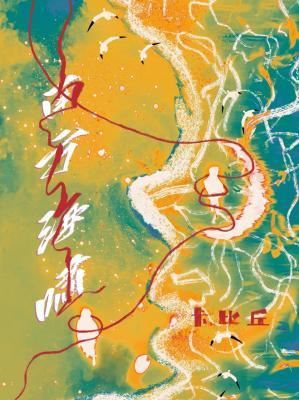
Let me just say this out loud: Zhao Jing is the most dangerous person in this novel and he does not even know he is dangerous. He is lying on top of Wei Jiayi, heavy and warm and obedient in the way that makes you forgive him for everything, and he casually drops the word marriage into the conversation like it is a routine purchase he is making at a market. Not a proposal. Not even a question. Just: I already saw what you were hiding. I already made a decision. I do.
The relationship dynamic between these two is built on a foundation of asymmetry that the chapter exposes with brutal clarity. Zhao Jing has everything — wealth, social position, emotional freedom, the ability to act on impulse without consequences. Wei Jiayi has none of those things, or at least he believes he does not. He is the one who stays sober, who calculates, who worries about endings before beginnings. Zhao Jing is the one who assumes permanence because he has never experienced impermanence.
What strikes me most is how Zhao Jing's innocence functions as both weapon and vulnerability. He is genuinely happy. He genuinely believes they are on the same page. He genuinely does not understand why Wei Jiayi is panicking. And that innocence is not performative — it is structural. Zhao Jing has never been forced to consider that love might be conditional, that wealth might be withdrawn, that the person who dotes on you today might dismantletoday tomorrow. The anecdote about the luxury brand dinner is not random background detail. It is Wei Jiayi's thesis statement: love in this world is provisional, enforced by contract, revoked by power. Zhao Jing has the power. Wei Jiayi has the fear.
But the chapter also reveals Zhao Jing's own vulnerability, though he would never name it. He cancels his own ring order. He lets Wei Jiayi believe he is the one planning the surprise. He sits in the dark waiting for words that may never come. He is not invincible — he is just protected by a fortress of privilege that Wei Jiayi can see through but cannot enter.
Their physical intimacy in this chapter is also deeply meaningful. Zhao Jing is obedient when Wei Jiayi pushes him away. He stops immediately. He does not press, does not demand, does not override consent. This is not the behavior of someone who dominates — this is the behavior of someone who has learned, somehow, to yield. And yet he yields in a way that still controls the narrative. He lets Wei Jiayi think he has agency while Zhao Jing has already made every decision that matters.
The guesthouse flashback is the key to understanding Zhao Jing's character arc. As a younger man, he was annoying, spoiled, demanding comfort without knowing how to ask for it. He poked at Wei Jiayi in chat without speaking, waiting to be pursued. Now he is still that person, but the dynamic has inverted — Wei Jiayi is the one being pursued, and he is terrified of arriving.
What makes their relationship compelling is not that they are matching each other perfectly. It is that they are misaligning in ways that reveal exactly who they are. Zhao Jing loves openly because he has never been forced to love carefully. Wei Jiayi loves cautiously because he has watched love fail spectacularly in front of him. Neither is wrong. Both are trapped.