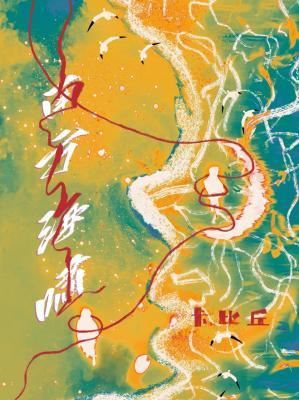
Let me talk about pacing because this chapter is a textbook example of how to control reader engagement through strategic compression and release. The chapter opens at a deceptively casual velocity — a phone call, some physical affection, a touch of guilt about university finance classes. Nothing is happening yet. Nothing urgent. Just two people existing in the same space, which is precisely how the author lulls you before the drop.
The first structural shift happens when Zhao Jing abruptly ends the call and presses Wei Jiayi back down. This is not a violent action — it is an emotional one. The casual domesticity fractures, and the chapter enters a new mode. Physical intimacy follows, but it is not eroticized in the traditional sense. It is exhausting, almost mechanical, a way of saying what cannot yet be said in words. Wei Jiayi is drained. Zhao Jing is obedient. The scene ends not with satisfaction but with depletion.
Then comes the real pivot: I'm leaving at six tomorrow morning. This line functions as both temporal marker and emotional detonator. It creates urgency where there was none, establishes a deadline where there was only endless now. The reader, like Wei Jiayi, suddenly realizes that time is finite and the conversation has not happened yet.
The pacing of Zhao Jing's revelations is meticulously controlled. He does not dump everything at once. He drips information like water through a cracked vessel: I already saw what you were hiding. Actually, I ordered one for you too. For our wedding, all we need is a single pair of rings. I do. Each statement is a new wave, and each wave pulls Wei Jiayi — and the reader — deeper into panicked clarity.
The middle section, where Wei Jiayi's mind drifts to the guesthouse and the luxury dinner, serves as a deliberate tempo reduction. It is the calm before the structural collapse. These memories slow the chapter down, allowing the reader to breathe, to contextualize, to understand why Wei Jiayi's heart is racing at the speed it is. Without this passage, the panic would feel unmotivated. With it, the panic feels inevitable.
The final movement — Wei Jiayi turning on the light, seeing Zhao Jing's face, feeling the impossibility of explanation — is where the pacing accelerates again. The chapter does not drag to its conclusion. It falls into it, like a stone dropped down a well, hitting bottom with a sound that reverberates long after the chapter ends.
What makes this structure work is that the author understands something most writers miss: tension is not created by events piling up. Tension is created by the gap between what the reader knows will happen and what the characters are able to say. This chapter stretches that gap to its breaking point.