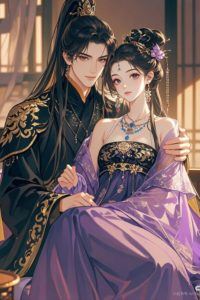
"The lively, clever lamb was far more interesting, far more charming than this meek facade. The Duke's household didn't even realize how precious a gem they'd lost—a bunch of blind fools."
This line — spoken by Lin Zhuo as he watches Ruan Mianmian perform weakness for the Duke's family — is honestly the thematic key to everything that's happening in these chapters. It's about performance. About the masks people wear to survive. About who gets to see behind the mask and who doesn't.
The "little white flower" motif appears again and again. Ruan Mianmian describes it herself: "Pure and gentle little white flowers—so weak and fragile in the wind, just begging to be pitied." She adopted this persona to protect her family in the Duke's manor. She had to appear harmless, pitiable, insignificant. And the Duke's household fell for it completely — they saw a fragile girl and never once considered that she might be the most dangerous person in the room.
But Lin Zhuo sees her. From the beginning, he's recognized the performance. On their wedding night, she "dared to drop the act" — and he noticed. He noticed the lively, spirited lamb underneath. And now, watching her perform once more, he feels irritation, not because he minds the strategy, but because the Duke's household is still too blind to see what they've lost.
The fox is the second animal metaphor, and it's equally loaded. Foxes are cunning, adaptable, survival-minded creatures. They wear many faces. Ruan Mianmian is a fox — she knows how to navigate hostile environments, how to read people, how to turn apparent weakness into actual power. Her scheme to get her family out of the Duke's house while appearing to be a powerless, devoted wife is pure fox behavior.
There's also the lamb imagery, which is interesting because it's Lin Zhuo who calls her a lamb. Not a fox — a lamb. This suggests he sees something else in her too: vulnerability, innocence, something worth protecting. The fox and the lamb coexist in her, just as the white flower and the lamb coexist. She's not one thing; she's all of them, and she deploys each one strategically.
The deeper theme here is about authenticity in a world that demands performance. Ruan Mianmian has spent her entire life pretending to be someone she's not — first as a village girl in the Duke's household, then as a delicate flower in the prince's residence, then as a pitiable daughter-in-law at the Duke's mansion. The question the text keeps asking is: who gets to be real, and with whom? The answer seems to be: only with each other. Their marriage is the one space where the performances drop, where they can be the fox and the lamb and the strong woman who pounded grain with the boys.
And the Duke's household? They're the "blind fools" who mistook performance for reality. They lost a gem and never even knew it was gone.