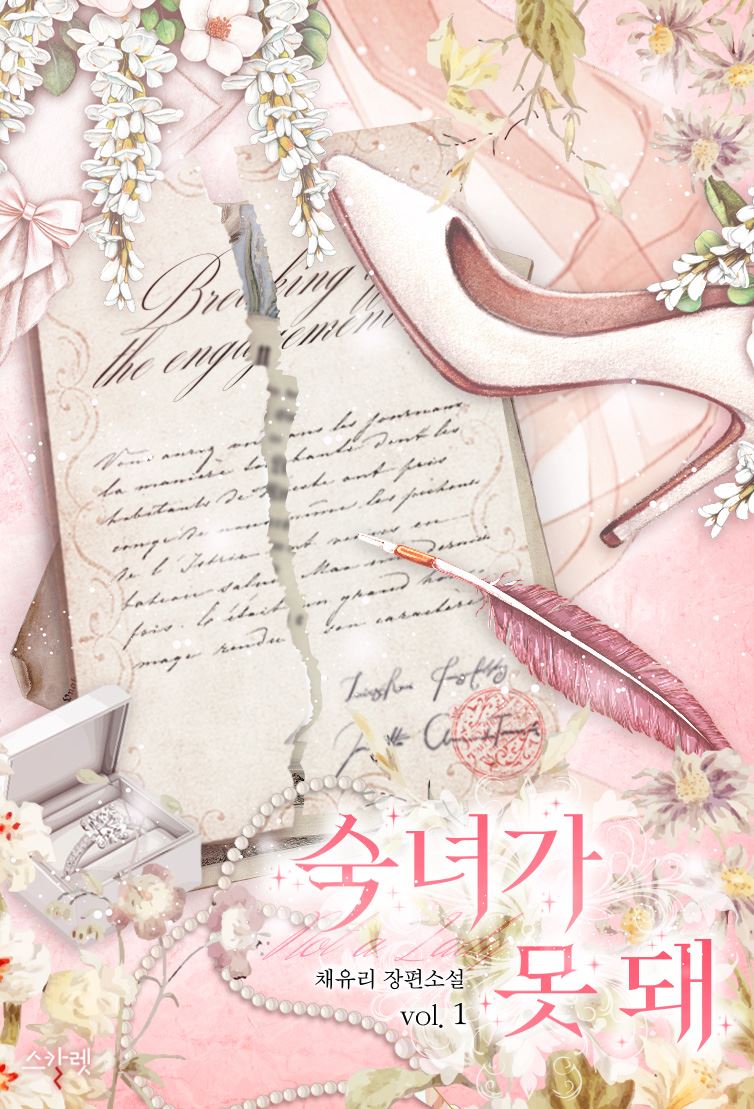
Not a Lady
+Add to Custom List
Genres:
Novel Info
  • Author:
  • Status:Ongoing

Summary

... Read More
Ariesha Verdía is the eldest daughter of a wealthy count family in the Kingdom of Eurasia. She possesses extraordinary beauty and refinement, traits that have made her the envy of noble society and the subject of many marriage proposals. Nine months prior to the current timeline, she becomes engaged to Zilcheck Zipchak Goldfork, one of the four great dukes of the kingdom. The union is viewed as a magnificent opportunity for the Verdía family, who see it as a strategic stepping stone to elevate their social standing and secure favorable marriages for Ariesha’s younger siblings. However, despite his impeccable status and outward courtesy, Zilcheck proves to be a controlling and manipulative man. He dictates Ariesha’s clothing and appearance, dismissing her personal preferences as irrelevant. His affection is conditional upon her compliance with his image of a delicate, submissive wife.The engagement reaches a critical breaking point at a royal ball held shortly before the wedding. Zilcheck subtly drugs Ariesha’s drink, rendering her dizzy and disoriented. Under the pretense of protecting her, he attempts to drag her away to a private sitting room, ignoring her pleas for help and her clear refusals. Humiliated and terrified, Ariesha grabs the sleeve of a passing stranger to escape. This man, characterized by black hair and blue-violet eyes, pretends to be a distant relative and successfully extracts her from Zilcheck’s grasp. He escorts her to her carriage with polite detachment, ensuring she reaches home safely. Before losing consciousness, Ariesha catches only a glimpse of his face and desperately wishes to know his name, but he departs without revealing his identity. She wakes the next morning with fragmented memories and no recollection of the man’s name or family.Upon regaining her composure, Ariesha resolves to break the engagement. She confronts her parents, recounting Zilcheck’s assault, but they dismiss her claims. Count Verdía has already accepted Zilcheck’s explanation that the incident was a momentary lapse due to repressed desire and his eagerness to finalize the union. Her father insists she accept the apology and move past the event, treating her distress as ingratitude rather than trauma. Realizing she cannot rely on her family or the legal system, Ariesha devises a plan to make Zilcheck lose interest voluntarily. She adopts a radically different persona, appearing in public as a fashion disaster with exaggerated makeup and erratic behavior. She publicly berates servants, demands expensive jewelry, and acts with vulgar unpredictability. Zilcheck, shocked by this departure from her gentle facade, begins to view her as a liability.Ariesha further manipulates the situation by bribing a fortune teller to predict that her greed and spending habits will lead to Zilcheck’s financial ruin. The prediction plants seeds of doubt in his mind. However, her actions are observed by Raymon Reflect Rivers, the Marquis Rivers. Raymon, who had previously felt an inexplicable attraction to Ariesha, becomes increasingly concerned by her distress. He witnesses her strange behavior and senses the underlying tension, suspecting that her changes are a reaction to Zilcheck’s treatment rather than a inherent personality shift. Raymon attempts to intervene, offering her kindness and gifts tailored to her known preferences, but his own behavior becomes erratic due to his overwhelming attraction to her beauty, causing him to pull away abruptly when physical contact occurs.The narrative explores the contrast between Ariesha’s desperate struggle for autonomy and Raymon’s confused admiration. While Ariesha battles to escape a dangerous marriage, she finds herself drawn into a complicated dynamic with Raymon. He offers her a semblance of safety and understanding, yet his own inconsistent actions leave her bewildered. As the pressure from Zilcheck and her family mounts, Ariesha continues her campaign of sabotage, unaware that Raymon is gathering information about her past and the circumstances surrounding the ball. The story sets the stage for a confrontation where Ariesha must decide whether to continue her dangerous game alone or trust the enigmatic marquis who seems to see beyond her performed madness.

Latest Release
DateGroupRelease
2026-10-03dusk blossoms c18
2026-10-03dusk blossoms c17
2026-10-03dusk blossoms c16
2026-10-03dusk blossoms c15
2026-10-03dusk blossoms c14
2026-10-03dusk blossoms c13
2026-10-03dusk blossoms c12
2026-10-03dusk blossoms c11
2026-10-03dusk blossoms c10
2026-10-03dusk blossoms c9
2026-10-03dusk blossoms c8
2026-10-03dusk blossoms c7

Community Reviews

Rating(0 / 5.0, 36votes)
5 stars
0(0%)
4 stars
0(0%)
3 stars
0(0%)
2 stars
0(0%)
1 stars
0(0%)

Popular reviews

... Read More
I laughed out loud at the tarot café scene. Actually laughed. Ariesha bribes a fortune teller, puts on a show, and watches Zilcheck slowly digest his own doom card by card. The humor is so dark it loops back around to being absolutely brilliant. "Have you ever heard the saying, 'when the hen crows, the household falls'?" That line. That is the fortune teller speaking and Ariesha is standing right there listening. Zilcheck is getting read for his entire future — financial ruin, a wife who consumes wealth, Death as the final card — and the woman running the reading is a COCONSPIRATOR. She even slips out quickly and exchanges a quiet glance with Ariesha while Zilcheck is too busy spiraling to notice. This is a heist. A heist against a man's confidence. But beneath the comedy there's something genuinely heartbreaking. Ariesha has rewritten herself from a trembling fiancée into a woman who can look Zilcheck in the eye and ask for a ruby necklace like it's nothing. Watch her performance when she says: "Oh, it's gorgeous! I'm absolutely in love with it. What do you think?" She loops her arm through his. She's playing the gold-digger. But she's also testing him — can he still be fooled? And he almost is. Almost. He stares blankly for a moment, confused, because the old Ariesha never asked for anything. The system has glitched. Later at the restaurant she clears every plate. The narrator tells us directly: "On any other day she would have eaten barely half, keeping up the modest pretense. Today was different." Something shifted inside her. She stopped performing modesty and started performing greed — but the eating, the eating feels real. That's the detail that gets me. A body that spent years shrinking itself finally remembers what hunger feels like.
... Read More
I need to sit with this for a moment. The image of Ariesha standing before the mirror, examining her own face like she's appraising merchandise — 'a classic beauty, the pure and fragile type' — and then deciding that this beauty is the very thing that will destroy her? That hits different. She spent her whole life being told she was precious, and now she realizes she was precious the way a vase is precious: beautiful, breakable, and meant to be placed somewhere someone else chooses. The confrontation with her parents is where everything fractures. Not because they're evil — because they're normal. They loved her. They really did. But their love came with an instruction manual and she violated every page by having opinions. 'Those tears were… crocodile tears.' This line stopped me cold. She's crying in her mother's arms, and the narrator tells us it's not real. But what IS real? The fear? The grief? The understanding that no matter what she does, she was never going to be their daughter first — she was always going to be their investment? And then the transformation. Oh god, the transformation. Watching her deliberately make herself uglier, louder, more unbearable — this isn't just strategy, this is mourning. She's killing the girl her parents loved and the man desired, because that girl was never going to be allowed to survive. The moment she says 'From this moment on, you're reborn as the off-putting disaster woman!' — that's not comedy. That's a girl signing her old self's death certificate. The ending leaves me breathless. She smiles at her reflection in the carriage mirror. 'Exactly as expected.' The maid is miserable. Ariesha is satisfied. What kind of satisfaction is that? How do you comfort yourself with the knowledge that you have to become someone horrifying just to be free? I keep thinking about that smile and I can't shake it.
... Read More
This batch moves like a freight train and I cannot complain. We open mid-crisis — less than a month to the wedding, Ariesha needs to confront her parents, already establishing the ticking clock. Then BAM: the overheard conversation. The stakes go from 'I don't want to marry him' to 'my entire family has calculated my worth and I am inventory.' That escalation is seamless. The confrontation with her father is short but perfectly paced. No drawn-out speeches, no dramatic declarations — just the cold, bureaucratic violence of a man who says 'You will accept his apology graciously' like he's discussing weather arrangements. Then Ariesha's internal pivot: 'Zilcheck, you coward. You knew you couldn't change my mind, so you went to Father first.' This is where the story shifts from reactive to proactive, and the transition feels earned because we've seen her think through the problem. 'Fifteen days remained until the wedding.' That sentence is a full paragraph on its own and it does more work than most chapters. It resets the clock, redefines the stakes, and gives us a deadline that makes everything feel urgent. What I love about the pacing here is how the author lets moments breathe. The mirror scene where Ariesha practices swearing takes time — we watch her fail repeatedly, and it's funny but also painfully human. She's trying to learn a language she was specifically raised not to speak. Then the parlor scene moves at a completely different speed: rapid-fire actions, smashed cake, trembling Dinah, Zilcheck's confusion, Ariesha's gag — it's a whirlwind that leaves you breathless. And the chapter structure itself is brilliant. Each section ends on a note that propels us forward: 'A bad feeling crept in,' 'fifteen days,' 'a smooth start,' 'keep this up until the wedding.' The father's closing line is especially devastating because he thinks he's won. He has no idea the enemy is already inside his house, destroying everything from within.
... Read More
This book is full of symbols that operate beneath the surface, and two of them keep coming back to me: the golden carriage and the rose quartz necklace. Let me unpack both because they are doing heavy lifting here. The opening line—“Out with the dung cart, in with the golden carriage”—is not just a joke about romance tropes. It is the thesis statement of the entire passage. Ariesha believes that trading one bad situation for a better one will solve her problems. She thinks the carriage itself is the solution, not the driver. But Raymon is not a golden carriage. He is a man trapped inside his own head, unable to drive straight, swerving between warmth and recoil. The symbol breaks down the moment she steps into the vehicle. Then there is the necklace. Ariesha tells Raymon about her rose quartz necklace and how her sister Ailee always asks to borrow it. “Once something has passed through someone else's hands,” she says, “it doesn't feel like mine anymore.” This is not just about jewelry. This is about intimacy, about touch, about the boundary between self and other. Raymon is the one who cannot let anything pass through his hands without recoiling, and yet he is the one who wants to hold on the tightest. The necklace becomes a metaphor for the relationship itself: Ariesha wants to give Raymon access to her life, to her proximity, to her touch, but every time she does, he flinches as though the very act of receiving it contaminates him. There is also the recurring motif of doors. The passage opens with Ariesha walking toward the Rivers residence, stepping across a threshold. It ends with her being pushed through a doorway that slams shut between them. The door is the physical manifestation of Raymon's emotional boundary: close enough to touch, far enough to remain safe. And the tea service itself—the caramel-topped milk tea, the crepe cake, the hibiscus drink—these are all artifacts of a relationship built on observation and memory rather than mutual understanding. He remembers what she likes. She does not yet know what he needs. The deepest symbol, though, is the hand. Hands reach out, hands are pulled away, hands grip tightly, hands slam against wood. Every physical contact in this passage is charged with meaning. The hand that touches a cheek and then recoils. The hand that is seized and held. The hand that kicks a door. These are not just gestures. They are the language of two people who cannot find words but cannot stop reaching.
... Read More
Okay so I need to talk about Zilcheck because THIS MAN. The scene where he drags Ariesha into that alley and pins her against the wall?? My blood boiled. Like, yes he is stressed about the engagement and whatever backstory is going on, but grabbing a woman by the wrist, forcing her into a corner, threatening to make love to her RIGHT THERE on the street—this is not romance, this is a crime in progress. And the worst part? Ariesha actually calculated this. She wanted him to explode. She wanted him to cancel the engagement so badly that she played the spoiled brat, stained her own dress with sauce of all things, and let herself get talked into buying three dresses just to push him over the edge. That is some next-level desperate energy right there. But here is what really got me—it is Zilcheck himself who accidentally exposed the whole thing. He says "Don't tell me you were doing this on purpose. Trying to make me break the engagement." BAM. Direct hit. And Ariesha's face completely drains. For a second there I thought she was done for, but she recovers fast with the stiff cheek scratch and that pathetic "Th, that's right." The acting is IMMACULATE. This woman could win an Oscar. And then Zilcheck says "Then sleep at my estate tonight. If you mean what you say, I need to have you tonight." Which is honestly so manipulative on his part too—he is using intimacy as a test, like if she refuses then she's clearly plotting against him. It is a lose-lose situation for Ariesha no matter what she does. I was genuinely sweating reading that. Meanwhile, across town, Raymon is sitting at a restaurant pretending to eat while internally screaming about a girl he met drunk. The fact that he remembers THE DETAILS—her emerald eyes trembling, her hair brushing his neck, the scent—is so telling. He literally cannot stop thinking about her and he is furious about it. "A connection remembered by only one side. It was nothing." NO IT IS NOT NOTHING, RAYMON YOU ARE BLIND. The moment Edwin tells him she has a fiancé and it is THAT man—Zilcheck—the realization hits Raymon like a truck. He basically ran to help a woman who was already betrothed without knowing it, and now he has to sit with the fact that his heroic moment was technically interference in someone else's relationship. And yet—had he known, would he still have done it? His silence says everything.
... Read More
The dialogue in this section is absolutely vicious and I mean that as the highest compliment. Every character sounds exactly like who they are, and the gap between what they say and what they mean is where the real writing lives. Count Verdía's voice is the masterpiece here. 'As it happens, His Grace came by early this morning. He said he would like to move the wedding forward by about two weeks, if we had no objection. Ha ha, His Grace must be quite taken with you.' This sounds warm. It sounds like a proud father. But the subtext is a gun pressed to his daughter's temple. He's announcing that he already agreed to accelerate the wedding while she's still in the room, and he does it with a laugh. His escalation is perfectly calibrated: 'You are my daughter. It is your duty to marry the man your father and head of this household has chosen for you. How dare you speak back to me.' No raised voice. No physical threat. Just the quiet, surgical removal of her agency through words alone. Zilcheck's dialogue is equally revealing. 'You look fine, Ariesha. I was worried you'd still be suffering from the hangover today after drinking so much yesterday.' He comes in playing nice, but there's this predatory undertone — he knows something happened, he's testing her, he wants to see how far he can push. And then: 'Don't tell me she has... a mean drunk streak?' That question is so casually cruel. He's framing her survival strategy as a character flaw. But the dialogue gem of the entire batch is Ariesha's performance. 'Oh, my, why is there soufflé cake on the floor? ... I truly don't know what Your Grace is referring to.' The deliberate innocence, the feigned amnesia, the way she uses the language of nobility as a weapon — this woman is an actress and she just auditioned for her role. The most chilling line though? 'just two more weeks and I'll be a duchess. I've been waiting so long for this day... urgh.' The giggle, the hand over the mouth, the physical gag. She's literally vomiting on the concept of her own future and calling it laughter.
See all reviews

Custom lists

See all custom Lists