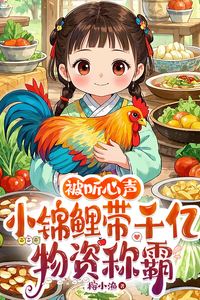
Inner Voice Revealed: Little Lucky Koi Dominates with Trillions in Supplies
Novel Info

Summary

... Read More

Song Tiantian, a modern woman, dies after falling from a cliff while hiking. She awakens in a metaphysical Wishing Space overseen by a giant rooster steward. The space contains unlimited resources, including vaults for gold, weapons, vehicles, and sentient animals, as well as fields that produce ten thousand jin of crops monthly. Tiantian uses three free wishes to gain eternal youth, a constitution of endless good fortune, and the ability to communicate with animals. She queues additional wishes for beauty, strength, martial arts, medical expertise, and mind-reading, which unlock as she earns currency in her new life. She transmigrates into the body of a newborn girl in the Song family of Liuhua Village, a poor coastal fishing community in the Yunyuan Kingdom.

The Song family has gone eight generations without a daughter, causing great distress to the matriarch, Madam Zhou, who desperately wishes for a granddaughter to dote on. When Song Tiantian is born, she smiles instead of crying, and the sky fills with auspicious colorful clouds. The family discovers they can hear her inner thoughts during her infancy. Her presence immediately brings supernatural luck: the family’s fishing hauls triple, and their poultry lay eggs out of season. The household, previously strained by poverty and gender bias, unites in adoration of the child, whom they nickname Little Sweet Treasure.

Recognizing the family’s financial struggles, Tiantian guides her grandmother to introduce innovative fish dishes, such as spicy grilled grouper and mackerel dumplings, using secret seasonings supplied by a clone robot disguised as a southern traveling merchant. Madam Zhou takes the dishes to the largest restaurant in town, Kelaixiang, where the manager is impressed by the unique flavors. The restaurant purchases the recipes for ten taels of silver each and buys the secret spices for eighteen taels, generating a profit of fifty-five taels in a single day—more than the family’s annual income. This success transforms the Song family’s economic status, allowing them to buy fine rice, flour, and fabric, and ending their constant struggle for survival.

As the family prospers, Tiantian plans further agricultural innovations, suggesting the cultivation of sweet potatoes, a crop unknown in this era. The family trusts her implicitly, planting ten mu of land with the new crop. The narrative establishes Tiantian’s role as the family’s lucky star and strategic mastermind. She navigates the dynamics of a large, multi-generational household, using her mind-reading ability and verbal compliments to win over skeptical relatives, particularly the jealous second daughter-in-law, Madam Zhang. The story focuses on the gradual elevation of the Song family from poverty to wealth, driven by Tiantian’s modern knowledge and the supernatural advantages of her Wishing Space, while she prepares to accumulate the wealth necessary to unlock her remaining wishes and secure her power in this new world.

Latest Release
DateGroupRelease
2026-08-11shanghai fantasy c64
2026-08-11shanghai fantasy c63
2026-08-11shanghai fantasy c62
2026-08-11shanghai fantasy c61
2026-08-11shanghai fantasy c60
2026-08-11shanghai fantasy c59
2026-08-11shanghai fantasy c58
2026-08-11shanghai fantasy c57
2026-08-11shanghai fantasy c56
2026-08-11shanghai fantasy c55
2026-08-11shanghai fantasy c54
2026-08-11shanghai fantasy c53

Community Reviews

Rating(4.2 / 5.0, 13votes)
5 stars
6(46%)
4 stars
4(31%)
3 stars
3(23%)
2 stars
0(0%)
1 stars
0(0%)

Popular reviews

... Read More
There's something really interesting happening beneath the surface of these chapters, and I think it's about voice. Song Tian'er is a baby. She has no power in the traditional sense—no money, no status, no physical ability. But she has something far more dangerous: she can speak her thoughts aloud, and everyone can hear them. In a family hierarchy where women and children are supposed to be seen and not heard, she literally cannot be ignored. Her voice forces everyone to listen, to act, to change. The fish recipes are symbolic too. The family has been eating fish the same way for generations—stewed, steamed, boring. Song Tian'er introduces them to something new, something exciting, something that makes them feel alive. It's not just about money. It's about breaking out of a cycle of subsistence and dreaming bigger. "Our family is going to get rich," Madam Zhou says, and it's delivered with this almost religious conviction. The little granddaughter isn't just a business consultant—she's a goddess, a symbol of hope in a world that's been harsh and limiting. But the most subtle theme is about kindness as currency. Zhang starts off jealous and sour, but one genuine compliment from Song Tian'er transforms her completely. "Once the fourth sister-in-law finishes confinement, I'll teach you how to take care of your hair." That's not just plot—it's a statement about how a single act of kindness can rewire human relationships. And then there's the clone robot thing. A high-tech AI posing as a southern salesman in an ancient farming village. The juxtaposition is absurd, but it also raises a question: what counts as 'real' help? Does it matter that the spices come from a machine in a space dimension, as long as they feed the family?
... Read More
Okay, I need to talk about this one moment because it completely wrecked me. Old Master Song taking Little Sweet Treasure into his arms and just... breaking down. He's been the head of the household, carrying the weight of eight generations of poverty on his shoulders, worrying every year whether they'd have enough to eat. And then this tiny child shows up and changes everything. The scene where he says "Thank you for making sure we'll never go hungry again" and tears well up in his eyes—not from sorrow, but from overwhelming joy—I literally had to pause and stare at the ceiling for a minute. And then Little Sweet Treasure just giggles and wipes his tears. That image. A tiny hand wiping an old man's face. I'm not crying, you're crying. The whole family dynamic is so warm too. Grandma Zhou immediately deflecting his emotional moment by telling him not to scare the kid. The way everyone rallies around when Old Madam Zhou faints from shock—panic, then Old Master Song staying calm and directing everyone. That's a family that loves each other, not just surviving together but genuinely caring. Even the joke about Tianbao becoming her grandmother's grandmother instead of the other way around had me laughing out loud. The emotional whiplash from tears to comedy to pure disbelief is what makes this chapter hit so hard.
... Read More
Let me just say this: the food descriptions in this book are not fair. I was literally hungry while reading Chapter 8. "The fish had a spicy, numbing flavor... The meat was fragrant, with a numbing and spicy taste that stimulated the palate." And then the side dishes—"Cooked in the chili oil, they were spicy, numbing, and fragrant." I'm not exaggerating when I say I could practically taste this through the screen. The author really understands how to make a scene come alive through sensory detail. But it's not just food. The worldbuilding is quietly impressive. You get these little details that ground the story: the heavy taxes, the six baskets of fish sold just to buy white flour, the fact that only villages within ten miles of the coast have access to seafood markets. The Song family isn't just randomly poor—it's a specific kind of poor, shaped by geography and economics. The scene where Madam Zhou hurries outside to wait for the southern traveling salesman is one of my favorites. You've got this rural farming family, generations of people who've never thought about commerce, and suddenly they're doing market research. The contrast between their usual world and this new entrepreneurial impulse is hilarious and touching at the same time. "This uses way too much oil. Look, it's all red oil on top." — Old Master Song, probably squinting at the dish like it offended him personally. Classic. The atmosphere shifts from a tense family dynamic (Zhang's jealousy, the old madam's suspicion) to something warmer and more collaborative. By the end of these chapters, the whole household is united around Little Sweet Treasure's vision. That emotional arc is wrapped into the scene work beautifully.
... Read More
I love a good conflict, and this book delivers it in layers. On the surface, it's a family trying to survive—taxes are heavy, fish vendors are scammers, and they're one bad harvest away from disaster. But the real tension comes from the interpersonal dynamics. Zhang's jealousy toward Liu is so real. You can feel it in every interaction: the forced smile, the sour tone, the way she softens only after being complimented. That's not just background flavor—that's the kind of detail that makes family drama feel lived-in. Then there's Old Master Song, the ultimate skeptic. "What is all this? What's it for? Why buy so much?" He's the voice of reason in a household that has collectively lost its mind over a toddler. And honestly? I'm on his side sometimes. Buying spices from a mysterious southern salesman, experimenting with cooking methods no one has heard of, planning to sell recipes to restaurants—it's risky. Like, what if it fails? What if they lose the little money they have? The stakes keep rising too. It starts with "maybe we can sell some fish at a better price" and escalates to "when we have money, we'll open a restaurant." Each step feels earned because the food actually works. Old Master Song himself admits it's delicious. That's the author being smart—every escalation is backed by proof, so the stakes feel real, not manufactured. And the sons! "I can't do this, I don't know how to talk." Two grown men who've never done business being sent to promote food. The comedy of errors is palpable. I genuinely worried for them. The suspense is maintained well because we know the baby has a long-term plan (the restaurant, the empire), but we also know the family has no idea. That dramatic irony keeps you reading—will they figure it out? Will it work? What happens when they do?
... Read More
I need to talk about the sensory world-building in this because the author is quietly incredibly good at it without ever stopping to give you a textbook description of the setting. Let me just... walk through the lunch scene because it's basically a masterpiece of domestic atmosphere. Old Madam Zhou is cooking alone while everyone else is in the fields. The firewood in the big stove crackles. She heats lard in the hot pan, tosses in sliced pork belly, stir-fries until the fat renders, then adds cabbage. She soaks vermicelli in hot water. She mixes cornmeal and white flour and sets the dough to rest in a warm spot. She sticks cornmeal patties around the edge of the pot. In another big pot, chopped sweet potatoes and water with a handful of millet. And next to the fire, she's roasting dried chilies that were harvested last autumn and hung in red bunches from the eaves. Do you understand what the author did here? In about four paragraphs, we went from a cold, hungry peasant existence to this warm, aromatic, almost cinematic kitchen scene. The red bunches of dried chilies hanging from the eaves—that's a visual I will not forget. It's such a specific, grounded detail that tells you everything about this world: the seasons, the preservation methods, the rural northern Chinese setting, the passage of time. And the sweet potato soup, which is apparently a new thing for them because sweet potatoes haven't reached the Central Plains yet? That's world-building through food, which is honestly the best kind. Then there's the field scene where Old Man Song leads the whole family to work the fields in April, "full of confidence," with spring flowers blooming. The contrast between the earlier hardship and this moment of agricultural optimism is everything. And the village gossip scene—villagers talking about the Song family's sudden luck, the colorful clouds in the sky, the chickens and ducks laying eggs daily, the fish traps always full. All of these details layer together to make this world feel lived-in and real, not like a generic historical backdrop. The spiritual spring water detail is interesting too—100% survival rate for the sweet potato seedlings because they were soaked in it. The author never over-explains the magic system, just drops these small supernatural elements into an otherwise very grounded, tactile world. It works because the world feels so real that the magic doesn't need to shout to be believed.
... Read More
I need to talk about the tension in this section because on the surface it's just a family planting sweet potatoes, right? But the stakes are actually enormous and the author never lets you forget it. Let's be clear about the context: this is a peasant family in an era where grain is incredibly precious. Old Man Song is literally replacing their staple crop with something nobody has ever seen before. The tofu seller, who means well, says it straight: "What if it fails or can't be sold?" The text explicitly tells us: "If it didn't yield or produced too little, and their families ran out of food, what would they do?" This isn't a business decision, this is a survival decision. Fifteen mu is their family's food for a whole year. He's betting everything on a root vegetable from the south that a random peddler brought to town. And yet he does it. Because he tasted the sweet potato and he believed. The villagers think he's gone mad. The tofu seller is genuinely worried. But Old Master Song decides on five mu of corn and fifteen mu of sweet potatoes—a compromise that still shows enormous faith. The text notes: "Being willing to plant more than half their land with sweet potatoes already shows how much they trust little Tianbao." What's brilliant about how the author handles the stakes is that they never disappear. Even after the planting is done, Old Man Song checks on the fields every single day, worried something might go wrong. That's not paranoia, that's the anxiety of a man who just bet his family's survival on faith. And the whole village is watching, gossiping, waiting for him to fail. The social stakes are real too—if this goes wrong, he's not just hungry, he's the laughingstock of the village. But here's the thing that keeps me reading: the author never makes the conflict feel manufactured. This isn't a villain causing problems, this is the ancient, fundamental conflict of farming itself—the gamble with the earth, the hope that the seeds you trust will actually feed you. And with Tianbao's spiritual spring water guaranteeing 100% survival, the author has already resolved the agricultural conflict but kept the emotional tension alive through the human element. Old Man Song doesn't know about the magic. He's still checking those fields every day, still worried, still hoping. That gap between what the reader knows and what the character knows? That's where the real suspense lives.
See all reviews

Characters

See all characters

Custom lists

See all custom Lists