I Didn’t Kill My Husband - Reviews

I Didn’t Kill My Husband
+Add to Custom List
Sort
Add review
... Read More
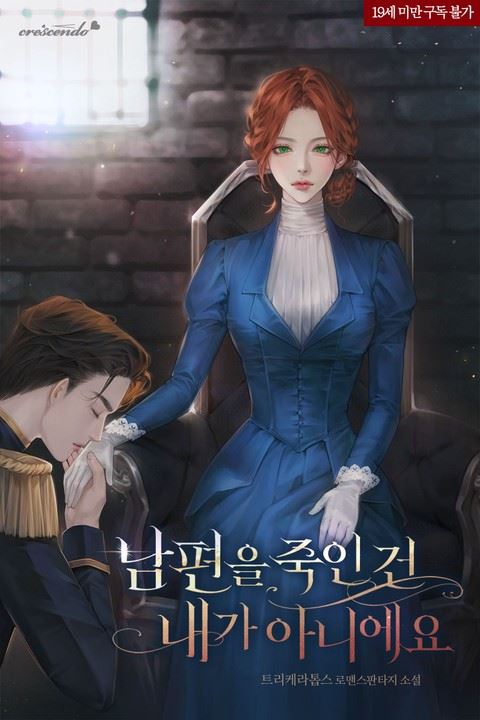
I keep coming back to one detail from these chapters and I think it's the key to everything: Scarlet's gloves. She's described as "absently kneading her thick gloves out of habit as she walked down the corridor." Habit. Not necessity. She KNEADS them. Fidgets with them. They're an extension of her anxiety, her control mechanisms, her armor. And then later, when Chris is desperate and asking for her help, the text says: "With my ability as it is now, it would be over simply by taking off my gloves and looking around that area once, but why should I?" Taking off the gloves. Removing the barrier. Using her power. And she REFUSES. Not because she can't—because she WON'T. The gloves represent her choice to stay armored, to stay detached, to NOT engage with a man who doesn't deserve her energy. Every time she keeps them on, she's making a statement. Then there's the body as battlefield. Chris's body—once the instrument of his violence, the thing he used to grab, kick, and strike—is now completely useless to him. Only his face moves. His face, which is the part that cries, that pleads, that lies. The rest of him is silent. Powerless. And Scarlet's body—once the target, the object, the thing to be used and discarded—is now the thing with agency. She chooses when to approach him, when to speak, when to leave. Her body is NO LONGER his to violate. The text makes this shift subtly but relentlessly. The greatest symbolic moment though is Gloria looking at Scarlet "as though she were an insect." And Scarlet's thought: "If there had ever been a greatest humiliation in Scarlet's life, it was the moment when she had unconsciously looked up at her with eyes asking for help." An insect doesn't ask for help. An insect doesn't expect rescue. An insect survives by enduring. And that's exactly what Scarlet became—and that's exactly what she's now weaponizing. The humiliation that broke her is the same thing that made her unbreakable. This book isn't just a revenge story. It's about what happens when the abused stops being a victim and starts being a strategist. The body was the battlefield. Now the mind is the weapon.
... Read More
Chapter 34-40 is a masterclass in whiplash pacing. You start with Emperor Kal, all sharp eyes and cold calculations, worrying about gossip around an unmarried crown prince staying at a collapsed duke's house. Edward's spouting off about grain prices and Artong and the emperor's just… watching him leave with those distrustful eyes. Then BAM—the letter from Scarlet. The tone shifts so completely I almost dropped my phone. It goes from political chess games to a girl who's been sitting in silence for days, staring out windows, feeling like a caged bird. And then her father arrives. The author doesn't ease into it either—just drops you into the drawing room conversation mid-exchange. What follows is this devastatingly quiet scene where two people who love each other but have never truly *seen* each other finally bridge that gap. The pacing here isn't about speed; it's about permission. Permission to grieve, to blame, to release. And then Scarlet pivots so sharply back to strategy—investigating the accident site, planning her next move—and I'm left reeling. One minute you're crying with a father, the next you're watching a survivor plot her escape. The author knows exactly when to break your heart and when to hand you a weapon.
... Read More
I need to talk about the symbolism in this section because it's so rich and I've been turning it over in my head ever since I finished reading. The horse accident that ruined Chris's life is doing so much heavy lifting thematically. Horses in noble society represent power, status, freedom—and in this story, the very thing that gave Chris his identity (riding, hunting, being active) is also what destroyed him. Scarlet mentions early on that Chris's favorite horse 'is not the sort that would create a disturbance, throw its master, and run off. It is a gentle creature, gentle to a fault.' That description of the horse feels uncomfortably close to describing Chris himself—something fragile and domesticated that was manipulated into catastrophe. Then there's food. Oh god, food. Chris refusing to eat because he doesn't trust anyone to prepare it—this isn't just a plot detail about poison, it's a symbol of how completely he's lost agency over his own body. The person who used to control everyone around him through fear and violence now can't even force himself to swallow without suspecting it's poisoned. And Gloria, who used to feed him herself, now finds it 'too exhausting' and avoids him. The deterioration of care mirrors the deterioration of their entire family structure. But the deepest symbolism for me is Scarlet's role as 'acting head of the house.' She's a woman trapped in a marriage with an abusive husband, yet by managing the estate during his incapacity, she gains the one thing she's never had—power. The irony is almost cruel. Edward told her the only thing that mattered was whether SHE wanted the divorce, and yet here she is, building a fortress of responsibility and authority in a mansion that was supposed to be her prison. Is she becoming what she hates, or is she finally free?
... Read More
Honestly, the pacing in these chapters is absolutely ruthless in the best possible way. Chapter 5 starts with Scarlet already deep in internal turmoil — she's just discovered something about Chris's accident, she's thinking about her father, the Emperor's greed, her own hidden power — and then the butler appears and drops the bomb: the Crown Prince is here. Right now. No transition, no breathing room. Just straight into the pressure cooker. What I love about how the author structures this is that Scarlet's internal monologue before seeing Edward is basically the entire emotional setup — we know she's unhappy, we know about Edward from her past, we know she regrets her choices — so when they finally meet in the drawing room, nothing is wasted. Every line of dialogue carries the weight of five years of separation and unspoken feelings. The author doesn't need flashbacks or exposition dumps because the tension is already baked into every single interaction. And then Chapter 6? The glove scene unfolds like a slow-motion car crash — you can see it coming, you want to look away, but you can't stop watching. The pacing deliberately slows down to almost agonizing levels during intimate moments, then accelerates when emotion peaks. Watch how Edward moves from pacing angrily to suddenly grabbing her hand to pouring power into her — the tempo shifts so naturally you don't even notice until you're already breathless. The chapter structure itself is smart too. Each chapter ends on an emotional cliffhanger rather than a plot cliffhanger. Chapter 5 ends with Edward extending his hand. Chapter 6 ends with the Guiding beginning and that line about them being “like puzzle pieces that fit perfectly.” Neither chapter is giving you action beats — they're giving you emotional beats that hit harder than any explosion could. Is there any part that drags? Not really. Even the expository bits about the Guide/Espirit power system and the Imperial Family's history are woven into character moments rather than delivered as info-dumps. The author trusts the reader to keep up, and honestly? I was fully on board the whole way.
... Read More
This text is SO much deeper than it first appears and I am obsessed with the thematic layers. The central metaphor of the entire opening is marriage as economic transaction. Chris literally calls Scarlet a 'broodmare'—a breeding animal. He tells Lady Gagnon he needs her because of what she represents politically, not because of who she is. And then the story about the Grand Duchess Dehart fifty years ago? 'Replacing a land transfer contract with human trafficking.' That line absolutely destroyed me. The author is telling us that in this world, women HAVE ALWAYS been property, and Scarlet's particular hell is just the most visible version of a systemic disease. The symbolism of blood is everywhere—the blood-stained cloth that everyone downstairs is waiting for on the wedding night, the blood from Scarlet's bitten lip, the literal blood of her 'defective' inability to produce an heir. Even the title she fights for—the Dukedom—is ultimately meaningless if she can't produce a successor, which is the ultimate irony because she's been denied the very act that would give her that status. And Gloria! Gloria is both victim and perpetrator—she sacrificed her own marriage to the late Duke for political gain, and now she's enforcing the exact same system on her daughter-in-law. The hospital imagery in Chapter 1 is also fascinating: Chris is literally broken, and Scarlet is emotionally broken, but she's the one standing while he lies immobile. Power has already started to shift, even if no one else notices yet. The gray life Scarlet describes after five years isn't just depression—it's the systematic erasure of self. But the text suggests that even gray can become a color, can become camouflage, can become the background from which something new emerges.
... Read More
So let me unpack this plot because WOW, the layers here are insane. Chris has filed for divorce. He's gotten the Emperor's permission and sent a petition to the Pope. His reasoning? Scarlet can't bear an heir, and as a member of the Imperial Family, an important bloodline is at risk. They've been married five years with no child. But here's the thing that got me—Scarlet assumed the Emperor already knew about this, but when Edward reacts with genuine surprise to the divorce mention, she realizes: the facts she revealed were based on her own assumptions. Things are not what they seemed. This is such a clever narrative move by the author. Scarlet has been carrying this burden alone, making decisions based on incomplete information, and the moment she almost slips and tells Edward something he doesn't know yet—that's when the plot gets interesting. The reader is now sitting with the same uncertainty she is. But then Edward drops this bomb: "It would be different if Chris is the one who filed for divorce first. You would only need to accept it lightly. Of course, some outrageous rumors would spread, but if you were to bear another man's heir, those rumors would die down. Would they not?" Let that sink in. The Crown Prince of the Empire is casually suggesting that his childhood friend—now a married woman—bear another man's child as a solution to her divorce problem. Is he serious? Is this a test? Is he genuinely trying to help or is he probing her reactions? The text says his expression was "so calm" while saying this, which makes it impossible to read. And Scarlet's reaction—imagining herself pregnant with someone else's child, imagining Edward's hand on her belly—suggests she's not as immune to this fantasy as she probably should be. Meanwhile, Gloria is maneuvering in the background, wanting to become acting head of the house, writing letters to the Emperor, essentially trying to seize power while her son lies incapacitated. And the Emperor himself—described as playing the role of a hearty emperor who loves his nephew but really treating Chris "as nothing more than a fine horse prized only for its bloodline" This is a political marriage plot where everyone is playing chess and nobody knows who's actually winning. The stakes keep escalating with each chapter and I cannot look away.
... Read More
OK so let's talk about the stakes here because this whole situation is genuinely terrifying and I can't stop thinking about it. Chris is lying in bed unable to move, refusing food because he suspects poison, and he's basically trapped in his own body. But here's the thing that really got me—the most chilling moment isn't any dramatic confrontation, it's when Chris whispers to Scarlet 'Please, do not leave me alone with Louis.' Like, think about that. The person who abused her is now terrified of someone else in this house and he's asking HER for protection? The author does this incredible job of layering the conflict. On the surface it's 'did someone try to kill Chris?' but underneath it's so much messier. Who benefits? Gloria has been neglecting him lately, Louis is the second son who stands to gain, and Scarlet herself has every reason to want him gone. Even the servants—note how the author mentions that among the household staff, 'there could hardly be anyone who had not at least once imagined killing him.' That single line transforms this from a puzzle about one crime into a portrait of a toxic ecosystem where violence is so normalized it's almost ambient. And Scarlet's internal conflict! She's playing the perfect dutiful wife to maintain power, but her thoughts keep drifting to Edward and divorce. The stakes aren't just 'solve the murder mystery,' they're 'survive this marriage while figuring out who actually wants your husband dead.'

Leave a comment

You must be logged in to leave comments. or
